24-FEB-22: My crew nudged me to post my manic analysis/charts of RUS's war on UKR (v2022) & maybe help the cause. Start here: #OSINTguild224#1pageAssessUkrWar
#ucraina raffinerie in fiamme, centri di comando distrutti, navi colpite, logistica sconvolta con trasporti attaccati sistematicamente.
In crimea popolazione non ha già più accesso al carburante. A questo ritmo l'intero gruppo vostok si muoverà a piedi, con difficoltà crescenti anche per il vettovagliamento e le munizioni.
Con la distruzione sistematica dell'antiaerea, anche l'aviazione ucraina avrà maggiore libertà di colpire obiettivi di alto livello, prima tra tutti le unità di dronisti rubicon, come è successo ieri a Pokrovsk.
La prima linea riveste sempre minore importanza e paradossalmente avrà un tasso di uccisione minore rispetto alle immediate retrovie, completamente saturate dai droni.
La guerra ha cambiato i suoi paradigmi senza in realtà cambiare i fondamentali. Per anni la guerra fatta di strike, bombe intelligenti e Sof, ci aveva fatto scordare la base di ogni guerra: Ia capacità d'interrompere la logistica e quella colpire la produzione interna, che restano i cardini dell'azione bellica. Anche il concetto di massa è rimasto lo stesso, ma è diventato una massa di droni, che saturano il cielo e ben presto anche la terra, remotizzando la guerra, che ora può essere combattuta in prima linea a decine e centinaia di km dal fronte.
Gli ucraini hanno guidato questa trasformazione per necessità, che d'altra parte è il primo motore delle innovazioni umane.
In questi contesto l'avanzata, già lentissima dell'esercito russo, è destinata a fermarsi, e forse solo con una nuova mobilitazione, dai costi sociali ed economici paurosi, riuscirà a mantenere l'attuale lentissimo tasso d'avanzamento.
La Russia risponderà nell'unico modo possibile, aumentando attacchi di droni e missili su città ucraine, senza che questo abbia però effetti ne su capacità produttiva ucraina, né sul fronte.
Stiamo assistendo ad una rivoluzione che è destinata a cambiare e diminuire il ruolo del tank, ormai diventata costosa artiglieria mobile e snaturato dalle sue funzioni di penetrazione e sfondamento. Rivoluzione che investirà a breve anche l'aeronautica, destinata ad essere soppianta da uav,droni e missili nel prossimo futuro.
L'Intera logistica sarà remotizzata con gli ugv che sostituiranno anche gran parte dei blindati.
Fino al settore navale, dove le grandi e lente navi, sembrano impotenti davanti ai droni marini ed aerei.
Una rivoluzione del warfare è sotto i nostri occhi e non vanno nascosti i lati estremamente inquietanti e pericolosi che ogni cambiamento tecnologico ,nel mondo della guerra, ricopre.
Che poi è, probabilmente, la stessa serie d'inquietudini che intere civiltà hanno avuto nel passaggio dalla pietra al bronzo e dal bronzo al ferro e così via.
Ps. Mi scuso per eventuali errori ma sto postando da cellulare
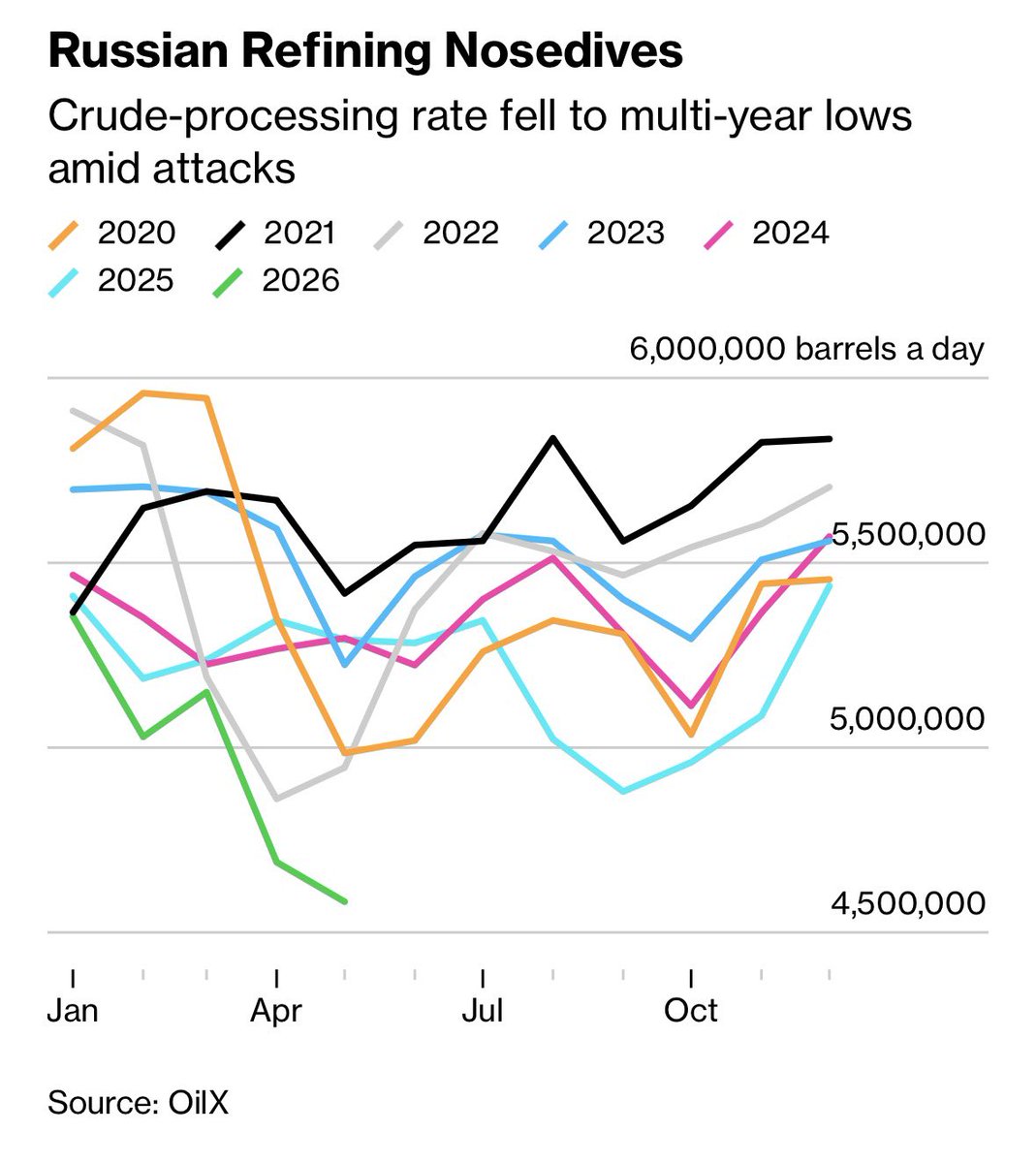
“Ukraine’s attacks on Russian oil refineries set a record in May, threatening to further hurt processing that’s at a 16-year low and risking domestic fuel shortages just as summer holiday demand picks up.
Ukraine carried out at least 16 attacks on Russia’s fuel-producing facilities in May, according to a Bloomberg tally of public statements from both countries. Drones targeted eight of Russia’s 10 biggest refineries last month, the data show…
Ukraine’s attacks mark a shift in strategy from previous years. It’s now not only targeting primary refining units — which have been relatively easy and quick to repair — but also secondary units, including high-value and technically complex ones”
https://t.co/sulStrV0KI
Regarding this:
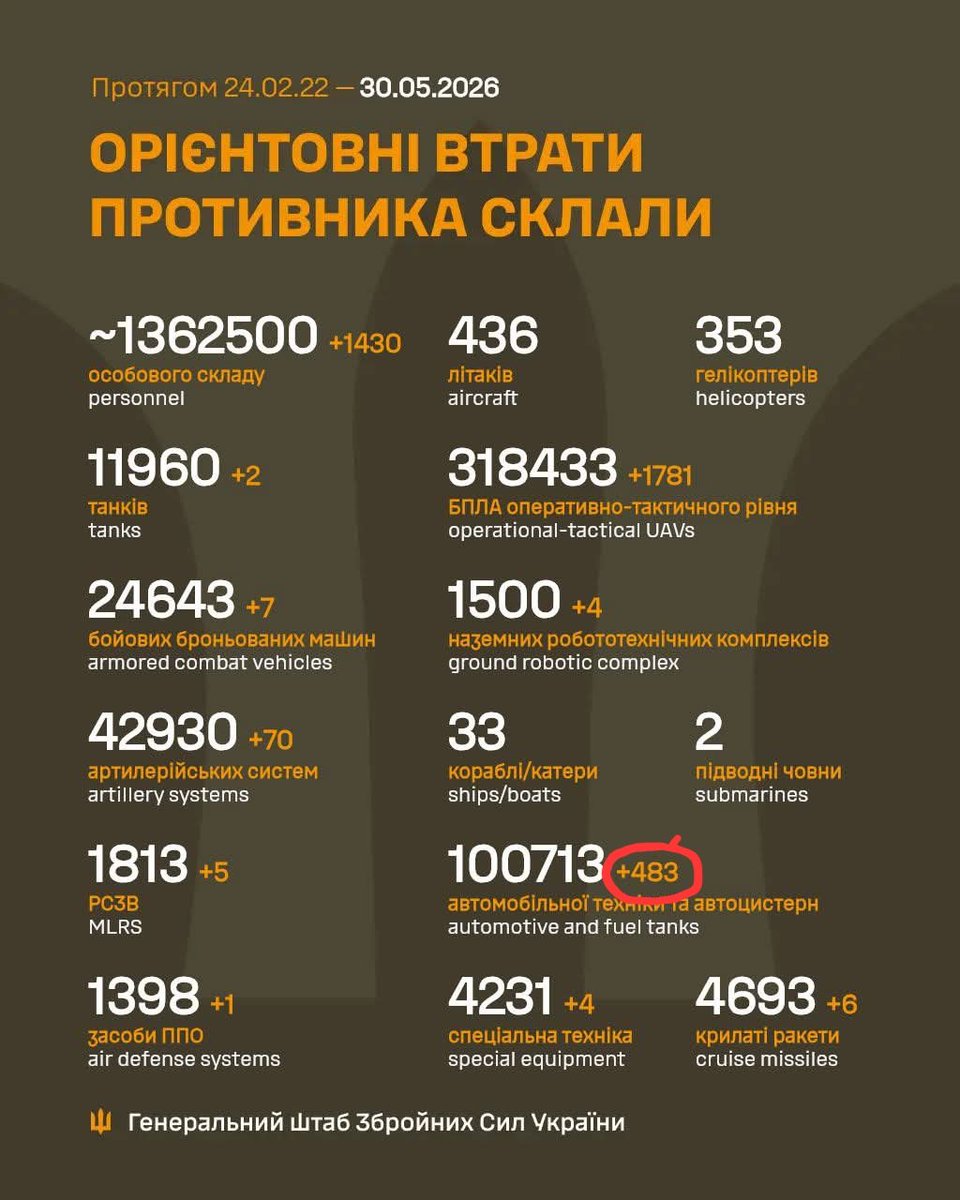
>>The intensification of strikes against Russian 🇷🇺 logistics (150 vehicles, 30 trains, 400 warehouses) is a real game-changer in the war.
The 30 trains represent far more logistical tonnage than the trucks.
1/
Carrying capability 🧵
#StopRussianSupplyTrains#Strelnikov#StrikeRusRRsupply#1pageAssessUkrWar#Ukraine️️#UkraineRussianWar#UkraineWarNews
Great analysis back on NOV 23, 2021 from Alex Vershinin regarding Russian army logistics: specifically its dependency on rail. The Orc Triangle (Mariupol - Kherson - Sevastopol) continues to exist due to Russia's THIN line of communication running through the region.
NATO had the ability to supply Ukraine the platforms/systems for a systematic attack on LoCs in the 30 km to 100 km range five years ago. Those would have enabled Ukraine to choke those LoCs. Where NATO has declined to provide necessary platforms, Ukraine has essentially grown their own. That has now born fruit with this particular battlefield challenge (chart left from @TheStudyofWar ).
Tomorrow, I will publish a long detailed thread about the ukrainian middle strike. I mapped more than 1 000 strikes since january.
I start getting tired and every time i open X I see that geolocators (@moklasen@99Dominik_@neonhandrail... thanks to them !) found new destroyed trucks for the map...
I will put everything throughClaude to have detailed statistics later, I still have 13 days of march with tons of geos to add...
In 1943, the Gestapo finally caught Raymond Aubrac — one of France's most wanted Resistance leaders. He was sentenced to death. His execution was days away.
His wife Lucie was six months pregnant.
Most people would have hidden. Would have grieved quietly and prayed for a miracle. Lucie Aubrac did something else entirely. She obtained forged identity papers, constructed a cover story, and walked straight into the office of Klaus Barbie — the man history would remember as the Butcher of Lyon — and convinced him to grant her a visit with the condemned man.
She wasn't there to say goodbye.
She was memorizing guard positions. Counting minutes. Mapping the route the prison truck would take.
On October 21, 1943, that truck rolled through the streets of Lyon carrying Raymond and other prisoners toward what should have been the end. Lucie had spent weeks quietly assembling a team of Resistance fighters, planning an ambush with the precision of a military operation. When the truck reached the ambush point, the team struck — fast, coordinated, and without hesitation.
In the chaos of gunfire and confusion, Raymond Aubrac was pulled free.
Lucie — visibly, unmistakably pregnant — had organized every detail of his liberation.
They went into hiding. Weeks later, Lucie gave birth to their daughter in a safe house while German forces searched for them across France. When liberation finally came, the Aubracs didn't merely survive — they rebuilt.
Raymond became a celebrated engineer and entered public life. Lucie became a historian, pouring decades into ensuring that the women of the French Resistance — so often unnamed, so easily forgotten — were written permanently into the record. They raised three children. They traveled the world. They argued and laughed and grew old together.
When journalists asked Lucie, years later, what had compelled her to risk everything that October day, she didn't hesitate.
"He was my husband. What else would I do?"
Lucie Aubrac passed away in 2007 at the age of 94. Raymond — who had once needed a commando team to be freed from a German prison — lived on until 2012, reaching 97 years old. In his final years, he continued speaking publicly about the Resistance, about memory, about the obligation to tell the truth.
They had been married for 64 years.
Not a love story built on grand gestures or perfect circumstances. A love story built in occupied France, in safe houses and forged documents and a prison truck ambush on a Lyon street — forged in fire, and never broken.
True love doesn't wait for rescue. Sometimes, it does the rescuing
Ummm...no. @grok said 10K Truck Movements, not trucks.
A truck making two movements a day within 150 km of the Russian border for 30 days is 60 truck movements out of the 10K, or 0.6%.
@grok's estimate was based on mirror imaging Western Mechanized logistics.
Truck Intel🧵
1/
#1pageAssessUkrWar#TheOrcTriangle#ukraine
A @nickreeves9876 question for @TrentTelenko ��How many trucks a day use that route? How many would need to be hit to introduce severe Russian LoC blockage on the #ZapDonetskFront ?
Let's say 20 supply trucks per day (weighted mid point based upon composition on chart right) to supply a Russian BTG...per 100 battalions...2,000. Seems like a lot of truck traffic. Can they make two trips a day? No idea...
The route is the LOC in #TheOrcTriangle running between Sevastopol and Mariupol indicated by the chart below from @clement_molin .
This morning, a continuous fid a videos from key roads in russian 🇷🇺 occupied territories allowed a large number of new geolocations.
I have now mapped 125 trucks hit on key roads, mostly in may, with more than 80 destroyed.
🧵THREAD🧵1/8 ⬇️
We’re calling it: The war in Ukraine has entered a new phase.
@KatStepanenko and I have authored a new special report studying how Ukraine is actively challenging the positional character of the war that has dominated the battlefield since 2023.
Data on Russia’s battlefield performance indicates that the character of the war is shifting in favor of Ukrainian forces – at least for now. Russian forces rates of advances are stagnating while Ukrainian forces are employing novel tactics and operational concepts in efforts to break out of positional warfare. Neither Russia nor Ukraine can conduct operational maneuvers yet, however.
The bottom line is that the war in Ukraine is competitive and far from stalemated. Ukrainian forces are out-innovating Russian forces in both military technologies and in applying these new technologies in effective operational concepts that can help Ukrainian forces break out of positional warfare. Ukraine is employing mechanized equipment in tactical maneuvers in ways that were impossible 12 months ago. Russia’s ability to conduct infiltration missions will likely continue to degrade as Ukraine’s intermediate-range strike campaign pushes Russia’s logistics and forward operating bases further away from the frontlines, reducing resourcing to sustain infantry tasked with infiltration missions. Ukraine may be able to scale these effects if they resourced properly by international partners.
Ukraine’s advantage in intermediate range strikes is notably not permanent, and Russia will very likely eventually develop countermeasures to mitigate Ukraine’s advantages. Ukraine’s international partners thus have a rare and temporary opportunity to help Ukraine exploit favorable battlefield dynamics while Ukraine has the upper hand.
Key Points of the report:
• Russia’s rate of advance is plummeting during the Russian Spring-Summer 2026 offensive.
• Russia is losing more soldiers to make fewer gains, with monthly Russian casualty rates reportedly outpacing monthly recruitment since December 2025.
• Ukraine is starting to regain more ground than it is losing for the first time since 2023.
• Ukraine’ recent counterattacks feature unique characteristics and deviate from key trends that defined the positional character of the war since 2023.
• Ukraine is conducting a pattern of more frequent mechanized counterattacks at the tactical level for the first time since 2023.
• The Ukrainian command’s operational planning is maturing.
• Ukraine’s early 2026 counterattacks in the south were successful likely due to better planning and preparation of the battlefield.
• Ukraine has been conducting a coherent campaign to suppress and destroy Russian air defenses since late 2025, in order to shape the battlefield as part of more sophisticated campaign planning.
• Ukraine significantly intensified its intermediate-range strike campaign against dynamic targets in Spring 2026 in order to degrade Russian logistics at operational depths ahead of planned Ukrainian maneuver.
• Ukrainian forces started actively disrupting Russian railway logistics in occupied Ukraine and Russian western regions in Spring 2026.
• Ukrainian intermediate-range strikes are already achieving notable operational effects, including degrading Russia's ability to use the key Russian highway connecting Russia to occupied Crimea and GLOCs around Donetsk City.
• Ukrainian forces decisively seized the initiative in intermediate-range strikes by fielding new technologies such as the US-made Hornet strike UAV, among other systems.
• Ukrainian forces are achieving temporary tactical drone overmatch in some frontline sectors, which is slowing Russian offensive operations by degrading the effectiveness of Russian shaping operations.
• Ukrainian forces likely achieved tactical drone overmatch in certain frontline sectors after degrading Russia’s drone capabilities in late 2025 to early 2026 - primarily by suppressing drone launch positions and increasingly intercepting Russian tactical UAVs.
• Ukraine’s degradation of Russian forces at operational depth combined with tactical-level drone overmatch likely is creating vulnerabilities in the Russian lines.
• Ukraine’s intermediate-range strike campaign is likely far from its zenith, assuming continued support from Ukraine’s partners, and will likely intensify over 2026 as Ukraine fields new weapons capable of striking Russian’s operational rear.
Link to full report: https://t.co/rCeWbYJNiB
Selenskyj hat es versprochen:
Landkorridor zur Krim schneller als gedacht unter ukrainischer Kontrolle:
General Ben Hodges – ehemaliger NATO-Oberbefehlshaber Europa – berichtet direkt.
Laut Hodges hat Ukraine nach einer Woche der Kampagne die Kontrolle über den Landkorridor zwischen Russland und Krim übernommen – Militär, Logistik und Treibstoff können nicht mehr passieren.
(GIS Reports)
General Ben Hodges – ehemaliger NATO-Oberbefehlshaber Europa – meldet: Zwei Wochen nach Beginn der ukrainischen Kampagne gegen den Landkorridor zwischen Russland und Krim läuft die Operation sehr gut. Der russische Besatzungsgouverneur von Cherson hat bereits ein Dekret unterzeichnet das den Frachtverkehr auf der M-14 – der Hauptlandverbindung zwischen Russland und der besetzten Krim – einschränkt. (Euronews) Militär. Logistik. Treibstoff. Alles unter ukrainischem Feuer. Der Landkorridor wird progressiv unpassierbar. 🇺🇦
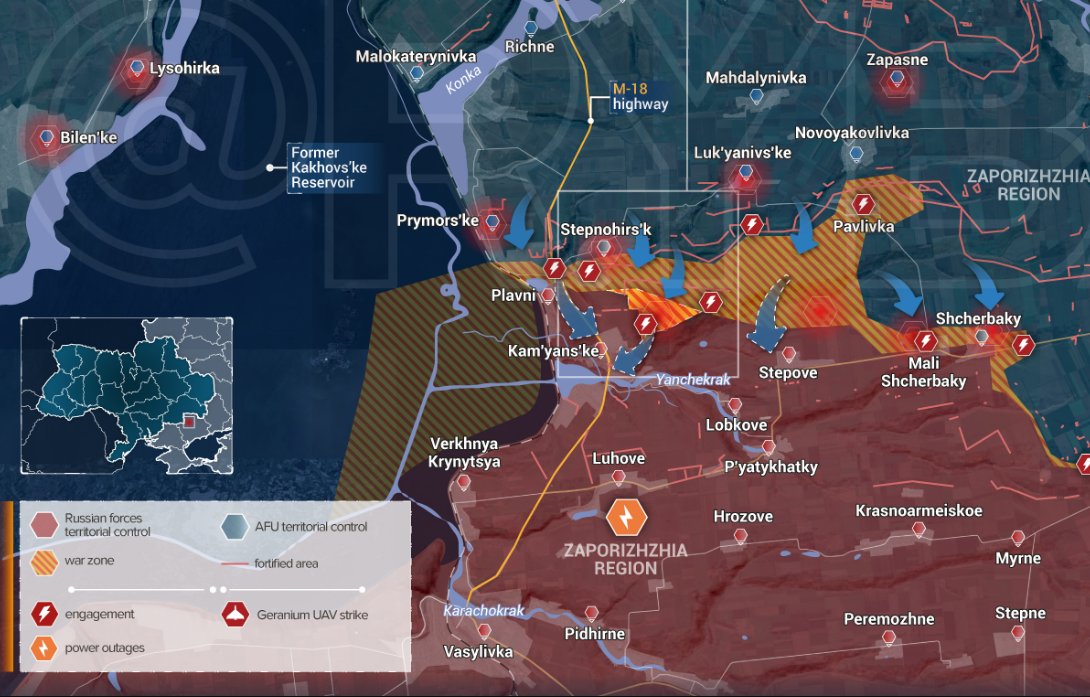
Ukrainian forces have reportedly taken advantage of the chaotic Russian supply situation to mount a local offensive south of Zaporizhzhia, retaking the key town of Stepnohirsk.
Ukrainian forces are now pushing towards Kamyanske, rolling back nearly a year of Russian progress.
Ukraine’s long-range sanctions against Russia’s oil industry — the engine funding this war — will continue. Every strike on the Kremlin’s energy revenues brings peace closer. Russia must be forced into peace.
The latest Russia Contingency is out. I join @Jack_Watling to talk about the current battlefield dynamics. We compare notes from recent trips, exploring why Ukraine is doing better and Russian forces are visibly performing worse. @WarOnTheRocks https://t.co/r8W8S5vpFS
"As before, I remain convinced that Putin will leave us this year - most likely in the autumn," Russian "Z-blogger" Ilya Remeslo, who continues to criticize Putin, said.
Comment from me:
Of course, Remeslo says what he's been ordered to say. That he says this while remaining free speak volumes. The question is who allowed him to talk and why.
At this point, no one in Russia appears happy with Putin - not the elites, not the security establishment, not oligarchs, and not officials. Yet Putin remains the key guarantor of the system’s stability while constant behind-the-scenes struggles continue between Russian clans and power groups.
Putin is bad - and bad for everyone - and he does not hide it. But he has built a system in which there is no alternative. He needs a situation in which people believe that anyone else would be even worse.
Contradictions, infighting between clans, and war itself have become sources of Putin’s power.
Everyone already understands how damaging Putin has become for Russia - both inside and outside the country.
But as long as there is no successor capable of playing Putin’s role, he remains in power.
Many, both inside and outside Russia, feared and continue to fear that the system could collapse and descend into uncontrollable chaos.
But the system is starting to crack.
Through Remeslo, part of the Kremlin elite is directly appealing to Putin. The message to Putin is: things cannot get any worse.
Putin will not rule forever - that much is certain. But when exactly the transfer of power happens, there won’t be advance hints on Telegram. It will happen very rapidly and very suddenly, and might take place sooner than we think.
#1wayTrainRideRus#1pageassessUkrWar
Been a lot of chatter lately regarding a shaky little tsar.
Sergey Kiriyenko's name being whispered now... one of the Martha's (technocrats) and linked with the St.Petersburg team. A plausible interim choice if little tsar is retired.
Is little tsar's end time near? No idea...but I'd say doubtful as long as his protector Useful Idiot reign continues - and why would China want the instability in their Russian vassal?
⁉️Can you imagine, a year ago, Russian commentators openly discussing Putin’s potential successors, even mocking the ‘front runner’ and suggesting things like: ‘the president doesn’t play as big a role as we’ve always thought’?
Russia is changing, and it’s entertaining to observe this shift.
This is a truly fascinating clip. Enjoy.
The speakers are Pavel Ivanov and intelligence historian Alexander Kolpakidi.
FYI: ‘Semibankirshchina’ refers to the informal influence of seven powerful Russian bankers/oligarchs who held significant political power in the 1990s under Yeltsin.
In the clip, when Ivanov asks Kolpakidi not to insult Sergey Vladilenovich’s nationality, he is referring to Sergey Kiriyenko who has a Jewish/Ukrainian background.
Formations of Ukrainian drones flying over Russia underling the almost complete collapse of the VKS missile based integrated air defenses.
It took Ukraine three years to do what one week of a million Chinese super-Shaheed class PD-2900's will do to Taiwan, Japan, Guam and Philippine missile based integrated air defenses.
The Security Service of Ukraine has detected ❗️elevated radiation levels on the wreckage of a Russian "Geran-2" (Shahed) strike drone used in the attack on Chernihiv region on the night of 7 April 2026.
Fragments of an R-60 air-to-air missile were found near the settlement of Kamka. Radiation reconnaissance measured gamma radiation of 12 microsieverts per hour near the debris - significantly above the natural background.
The warhead contained depleted uranium (U-235 and U-238). The explosive part was neutralized by the Security Service of Ukraine, State Emergency Service and Defence Forces and transported to a radioactive waste storage facility.
Several Russian trucks were attacked by drones at the Voznesenka checkpoint on the Russia–Ukraine border, along the Rostov–Mariupol highway, roughly 150 km from the frontline.