This analysis deeply misunderstands how deterrence works on the strategic scale, and deeply misunderstands the necessary, if painful, logic of anti-imperialist war.
Squirrel is trapped within a Eurocentric frame, and ignores how Iran and the axis have, informed by the Shia tradition, wrestled the signification of death away from the zionist-imperialist bloc. And forgets the lessons of Ho Chi Minh and Basel al-Araj, that the revolutionary intellectual should never compare casualties between colonizer and colonized, imperialist and anti-imperialist, for they will always be skewed. What matters is how the resistant society demonstrates the capacity to reproduce itself while absorbing these costs (or what Amal Saad might call "deterrence by regeneration")
More fundamentally, Squirrel seems to only be capable of apprehending deterrence on a very narrow tactical scale - in terms of counting casualties on each side. In this sense, it is true that the US-Zionist bloc killed more people and visited more destruction upon Iran and Lebanon. And, yes, it retains the ability to strike Iran at will without experiencing a commensurate counter-response.
However, the zionist-imperialist bloc has not been able to translate their tactical strikes into strategic gains, which is the scale at which Iran has sought to establish deterrence.
For example, the US-zionist assassinations did not lead to institutional fracturing, as was the strategic aim of the attackers, but instead was responded to with institutional and governance continuity and coherence.
The attacks on civilian infrastructure and civilian life did not lead to social fracturing, as was the strategic expectation, but rather was responded to with national and social cohesion, a renewal of the popular sovereign basis of the Republic.
The attacks on core economic infrastructure did not succeed in de-industrializing Iran, as it instead responded with rapid repair and replenishment where necessary in the short term, and preserving of capabilities so restoration could happen in the medium term. And, most significant, Iran responded to the tactical blows, as a whole, by establishing permanent escalation dominance through its demonstration of its sovereignty over the strait of Hormuz.
Iran's "escalation dominance", or its moving of deterrence to the strategic scale, had the effect of demonstrating that while the enemy could inflict casualties and destruction, it would fail to achieve any strategic advance. In fact, it would experience strategic reversals - rising costs in the form of revenue drain (US was spending 2 billion/day), munitions attrition, and an internal social fracturing (growing opposition to war in US). The US has permanently lost its standing as a security guarantor for the GCC.
Perhaps, most significant, when Trump and Hegseth threaten Iran with death, the response they receive is: "we do not fear death, we choose dignity over humiliation." This has the impact of disarming the imperialist power - it can spend billions inflicting death, but it achieves nothing strategically.
Now, see where we find ourselves. It is no longer up to the US to either uphold or undermine the ceasefire - the initiative is in the hands of Iran. The strait of Hormuz is a counter-sanctions enforcement mechanism, this is a reality the US must now accept. Iran has further demonstrated that the US can spend 65 billion dollars per month and achieve no strategic gains, and lose strategically in the sense that the Gulf no longer has a security guarantor.
Certainly, war can break out again, but what has been revealed is that it is the US, not Iran, that is increasingly moving out of weakness and panic, and a realization that its projection of power in the region is in irreversible decline at the strategic scale.
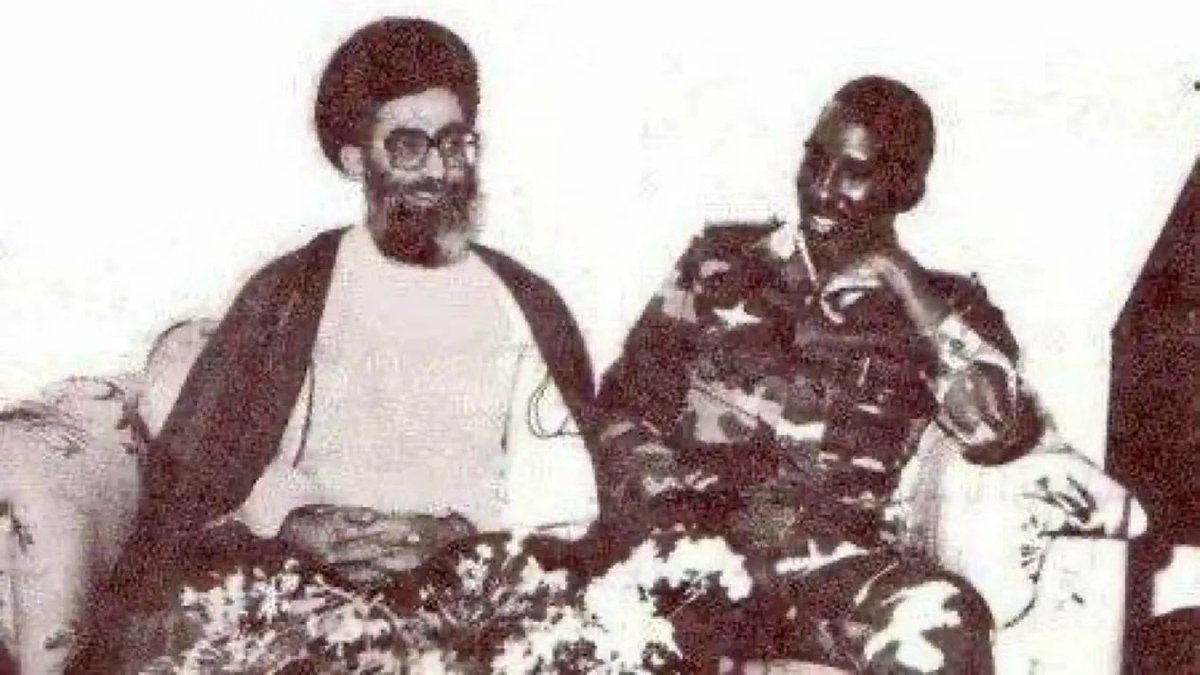
🇮🇷🇧🇫 A young Ayatollah Khamenei sitting with Thomas Sankara.
Two men from opposite ends of the world. One a Shia cleric from Iran. The other a Marxist soldier from Burkina Faso. Both shared one conviction: their people would never be free under Western domination.
Sankara was assassinated in 1987, overthrown in a French-backed coup at the age of 37. He wanted to free Africa from debt, dependency, and foreign control.
Khamenei was killed yesterday by American and Israeli bombs. He spent 35 years trying to keep Iran free from the same forces.
Both men were called dictators by the West. Both were loved by millions who saw them as defenders of sovereignty.
History separated them by decades. Empire united their fate.
African-American actor Cedric Robinson has announced his support for Captain Ibrahim Traoré and expressed solidarity with the people of Burkina Faso on his Instagram account.
@MomodouTaal True word @VoxUmmah has consistently tried to push a material analysis on Sudan and platformed organizations doing tangible work — the analysis primarily coming from the orgs submissions to vox
Even when, not if, a line disagreement happens critiques are handle principally
Just found out there’s a Brazilian footballer called Marx Lenin. Started out at Flamengo, the country's biggest club.
He also used to play for a Russian club named "Akron Togliatti", the team of a small industrial city named after Italian Communist leader Palmiro Togliatti.