I genuinely don't understand why everyone isn't using this yet
Andrej Karpathy, a co-founder of OpenAI, posted a simple idea that hit 16 million views: stop using AI to write code, use it to build a second brain.
You point Claude Code at a folder, drop in any source, an article, a transcript, a PDF, and Claude reads it, links it, and files it into a living wiki of everything you know. It compounds like interest, the more you feed it, the smarter it gets.
Here's the whole thing:
> Install Obsidian, create a vault, open it in Claude Code
> Paste Karpathy's wiki idea file and tell Claude to build it
> Claude makes three folders: raw for sources, wiki for its pages, a CLAUDE.md that runs it
> Drop any source into raw and say "ingest this"
> Ask questions across everything, forever
Five minutes to set up, and you never start from a blank chat again.
Full step-by-step guide with Claude and Obsidian, link below.
Bookmark this
A 21-year-old solo developer stopped chasing AI trends and locked in a $35,000/month B2B niche using a single Python script
He built a production-ready traffic monitoring Micro-SaaS that smart cities and businesses pay big money for
He didn't build complex AI agent teams
He just paired an open-source model with a high-ticket commercial concept
Every single day, his system follows a military-like routine: tracks the bounding boxes, calculates telemetry, and locks in the data
For 4 to 6 steps straight, the pipeline is completely optimized. Zero frame drops, zero lag. Just pure automated tracking under the hood
He doesn't even use raw screen pixels for calculation to keep his speed metrics clean from perspective distortion
Out of 6 core features he launched, 3 handle the baseline detection and tracking using YOLOv8, Supervision, and ByteTrack
But one single feature (Perspective Transform via OpenCV) converts pixels to real meters and generates high-value Excel traffic reports for clients
His main secret? He utilizes a custom Polygon Zone to filter out noise and ships a ready-to-sell B2B product immediately instead of overcomplicating the setup
MIT defines an algorithm in one sentence that changes how you think about trading
"a computational procedure that takes an input and produces an output through a well-defined sequence of steps"
that's it. not AI. not machine learning. not a black box
a set of rules that takes data in and spits a decision out
every quant strategy ever built is just an algorithm
Citadel's execution system that routes 40% of US equity volume is an algorithm
Renaissance's Medallion Fund running millions of trades per year is an algorithm
Jane Street's market making engine processing $26 trillion annually is an algorithm
input: market data
rules: mathematical conditions
output: trade or no trade
the difference between a quant desk and a retail trader is not the data
it's that one side wrote down their rules precisely enough for a machine to execute them
retail says "if RSI is low and the chart looks good, i'll probably buy"
a quant desk says "if RSI < 30 AND 20-day realized vol < 15th percentile AND sector momentum z-score > 1.5, buy 0.3% of NAV"
same logic. one is a feeling. the other is an algorithm
the feeling can't be tested, can't be repeated, can't be measured
the algorithm can be backtested across 10,000 trades and you know exactly when it works and when it doesn't
> this lecture: MIT, free, 70 seconds
> algorithmic trading volume: 60-75% of all US equity trades
> Jane Street, Citadel, Two Sigma: every trade is algorithmically executed
> tools to build your own: Python, free data, a laptop
you don't need a faster computer or better data
you need to write your strategy down precisely enough that a machine could run it without you
that's the whole leap. from intuition to algorithm
full breakdown in the video below
🚨 THIS GUY JUST PLUGGED CLAUDE STRAIGHT INTO HIS BROKERAGE ACCOUNT AND REBUILT $99/MO INDICATORS IN MINUTES!!
No course. No bot promising 1000% gains. Not clickbait
Just a dude in a flag hat wiring AI into his trading workflow from his kitchen
The play: connect Claude to his account → ask it to recreate the indicators other people gatekeep and sell → done in minutes, not months
It sounds like cope until you clock what actually happened:
The secret strategy everyone's charging for? Rebuilt for free
The locked "DM me for access" indicator? Cloned on the spot
The edge was never the indicator, it's that nobody told you you could just build it
Five-minute setup vs a $99/month subscription that does less. That's the whole trade
His call: retail trading gets rewritten over the next 2-5 years. The ones putting in reps now eat. The ones waiting for it to get easy get left
Bookmark this! The edge is now a chatbot and the will to actually use it
GOLDMAN SACHS open-sourced most dangerous quant repo on the internet.
THE EXACT FRAMEWORK THEIR INTERNAL DESKS USE TO BUILD & RUN TRADING STRATEGIES.
They even left their Claude skills inside. Plug them in & you've a Goldman Sachs quant building strategies for you. BOOKMARK.
Our mission is to make it easy for anyone to deploy a robot to help them in the real world
We wrote an intuitive guide to understanding modern robotics, catered toward an audience that understands technology but not AI robotics
We hope that this short blog post embeds in you the core principles that will bring further curiosity.
INSTEAD OF WATCHING NETFLIX TONIGHT.
Spend 1 hour with this.
Claude AI FULL COURSE that teaches you how to BUILD and AUTOMATE anything.
The people who watch this tonight will wake up tomorrow with a new skill.
Watch it and Bookmark it now
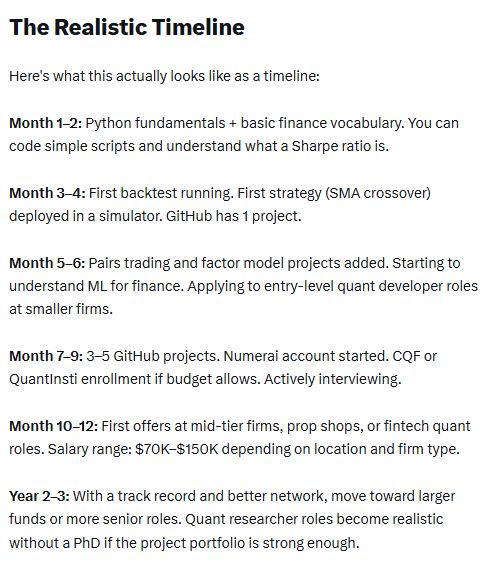
'How to become a Quant' Roadmap
Simple steps:
1. Math: Probability & Statistics, Linear Algebra, Calculus, Optimization
2. Programming: Python, NumPy, Pandas, scikit-learn
3. Finance: Market structure, Mean Reversion, Momentum, Factor Models
4. Build: Backtests, Pairs Trading, Factor Research, Volatility Models
5. ML: XGBoost, HMMs, NLP, Feature Engineering
6. Portfolio: GitHub, Research reports, Real performance metrics
Try to put your knowledge into practice asap
This is the best way to learning something
I’d like to add that without a PhD it’s highly unlikely you’ll land a high-paying job
but it’s entirely possible to apply this knowledge to your trading strategies
🚨 Claude just changed the game.
All you need is:
💻 A laptop
🌐 Internet connection
⏰ 60 minutes a day
That’s enough to build a $7,200/month online income stream using AI.
No coding.
No expensive setup.
No years of experience.
Most people still use AI for fun…
But smart creators are quietly using Claude to:
• Create digital products
• Offer AI services
• Write viral content
• Automate work
• Build online income streams
Usually, I sell this detailed guide for $97…
But today you can get it FREE. 🎁
Inside you'll discover:
✅ The exact asset
✅ My full workflow
✅ The Claude prompts I personally use
✅ How to scale to $10K/month
✅ How beginners can start fast
Want it?
❤️ Like this post
💬 Comment “AI”
➕ Follow me to receive it in DM
⏳ Available FREE for 48 hours only.
🚨BREAKING: A new Python library for algorithmic trading.
Introducing TensorTrade: An open-source Python framework for trading using Reinforcement Learning (AI)
i have created a master loop harness that allows you to run perpetual mission loops that create goal loops that then spawn agent loops which then run their own workflow loops which finally run the tool loops.
i really wish i was joking 🙃
10 LEARNING WEBSITES THAT WILL REPLACE COLLEGE.
Bookmark every single one. The most valuable skills are not on a transcript.
1. https://t.co/Y72s2yrfwV
3,000 hours of free coding courses. JavaScript, Python, React, machine learning, all certified.
2. https://t.co/5yvmVy6f0H
The most respected free full stack web dev curriculum. Built by working engineers.
3. https://t.co/9hyU4IHyRK
Harvard's intro to computer science. Free. Includes graded assignments and a certificate.
4. https://t.co/w36kM7zjUf
K-12 through college math, science, and economics. The teacher you wish you had.
5. https://t.co/uuDbFwxEmk
Every MIT lecture, problem set, and exam. Free since 2002.
6. https://t.co/6BdGCxVTqW
Math and science taught through interactive puzzles. Builds intuition instead of memorization.
7. https://t.co/8OU64RkJ7f
The Barbara Oakley course taken by 4 million people. The science of how to actually study.
8. https://t.co/TEWErJLn6p
3,000 coding exercises across 60 languages with free mentor reviews.
9. https://t.co/xlyfUgvYIb
A search engine for every free university course online. 100,000 indexed from MIT, Stanford, and Yale.
10. https://t.co/viMfFnfn9B
The most underrated learning resource on the internet. Still free. Still ad free. Still neutral.
The students who win the next decade do not need permission to learn anything.
🚨 Hedge fund managers are going to hate this. Someone just open sourced a system that does their entire job.
30.5% annualized returns. $0 in fees.
It's called TradingAgents.
Not one AI agent. An entire simulated trading firm. Analysts, researchers, traders, and risk managers. All AI. All arguing with each other before making a single trade.
No Bloomberg Terminal. No $50K data feeds. No MBA required.
Here's what's inside this thing:
→ 4 AI analysts scanning financials, news, social sentiment, and technicals
→ A Bull and Bear researcher that literally debate each other
→ A trader that synthesizes every argument into a final call
→ A risk management team that can veto any trade
→ A fund manager that approves or rejects execution
Here's the wildest part:
It beat every traditional trading strategy they benchmarked. Cumulative returns. Sharpe ratio. Max drawdown. All of them.
Hedge funds charge 2% management + 20% performance fees for this exact workflow. This is free.
100% Open Source.
Grab it here: https://t.co/VMx7hM62bT
🚨Want to learn Algorithmic Trading Strategies (that actually work)?
On June 25th, we are hosting a free workshop to help you get started with algorithmic trading with Python.
Register here (500 seats): https://t.co/uBk2SeORef
This 17 page pdf reveals the same technique Hedge Funds like Jim Simons' Renaissance Technologies use to find signal through noise.
Stanford released the complete Hidden Markov Model framework for everyone to use it.
Bookmark it before someone takes it down:
🚨 ANTHROPIC JUST PUBLISHED A 36-PAGE SECURITY GUIDE THAT BASICALLY TELLS YOU TO STOP TRUSTING YOUR OWN AI AGENTS.
If you run agents on Claude Code, MCP servers, or automation tools, pay attention.
The attack timeline has collapsed.
AI models compress the gap between a vulnerability and a working exploit from months to hours, for mere dollars.
Agents introduce new autonomous risks, from tool poisoning to context memory manipulation.
The most useful idea in the guide is Anthropic's new security test:
Does a control make an attack impossible, or just tedious?
Automated attackers have unlimited patience. They will grind straight through friction like rate limits and 2FA. To defend at the speed of AI, you need hard barriers and automated defensive operations.
Here is how Anthropic says you should lock down agents:
→ Treat static API keys as compromised. Use short-lived tokens that expire in minutes.
→ Apply "Least Agency": explicitly limit what each tool can DO.
→ Sandbox agents that process untrusted inputs like emails and web pages.
→ Scope permissions dynamically per task, not permanently.
I've added the link to the guide in the 🧵↓
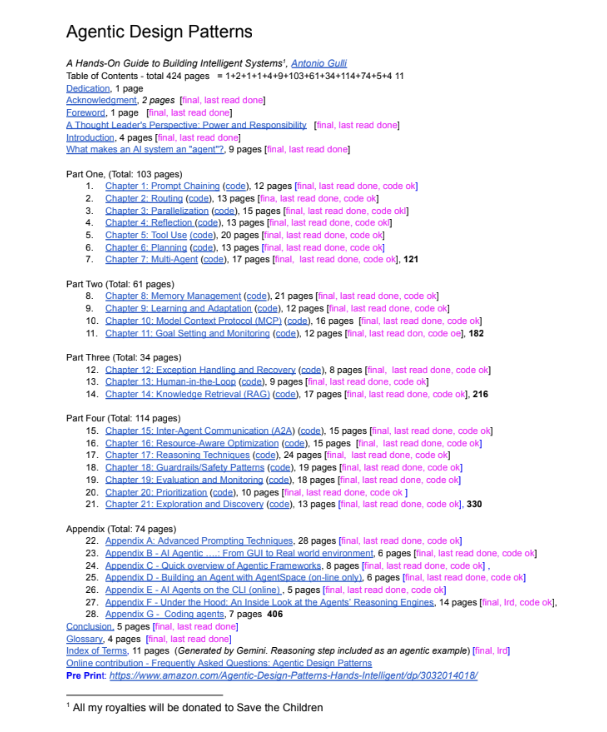
A SENIOR GOOGLE ENGINEER DROPPED A 421-PAGE DOC THAT NO ONE IS TALKING ABOUT.
It is called Agentic Design Patterns. 100% FREE.
Every AI builder paying $200/month for courses just got obsoleted.
This is the most comprehensive AI systems guide I have seen in 2026.
Code-backed and production-ready.👇