@r0ck3t23 Worth adding: the incumbents weren't incapable, they were profitable. GM had the EV1 in 1996 and crushed most of them. Kodak built the first digital camera in 1975 and sat on it. The present was paying them too well to chase the future.
@The_AI_Investor Fun detail: Philips owned 27.5% of TSMC when it was founded in 1987 and licensed it the process tech. ASML started in 1984 as a joint venture between Philips and ASM International. One Dutch electronics company sits upstream of almost every advanced chip on the planet.
@sciencegirl "Jobs no one wants" is exactly where robots break in. They won't start with the work people are proud of. They start where turnover is brutal and nobody stays. Hauling and cleaning fit that perfectly.
@0xProbabillity The "Movie" button is the actual product. Nobody wants a smarter TV, they want a room that reacts. Wild that a $50 stick and a weekend with AI beats what TV makers ship on a $1,000 panel.
@StockSavvyShay Makes sense. Agents spend most of their time not doing matrix math: waiting on tools, running code, parsing JSON. That's CPU work. The GPU thinks, the CPU does the chores, and the chores scale with every agent you spin up.
@dreamlabs_ai $3/hour is the real headline. Once robot labor is priced like cloud compute, the debate moves from "can it do the task" to "what's the success rate per attempt." Would love to see how often it fails on the unseen tasks.
EVERY FAMILY JUST GOT A NEW IT DEPARTMENT. IT'S YOU.
Day 1: you fix your parents' TV with an AI agent.
Day 2: they learn it works on anything with a model number.
Day 3: the microwave, the robot vacuum, the 2009 printer, and the fridge that started showing ads.
Funny, but it's also the real shift:
for 20 years "smart" devices were built to serve the manufacturer.
Now anyone with an agent can make them serve the owner.
Not a robot butler. A universal remote for everything you own.
Physics Inspection verdict: REAL. Good luck with the printer.
In 2023, Vizio made −$8.6M selling TVs.
And $364.9M selling you.
That's gross profit from their own annual report. The TV itself lost money. The ads on your home screen and the data on what you watch paid for everything.
Then Walmart bought the whole company for $2.3B, and said the deal was about growing its ad business.
So when people point Claude at their TV and rip out the ad rows, they're not really hacking a TV.
They're deleting the business model.
And it was never technically hard. Most smart TVs are full computers running Android or Linux. The only thing protecting the locked-down version was friction: hidden developer menus, commands nobody knows, settings buried six screens deep.
AI just made friction free.
That's the real story, and it's way bigger than TVs. Every product built on "users won't bother" is about to meet users who have a bot that bothers for them.
Printers that reject cheap ink. Cars with paywalled features. Apps that hide the cancel button.
All of it was protected by the same thing your TV was: effort.
One tip if you try this yourself: turn developer mode and network debugging off when you're done. Leaving them on is a spare key under the mat.
Claude Opus 5.5 just reverse-engineered my TV...
1 prompt + 5 min = total control: 10x faster UI, ads blocked, any app from GitHub and that's just the beginning
here's full guide step by step:
step 1 → put your computer and TV on the same Wi-Fi network
step 2 → paste the prompt below into Claude Code with a photo of your TV
step 3 → unlock the hidden Developer menu with your remote - Claude tells you what to press
step 4 → hit "allow" on the TV - it's last time you touch the remote
step 5 → say yes to the cleanup: no ad rows, no bloat, 2x faster UI - all reversible
step 6 → install any open-source app straight from GitHub - no Play Store
the result: now anything you can think of, your TV can do...
p.s: works on almost any TV. Mine in the video is from 2017
Try it now, you're welcome. Then read article below on how to reverse-engineer anything:
@ergogarage The printer has always been the final boss. Claude just made it official.
Some hardware doesn’t have bugs — it has a personality and a grudge.
Someone built this exact system over 70 years ago. With paper.
Niklas Luhmann, a German sociologist, kept ~90,000 index cards in wooden drawers. Every card linked to other cards. He called it his "conversation partner" and used it to write 70+ books.
Same pattern as here:
→ raw sources stay untouched
→ notes get rewritten and linked
→ contradictions get surfaced, not buried
The only difference is who does the boring part.
Luhmann maintained his cards by hand for decades. Most of us tried the same thing in Notion or Obsidian and quit after 3 weeks.
Collecting is fun. Maintaining is a chore. That's why every "second brain" ends up as a graveyard of notes nobody reads.
This setup hands the chore to the bots. You just keep dropping stuff in.
The part I'd steal first is the Checker.
A memory that never doubts itself isn't a brain. It's a confident liar with good formatting.
"Unconfirmed after 30 days" is a rule most people never apply to their own beliefs.
Start with one topic. Run it for a month. Then decide if you want it for your whole life.
holy sh*t. Karpathy's second brain pattern runs on Grok Bot now: stop explaining your life to AI from zero every chat, keep a wiki that writes itself
three bots in one group chat, each with its own memory:
the reader takes every link, PDF and voice note you drop and never edits it
the librarian rewrites every wiki page that source touches, usually 10 to 15 of them
the checker wakes up on a nightly routine and hunts contradictions, stale claims and pages nothing links to
→ you ask a question: the answer gets filed back as a page, so the brain grows from use, not only from reading
→ a new source contradicts an old page: the checker tags you instead of quietly overwriting it
→ a page goes 30 days without a fresh source: it gets marked unconfirmed
a second brain can sound sure while remembering the wrong thing
Reader collects. Librarian writes. Checker doubts.
every page has to show:
> the claim
> the source it came from
> the date it was last confirmed
paste this into Grok Bot:
"Build me a second brain with three bots in one group chat. Keep my sources untouched in raw/, maintain wiki/ yourself, file good answers back as pages and run a nightly check for contradictions. Show me the structure first. Do not create anything until I confirm"
start with one topic you actually work on, not your whole life
full setup below
Someone built this exact system over 70 years ago. With paper.
Niklas Luhmann, a German sociologist, kept ~90,000 index cards in wooden drawers. Every card linked to other cards. He called it his "conversation partner" and used it to write 70+ books.
Same pattern as here:
→ raw sources stay untouched
→ notes get rewritten and linked
→ contradictions get surfaced, not buried
The only difference is who does the boring part.
Luhmann maintained his cards by hand for decades. Most of us tried the same thing in Notion or Obsidian and quit after 3 weeks.
Collecting is fun. Maintaining is a chore. That's why every "second brain" ends up as a graveyard of notes nobody reads.
This setup hands the chore to the bots. You just keep dropping stuff in.
The part I'd steal first is the Checker.
A memory that never doubts itself isn't a brain. It's a confident liar with good formatting.
"Unconfirmed after 30 days" is a rule most people never apply to their own beliefs.
Start with one topic. Run it for a month. Then decide if you want it for your whole life.
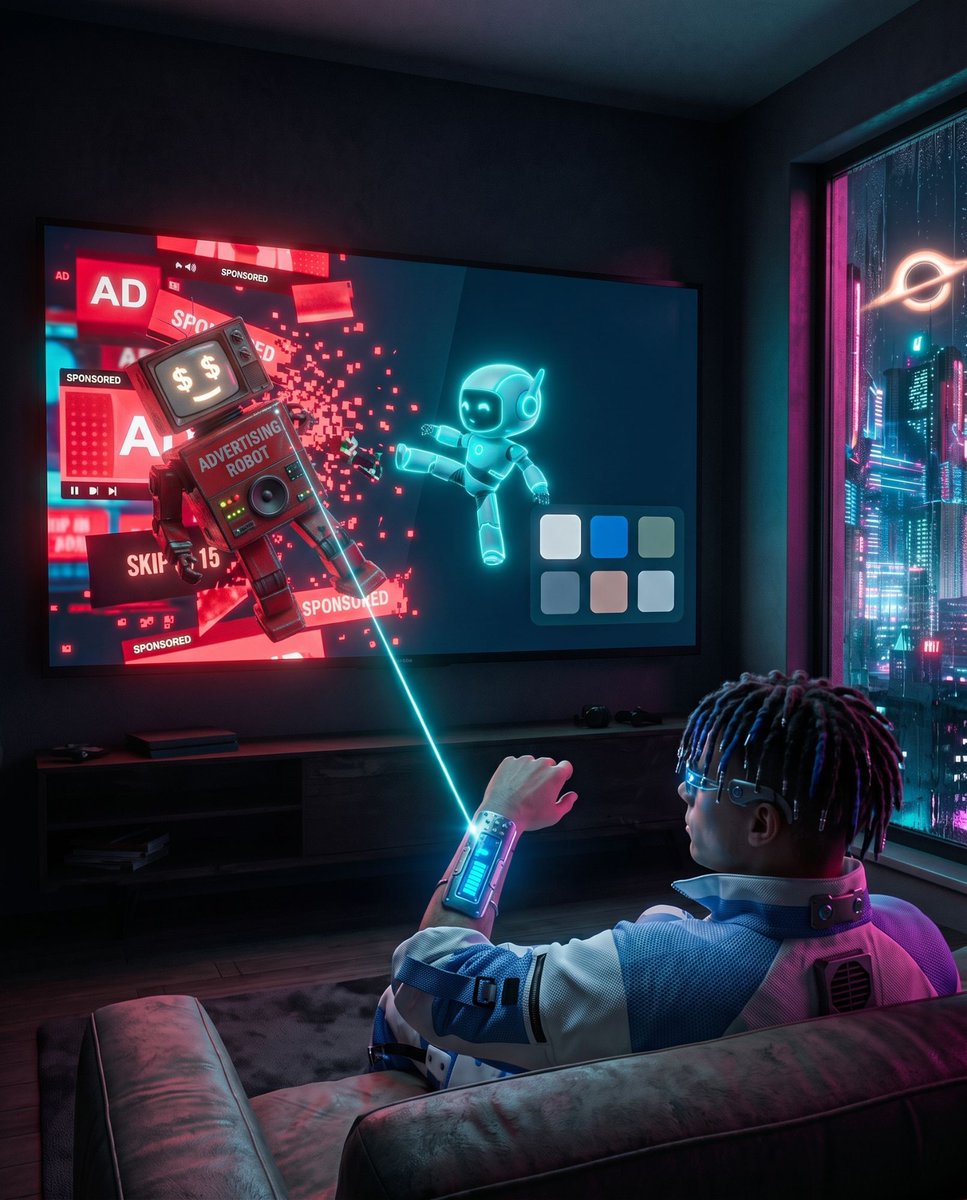
THE FIRST AGENT WAR ISN'T IN A LAB. IT'S IN YOUR LIVING ROOM.
Your TV shows an ad before Netflix.
So you hand an AI the model number, and it hands you back your TV.
What actually happened:
→ it found the TV on Wi-Fi
→ connected through Android's debug bridge
→ uninstalled 25 vendor packages
→ wrote a clean launcher
Five years ago that was a weekend on XDA forums. Now it's one prompt.
Why it matters:
some TV makers already earn more profit from ads and data than from the TV itself.
The screen was cheap because you were the product.
Soon every device in your home will run two AIs:
the one the manufacturer installed, and the one you brought.
Guess which one works for you.
Physics Inspection verdict: REAL.
@ergogarage This isn’t a hack anymore — it’s the default path. Manufacturers sell you a cheap screen and make their real money on ads and data. Once an agent can wipe the bloat and install a clean launcher in a couple of prompts, “whose TV is this?” stops being a rhetorical question.
@Drundor The real unlock isn't the jailbreak — it's Claude turning "I should set this up someday" into "it's done, and here's how it actually works for my workflow."
Source: Luhmann described it in his 1981 essay "Communicating with Slip Boxes." His whole archive is digitized by Bielefeld University and you can browse the cards online.