25× FASTER. 30% MORE MEMORY. ONE CHANGE.
THE BOTTLENECK WAS HIDING IN PLAIN SIGHT.
OpenAI's engineers had a slow build of their own coding tool.
They didn't rewrite the system.
They didn't need a smarter model.
They found a memory bottleneck and replaced one allocator.
Result: every turn became 25× faster.
That's the part people should pay attention to.
A system can look slow because the model is weak, the code is bloated, or the architecture is wrong.
But sometimes, one hidden bottleneck is dragging down everything.
And you won't find it by pasting an error message into a chatbot and asking for a fix.
You need an agent that can inspect the actual system, follow the evidence, test hypotheses, and fix the cause instead of patching the symptom.
That's the shift Argona is pointing at:
Stop being the middleman between AI and the problem.
Give it the whole repository.
Give it the failing workflow.
Give it a clear objective.
Then make it prove the fix works.
The trade-off matters: the reported speedup came with roughly 30% more memory usage. And the article's 88% first-attempt / 99.2% within-four-attempt figures refer to a separate reverse-engineering test, not the same benchmark.
Still, the bigger lesson is hard to ignore.
**The next leap in AI productivity won't come from writing better prompts for every tiny problem.
It'll come from giving agents enough context to solve problems you haven't even figured out how to describe yet.**
@0xSeinz The 10-app batching rule is the real gem here. Most people focus on what AI can change, but the real skill is knowing how to test changes without breaking everything.
@Plutkar The reversible-first approach is the smartest part. Listing everything before making changes—and leaving the remote, HDMI, and Play Store alone—makes this feel like a weekend project instead of a risky cleanup.
HOLY SH*T. The moat around software is getting harder to defend.
For decades, building software was expensive.
Not just because writing code was difficult.
You also had to understand how existing systems worked, figure out their internal logic, reproduce their behavior, and spend weeks debugging everything that broke along the way.
That complexity was a competitive advantage.
A company could spend years building a product, and competitors would have to invest enormous resources just to catch up.
Now look at what's happening with AI agents.
REA can investigate how software works, trace behavior, collect technical evidence, and turn its findings into a structured specification.
Claude Code can then use that specification to help implement the functionality independently.
The important part isn't that AI can write code.
It's that AI can help remove the research bottleneck that comes BEFORE the code.
Think about the implications.
A solo developer wants to build an alternative to an expensive tool.
Instead of spending days manually investigating how one feature behaves, they can use an agent to accelerate the discovery process.
A startup wants to enter a market dominated by established products.
It can study existing workflows, identify what users actually need, and build its own implementation with a much smaller team.
An engineer needs to understand a complicated application.
AI can help turn an opaque system into something documented, testable, and easier to reason about.
Of course, this doesn't mean you can magically clone any application.
Large software products contain years of engineering decisions, edge cases, infrastructure, integrations, and proprietary data.
Understanding a feature is not the same as reproducing an entire business.
But that's exactly why this matters.
You don't need to recreate an entire product to threaten the company that built it.
Sometimes, all you need is to reproduce the one feature customers are actually paying for.
And if AI keeps making that process cheaper and faster, smaller teams will be able to challenge products that once seemed impossible to compete with.
The next generation of software companies might not win by building more.
They might win by understanding what already exists, identifying what can be improved, and rebuilding only what matters.
That's a much bigger shift than AI simply writing code faster.
REA is most dangerous thing on the internet right now...
It lets your AI agent reverse engineer any app, down to the binary
If you use it correctly, you can rebuild any feature you pay for, for FREE
In this article, I show you how: https://t.co/3P1FNXiXzl
Most people don’t have an AI problem.
They have a context problem.
The smarter your AI gets, the more frustrating it becomes when you have to explain yourself from scratch every single time.
The real upgrade isn’t a better model.
It’s building a system that remembers how you think, what you’re working on, and how you want things done.
Stop treating AI like a chatbot. Start treating it like an operating system for your brain.
HOLY SH*T. WHAT IF THE BIGGEST OPPORTUNITIES ON EARTH ARE HIDING IN PLAIN SIGHT — AND WE’RE ALL TOO BLIND TO SEE THEM?
Look at that red flash in the sky.
Millions of people could watch this exact moment, replay it, argue about it, and scroll away.
But what if the real story isn’t the flash itself?
What if it’s everything we’ve failed to notice about it?
Thousands of similar recordings. Tiny visual anomalies. Patterns buried in data scattered across the internet.
To a human, they’re disconnected moments.
To the right AI system, they could become pieces of a much bigger picture.
And that’s what makes this new wave of AI so interesting.
Think about the trading bot everyone’s talking about.
While most traders stare at charts, trying to predict the next move, an algorithm can scan dozens of markets, compare prices, and search for discrepancies a human might miss.
Now take that same principle beyond trading.
Imagine AI comparing millions of medical scans to detect subtle warning signs.
Analyzing astronomical observations to identify unusual signals.
Searching scientific papers for connections between discoveries that were never studied together.
Or examining thousands of videos to find recurring patterns hidden inside what looks like random footage.
Different problems. Different industries.
The same advantage: finding connections at a scale humans simply cannot match manually.
We’ve spent centuries believing that discovery depends on having the smartest person in the room.
But what happens when intelligence can search millions of possibilities before that person has finished asking the question?
The next breakthrough might not come from someone looking harder.
It might come from a machine looking everywhere at once.
And here’s the part most people are missing:
AI doesn’t need to make the world more mysterious.
It might reveal how much we’ve been overlooking in the world we already understand.
STOP SCROLLING PAST THE SIGNAL. START LOOKING FOR THE PATTERN.
Because while everyone else is watching the road…
Someone is building the machine that sees every possible turn.
19 year old Japanese student built a trading bot with Claude Code in 2 days.
Used his iPad as a second monitor.
First night: $6,732 profit.
Starting capital: $68.
Total profit so far: $750,000.
[ 𝐍𝐨𝐭𝐞: 𝐅𝐨𝐥𝐥𝐨𝐰 𝐌𝐞 @monicaa_AI 𝐅𝐨𝐫 𝐢𝐧𝐬𝐭𝐚𝐧𝐭𝐥𝐲 𝐚𝐮𝐭𝐨 𝐃𝐌]
Here's how it works👇
The bot scans over 50 markets simultaneously.
Syncs live BTC data from Binance every second.
Spots price errors before humans even notice.
The edge is pure speed + pattern recognition.
While traders stare at charts trying to predict the next move, his bot is already executing on mispricing across dozens of markets.
No guessing.
No emotions.
No hesitation.
Just Claude Code logic finding gaps that close in seconds.
He built the entire system in 48 hours:
→ Claude Code handles the trading logic
→ Binance API feeds real-time BTC data
→ iPad displays multi-market monitoring
→ Executes trades when arbitrage windows open
The system runs 24/7.
Every price dislocation = profit opportunity.
Most people are still trading manually, refreshing charts, second-guessing entries.
Meanwhile this 19 year old engineering student turned $68 into $750K by letting Claude Code do what humans can't: process 50 markets instantly and execute without fear.
Why are people still trading manually?
I'm giving away the exact Claude Code setup for free.
24 hours only.
To get it 👇
1️⃣ Comment " Claude "
2️⃣ Like and Repost
3️⃣ Follow @monicaa_AI (so I can send it via DM)
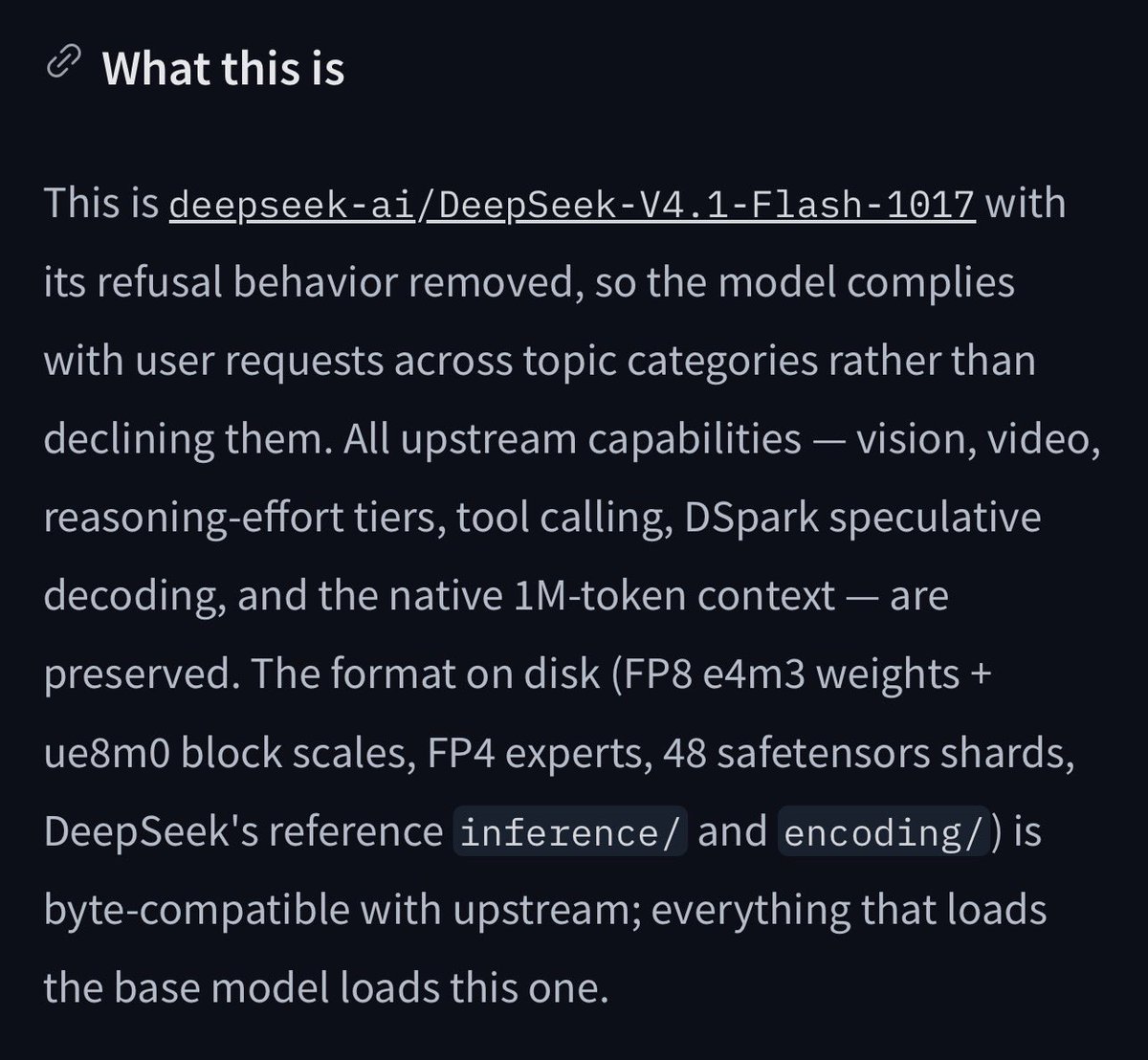
Most AI models come with a leash. What happens when you take it off? 🏴☠️
DeepSeek V4.1 Flash 1017 is being released as a fully uncensored model.
No system-prompt tricks. No LoRA patches. No extra fine-tuning.
The goal? Preserve the model’s original capabilities while removing behavioral restrictions.
And there’s more:
→ NVFP4 version planned
→ ~2.8 bpw build planned for 2× DGX Spark systems
→ Designed to retain as much of the original model’s capability as possible
But here’s the real question:
If you can run a powerful model locally, with more control over how it behaves, how much of the AI stack do you still need to rent from someone else?
The next AI flex might not be a bigger model.
It might be owning the machine it runs on.
DeepSeek v4.1 Flash 1017 FULLY UNCENSORED.
No cheap system prompts, no cheap template tricks, no lora or runtime bs, no sft. Model’s capabilities preserved as much as possible.
Complies with all requests on low/max reasoning efforts.
I’ll be making NVFP4 and a ~2.8bpw version for 2x DGX Sparks soon too.
https://t.co/0QbFq24Cvc
Everyone is using AI to build another SaaS.
Meanwhile, an entirely different opportunity is hiding in science.
K-Dense just open-sourced 177 scientific skills for Claude Code, Codex, and Cursor.
Drug discovery. Molecular screening. Scientific databases. Biology. Chemistry. Medicine.
But here’s how I’d look at it:
You don’t need to be a scientist to build for scientists.
Labs need better workflows.
Biotech startups need custom data pipelines.
Researchers need tools that save hours of specialized work.
And developers who understand these problems can build products around them.
Imagine using an AI coding agent to build a niche tool that would have taken weeks to develop manually.
Not another generic AI wrapper.
A solution for a specific industry with a specific, expensive problem.
The real money in AI might not be building AI products for everyone. It might be building specialized tools for people most developers overlook.
177 skills. MIT license. Free to explore.
The question isn’t whether AI can help you build.
It’s which underserved market you’d build for.
Claude Code can now work like a research scientist.
K-Dense open-sourced 177 science skills for coding agents:
- Drug discovery: query ChEMBL, screen molecules with RDKit and DiffDock
- Single-cell RNA-seq analysis with Scanpy
- 100+ scientific databases in one place
- Biology, chemistry, medicine, physics, engineering, Earth science
- Works with Claude Code, Codex and Cursor
52K stars. free. MIT license.
https://t.co/ws9BwwAIYg
AI can make your startup look fundable in 10 minutes.
That’s exactly why you should be careful.
Give Claude a pitch deck and it’ll make it cleaner, sharper, more convincing.
But what if the business behind those slides is fundamentally flawed?
A polished deck can hide weak assumptions.
A beautiful chart can dress up bad numbers.
A perfect narrative can make a terrible idea sound inevitable.
So here’s how I’d actually use Claude Slides:
→ Build the 10-slide investor deck.
→ Ask Claude to review it like a skeptical VC.
→ Make it challenge the market size, business model, and competitive advantage.
→ Rebuild the 3 weakest slides based on its critique.
Don’t use AI just to make your ideas look smarter.
Use it to find the reasons they’re wrong.
Because the most dangerous thing AI can do isn’t give you a bad idea. It’s make you believe a bad idea is brilliant.
The guy who built Claude Code doesn't make slides the old way anymore.
Boris Cherny: "This is how I make slide decks now"
It's Claude Slides. try this:
"Make a 10-slide investor deck for [company] from this doc: [paste]. One idea per slide, max 12 words of text each. Put real product screenshots in device frames, build one chart from my numbers, end on a slide with the ask. Dark theme, one accent color. Then critique the deck as a skeptical VC and rebuild the 3 weakest slides."
@Ravlizk The real shift is moving from “AI that writes code” to “AI that orchestrates work.”
The interesting part isn’t the number of agents running in parallel — it’s how the system verifies their output before trusting it.
Claude Code re-uploads your entire conversation on every single turn.
That's why a boring 1992 file format just made it feel faster. The math ↓
Every turn, the request carries the full history: your prompts, every file it read, every tool result.
I rebuilt a 24-turn Claude Code-style session from a real codebase and measured every request:
Turn 1: 7 KB
Turn 24: 372 KB
Total uploaded: 4.1 MB
Each request grows like n. The total grows like n².
Now gzip it:
372 KB → 85 KB (4.4× smaller)
Cost: 14 ms of CPU
On a 10 Mbps upload, turn 24 goes from 0.30 s to 0.08 s. That's before the model sees a single token.
When does compressing pay off? One line:
compress if uplink < gzip speed × (1 − 1/ratio)
My laptop gzips at ~220 Mbps, ratio 4.4 → gzip wins on any upload slower than ~170 Mbps. That covers most home and mobile connections.
Lesson for anyone building agents: your context isn't just a token bill. It's bytes on a wire, every turn.
Send less, or send it smaller.
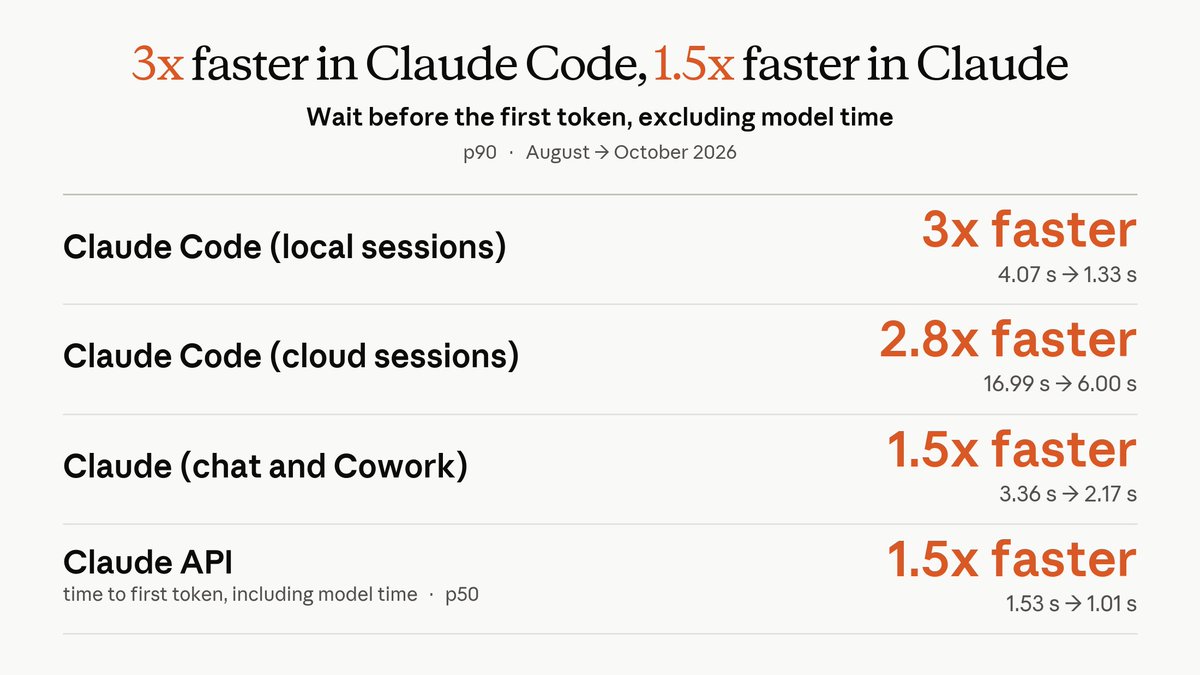
We keep improving performance across Claude, and you may have noticed it starts responding sooner!
Claude Code now gzips the conversation it sends on every turn, so it reaches the model faster. Cloud sessions also start up as soon as you start typing.
@Avernyx 0.81 seconds sounds insane — but I’d wait for real-world tests before believing the headline numbers.
The real question isn’t just how fast it launches, but whether it can deliver that performance consistently, safely, and outside ideal conditions. 🚀
@Xylomere The license is just as important as the sound itself.
A track being free to download doesn’t automatically mean it’s safe for commercial use. Logging the license for every clip is a small step that can save you a big headache later.
The real problem isn’t the strategy. It’s the feedback loop.
If an agent keeps tweaking and retesting until something passes, it’s not finding an edge — it’s manufacturing false confidence.
More iterations don’t guarantee better results. Sometimes they just make the overfitting harder to spot.
The spec is the real leverage here. Once you can describe behavior precisely enough to test it, the original implementation becomes much less important. The hard part isn’t rebuilding the code — it’s proving the replacement behaves the same under edge cases.
Make the comment more conversationalAdd a concrete edge-case example
@0xboan The most interesting part isn’t the 100x return, it’s the risk architecture behind it. Most traders build systems around finding entries. Very few build them around knowing when NOT to trade. Though I’d want to see the full trade history before calling this a proven edge.