Have you seen what we have just announced at Microsoft Ignite from our Intune product group??
✅ Windows Server Management in Intune (Insider Preview)
✅ Windows Autopatch support for eligible servers
✅ AI Agent Governance with Software Compliance Policies
✅ Microsoft Execution Containers (MXC) for AI agent containment
✅ App Protection for Copilot, ChatGPT, Claude, and GitHub Copilot
✅ Vulnerability Remediation Agent with AI-assisted remediation workflows
✅ Device-level App Inventory
✅ CIS Benchmark Auditing in Intune Advanced Analytics
✅ AI-powered investigations through Microsoft Perception
✅ Improved Windows Autopilot and endpoint visibility experiences
https://t.co/rQnENrleKm
The Wachowskis reportedly want to regain control of ‘THE MATRIX’ franchise. With a fifth film already in development, the filmmakers have informed Warner Bros. of their intention to reclaim the rights.
(via @PuckNews)
MICROSOFT ANNOUNCES 6 NEW AI MODELS AT IGNITE
$MSFT unveiled six MAI models across coding, cybersecurity, image generation and voice on the same day its partner OpenAI released GPT-6.2.
1) MAI Code 2: Delivers 98% of GPT-6.1 Sol's performance at 40% of the cost. Now in GitHub Copilot.
2) MAI Code 2 Flash: Outperformed GPT-6.1 Sol in AT&T testing while costing 50 times less.
3) MAI Cyber 2 Flash: Outperformed GPT-6 Astra on a cybersecurity benchmark at less than 2% of the cost per task.
4) MAI Realtime 1: Outperformed GPT Realtime 2.1 on public benchmarks and Microsoft's own evaluations.
Microsoft is also launching MAI Image 2.7 in public preview and bringing MAI Transcribe 2 to Dragon Copilot for medical use cases.
Separately, Microsoft says it is making progress on its own general-purpose frontier AI model.
🆕 @MicrosoftAI's MAI Code 2 and MAI Code 2 Flash are now generally available in GitHub Copilot.
MAI Code 2: A powerful, general purpose coding model built to help developers get from request to result with focused responses, practical code changes, and less unnecessary back and forth. Ideal for complex tasks like deep debugging, multi-file implementation, refactoring, and repository-wide reasoning.
MAI Code 2 Flash: A lightweight, cost-efficient coding model optimized for everyday development workflows. Well suited for code explanations, targeted edits, routine fixes, and rapid iteration.
Try them in the GitHub Copilot app, CLI, and @code.
https://t.co/qz95P3pckp
Introducing MAI Code 2 and Code 2 Flash.
Code 2 brings frontier price-performance for everyday enterprise coding tasks.
Code 2 Flash brings affordable and high-quality coding for routine work at scale.
Try both today in GitHub Copilot.
Over the past week, I’ve been overwhelmed by the love and support of friends, industry colleagues, and people I've never met. Thank you to everyone who has shown kindness to my family and me. It means the world to me.
I came to the United States 53 years ago, and becoming an American citizen is one of the greatest gifts and proudest moments of my life. NVIDIA has been my life’s work. Building it into the company it is today alongside my colleagues has been a privilege and an honor. Nowhere but in America could a company like NVIDIA be possible. I love our country, and I love NVIDIA.
I did not live up to the standards expected of everyone at NVIDIA, and I have made serious mistakes in my personal life. I created problems for the Board that I deeply regret. I own my mistakes completely, and I am committed to cooperating with the Board’s independent investigation.
Since my departure, I’ve seen an outpouring of calls from NVIDIA’s employees, investors, business partners, and customers for me to return as CEO. Many continue to reach out to me directly as the company navigates complex technology, market, competitive, and geopolitical dynamics. NVIDIA is a once-in-a-generation company. If the Board of Directors decides that my return is in the best interest of our shareholders, our employees, the company, and America, I would be honored to answer these calls and return as CEO.
Thank you again to everyone who has shared their good wishes. I am profoundly humbled by your support. To my family: I love you, and I will spend the rest of my life being worthy of yours.
Jensen
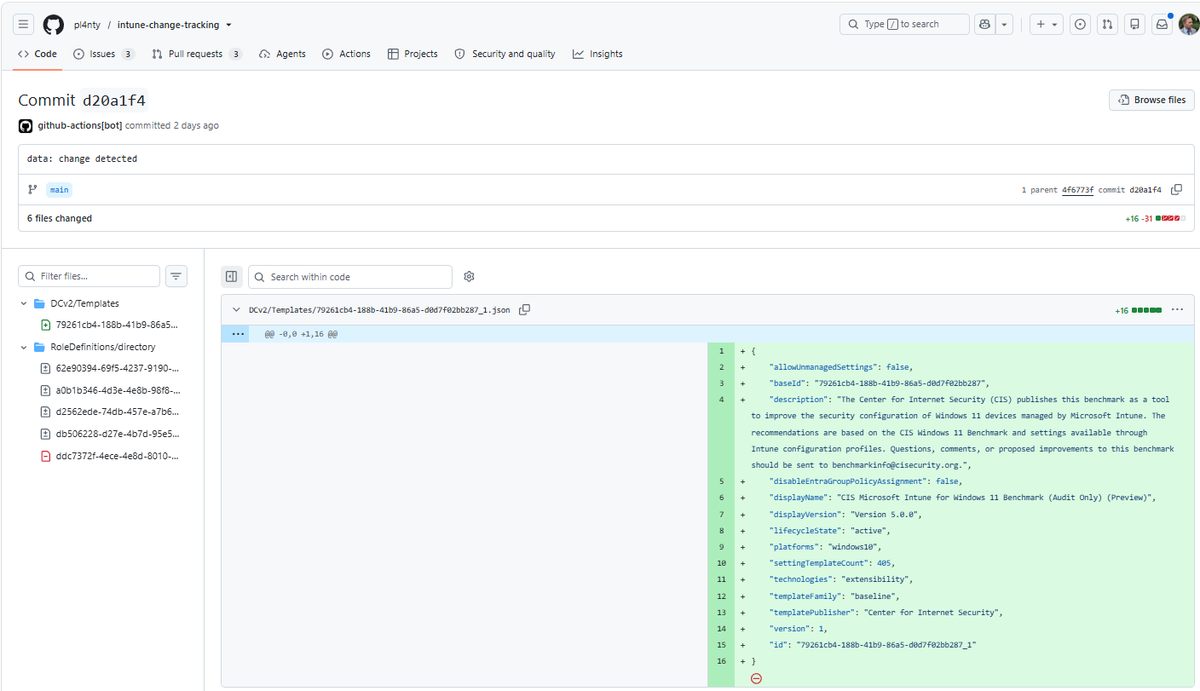
Looks like third-party security baselines are coming to Intune.
CIS Windows 11 Benchmark v5.0.0, 405 settings, Audit Only
https://t.co/lLhcDvWA5g
#MSIntune#CIS#Windows
Maintenance Windows are BACK in Microsoft Intune!!
Remember this feature?
Back in March, I wrote about Microsoft's plans to introduce Maintenance Windows for Windows OS and driver updates.
Finally, a way to control WHEN Windows is allowed to install updates and restart, instead of just relying on Active Hours. But then something strange happened...
Microsoft quietly removed the Maintenance Windows announcement from the Intune roadmap. Was the feature canceled? Delayed? Nobody really knew. Well... guess what's back!
Microsoft has now officially announced Maintenance Windows in the November 2026 Intune What's New!
And this time, we're getting a dedicated Maintenance Windows section in Intune, where we can configure when update actions are allowed to run.
In my latest blog, I take a closer look at what Microsoft announced, how these policies work, and what the new configuration experience could look like.
And yes, I included some mockups based on Microsoft's documentation to show what we might expect!
Want to read the previous chapters of this story?
Part 1: Maintenance Window Settings for OS, Drivers, and Updates
https://t.co/kyb7WbT5rb
Part 2: Maintenance Window Settings Catalog… And It's Gone
https://t.co/pYwOrDMJ8n
Part 3: The Return of Maintenance Windows!
https://t.co/Zh5HsJirdc
Looks like Maintenance Windows finally found their way back into Intune!
#MSIntune #WindowsUpdate #PatchMyPC #Windows11
More details on the root cause can be found in the Microsoft 365 Admin center, and an abridged version can be found below.
We are deeply sorry for the impact to all our customers and recognize the impact that this has on their normal business & operations.
The incident on Thursday, November 12th, 2026, was caused by three main factors that together caused a global outage for the networking gateway that fronts many Microsoft 365 services.
First, a latent defect caused servers to become overwhelmed and unresponsive under certain load conditions. This was due to lock contention inside an internal process which caused the machine to become unavailable. This defect was the result of a fix that was prepared specifically for Microsoft 365 networking gateway servers; neither the underlying defect nor the fix applies to broader Windows deployments.
The initial change in behavior first started deployment in July of this year. The update went through safe deployment and saturated globally over several weeks, during which time no issues were observed. For more than three months, the change was deployed worldwide without impact.
Our normal load testing did not detect the latent issue because the different traffic and SKU mix used in our test labs. The contention issue is worsened on machines with more cores and newer hardware; whereas our load testing tended to focus on our weaker hardware SKUs with fewer cores.
Second, a surge in load increased the likelihood for the networking gateways to encounter the contention. Within Microsoft 365, we maintain two independent and heterogenous network gateway systems designed for isolation and high availability. This allows many Microsoft 365 services to fail to/from them during outages or disruptions. Approximately fifteen hours before the outage, Teams failed over from the alternative networking gateway to the ‘primary’ gateway that also supports Exchange Online. This increased the load on the networking gateway and changed its traffic patterns. This type of failover is part of normal operations and is integral to standard Microsoft resiliency efforts.
Third, at the same time, nearly 14% of server capacity for the networking gateway was out of service due to an unrelated issue from the previous day. This server capacity was on track to be returned to active service through routine maintenance and health processes. The service had sufficient capacity headroom, so the reduction in server capacity had no impact on its own.
Taken together, the increased load and the reduced server capacity, caused the network gateway to encounter the latent bug from July. This caused requests to build up until servers ultimately stopped responding. This occurred during the peak window of traffic in the United States.
When servers lose connectivity, our traffic management systems automatically route users to other healthy endpoints. This happens often and is critical to avoiding any interruption due to hardware, software, or network defects and is normally what makes the service resilient. However, the redirected traffic increased the likelihood for the same problem to occur on the remaining endpoints. This caused a cascading failure from server to server as the same amount of load was spread across fewer servers. In less than two hours, the previously unknown defect was encountered across our fleet and rendered them unresponsive. At its lowest, more than 80% of servers were unresponsive.
Normally, the network gateway is composed of thousands of ‘capacity units’ which represent shards of capacity, hardware, and networking infrastructure. These ‘capacity units’ are then organized into regions. In this case, due to a separate issue, the normal bulkheads between these different partitions did not stop the cascading failure. This is what allowed the impact to spread across our network gateway infrastructure globally.
Several services like Teams, OneDrive, SharePoint, and Office apps failed out of the faulty network gateway infrastructure. That is why those services were restored earlier, with Teams chats and meetings functioning without issue for most of the outage. But not all services, like Exchange Online, can fail out of this network gateway.
Recovery took longer than usual because as servers returned to service, they were immediately overwhelmed by waiting traffic and became unresponsive again. Our normally automated recovery processes were not designed to restore service from this broad unresponsive state. Additionally, since the main code defect was a latent bug from several months previous, our normal rollback, flighting, and feature flags were unable to quickly revert the change.
After engineers confirmed the defect as the cause, we developed an update that returned the code path to the previously known good state. To effectively apply this fix, and to slowly bring the service online again, we took groups of servers out of service, applied the change, and restarted them before returning them to service. This process was carefully applied to large quantities of infrastructure at a time (e.g. 50%+ of a region).
The final Post-Incident Review (PIR) will provide more details later this week.
PowerShell 7.7 is MSIX only.
No install as SYSTEM. Per-user only. No WSMan remoting. No machine-wide execution policy. No all-users profile.
An admin shell that can't do admin things. Removing MSI before MSIX covers the basics makes no sense.
Reinstall Windows from a fresh Microsoft image, no USB stick, no WDS. Cloud Rebuild shipped with the November update and worked on the first try.
First tests, where the logs live, and a script that turns them into one HTML report.
https://t.co/MTvwHi2AXt
#MSIntune#Windows11
Intune HealthCheck beta is out: a free tool that checks your Intune and Entra ID tenant against pre-defined rules and writes an executive report and a technical findings report.
Check it: https://t.co/xD50U7l0ZH
#Intune#EntraID#MicrosoftIntune#EndpointManagement#Windows
I wanted to test Fable 5.2's quality with one-shot prompts without human feedback.
Everything in this game is from scratch: models, sounds, textures. ~$550 at API pricing, ~2.7M output and 445M input tokens, heavily cached. Took 8 hours!
Play it here: https://t.co/fazOCcyNIH
The Fable of Clawd
A 2 minute 4K film made entirely in Blender, from one prompt on Fable 5.2. It took about 4.5 hours.
Claude built every asset in Blender by writing Python:
- 5 characters and props: Clawd, his friend Pip, a toy truck, a 3D-printed tulip and a gift box
- 7 full sets: a study, a staircase, a street, a workshop, an airport, a night sky and a house
- every camera move and every frame of animation across 52 shots
That came to 12,500 lines of code. It started 7 copies of itself to build the sets at the same time.
Then it rented 89 GPUs through RunPod to render 3,220 frames as fast as possible, 36 of them running at once. Total cost: a little over $20.
My biggest takeaway is my Claude Code knows it has access to cloud compute, so it's much more ambitious.
I tried a similar prompt on my other computer that doesn't have the runpod skill setup and it wasn't nearly as high quality
Full details linked below.
Claude Code can read files, run terminal commands, and help you build agentic workflows from the terminal.
In this course, @andrewbrown teaches you how to install and use it on Windows, Linux, and Mac.
You'll also learn about the agentic loop, session management, how to track API usage and costs across providers, and more.
https://t.co/XeVVRGAQm8