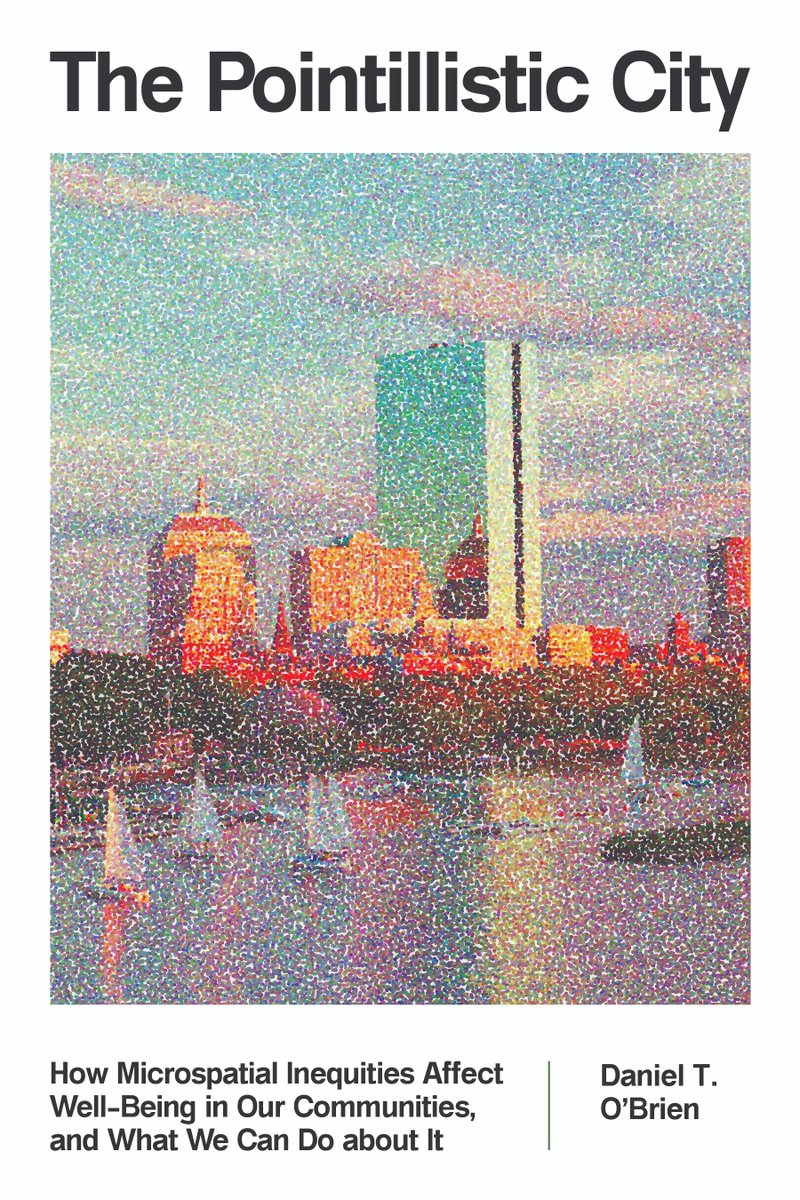
In a new book, we delve into #SharingEconomy societal benefits & systemic deficiencies. We then call for a re-engineering these platforms with a blend of design, self-governance, and regulation to maintain viability while managing negative externalities. https://t.co/2GKuG0edWw
Amazing how one (now-retracted) MIT PhD paper wrote the whole “AI makes professionals superhuman” script. A few months ago all researchers wanted its secret sauce; now we’re back to Grandma’s rule: if it’s too good to be true, it probably isn’t.
With the retraction of the MIT paper, we now have no clear experimental evidence that LLMs act as a multiplier for high performers (even though that would still seem to make sense).
Lots of evidence that low performers get a big performance boost, though, across many studies.
Verifying causality also becomes impossible: in the absence of any agency, we lose the potential for randomized experiments and genuine natural experiments, as truly exogenous events cease to exist.
Is #causality meaningful without some form of #agency?
Yes, we can still have mechanisms, but causation without a conceivable intervention becomes essentially void!
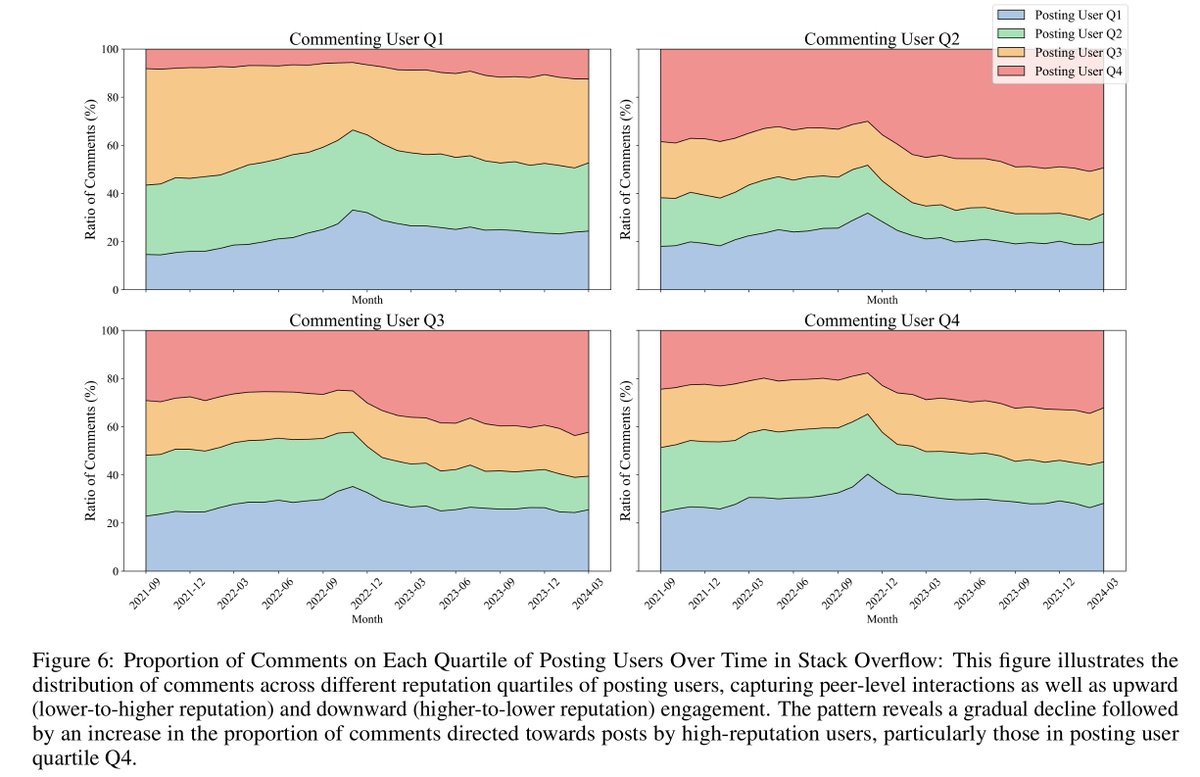
Considering the exploration/exploitation trade-offs in knowledge ecosystems: GenAI has taken over the exploitation side—transfer of existing knowledge; But the exploration side, where expertise deepens, and new knowledge emerges, remains active. 4/n
https://t.co/Xbd85G2i6m
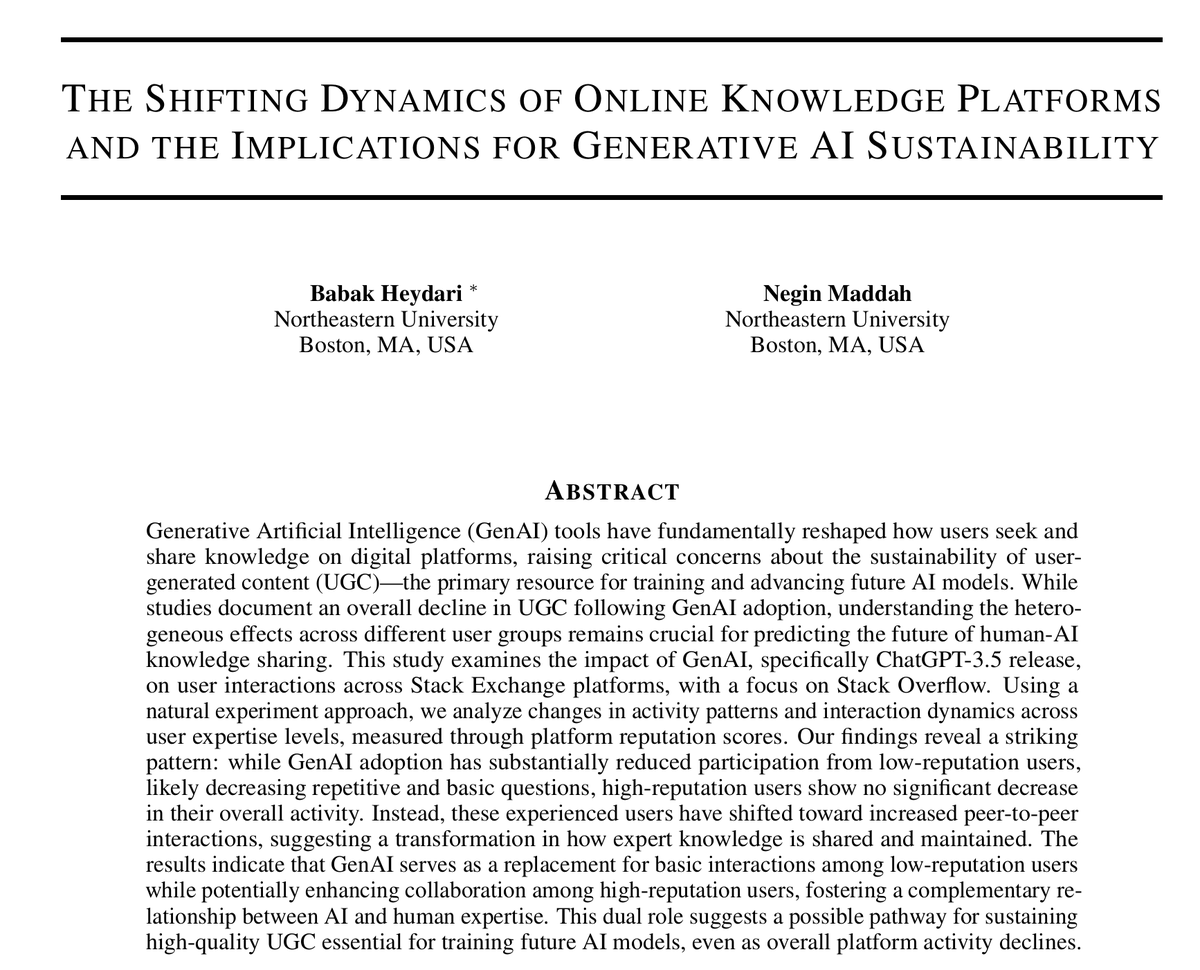
Decline of StackOverflow is more nuanced than it seems.
The sharp activity drop in knowledge-sharing platforms has sparked concerns re the sustainability of GenAI. If LLMs depend on human-generated data but reduce content generation, are we hitting the so-called "peak data"? 1/n
High-rep, high-skill users stay engaged, but their roles are shifting—less novice Q&A, more expert-to-expert interactions. A potential silver lining: while #quantity declines, #quality may evolve in ways that sustain AI training data. 3/n
The "it's the economy, stupid" argument for decline of identity politics gains credence from widespread econ dissatisfaction. Yet econ conditions, however objective, are still processed through identity-based perceptual filters that define how those realities are interpreted. 3/3
Recent election results are being interpreted as signaling the decline of identity politics. I think this is misleading! What we're witnessing is the formation of more potent identity lines that cut across boundaries taken for granted for the last few decades. 1/3
Take the Latino vote shift: voters aren't abandoning identity-based alignment; instead responding to emerging identity categories shaped by religious values, economic class, and cultural conservatism - transcending conventional demographic categorizations. 2/3
🚀The IC2S2'25 website is LIVE, and submissions are OPEN!
📍Norrköping, Sweden | July 21-24, 2025
Call for Abstracts - DDL: Feb 24, 2025
Call for Tutorials - DDL: Jan 17, 2025
🔗Explore details & submit: https://t.co/hdsdvXiHxJ
Stay tuned for exciting keynote announcements!
I truly enjoy creating models of emergence and evolution of risk-mitigating social norms and other collective behaviors. This NSF project and the incredible team of collaborators @DanOUrban@SilviaPrina & Gabor Lippner) provide the ideal platform to advance this research line.
To help policymakers make better decisions in both future #pandemics and other public crises, @Northeastern researchers are developing epidemic models that incorporate collective behavioral patterns.
https://t.co/yczRFx1XBh
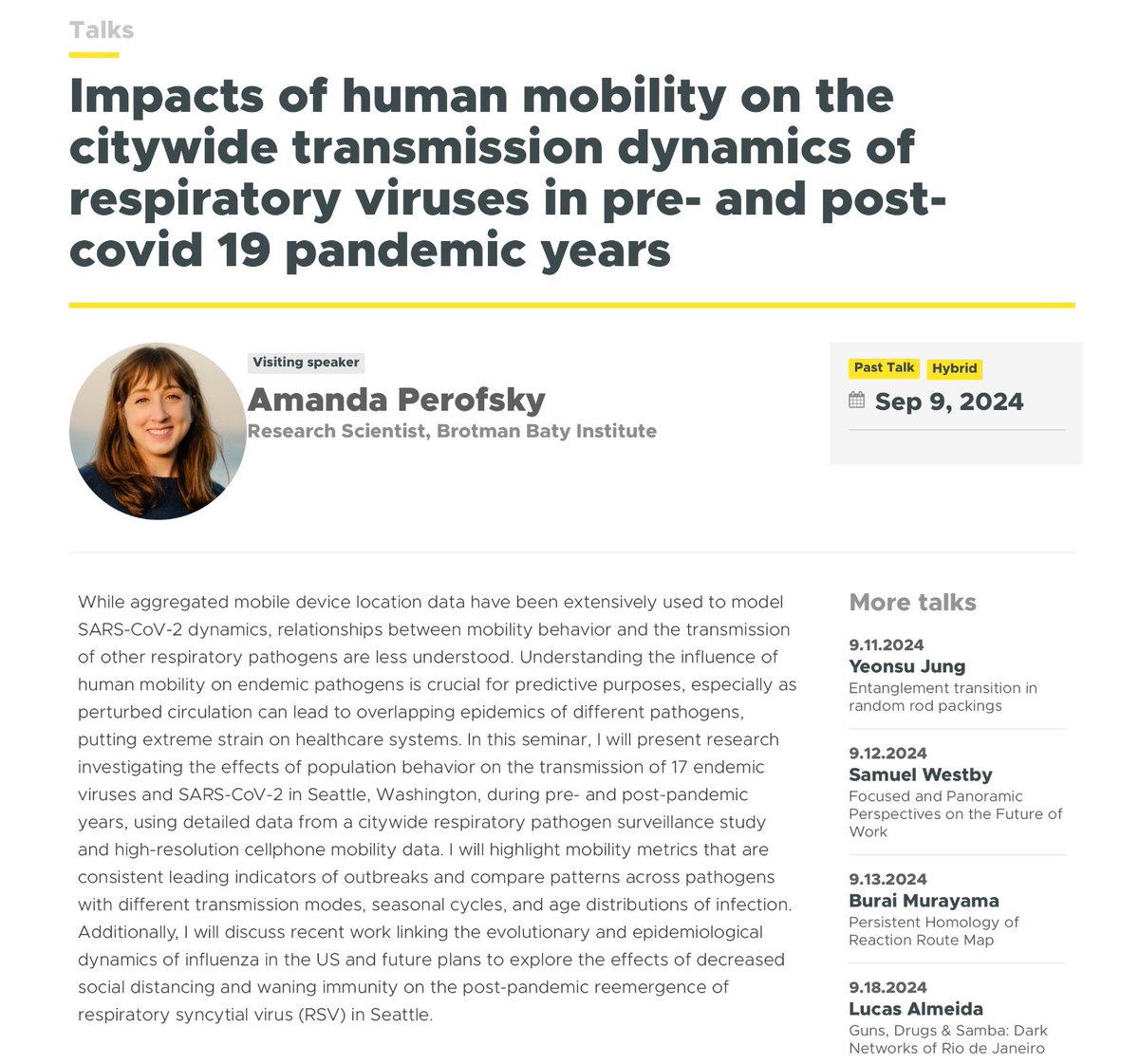
The scheduled talks (so far!) this fall at @NUnetsi — a really packed semester showcasing a range of interdisciplinary research.
Also, semi-periodic reminder that most of these are hybrid and can be joined via zoom! And more still to be announced 👀 https://t.co/aVp4hPAfG7
@BARIBoston is hiring! Join us as a postdoc on the Common SENSES (https://t.co/DoLCpZOdb0) project, supporting science-driven, community-led solutions for #environmentaljustice along Blue Hill Ave. in Roxbury. Reviewing applications now! https://t.co/mHId6ATlV8
Announcing a focus Issue on Statistical Inference and Machine Learning for Complex Networks at the Journal of Physics: Complexity.
Edited by @captainkirk1041@GTCantwell Cate De Bacco and myself.
https://t.co/3wyCuZSjs3
Submission by May 2025.
1/ 📢 New Research Alert: What influences decision-making in Large Language Models during #strategic scenarios? Do they prioritize mutual payoff structures (game types) or contextual framing? Our new pre-print looks into these questions for 3 #LLMs.
https://t.co/4WoMf8pQfl
Glad to see that our paper on strategic decision-making of LLM agents, with @NUnetsi PhD student Nunzio Lore, is finally out—one year after the preprint! Despite the rapid evolution of LLMs, our core messages remain largely relevant. Stay tunned for more!
https://t.co/c1tBHYNdk3