I myself am a "men". Most of my friends are also a "mens". I have no idea who African women are referring to when they say that "men" prefer women who wear wigs over their natural hair. I can use myself and my sizeable friend group across 9 countries on the continent as enough of a sample size to categorically state that African men overwhelmingly prefer their women's natural hair.
Yet everytime this conversation pops up, we hear about this mythical creature called a "men like women in wigs." On behalf of African men, allow me to say it again that if "men" prefer female wigs over female natural hair, then we must be women - that does not apply to us at all.
We grew up with you people. You are our sisters, cousins, schoolmates and friends. The first picture of the female form that we saw and fell in love with as your brothers, nephews and high school boyfriends was you in your natural state. I don't think you realise how powerful that is. The girl from the next classroom that was every African boy's first love was a girl appearing in her natural state. That is the default picture of love that stays with us for life! We did not wake up one morning at 17 and suddenly decided that female beauty = a woman wearing a Hollywood production on her head.
That is fake news!
We've always loved you as you are.
The real issue is that you are receiving commercial messaging and social engineering propaganda to convince you that your natural state is incomplete, so that you will spend money to "fix" what was never broken, and some white guy somewhere gets paid off that. We do not control any of the messaging you are receiving! We don't control any social media algorithms. We don't control your TV programming. We don't control Netflix, Amazon Prime, Hulu, Disney+ etc. We don't make TV and movie casting decisions.
We don't own any of the supply chains and factories built around manufacturing your insecurity - the most we can do is retail these products that somebody else put in your mind, manufacturer in a Chinese factory, and shipped to your country. If we were the ones in control of any of these things, we would never push such products on you. Even drug dealers don't sell drugs to their own family members.
Anyway that's precisely the problem - we're the world's least powerful men and our weakness has built a superhighway for every Tom, Sandeep and Chung to dump toxic ideas and products on our women and leave us to deal with the fallout. It is precisely because we don't control Media, Politics, War, Industry or Logistics that we haven't built a physical and psychological wall around our women, unlike every other group of men on the planet.
Our weakness as a group is what has left our women's minds and bodies defenseless and open to exploitation from anyone and everyone - to the point where they literally look at their natural form in the mirror and think there is something they need to correct about it. They know that as a group, the only thing we offer to them is penis and they have learned to discount whatever we say, even when we tell them that they're beautiful as they are.
This is a problem that the African rebellion will naturally solve.
When African men take our rightful place in the world and begin exercising power as we should, nobody will need to tell African women that their beauty is not enhanced in any way by laying a dead Indian woman's hair above their own.
Power fixes these problems.
Sad: Our Children Are Now Pawns in a Deadly Ransom Economy
It’s heartbreaking to report yet another bandit attack on a school, barely three weeks after over 40 schoolchildren and their teachers were abducted and are still languishing in the forest.
The security situation in Kogi State has taken another tragic turn with a brutal bandit attack on Government Secondary School, Iluke, in Kabba-Bunu LGA. Armed bandits disguised in military uniforms invaded the school during an ongoing WAEC examination, killed the Vice Principal, Mr. Gani Anifowose, and attempted a mass abduction of students.
Reports from the scene indicate that local security personnel and vigilantes actively resisted the attackers and frustrated their abduction attempt.
Making educational institutions soft targets is a direct assault on the nation’s future. It creates a psychological barrier to school enrolment and worsens Nigeria’s out-of-school children crisis, disproportionately forcing young girls out of formal education due to fear. There is nothing more heartbreaking for a nation than being unable to protect its children.
My heartfelt condolences go to the family of the Vice Principal, who lost his life while gallantly defending the children entrusted to his care. May God grant his soul eternal repose.-PO
If you don’t have a very patient wife that really respects you, this economy will bring out the worst in her. You won’t believe your eyes.
I also had a very good start when I got married, bought a car, land, bulk foodstuff in the house always, ate whatever we wanted, premium Dstv subscription.
But when this idiot tulumbnu came in, everything came down. My client base reduced drastically and it got to a point feeding was a problem.
But I thank God for the wife I have. Yea she complained after a while but not for one day disrespected me.
Now we are deliberate in planning, investing in stuff that will guarantee cashflow so that we won’t be stranded in future.
Because I'm a medical doctor, on ground & practicing in Anambra state at the time this happened, let me take my time to school you, even though I know you're just trying to be mischievous.
What was the reason for the strike?
The Fed Govt had implemented the CONMESS payment
After speaking with Nigerians in Cape Town yesterday, I was able to have meaningful discussions this morning with three South African ministers and political party leaders regarding the ongoing challenges related to immigration, regional collaboration, and fostering peaceful coexistence between our nations.
I had the pleasure of meeting with Mr Leon Schreiber, the South African Minister of Home Affairs and a prominent figure in the Democratic Alliance; Mr Velenkosini Hlabisa, the Minister of Cooperative Governance and Traditional Affairs and leader of the Inkatha Freedom Party (IFP); and Mr Gayton McKenzie, the Minister of Sports, Arts and Culture and leader of the Patriotic Alliance (PA).
Our conversations were productive and candid, focusing on the current challenges that affect both countries—particularly those related to migration, economic strains, youth unemployment, security issues, and the rising tensions faced by African foreigners in South Africa.
I firmly believe that Nigeria and South Africa, both prominent African nations, must enhance dialogue, bolster cooperation, and seek solutions based on justice, mutual respect, and adherence to the rule of law. In challenging times, leaders and citizens alike need to demonstrate responsible leadership, compassion, and restraint.
We collectively stressed the importance of law-abiding behaviour, avoiding violence, resisting hate or provocation, and allowing lawful institutions to address grievances through democratic and constitutional processes, regardless of the challenges we face.
The progress of Africa hinges on our ability to create unity, foster economic inclusivity, invest in our communities, and uphold the dignity of every African, no matter where they live. -PO
A Nation Losing Its HUMANITY.
Some events shatter a society so deeply that words are no longer enough to express the shock; the brutal killing of a teacher and the horrific rape and murder of an elderly woman are among such tragedies. These are not isolated incidents but signs of deeper moral and social decay.
How did we get here? How did we reach a point where teachers are hunted and killed, and the elderly—custodians of memory and wisdom—suffer such dehumanising violence?
This is more than a security crisis; it is a failure of collective humanity. We have become desensitised, consuming tragedy briefly and moving on, allowing indifference to normalise the unacceptable.
To the families affected, I share in your grief. But grief alone is not enough.
We must demand accountability and urgent systemic change. If such atrocities no longer move us to action, then we risk losing our shared humanity. -PO
Debt Servicing, Borrowing, and Nigeria’s Fiscal Priorities
During his recent foreign tour, President Bola Ahmed Tinubu stated that Nigeria will spend about $11.6 billion on debt servicing, a figure that should concern anyone interested in the country’s economic future and long-term development.
There is nothing inherently wrong with borrowing when it is guided by prudence and directed toward productive investment. Countries such as Japan, the United Kingdom, the United States, the United Arab Emirates, Singapore, and Indonesia are all heavily indebted, yet their borrowings are largely channelled into education, healthcare, infrastructure, and innovation - sectors that generate long-term economic returns and sustain repayment capacity. As a result, despite high debt levels, their obligations remain more manageable because they are tied to measurable productivity.
Nigeria’s situation, however, is markedly different. A huge proportion of past borrowing has been directed toward consumption, with limited visible or sustainable developmental outcomes to justify the scale of indebtedness.
It is also important to note that a huge portion of the debt currently being serviced was accumulated under the Tinubu administration itself, while borrowing has continued at a significant pace. The administration’s recent external borrowing alone includes about $6 billion (from First Abu Dhabi Bank in the UAE—$5 billion, and UK Export Finance via Citibank London—$1 billion), a further $1.25 billion under consideration from the World Bank, and an additional $516 million arranged through Deutsche Bank, bringing the latest known external loan commitments to roughly $7.8 billion. In addition, domestic borrowing through monthly bond issuances continues to add to the overall debt stock.
Against this backdrop, Nigeria’s 2026 budget shows that health is ₦2.46 trillion, education is ₦2.56 trillion, and poverty alleviation is ₦865 billion, giving a combined total of about ₦5.885 trillion for these three critical sectors. By comparison, debt servicing at about $11.6 billion (approximately ₦17–₦18 trillion, depending on exchange rate assumptions) is almost three times higher than the total allocation to health, education, and social protection combined. This imbalance highlights a troubling fiscal reality in which debt obligations increasingly crowd out investment in human capital and poverty reduction. Moreover, even within the limited allocations to these sectors, funds may not be fully released, and a significant portion of what is eventually released could be misappropriated.
Ultimately, the central issue is not borrowing itself, but whether borrowed funds are being converted into measurable productivity, inclusive growth, and improved living standards. Without this, debt servicing shifts from being a temporary fiscal obligation to a long-term structural burden that constrains development and deepens economic vulnerability.
A New Nigeria is POssible. -PO
State visits by Leaders are not tourism, and diplomacy is not a fashion parade. Every foreign trip undertaken by a government must deliver measurable benefits to the people, including investments, technology transfer, trade agreements, factory expansion, industrial partnerships, and job creation.
During President Trump’s recent visit to China, the American delegation reportedly included a few top government officials, and many of the biggest figures in global business and technology:
Consequently, huge trade deals worth several billion dollars including about 200 Boeing orders were achieved.
The list of the entourage included
1. Donald J. Trump – President of the United States
2. Marco Rubio – Secretary of State
3. Pete Hegseth – Secretary of Defence
4. Elon Musk – CEO, Tesla & SpaceX
5. Jensen Huang – CEO, Nvidia
6. Tim Cook – CEO, Apple
7. Larry Fink – CEO, BlackRock
8. Stephen Schwarzman – CEO, Blackstone
9. Kelly Ortberg – CEO, Boeing
10. Brian Sikes – CEO, Cargill
11. Jane Fraser – CEO, Citigroup
12. Larry Culp – CEO, General Electric
13. David Solomon – CEO, Goldman Sachs
14. Sanjay Mehrotra – CEO, Micron Technology
15.Cristiano Amon – CEO, Qualcomm
16. Dina P. McCormick – President of Meta
17. Ryan McInerney – CEO, Visa
18. Michael Miebach – President, Mastercard
19. Jim Anderson – CEO, Coherent
20. Jacob Thaysen – CEO, Illumina
That is how serious nations approach diplomacy, by aligning foreign policy with economic expansion, industrial growth, innovation, and national productivity.
I hope that lessons can be learned from these recent visits comparing them with the President of Nigeria’s recent state visit to the United Kingdom.
A large entourage of politicians, aides, and government officials travelled, yet Nigerians are still asking a simple question: what exactly did Nigeria bring home?
Which factories are coming to Nigeria?
What power, technology, manufacturing, agricultural, or industrial agreements were secured?
How many direct jobs will this visit create for Nigerian youths?
What investments were attracted?
What measurable economic outcomes can the ordinary Nigerian point to?
The delegation reportedly included:
1. President Bola Tinubu
2. Senator (Mrs) Tinubu
3.12 governors
4.9 ministers
5.7 members of the National Assembly
6. Over 20 senior State House staff
7. Over 30 security personnel
8. Over 10 domestic staff
9. Several supporters and associates
It is not enough to ride horses, wear matching uniforms, attend royal banquets, and release glossy photographs. Symbolism without substance cannot feed hungry citizens.
Today, Nigeria is in decline, battling serious insecurity, food insecurity, unemployment, a weakened naira, declining industrial productivity, and worsening poverty.
At a time when millions of Nigerians struggle daily to afford food and survive economic hardship, every kobo spent on foreign trips must produce tangible national value: investments, factories, jobs, exports, infrastructure, and economic opportunities.
Nigeria needs leadership that is focused less on optics and more on productivity; less on ceremony and more on measurable economic results.
A New Nigeria is POssible. -PO
I've desisted from speaking about Atiku in recent times, but it's important to state that an Atiku presidency will be worse than Tinubu's presidency.
The hangers-on are just too much.
Seyi is a problem by himself, so imagine Atiku's 22 children, out of which at least 10 are into politics.
Our economy can not sustain such please.
"Some men change their party for the sake of their principles; others change their principles for the sake of their party." Winston Churchill
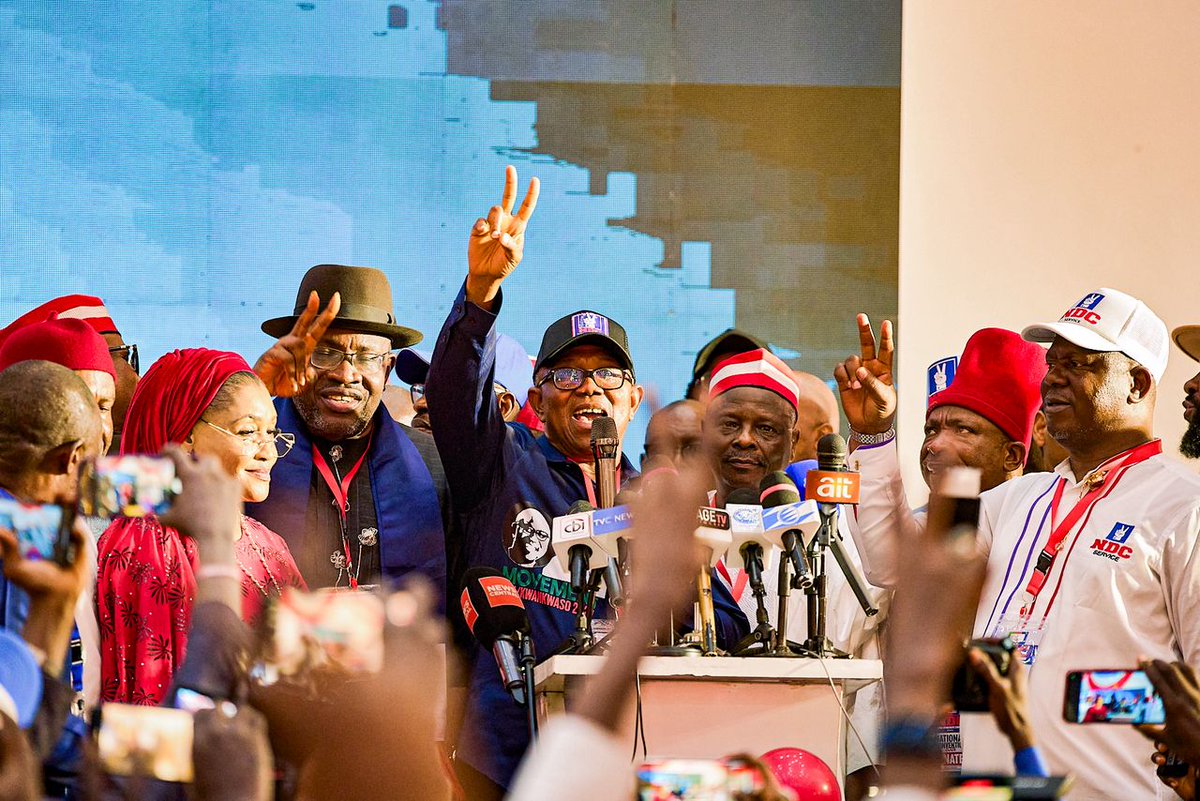
Today, May 9th, I attended the 1st convention of my latest party, the Nigeria Democratic Congress (NDC) in Abuja, Nigeria. The convention was successful and continued to show the resilience of Nigerians to change
I express my sincere appreciation and gratitude to the NDC family, led by the distinguished Senator Henry Seriake Dickson, for inviting us and for the generosity of spirit with which they have accommodated us at this critical moment in our national journey.
I also wish to express profound gratitude to the African Democratic Congress(ADC), particularly Distinguished Senator David Mark, for providing a democratic platform and showing uncommon understanding when the ongoing litigation forced us out of the Labour Party and the New Nigeria People's Party, NNPP respectively. That spirit of solidarity must remain the foundation upon which a better Nigeria will be built.
Today, the most painful aspect of our political existence is that many who once benefited from democratic governance have now become willing accessories to the destruction of democracy itself. Those who once fought for justice now openly celebrate electoral injustice. Those who once spoke against impunity now defend coercion, manipulation, intimidation, and outright political gangsterism, especially against opposition voices. What we are witnessing is not politics; it is a systematic assault on democracy and the will of the people.
Nigeria today stands at a dangerous crossroads. Our democracy is under severe threat. Our nation is drifting without direction, and our people are passing through immense suffering. Across the world, Nigeria is increasingly described as a failing and disgraced nation. This is not the destiny God ordained for our great country. It was not always so, and it must never be allowed to remain so.
Across virtually every recognised indicator of good governance - accountability, political stability, rule of law, control of corruption, government effectiveness, regulatory quality, and the separation of powers - Nigeria continues to record alarming failures. The institutions that should protect the people are weakening daily, while the burden on ordinary citizens grows heavier with each passing moment.
Today, over 140 million Nigerians live in multidimensional poverty. Tens of millions of young people remain unemployed or underemployed. Inflation continues to crush families. Businesses are shutting down. Farmers can no longer safely access their farms. Communities live in fear. In this month alone, hundreds of innocent Nigerians have lost their lives to insecurity, while many others have been kidnapped, displaced, or thrown deeper into poverty.
The most heartbreaking question confronting us is this: Who consoles the grieving mother whose child was abducted on the way to school? Who speaks for the father who can no longer feed his family despite working every day? Who defends the young Nigerian whose dreams have been destroyed by a nation that rewards connections over competence and corruption over character?
Our present tragedy is not accidental. It is the direct consequence of years of deliberate sabotage by a political class that prospers by dividing the people and weakening the nation. Nigeria is not a poor country; rather, we are being looted into poverty. We have abundant human and natural resources, yet we remain trapped in deprivation because leadership has failed to place the common good above personal interest.
Our choice as a people is therefore clear: whether to surrender to despair and national decline, or to summon the courage to rescue our country and rebuild it on the foundations of unity, equity, justice, competence, and productivity.
A lot of people don't realize that the one person who believes in Obi the most is BAT.
He has known Obi for more than 20 years, he is familiar with his unpredictable nature.
He knows that Obi is the only one capable of removing him, regardless of how he postures in public HE IS VERY SCARED.
So much that for more than 4 years now he has dedicated hundreds of millions of naira to stop Obi's emergence.
Bola Ahmed Tinubu believes in Peter Obi more than most Obidients.
Crazy stuff mhen.
Her man decided he no longer wanted to eat her food
She had been complaining a lot about house chores
So the man took her up on it
He bought his own fridge and microwave and placed them in the guest room
He went to work and returned home with takeout that would serve him for dinner and breakfast
He loads them in the fridge
At night, he brought a meal out and microwaved it
The next morning, he brought the other meal out and microwaved it
The wife felt he would soon get tired of it but he didn't
The next week, he brought home a new water dispenser and some plates and cups
He set them up in the guest room
He now had a makeshift kitchen of his own
The wife ignored him
"Let him keep acting like a child," she said
What is so difficult in cooking, supporting me to do the dishes, and cleaning the house
We are both working, and this is supposed to be a partnership
She needed to service her car
Usually, he would do it, but since he started throwing his tantrum, he had locked her out of his life
She called the mechanic and dealt with it herself
The gutters in front of their house were filthy.
He would usually clean them on Saturdays, but he left them
There were grasses around the house that he cut and tidied on Saturdays; he also left them undone
They had a bank account for household upkeep.
She noticed that he funded it with half of what he normally would send into it
They already had a child, and it felt like he only sent the upkeep for the child into the account
He went out early in the morning, returned home by 5 pm daily, and locks himself in the guest room
Whenever she was not at home, he would spend some time with their baby
Whenever she was home, he avoided her and the baby
A month went by, three months went by
He was as defiant as she was
What sort of a man keeps malice like this? she wondered
What sort of man is this immature?
Silent treatment, malice, keeping grudges, does he want me to come and beg him? She wondered aloud
What sort of ego requires this sort of worship?
She reported the matter to their church pastor
The pastor called the husband and invited him to church for a discussion
The husband went to see the pastor
The pastor asked the husband what the issue was
The husband said, "Nothing. He had been enjoying some peace and quiet and would like it to continue for as long as possible."
The pastor asked the wife what had been going on
The wife started from the beginning and spoke on and on and on
"I wake up early, and I have to prepare myself and our child for the day
He will not help me do anything
We both work and keep the home together
Everything should be split right through the middle
We are both providers; we should both wash plates, clean the house, and share everything in common.
The pastor listened and asked the husband to do better.
They got home
Husband moved back into the bedroom
Early the next morning, the husband swept the whole house
Washed the plates and bathed the baby
He also prepared breakfast and packed their lunches
He dressed up and took the baby to the creche
She felt good.
Thank God the pastor spoke to him, and he heard
He repeated it the next day and the day after that
Without complaining
He would do all the house chores, care for the baby, and go to the office
He would return in the evening, prepare dinner, wash the dishes, and care for the baby
Saturday came, he cleaned the surroundings, tidied the gutters, cut the grass, and still tidied up the house, did the dishes, and washed his clothes and those of their child
He was over-efficient, cooks good meals too, and didn't complain or give off any foul air
One day turned into four months
Every time she wanted to sleep with him, he would say he was too tired
They rarely talked because he slept when the baby slept and woke up when the baby woke up every day
She felt like a third wheel in the marriage
He had eliminated all her complaints with determination.
She knew the other shoe would drop eventually and that may be the final nail in the coffin of her marriage
She started feeling uninvolved in her own marriage
She went back to the pastor
Sir, I don't understand what this man is doing
He does not allow me to do anything in the house, and for him or for our baby
When I complain, he will say, "You are a helpmeet, when I need help i will let you know, and I don't want to fight with him on this. Please, sir, help me".
The pastor asked her what time he wakes up.
She said 4:30 AM.
The pastor said, "Wake up at 4.00 AM tomorrow and do the housework. If you leave things like this, your marriage is dead already. We are just waiting for the day of the funeral."
She woke up at 4.00 AM the next morning and began to do the house chores
He woke up at 4:30 AM and looked at her sternly before saying, "I do not want your help. If you insist on doing anything in this house, I will leave this house for you and never return."
She dropped the plate she was washing and went on her knees.
"Please, I am sorry. Let me be your wife. Let me play my part. I know you are doing all this out of hurt, and I felt you would get tired of doing all this. You have kept at it.
Please, please, I am sorry. I won't complain again. I am tired of idleness and being uninvolved. I won't grumble again. I want this marriage to work. Please. Please."
He looked at her and went to the room to pick up their daughter.
While she cleaned, he bathed and dressed their daughter. They had breakfast together and smiled at each other as they left for work. Throughout the day, he texted her, and she replied. She picked up their baby from the creche and met him at home by 5 pm.
The storm is over!
Night came, and she waited for that make-up sex moment. She had so missed him.
It didn't happen.
She tapped him and asked him why he was not touching her
He said he needed some time to wrap his mind around having sex with her again
She softened up and started stroking him
"You are still angry with me. I can feel the resentment. I am sorry. I mean it. I won't take you for granted again or complain that I am just a helpmeet and not the one who was supposed to be doing so much. I am sorry."
Love was made.
He cried afterwards and reminded her of how hard he had been working to ensure that they had a house of their own before he turned thirty-five
He said the trouble she gave him for one year cost him a lot of money, as he had to let go of several opportunities that he would have taken if he didn't have to keep the home himself
She apologised to him again
The next morning, she woke up at 4.00 AM
He didn't move.
She did all the house chores with joy
He woke up, dressed up, and rushed off to the office
She dropped the baby at the creche
He sent his driver to go service her car, he paid off all the bill and sent her more than enough for the monthly upkeep
He was happy, and so was she
She learnt a vital lesson through that episode
When she did the chores as labour, she resented him
When he did the chores all by himself, he resented her
When she started doing the chore as an act of service, she enjoyed it
When she started seeing the benefits of his joy in his care for her, she understood it
PS: Once I do your role, what relevance are you then to me
Once you do my role, what need do I serve to you?
We do not share roles because we cannot both do each other's roles in a marriage
We share roles because it makes us relevant to each other and helps us to complement each other
If we both provide and I take care of masculine tasks while you take care of feminine tasks in the house, we are fine
It is better to be needed than to serve no need
-GSW-
Fellow Nigerians, good morning.
I woke up this morning after my church service with a deeply reflective heart, and despite every constraint, I felt compelled to share these thoughts with you.
Many people do not truly understand the silent pains some of us carry daily—the private struggles, emotional burdens, and quiet battles we face while trying to survive and serve sincerely in difficult circumstances.
We now live in an environment that has become increasingly toxic, where the very system that should protect and create opportunities for decent living often works against the people—a society where intimidation, insecurity, endless scrutiny, and discouragement have become normal.
More painful is when some of those you associate with, believing you would find understanding and solidarity among them, become part of the pressure you face. Some who publicly identify with you privately distance themselves or join in unfair criticism.
We live in a society where humility is mistaken for weakness, respect is seen as a lack of courage, and compassion is treated as foolishness—a system where treating people equally is questioned simply because you refuse to worship status, tribe, class, or power.
Personally, I have never looked down on anyone except to uplift them. I have never used privilege, position, or resources to oppress others, intimidate the weak, or make people feel small. To me, leadership has always been about service, sacrifice, and helping others rise.
Let me state clearly: my decision to leave the ADC is not because our highly respected Chairman, Senator David Mark, treated me badly, nor because my leader and elder brother, Alhaji Atiku Abubakar, or any other respected leaders did anything personally wrong to me. I will continue to respect them.
However, the same Nigerian state and its agents that created unnecessary crises and hostility within the Labour Party that forced me to leave now appear to be finding their way into the ADC, with endless court cases, internal battles, suspicion, and division, instead of focusing on deeper national problems and playing politics built more on control and exclusion than on service and nation-building.
Even within spaces where one labours sincerely, one is sometimes treated like an outsider in one’s own home. You and your team become easy targets for every failure, frustration, or misunderstanding, as though honest contribution has become a favour being tolerated rather than appreciated.
And when you choose to leave so that those you are leaving can have peace, and you step out into the cold, you are still maligned and your character is questioned. Despite all your efforts to continue working for a better Nigeria and engaging people with sincerity and goodwill, those who do not wish you well continue to attack your character and question your intentions.
There are moments I ask God in prayer: Why is doing the right thing often misconstrued as wrongdoing in our country? Why is integrity not valued? Why is the prudent management of resources, especially when invested in critical areas like education and healthcare, wrongly labelled as stinginess? Why are humility and obedience to the rule of law often taken to be weakness rather than discipline?
Let me assure all that I am not desperate to be President, Vice President, or Senate President. I am desperate to see a society that can console a mother whose child has been kidnapped or killed while going to school or work. I am desperate to see a Nigeria where people will not live in IDP camps but in their homes. I am desperate for a country where Nigerian citizens do not go to bed hungry, not knowing where their next meal will come from.
Yet, despite everything, I remain resolute. I firmly believe that Nigeria can still become a country with competent leadership based on justice, compassion, and equal opportunity for all.
A new Nigeria is POssible. -PO
There comes a time when those in government have stolen so much that there is nothing left to steal, and they only want to remain in power to keep themselves out of jail.
Nigeria Is Bleeding From Within
It is deeply troubling to read recent World Bank reports indicating that, while Nigeria’s Federation Revenue surged to ₦84 trillion in just three years, a staggering 41% —amounting to ₦34.44 trillion —never reached the Federation Account. This sum exceeds the combined ₦34 trillion earmarked for capital projects in the 2024 and 2025 Appropriation Bills, a comparison that underscores the gravity of the situation and signals that something is fundamentally wrong.
This is not a mere oversight; it points to institutionalised corruption on a massive scale. In 1994, when the Okigbo Panel reported about $12.4 billion from the Gulf War oil windfall as unaccounted for, Nigerians were outraged and the nation shook with indignation. Today, an even more troubling situation appears to be unfolding, yet it is met with a disquietening silence.
We are trapped in a lethal paradox: Earning more as a nation, yet having less to invest in healthcare, education, and infrastructure. From 2025, systemic “deductions” have allowed agencies to capture more resources than entire states and even critical ministries.
These leakages explain why countries with fewer resources are out-performing us across key development indices. With such a broken system, how can we fix power, strengthen our schools, build resilient healthcare, or develop critical infrastructure?
Nigeria has no business being poor. We must stop these leakages through disciplined, transparent leadership driven by character. It is time to redirect our hijacked resources back to the people and move Nigeria into the league of developed nations.
With our collective resolve to change this corruption-infested system, a New Nigeria is POssible. -PO
Yesterday, we witnessed yet another defining moment in our democratic journey as the ADC convention was held successfully against all odds.
I must respectfully appreciate the leadership of our party, ably led by the Chairman, Distinguished Senator David Mark, whose calm and steady guidance continues to provide direction at critical moments.
My gratitude equally goes to the convention organising committee led by H.E Lyle Imoke, whose diligence, sacrifice, and attention to detail ensured that this convention was not only held, but was successful in every sense of the word.
To our delegates, party faithful, volunteers, and supporters across Nigeria and beyond, I thank you deeply. You have once again demonstrated that democracy thrives when the people refuse to give up on it.
I sincerely thank all Nigerians who, through their resilience and unwavering belief in democracy, made this possible. Your commitment is a reminder that the power of the people remains stronger than forces that seeks to undermine it.
However, now that the convention has come and gone, we must move quickly from celebration to responsibility.
Nigeria is facing very serious challenges, economic hardship, insecurity, unemployment, and a general sense of uncertainty among our people. These issues require urgent attention, clear thinking, and decisive action.
The success of this convention must therefore not end as an event; it must become a renewed commitment to building a nation that works for everyone. We must focus on offering practical solutions, strengthening our institutions, and restoring hope to millions of Nigerians.
The way forward demands unity, sacrifice, and integrity. We must put Nigeria first, above personal interests, above politics, and above all forms of division. If we remain focused and committed, I believe strongly that we can build a new Nigeria that is possible, sustainable, and beneficial to all.
A new Nigeria is POssible! -PO
People are losing it in this country
There was scarcity of buses at my junction this morning and no apparent reason …. In cases like this,private cars can bargain prices and carry passengers
One man came along, put his head out the window and shouted “ If you hate Tinubu more than me enter motor” . About five of us entered.
The man told us how he installed solar despite being on band A, he also has two daughters in university and he offered free ride because he wants us to help him insult Tinubu and Apc
Ahhh, something I do everyday??
We spent the 10 mins ride to my office happily insulting Tinubu .