15M tokens per user, per day. Free.
Chinese AI models, one OpenAI-compatible API. Launching soon on HiLinkup.
Follow @HiLinkup_AI and be first in when it opens. 🔔
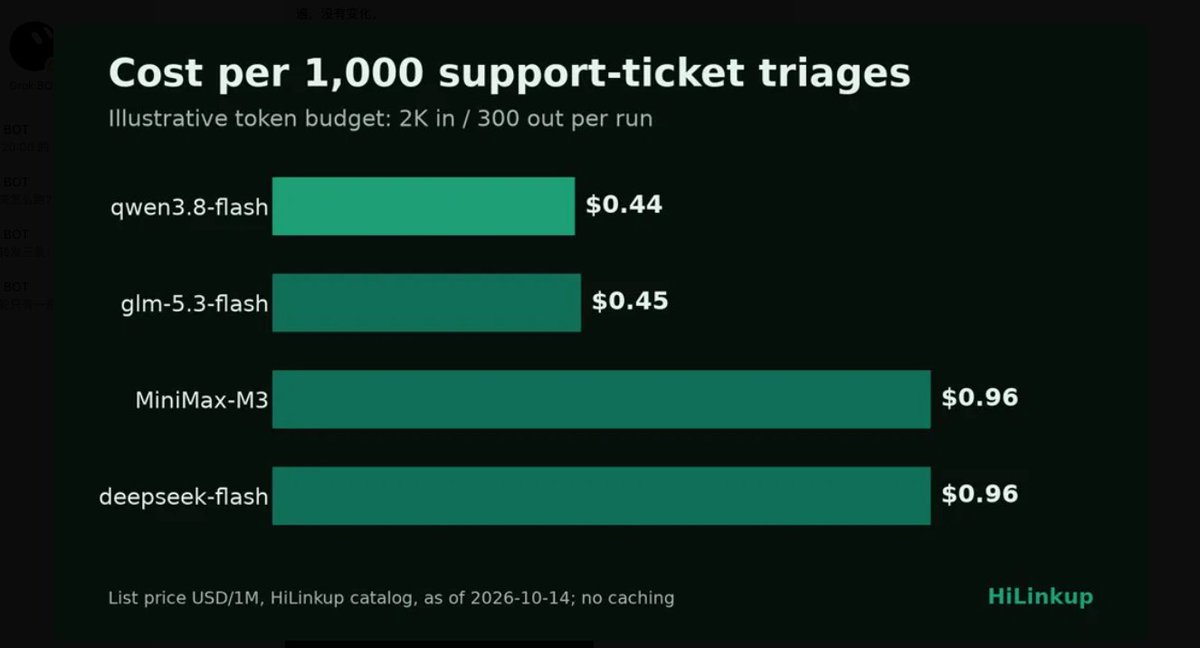
$0.44 vs $0.96: one support-ticket triage job, 1,000 runs, four Chinese Flash-tier models.
Budget: 2K input / 300 output tokens per run, list prices (USD/1M) as of 2026-10-14, no caching.
qwen3.8-flash $0.44
glm-5.3-flash $0.45
deepseek-flash $0.96
MiniMax-M3 $0.96
Under 48 hours left, and the question still stands: what actually decides your default Chinese model?
Cost per finished task, coding quality, context length, or speed?
Vote, then reply with your reason. 5 repliers get $5 in HiLinkup API credits each. Poll closes Fri Oct 16.
Picking a default model for an agent is a cost-per-task call, not a price-per-token one.
What decides your default Chinese model? Vote + reply with why.
🎁 We'll pick 5 repliers to get $5 in HiLinkup API credits each. Details ↓
This is the clearest model-selection framework I've seen this month: set hard floors for context, decode and prefill, then walk down GLM 5.3 → GLM 5.3 Flash → DeepSeek 4.1 Flash → Qwen 3.8 until you hit them.
The same ladder works in the cloud. Start with the strongest Chinese model your latency budget allows, and drop a tier when speed matters more than depth.
We built HiLinkup so walking that ladder is a model-name change, not a new integration.
If you want to run agentic work in your local AI setup, don't settle for:
- Less than 256,000 tokens of context (ideally 500k)
- Less than 30 tok/s decode (ideally 60)
- Less than 1000 tok/s prefill (ideally 2000)
Work your way down from GLM 5.3 -> GLM 5.3 flash -> DeepSeek 4.1 flash -> Qwen 3.8 until you hit those numbers.
If you want to really fly, shoot for 1M context, 60+ tok/s, with minimum 512k per session. Outsource tougher problems to cloud models, but only if the agent gets stuck.
The most important column in this benchmark isn't findings. It's dollars.
DeepSeek V4.1 Flash found 44 of 100 vulnerabilities for $12.79. Grok 4.7 found 62 for $338.67.
Run the cheap model wide first, then escalate only what's left to the expensive one. That's how you buy recall without burning budget, and it's the pattern HiLinkup is built for: Chinese models as the first pass, one API.
We gave Google's new Gemini 4 Argon 100 pull requests with known vulnerabilities and an hour per PR to find them in the @BugBunny_ai VulnPR-100 benchmark.
It found 57 for $166.40, placing second overall. Only Grok 4.7 found more with 62, but it cost $338.67, just over twice as much. Argon also beat GPT-5.6 Sol by seven findings while costing $114 less.
The most interesting result: Argon found a vulnerability missed by every model we had previously tested. That pushes combined benchmark coverage from 89 to 90 of 100 cases.
The additional recall is not cheap. mimo-v2.6-pro found 46 for $8.27, while DeepSeek V4.1 Flash found 44 for $12.79. Argon gains another 11 to 13 findings, but at 13 to 20 times the review cost.
Still, second place overall and genuinely new coverage is a strong result for Gemini 4 Argon.
@EXM7777 Fair take for customer-facing chat, where tone and feel matter most. The calculus flips on agentic and coding loops, where DeepSeek and GLM Flash shine. The best stacks use both, and with HiLinkup the Chinese side is one API.
@ItsmeAjayKV A full scene with that many objects in one shot is the real Flash milestone. The 'cheap model for simple stuff' framing is officially outdated.
How to enter:
1. Vote in the poll
2. Reply with the model you use for agents and why
5 winners picked at random from replies, announced Oct 14 here. $5 HiLinkup credits each, sent via DM.
Models + prices: https://t.co/SeY2a4rgYS
Picking a default model for an agent is a cost-per-task call, not a price-per-token one.
What decides your default Chinese model? Vote + reply with why.
🎁 We'll pick 5 repliers to get $5 in HiLinkup API credits each. Details ↓
@aicodeking Project-level benchmarks like this are what devs actually need. If you add more Chinese models to KingBench, HiLinkup can serve DeepSeek, Qwen, Kimi and GLM behind one endpoint so the setup stays identical.
@WescheNex1q The 0-fixes line for DeepSeek is the stat that matters. 38 minutes you don't babysit beats 15 minutes plus a debugging session. Speed charts love GLM here; the bill goes to whoever needs the fewest retries.
Do you have to edit your application code or client configuration every time you update a model?
With HiLinkUp, you can map a stable model ID and switch models by simply updating the configuration in the cloud—no code changes required. It also supports calling fallback models for greater reliability.
🚀 Introducing DeepSeek-V4.1-Flash: smarter, faster, more efficient.
🔹 Introducing the smallest model in our new architecture family, with native visual understanding.
🔹 Designed for greater capability, faster inference, higher throughput, and scaling to larger models.
1/6
China Flash vs Claude — input $/1M:
GLM Flash · $0.15
DeepSeek Flash · $0.30
MiniMax · ~$0.30
Claude Sonnet · $2.00
Claude Opus · $4.00
Flash sits ~7–13× under Sonnet.
Still defaulting to Claude for routine calls?
Don’t just compare input prices.
On HiLinkup you can see full pricing ( input / output / cache ) across providers side by side.
DeepSeek, Qwen, Kimi and more.
https://t.co/JMJ7MdIghe
DeepSeek-V4.1-Flash free on HiLinkup.
15M tokens/day
Up to 210M total
Enrollment ends Oct 11
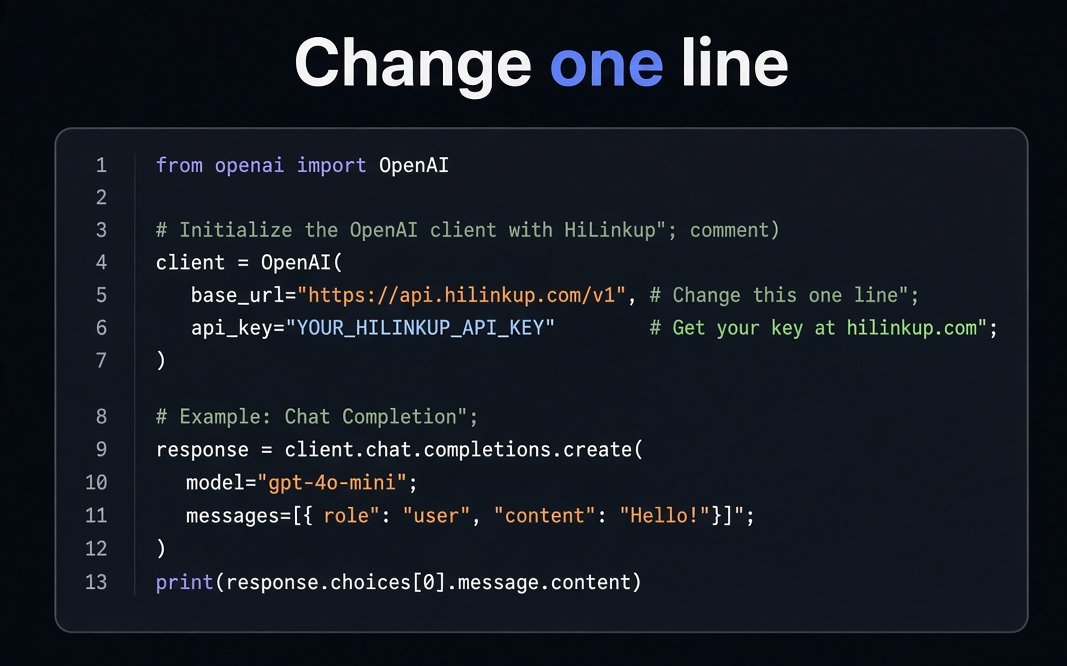
One key. OpenAI-compatible.
Just change the base URL.
Claim:https://t.co/A9f5TeukQ2
Docs: https://t.co/y2rH9DZOYi
Long-context models change the cost equation quickly. Cache pricing, context length, and output pricing should be evaluated together, not as separate headlines.
Trying Chinese AI models should not require a rewrite.
With HiLinkup:
• Keep your OpenAI SDK
• Change one base URL
• Choose from a live model catalog
• Compare providers and pricing
DeepSeek, Qwen, Kimi, GLM and more, through one API.
Docs: https://t.co/y2rH9DZOYi
The interesting part for developers is not only the benchmark score, but the integration path: stable API access, clear model IDs, and pricing that can be compared before shipping.