Interesting choice by @HelloFresh. It wasn’t enough for them to merely celebrate Pride Month, they went the extra mile in associating their food with human assholes, enemas, and shit. Bold strategy.
Unsubscribed.
The reason we think dandelions are weeds is because of a 1950s marketing campaign.
Dandelions, native to Europe and Asia, were brought to North America in the 1600s by European colonists who grew them deliberately.
Every part is edible. The leaves are a salad green, the flowers were made into wine, and the roots were roasted as a coffee substitute and used medicinally for liver and kidney conditions for thousands of years. They were a kitchen-garden staple well into the 1800s.
The shift happened after World War II, when 2,4-D (originally developed for chemical warfare research) was approved as a residential herbicide. Companies like Scotts built the modern lawn-care industry around the idea that a perfect green lawn meant zero broadleaf plants.
Dandelions, being bright yellow and resistant to mowing, became a visible enemy, and the campaign worked. By the 1970s, "dandelion-free" was synonymous with "well-kept."
They aren't native, but they aren't doing significant ecological harm either. The herbicides used to kill them, on the other hand, kill bees, contaminate groundwater, and have been linked to non-Hodgkin lymphoma in humans.
If you hate dandelions, it's most likely due to a marketing campaign that ran before you were born.
🚨WOW!!!
Tim Sparks has confirmed he purchased 80 PIZZA HUTS and brought back EVERYTHING that made them iconic!
Pac-Man is back.
Salad bar is back.
Red cups are back.
Booths for families.
"I want to rebuild places for families to connect and put their phones down..."
🚨 JUST IN — IT’S OFFICIAL: The U.S. Senate has BARRED members from receiving paychecks when the government shuts down
The ONLY useful thing the Senate has done in a long time.
I’m genuinely surprised!
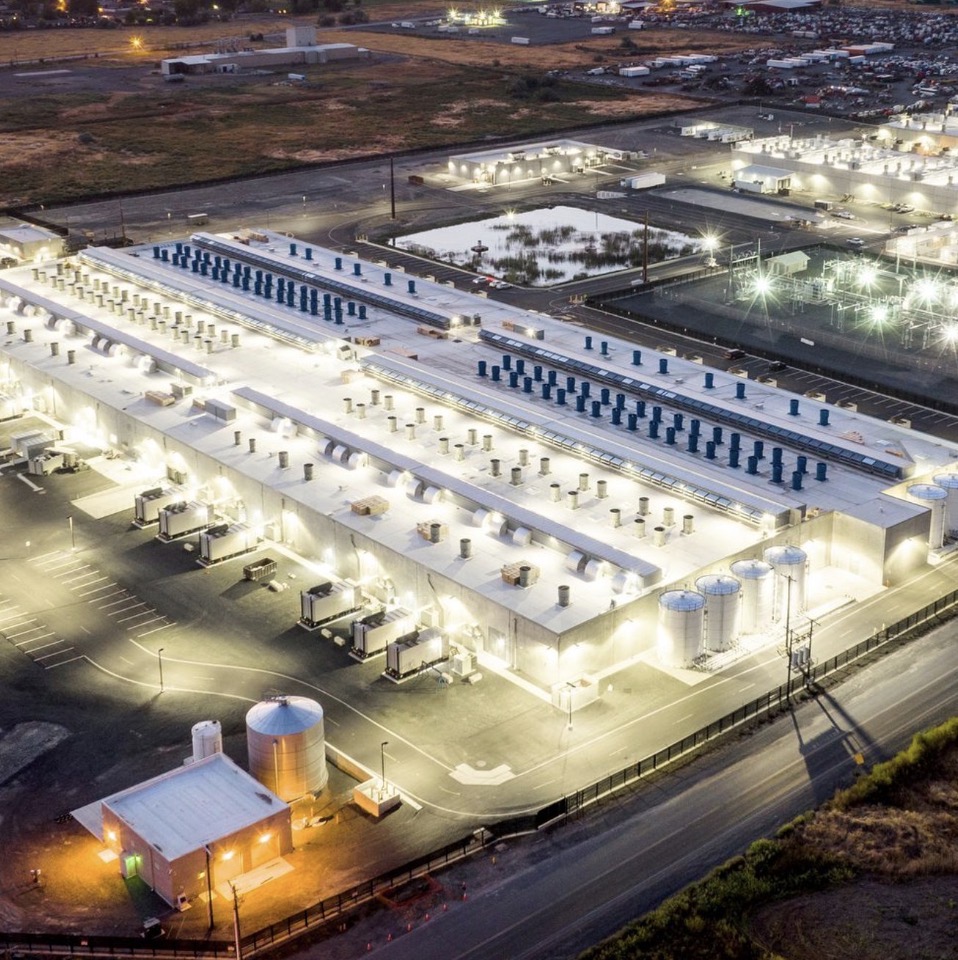
Residents living within a half-mile of new AI data centers are reporting dizziness, nausea, vertigo, and sleep disruption from sound they can't hear.
The source is infrasound. Frequencies below 20 Hz sit beneath the floor of human hearing but not beneath human physiology. The body's vestibular system registers low-frequency vibration directly, triggering the same response as motion sickness. The cooling systems and gas turbines running these facilities 24/7 produce exactly this range.
Noise ordinances were written for audible noise. Decibel measurements start at 20 Hz. Infrasound doesn't appear. A 200-megawatt data center with tens of thousands of tons of cooling equipment can run around the clock with zero measurable noise violation under any existing zoning law in the country.
The developers know this.
They're not randomly selecting sites. Rural jurisdictions get targeted because they lack the legal staff, the engineering expertise, and the regulatory framework to mount any challenge. These facilities require new transmission interconnects that take 5 to 10 years to process through utilities. Building behind-the-meter with gas turbines bypasses that queue. Speed to power, zero delay, zero grid dependency.
Households who bought before the announcement have two options. Sell at a price no buyer will pay, or stay and live with symptoms their family doctor has no framework to diagnose as infrastructure-related.
That cost never appears in a hyperscaler's earnings call.
The regulation will catch up eventually. It always does. But the facilities will already be running. The permits will grandfather everything in place.
The turbines don't stop when the legal framework finally notices them.
This MRI study on young kids just exposed something terrifying:
They scanned the brains of 60 children aged 3–5 — including 5-year-old Rose — and found interactive screen time is causing measurable loss of white matter in their developing brains. Even just 2 hours a day is linked to impaired neural connectivity, language, and literacy development.
Professor Mike Nagel (neuroscientist and father) said his first reaction was simply: “Wow… I was not anticipating seeing anything like that.”
We’re physically changing children’s brains before they even start school — and the damage is visible on scans.
This one actually unsettled me. I’ve always suspected too much screen time was bad, but seeing real white matter loss in toddlers hits different.
Parents of little ones — has this kind of research changed how much screen time you allow?
The popular Kellogg’s Nutri-Grain Strawberry Soft Baked Breakfast Bars sold in America contain the same chemical used in wallpaper glue
- Nutri-Grain bars use Methylcellulose (wallpaper glue) as thickener/stabilizer
- One bar has 40 different ingredients
- The strawberry filling isn’t strawberries, it’s refined glucose and then artificially colored
- Hexane-stripped oil is used. The soybean oil is processed with hexane (a solvent) in industrial extraction
- Chemical gums are used for a long shelf life
The FDA is completely worthless
Our food is a science experiment
In 19 days, a jury in Oakland is going to decide whether the entire legal foundation of the AI industry is built on fraud.
Everyone thinks the Musk vs Altman lawsuit is a billionaire grudge match.
Two egos, one grudge, a $150 billion damages number designed for headlines.
Easy to dismiss. Easy to scroll past.
That's exactly what Altman wants you to think.
Because what's actually on trial on April 27 is something much BIGGER than Elon's hurt feelings...
A jury is going to decide whether you can legally take billions of dollars in nonprofit donations, use them to build the most valuable technology in human history, and then quietly convert that nonprofit into a for-profit company worth $850 billion.
If the answer is no, the entire AI industry has a problem.
Because OpenAI is not the only company that did this:
Anthropic was founded by OpenAI defectors using the same nonprofit-first mission language.
xAI pitches itself as building AI "for humanity."
Every frontier lab has used the moral cover of "we're doing this for the good of the world" to attract talent, capital, and regulatory goodwill they would have never gotten otherwise.
An Elon win doesn't just touch OpenAI. It creates a legal precedent that every AI company built on a nonprofit or public benefit promise becomes vulnerable to shareholder and donor clawback suits.
That's why this case matters. And that's why Altman is panicking.
Just look at what he did this week:
Elon filed a motion demanding the court remove Altman and Brockman from their roles and FORCE OpenAI to return to its nonprofit origins.
Then he amended the suit to say if he wins the $150 billion, all of it goes to OpenAI's charity arm. Not him. Zero dollars to Elon personally.
That amendment was surgical. It stripped Altman of his entire public defense.
He can no longer claim this is about Elon's ego or Elon's bank account. Elon is now legally on record saying he just wants the mission back.
OpenAI's response was to panic-write a letter to the California and Delaware attorneys general asking them to investigate Elon for "anti-competitive behavior." Their strategy chief publicly accused Elon of coordinating attacks with Mark Zuckerberg.
They called the lawsuit "harassment driven by ego and jealousy."
That's NOT the response of a company that thinks it's going to win.
Real companies with real defenses don't ask the government to silence the person suing them 3 weeks before trial. They let the evidence speak.
OpenAI is scrambling because they know what's in discovery.
Elon's team has been building this case for two years. Emails, board minutes, internal conversations about the conversion.
The kind of paper trail that juries understand and executives can't explain away.
And the timing couldn't be worse...
OpenAI is trying to IPO at $852 billion. They just raised $122 billion. Microsoft has $135 billion of exposure to them.
A jury verdict that even partially sides with Elon in late April or May would crater the entire IPO runway and send shockwaves through every major AI investor on Earth.
This is why Altman spent the last 2 weeks doing press tours and policy blueprints and "super intelligence agendas" aimed at Washington. He's trying to REFRAME himself as the responsible statesman of AI right before a jury decides if he's a con artist.
Most people will watch this trial start and think it's celebrity drama.
The smart money is watching it and realizing that the legal foundation of the AI boom is about to be tested in court for the first time EVER.
And if that foundation cracks, everything built on top of it is at risk.
June 1983. A 28-year-old Steve Jobs walks into a design conference in Aspen, Colorado. He asks the room who owns a personal computer. Nobody raises their hand. He says “Uh-oh.”
Then he spends the next 55 minutes describing the next four decades of technology.
Jobs told the audience Apple’s strategy was to “put an incredibly great computer in a book that you can carry around with you, that you can learn how to use in 20 minutes… with a radio link in it so you don’t have to hook up to anything.” That’s an iPhone. In 1983. The Mac hadn’t even shipped yet.
He described an MIT project that sent a camera truck down every street in Aspen, photographed every intersection, and built a virtual walkthrough on a computer screen. Google Street View launched 24 years later. He said office networking was about 5 years away and home networking 10 to 15 years out. The web went mainstream in the mid-90s, about 12 years later. Dead on.
He described software being sent electronically over phone lines, with free previews and credit card payment. That’s the App Store, 25 years before it launched. He even compared it to the music industry and said software needed “the equivalent of a radio station” for free sampling. Apple built the iTunes Music Store 20 years later.
The AI prediction is the one that hits different now. Near the end, Jobs talked about machines that could capture a person’s “underlying spirit” or “way of looking at the world,” so that after they died, you could ask the machine questions and maybe get answers. He said 50 to 100 years. ChatGPT arrived in about 40.
The weird part is this speech was lost for nearly 30 years. The full hour-long recording only surfaced in 2012 when a blogger got a cassette tape from someone who attended the original conference. The Steve Jobs Archive didn’t release actual video footage until July 2024.
His timelines were consistently too fast. He wanted the “computer in a book” within the 1980s. Apple’s first attempt was the Macintosh Portable in 1989, which weighed 16 pounds and cost $6,500. The iPad arrived in 2010, 27 years late. He guessed voice recognition was about a decade away. Siri launched in 2011, nearly 30 years later. The vision was right every time. The clock was wrong every time.
Apple was doing about $1 billion a year in revenue when Jobs gave this talk, with under 5,000 employees. Today it’s worth $3.7 trillion.
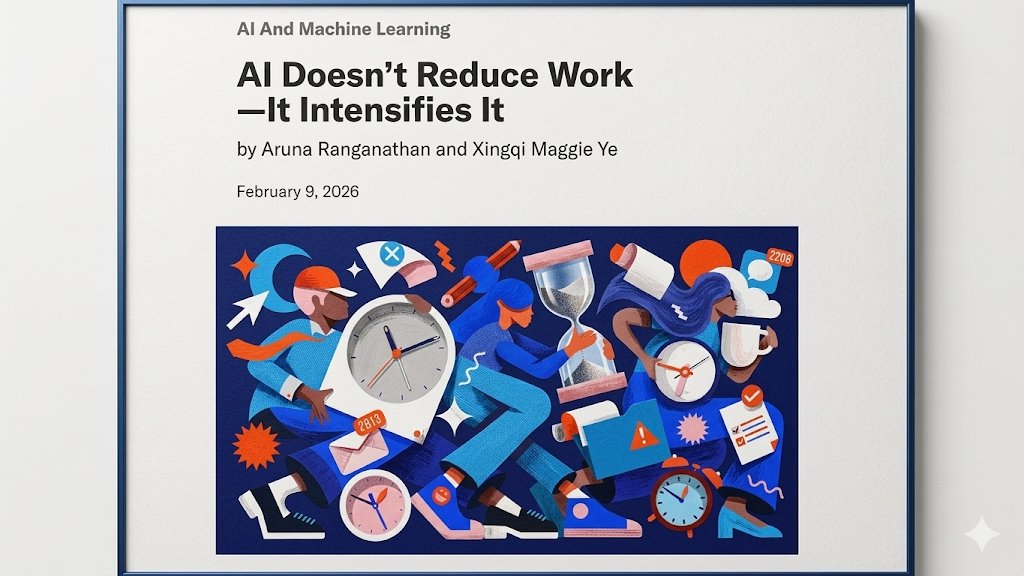
🚨BREAKING: Berkeley researchers spent 8 months inside a tech company watching how employees actually use AI.
The promise was simple: AI will save you time. Do less. Work smarter.
The opposite happened.
Workers didn't use AI to finish early and go home. They used it to take on more. More tasks. More projects. More hours. Nobody asked them to. They did it to themselves.
The researchers sat inside the company two days a week for 8 months. They watched 200 employees in real time. They tracked work channels. They conducted 40+ interviews across engineering, product, design, and operations.
Here's what they found. AI made everything feel faster, so people filled every gap. They sent prompts during lunch. Before meetings. Late at night. The natural stopping points in the workday disappeared. People ran multiple AI agents in the background while writing code, drafting documents, and sitting in meetings simultaneously.
It felt like momentum. It felt productive. But when they stepped back, they described feeling stretched, busier, and completely unable to disconnect.
83% said AI increased their workload. Not decreased. Increased.
62% of associates and 61% of entry-level workers reported burnout. Only 38% of executives felt the same strain. The people doing the actual work absorbed the damage while leadership celebrated the productivity numbers.
Then came the trap nobody saw coming. When one person uses AI to take on extra work, everyone else feels like they're falling behind. So the whole team speeds up. Nobody formally raises expectations. But the new pace quietly becomes the default. What AI made possible became what was expected.
The researchers gave it a name: workload creep. It looks like productivity at first. Then it becomes the new baseline. Then it becomes burnout.
AI was supposed to give you your time back. Instead it's eating more of it. And the worst part? You're doing it to yourself. Voluntarily.
This guy’s vow after learning about polyester is spreading fast for good reason:
“I will never let my little girl wear polyester again — and after hearing why, you might not either.”
In 65 seconds he explains the process:
Polyester is plastic — made from crude oil or recycled bottles, melted at high heat, extruded into threads through spinnerets, stretched, and coated with synthetic dyes, phthalates, BPA, antimony, and chemical treatments.
The problem:
Plastic fibers shed microplastics and nanoplastics that absorb through your skin — especially when you sweat (sports bras, activewear, leggings).
These carry endocrine-disrupting chemicals linked to hormone imbalance, fertility issues, and long-term accumulation in organs, blood, and brain.
His wake-up call:
What you wear against your skin is absorbed by your body.
Polyester clothing = wearing plastic all day.
How much of your current wardrobe is polyester?
Drop the percentage below — are you planning to make a change after this?
i watched a flight go from $483 to $547 in 24 hours WITHOUT a single seat selling
searched london to new york on a tuesday
$483
checked again 2 hours later
$512
next morning: $547
panicked and booked it
the guy sitting next to me paid $391
same seat, date + airline
$156 less
he searched once i searched 3 times
the algorithm saw me come back and charged me until i broke
the seat doesnt have a price
you have a price
and it goes up EVERY time you show interest
couldnt stop thinking about it so i tracked down someone who actually built pricing algorithms for a european carrier
asked him what happened to me
"you got profiled. the system assigned you an intent score after your second search and raised your ceiling every time you came back"
asked how to beat it
"most people think a VPN fixes it. thats 2015 advice. the algorithm fingerprints more than your IP now. it reads your device your browser your screen resolution your timezone. VPN to bucharest but your clock says london and your language is english? the algo knows youre faking and sometimes charges you more for trying"
"so what actually works?"
"you have to poison the entire profile. not just the location. the identity"
the protocol he gave me:
VPN AND match your timezone and language to the spoofed location. mismatched signals flag you and can trigger a price increase
use a fully clean browser. no history no saved passwords no google account. the algorithm fingerprints your session not just your cookies
one search one booking. the intent score activates on the second search. there is no safe way to look twice
book tuesday or wednesday 1-5am. lowest traffic means the least demand data for the algorithm to inflate against
if the price already spiked go dark for 72 hours minimum. not 24. the intent score on most carriers decays on a 3 day cycle. come back on a different device from a different network
"we spent $4 billion building these systems. theyre not going to lose to someone who opened an incognito tab"
$900 billion industry
the gap between what you pay and what the person next to you pays is not a bug
its the entire business model
stop letting an algorithm charge you for being predictable