Important point: patients are not voluntarily hyperventilating or breathing abnormally. Patients have dysfunctional breathing and hyperventilation BECAUSE of cardiac preload failure and cerebral hypoperfusion.
#MECFS#POTS#LongCOVID#Dysautonomia
When some of us noticed that our patients with severe #POTS get better, and even much better on #IVIG, others have countered with, "So now we should be putting everyone with POTS on IVIG, an expensive blood product?" Of course not! It's not going to be for everyone, but everyone who needs to try IVIG SHOULD have ACCESS to a trial. I had a patient today who tried it for 6 months, it helped a little, but not enough to continue. This is how it should be: our patients should not be excluded from trying life-changing medications. Our patients with #dysautonomia, #MECFS and #LongCOVID are as worthy of a trial as patients with CIDP, myasthenia, immunodeficiencies and autoimmune disorders. Yet because there is in no FDA-approval, our patients have very limited or no access to try these therapies. This is not only unfair, but also unscientific.
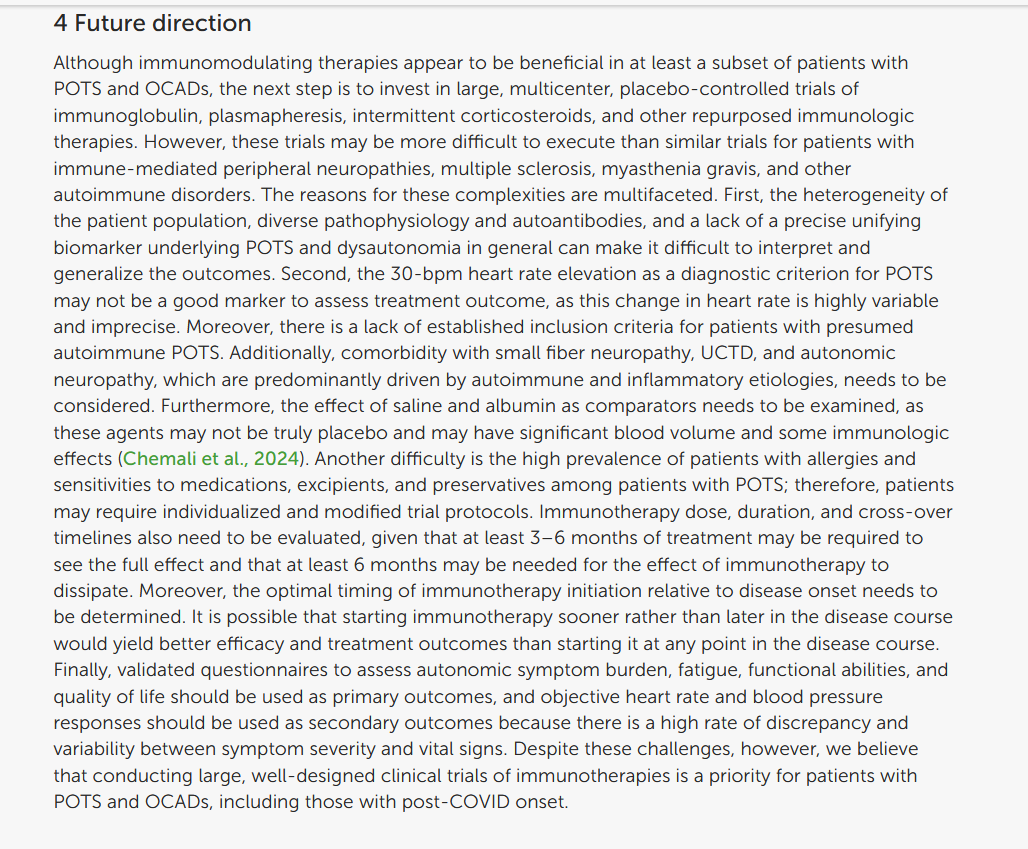
You and your doctor should be able to decide whether to try a potentially life-altering therapy: it should not be your insurance company or scientists who haven't seen a POTS patient in their career. We need Pharma to get on board with us: we can't have small biased trials that are set up to fail to direct FDA decision-making. Yes, I said it: don't waste our time and resources and our patients' time and resources on trials that are badly designed and ill-advised. Read the Future Direction section in this paper where I discuss what really needs to happen for successful clinical trials of immunotherapies and their FDA approval for conditions that our patients have.
#MedTwitter #BrainHealth #therapy #Neurology #Cardiology #Rheumatology
https://t.co/E7UoDEQ3rv
I saw a video the other day that hit me really hard. It said something to the effect of:
“My spouse will only ever know the sick version of me. My kids will grow up with a sick mom. Any new friends I meet will only know the sick me…”
And tbh it kinda restarted my grief. I had a solid day of just sobbing and grieving that day. For me chronic illness grief usually looks like grief—acceptance—grief—acceptance. It’s just a never-ending cycle because there’s always new things to grieve.
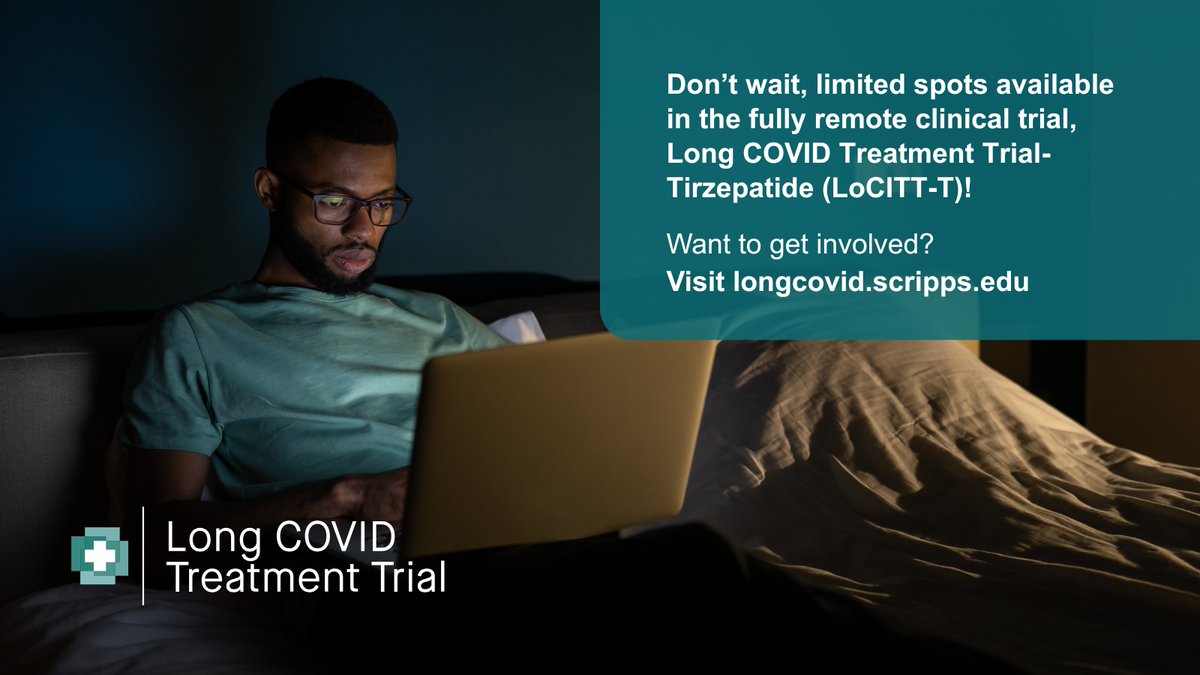
New #LongCovid clinical trial launched!!
Really excited about this for a bunch of reasons:
a) it's fully remote (you can do it at home!)
b) it's large (1000 participants!)
c) it's accessible to the most severe (even those who can't verbally speak)
https://t.co/QX0p0VEqYB 1/
With all that talk about PEM i want to share a story about my experience with it.
For background; my trigger event was in 2005 when i was 12 years old. I managed to go to school fulltime until the last year of highschool. Then i managed half days.
I'm glad to see @BuzzFeed running educational content about tick- and vector-borne illness like #lyme, but I must disagree with Dr Shapiro, who is quoted in this article, that an infected tick *has* to be on for 24-36 hrs to transmit Lyme Disease. The
1/
https://t.co/SCPUd6W2aa
Dr. Amy Proal last week: “When people get an infection, there’s a huge assumption that it just clears after their symptoms go away… Little amounts of the pathogen [can persist] in parts of your tissue, parts of your nerves—where they can still drive inflammation and directly hijack the functioning of your mitochondria.”
New research shows SARS-CoV-2 infection particles can persist in semen for up to 8 months after infection, raising critical questions about viral reservoirs and potential sexual transmission. The virus remained detectable in over half the study participants and was confirmed as infectious through cell culture. While decreased sperm quality showed signs of recovery by 6 months, the implications of viral persistence in the male genital tract remain under investigation.
This study adds to growing evidence that the male reproductive system may serve as an immune privileged site for virus reservoirs, similar to findings in Post-Ebola Syndrome.
Click below to sign up for our email list to receive updates about the latest research.
✍️: https://t.co/04IM5EJHYV
#LongCOVID #ChronicFatigue #PostCOVID #rthm_health #LongCOVIDResearch #IACC #ViralPersistence #COVID19
🚨 Excited to share our new paper on neuropsychiatric disorders in #MCAS. There are many interesting findings here, but the most striking is:
📢 The most common comorbidity of MCAS was #POTS occurring in 50% of female patients and 16% of male patients.
https://t.co/AxdUtux3YZ
In response to my question 'What do you see as the most promising medications for neuro-inflammation in ME'? @drclairetaylor wrote a brilliant thread
Unfortunately the order was all scrambled, so with the help of ChatGPT have tried to put it in the correct order!
🧵1/n
In honor of #PrideMonth2025, I just wanted to take a moment to discuss the crucial role of intersectionality, gender and inclusion in research, specifically as it relates to our research involving #LongCOVID, #MECFS, chronic #lyme and other complex chronic illnesses. As we 1/
People act like we’re supposed to know how to handle chronic illness. Like there’s a script.
There isn’t. You get sick and suddenly your life is completely changed.
Future plans are gone.
Career path becomes uncertain.
Relationships become strained
Yet somehow we’re supposed to know how to act. To show up. To smile.
We’re expected to act like our world didn’t fall apart and just carry on.
We are so excited about our clinical trial of low dose rapamycin for people with #LongCOVID. Understanding the mechanisms behind WHO this helps and WHY is crucial for establishing safe and effective treatments for people with LC and ultimately other complex chronic illnesses. 🙏
From a meta-analysis of over 4 million COVID survivors, "The prevalence rates for the different symptoms were as follows:
- fatigue 43.3%;
- memory disorders 27.8%;
- cognitive impairment 27.1%;
- sleep disorders 24.4%;
- concentration impairment 23.8%;
- headache 20.3%;
- dizziness 16%;
- stress 15.9%;
- depression 14.0%;
- anxiety 13.2%; and
- migraine 13%..
[In conclusion,] Neurological symptoms are common and persistent in COVID-19 survivors."
Everyone will soon forget this information also.
'Long-term neurological and cognitive impact of COVID-19: a systematic review and meta-analysis in over 4 million patients'
https://t.co/cbwCHCtxJJ.
If you are a patient that meets #ME/CFS and #PEM criteria, info on the specific #infections or exposures that led to onset or exacerbation of your symptoms is of major importance. That info will help you pursue personalized treatment.
A personal story about how the potential grant funding freeze might affect science. Right now, I'm in my fourth year of a 5-year NIH grant and my last year of funding is supposed to start February 1st. I'm supporting a postdoc, two graduate students, and two lab managers
We are excited to announce an $800,000 donation to Mount Sinai to support a clinical trial of the drug rapamycin in patients with long COVID. The trial will be conducted at CoRE: a clinic directed by Dr. David Putrino and PolyBio's Dr. Amy Proal:
https://t.co/oAcPFtyne8
I could not be more excited to be looking into the role of low-dose, weekly rapamycin to treat #LongCOVID. Hugely grateful to @polybioRF for their faith in us to get this exciting trial done right in collab with @VirusesImmunity and others. Looking to begin recruitment Q1 2025 🙏🏻
@ThePOTSPostman Yes. Never had issues before I got sick. Even half a drink of any alcohol within 30-45min will make me tachy (like 150 just standing to wash my hands) and give me a rash on my face, arms, back and chest. Thus I haven’t had a drink in years.
“The American Medical Association’s top journal, JAMA, in August published a key new study and editorial about pediatric #LongCovid. The editorial cites several robust analyses and concludes that.. LC symptoms appear to occur after about 10-20% of pediatric infections.”