Cassino físico é proibido no Brasil há 80 anos. Mas liberaram algo muito pior: o cassino de bolso gamificado. Todo atrito que protegia o apostador sumiu. Não precisa sair de casa, não precisa sacar dinheiro, não tem hora pra fechar. Na bet, a mesa vai com você: pro banheiro, pra cama, pro trabalho, pro velório. Aposta em 1 clique, notificação às 3h da manhã, bônus pra você "recuperar o que perdeu". Proibimos a roleta e colocamos algo pior na mão de cada brasileiro.
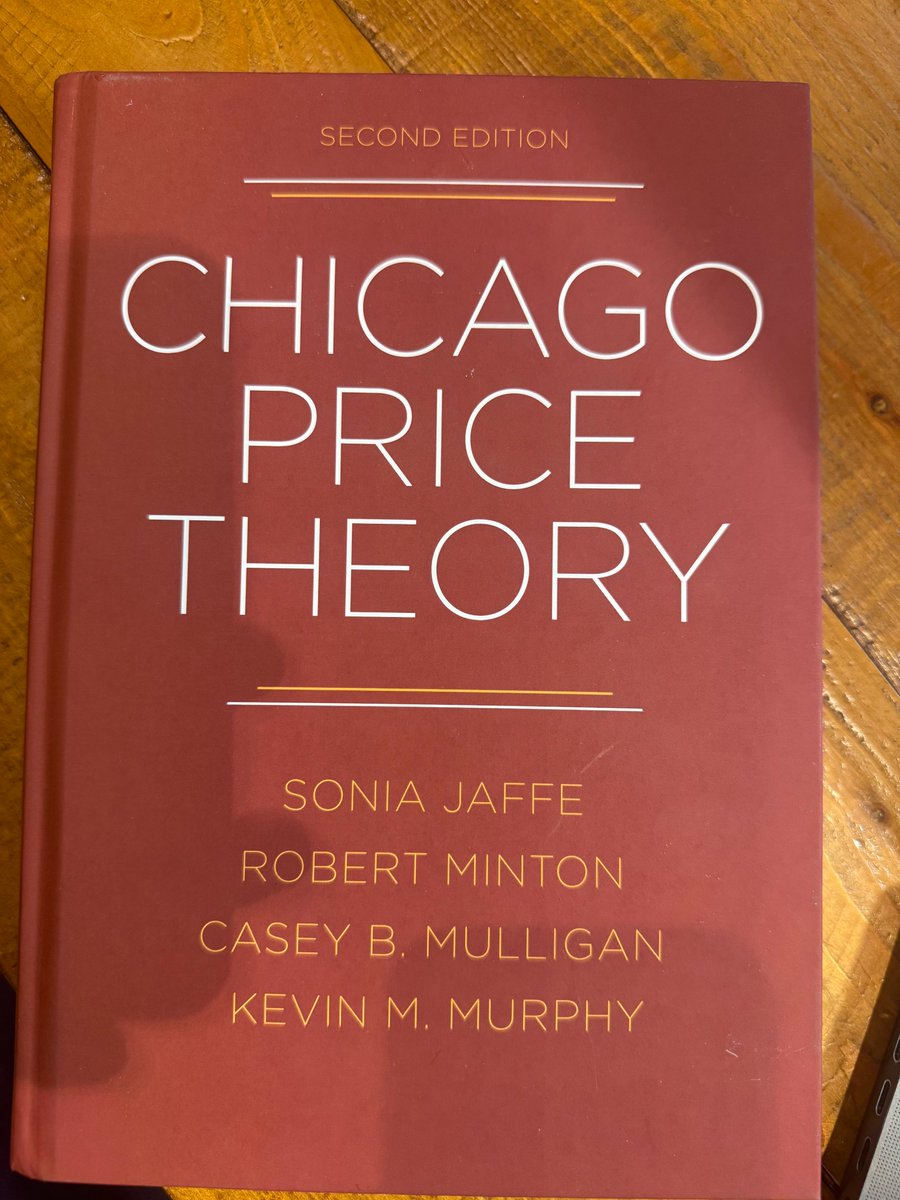
Just delivered at home.
More importantly, in a world with powerful LLMs, the relative importance of understanding economics (as opposed to being able to complete a proof) just went up considerably. An LLM can solve a fixed-point problem faster than most of us. What it cannot do is look at a policy proposal and see the second-order effect, the incidence shift, or the margin that adjusts. That is price theory. No amount of computation will give it to you.
Becker knew this fifty years ago: the power of economics was never in the math. The math was always the servant. The power was in thinking clearly about trade-offs, incentives, relative prices, and equilibrium. LLMs just made the servant very cheap. That makes the master more valuable, not less.
P.D. One still needs to know the math. I am only claiming its relative price changed!
1/n) New working paper: “The empirically inscrutable climate-economy relationship”, with @matthewgburgess.
We argue that it is not possible to reliably estimate economic climate damages from historical data.
Link below.
🧵
1/) Thanks to my fantastic co-author for posting this. Let me elaborate on one of the challenges Jesús mentions in his post.
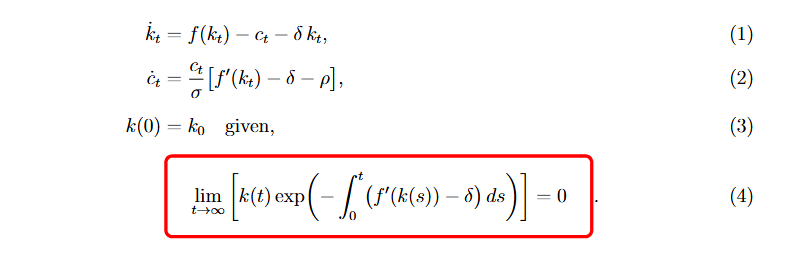
After grad school in (theoretical-ish) physics, I switched to economics. The first thing in macro that puzzled me was the Ramsey–Cass–Koopmans model.
A point that is sometimes overlooked is that PDEs in physics and economics have a subtle but important difference.
When a physicist solves the Schrödinger equation (see my slide below), the potential is given. The coefficients of the equation are part of the problem statement. You pick your grid, refine your mesh, and the equation never changes on you. Better numerics give a better approximation to a fixed target.
In economics, this is not the case. Look at the Hamilton-Jacobi-Bellman equation for the neoclassical growth model (also slide below). The drift of capital depends on a derivative of the value function, the very object you are trying to solve for. The “coefficients” of the PDE are endogenous to the optimal choices of the agents. This is what @UncertainLars and Sargent referred to as the cross-equation restrictions implied by optimizing behavior.
This is what @MahdiKahou and I call the “equilibrium loop”: improving your approximation changes the policy, which changes the dynamics, which changes where in the state space the economy spends its time, which changes where your approximation needs to be accurate. You are not chasing a fixed target with a better net. Moving the net moves the target.
This has serious consequences for computation. You cannot just borrow neural network architectures from deep learning in the natural sciences. The loss function comes from equilibrium conditions, not from labeled data. The evaluation points are not given. Instead, they are regenerated each epoch from the current approximation. Ignoring it is why you often get solutions that look good on a training set but fall apart in simulation.
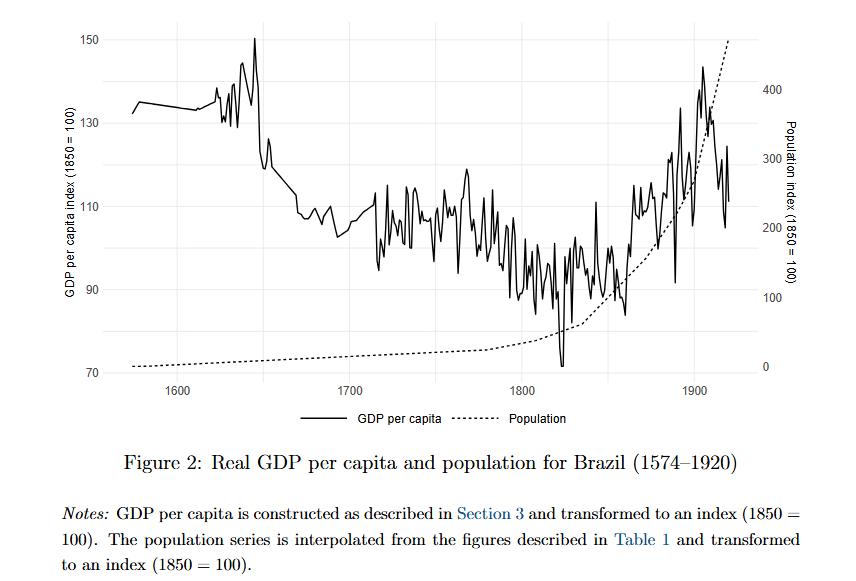
📢New paper: 𝐇𝐨𝐰 𝐚 𝐧𝐚𝐭𝐢𝐨𝐧 𝐰𝐚𝐬 𝐛𝐨𝐫𝐧: 𝐁𝐫𝐚𝐳𝐢𝐥𝐢𝐚𝐧 𝐞𝐜𝐨𝐧𝐨𝐦𝐢𝐜 𝐠𝐫𝐨𝐰𝐭𝐡, 𝟏𝟓𝟕𝟒–𝟏𝟗𝟐𝟎.
Joint with @glambais.
We built the first long-run GDP per capita series for Brazil, using 30,000+ archival price and wage observations across major regions🧵
Research involves two steps: 1) doing things, and 2) figuring out what to do. (Usually in the reverse order.) AI will certainly be quite helpful for the 'doing' part. But that leaves the -- arguably harder -- 'figuring out what to do' part.
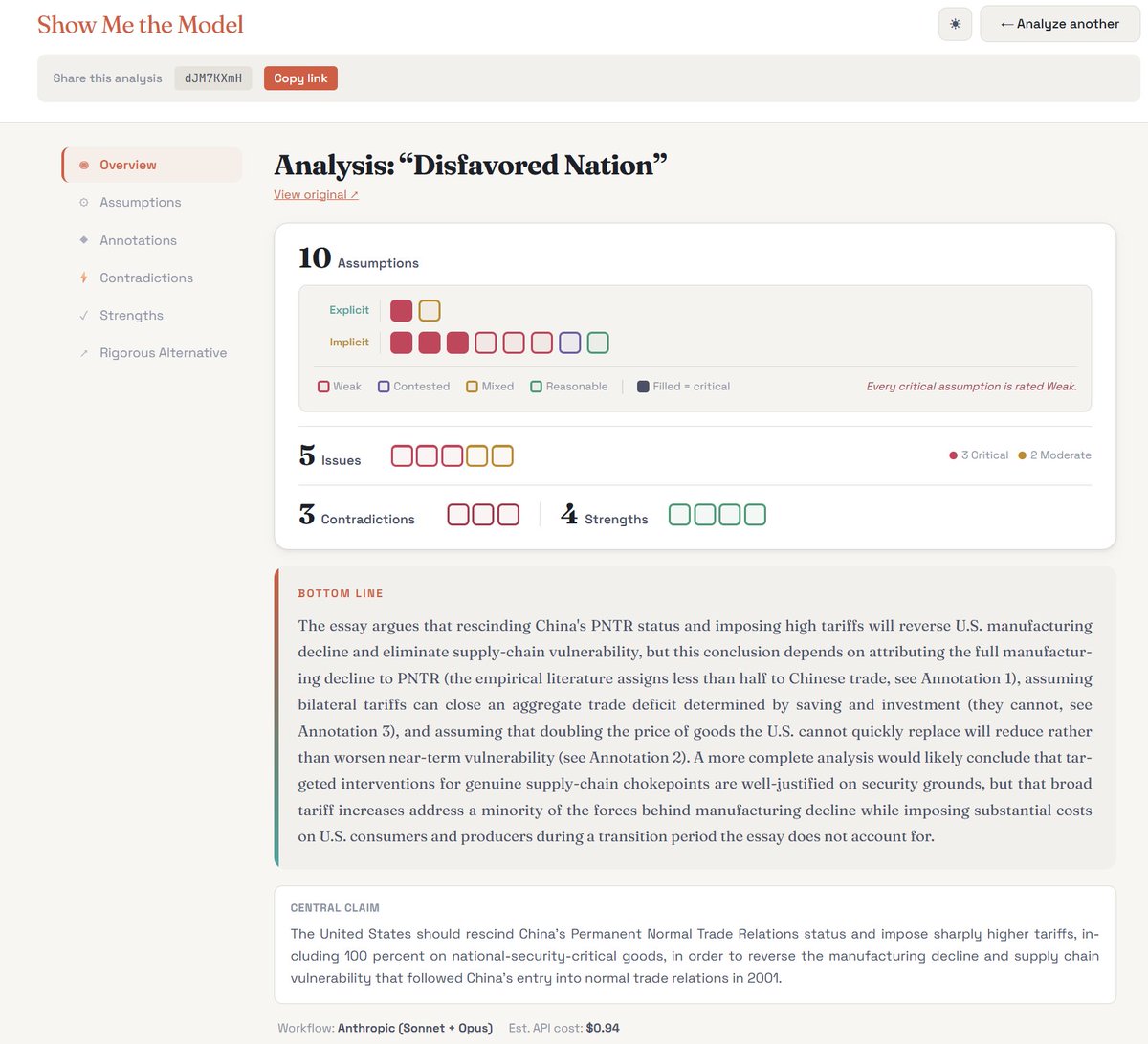
I spend way too much time on social media debunking "economic slop" promulgated by lawyers pretending to be economists, so I built Show Me the Model: a tool that uses AI to check whether the economic reasoning in an essay actually holds up.
https://t.co/cfhWs6MI27
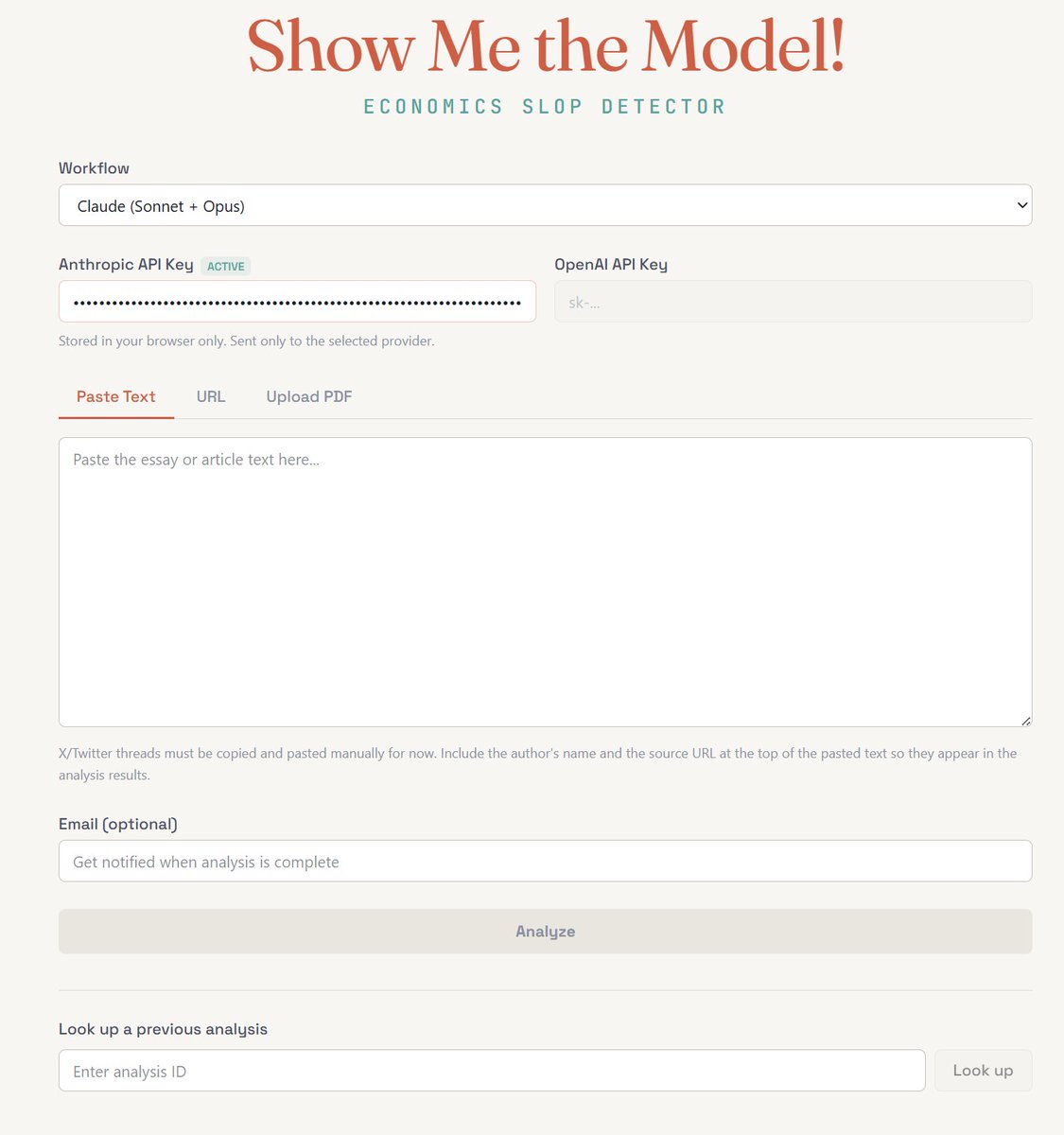
Give it a URL or paste some plain text, and the tool flags hidden assumptions, internal inconsistencies, and other problem areas, and tells you how a real economist would think through the issue.
Right now, it has 4 "personas:" macro, trade, IO/price theory, and labor. The tool first figures out which persona is right for the job, and then uses a parallelized prompt scaffold specific to that persona to process the source text.
Here are some example outputs based on some essays that triggered me hard:
Citrini Research's viral essay on how AI could trigger a self-reinforcing financial crisis rivaling the GFC:
https://t.co/ZNUFHqyEFT
American Compass on the harms of trade deficits:
https://t.co/Nasfvr36iY
@oren_cass on why Built-to-Rent should be banned:
https://t.co/niie7bVRoK
American Compass on the "China Shock:"
https://t.co/nZvoEaTdTv
@michaelxpettis on why China's trade surplus reduces global output:
https://t.co/LqocDslRrH
Try it yourself at https://t.co/cfhWs6MI27. You'll need to bring your own API key (OpenAI or Anthropic), and a typical analysis costs $0.50–$1.50.
It's super preliminary and will probably break on you. I'd love feedback about both the functionality as well as the quality of the output.
AI journal articles are a bigger risk to the career evaluation process than they are to the research process.
AI can produce articles comparable to those in many decent journals, but most of these articles are not that good—neither the AI ones nor those in journals.
In the post, @causalinf uses Claude to write a shift-share paper. Regrettably, the publication success of shift-share papers far exceeds their real-world accuracy or reliability.
There is a whole class of methods like this, which are good for careers because they reliably produce good t-statistics and nice stories for editors and referees—e.g. distance IVs, poorly identified structural models, diff-in-diff with few time periods, etc.
[hans_unpopular_opinion.gif]
It's not universally true, but for the most part, the class of papers that AI can rapidly reproduce were not adding all that much social value in the first place.
Flip through recent editions of the top econ journals and find the articles that you think are really correct and important. Very very few of those are in the category of "AI could have written this." Instead, they are good original ideas, creative (and often difficult) data collection, original solutions to real problems.
Maybe someday AI will produce these as well, but right now it's not even close. AI articles are mainly exposing the fact that a whole lot of econ research is formulaic and not that informative about the world.
Original work that says something new and important about the world will continue to stand out, at least for the time being. Maybe the AI slopcopalypse will force more researchers to do work with lasting value.
🚨 Forthcoming in Econometrica!
How does trade liberalization affect developing countries with large informal sectors?
Informality fundamentally changes how we think about the gains from trade. (1/5)
⚠️ O protecionismo no Brasil não é política baseada em evidências.
É uma loteria disfarçada de estratégia de desenvolvimento — e quem paga o preço é o país inteiro.
👉 Minha coluna no @valoreconomico:
https://t.co/zqhLz7lvJs
#Brasil#Economia#Protecionismo#Desenvolvimento
Very excited to see my first (and I expect, not last) paper w @ZiYangKang out in print.
Thread👇on what this paper is about + why I hope lots of folks will use it.
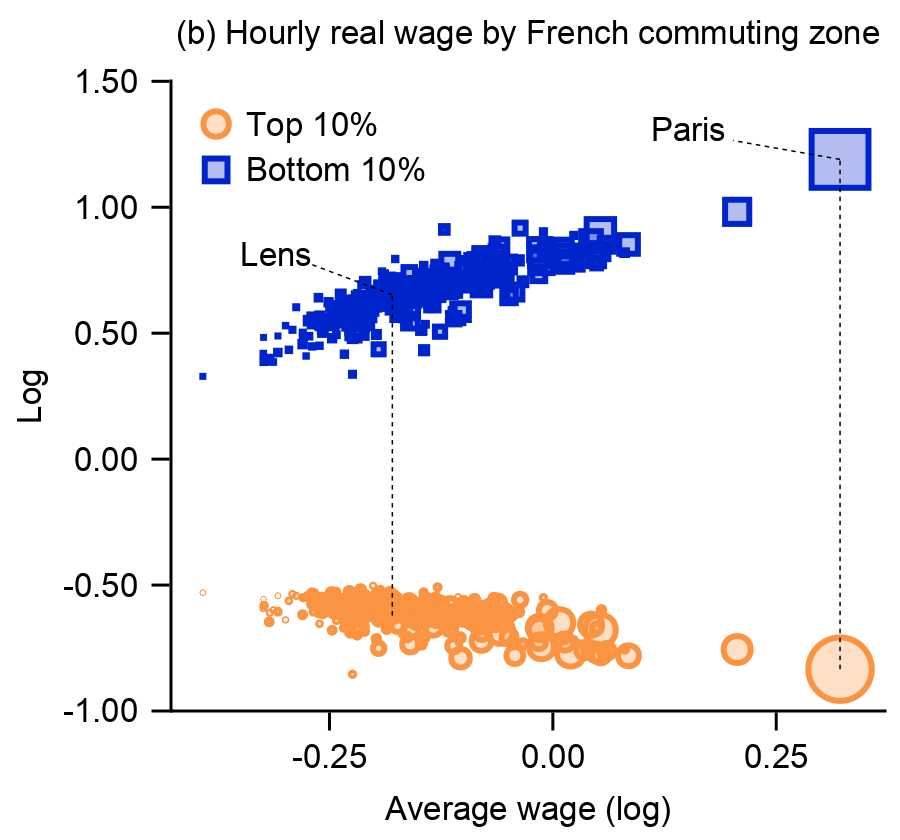
🚨 New working paper 🚨
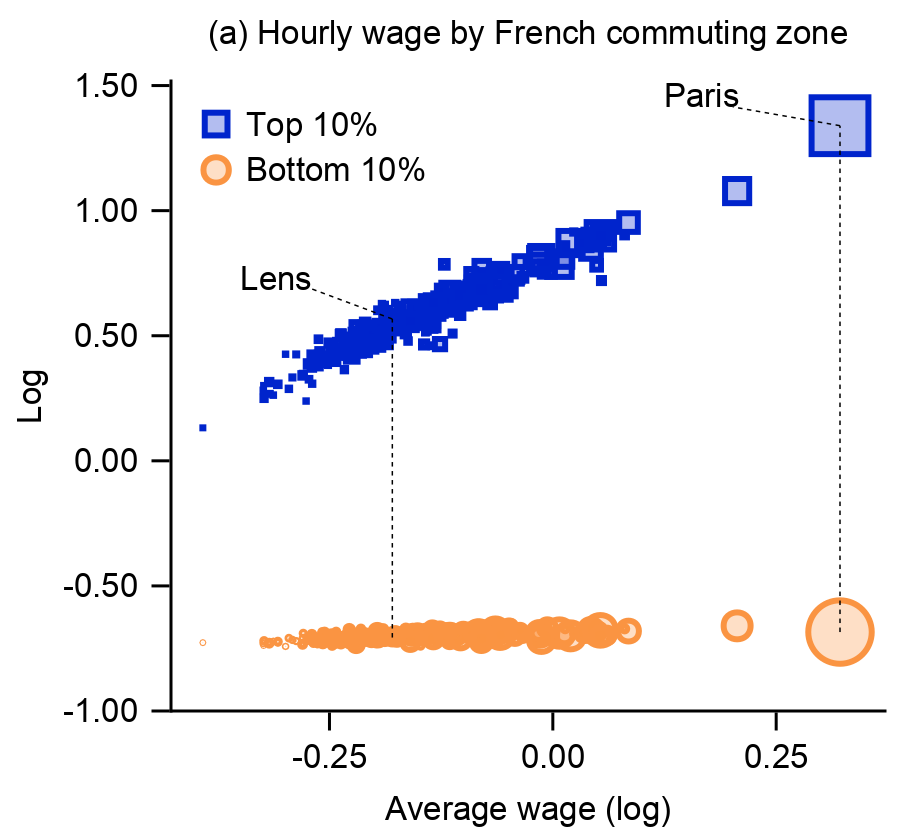
In large cities, wages are higher. But so are inequalities. In fact, low-wage workers earn lower real earnings there.
Why? What drives spatial wage disparities? Why some workers work at lower real wages in large cities?
This article is about Júlia, my daughter. She's stuck in visa limbo in the UK, due to a mistake by @ucl and the Home Office's slowness, incompetence & arrogance. 7 months unable to work or leave the UK. Hope visibility here pushes the HO to take action.
Report from the teaching trenches:
I teach an advanced elective (Social and economic networks) which is difficult for top undergrads but where AI can do the homework perfectly.
The main changes this year:
(i) I encourage AI use for learning;
(ii) closed book exams
1/
Unspeakably excited to share HANKSSON, joint work w/ (lucky me!) @sigurdgal@RefetGurkaynak M. Mæhlum K. Molnar
A key question of the HANK literature:
Does (household) heterogeneity amplify the aggregate effects of demand policies and shocks?
Well ... 1/n
https://t.co/RgdJyrlDZC
This “miracle” happen to the whole group of countries that joined the EU 2004. Not in the other OECD countries.
Is this a EU 🇪🇺 miracle?
Paper: https://t.co/LSgnWfx9iF
VoxEU column: https://t.co/UH1tutsiLw