6/6: While my platform has changed, my dedication to building stronger global connections remains the same. I look forward to reconnecting with old friends and engaging with new peers in this exciting new phase.
KSA has finally begun taking steps to restore its prestige and reestablish its deterrence against the Houthis after having the approval by the US and air defense support within KSA by France and others.
The Trump administration is deeply reluctant to get bogged down in a two-front war in the Middle East involving the Strait of Hormuz and the Strait of Bab el-Mandeb, so it is unlikely that the US will intervene for the time being.
https://t.co/62L5RtXFUv
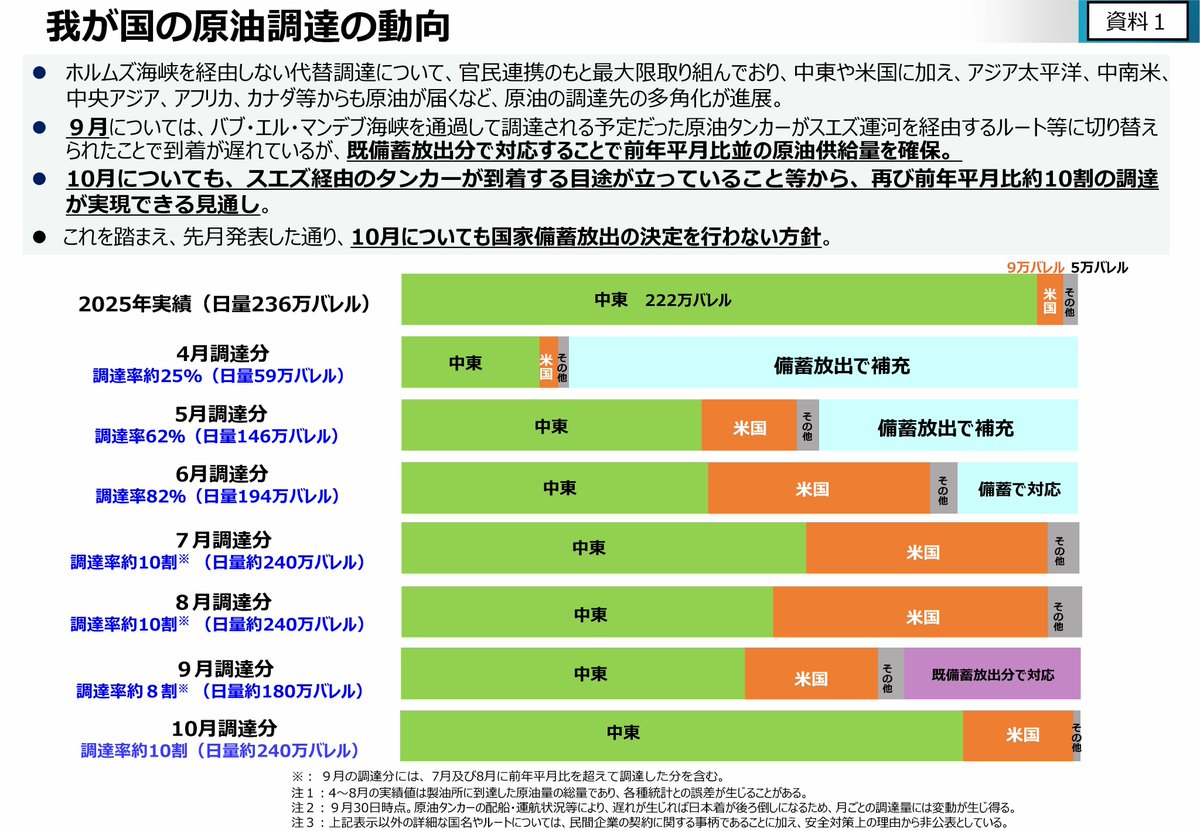
🇸🇦🇦🇪 Gulf oil producers will help Asia stockpile crude beyond Hormuz.
According to Nikkei, Saudi Arabia and the UAE are joining a framework to build oil reserves in Asia.
🇯🇵Japan will support it with finance and storage technology.
The talks will be held at a ministerial meeting of the Japan-led AZEC group in the 🇵🇭Philippines on 8 October.
The need is clear in the Philippines.
Saudi Arabia and the UAE supplied 82% of its crude imports in 2024.
Its stocks cover about 15 days and the Hormuz closure pushed Manila to declare a national energy emergency in March.
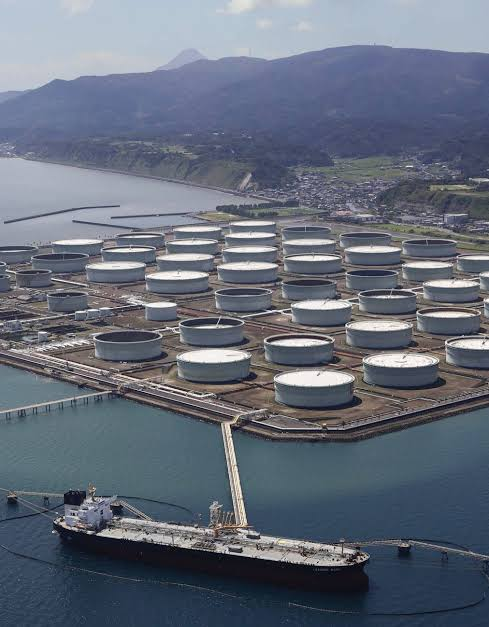
Joint stockpiling works like this: the producer keeps its own crude in tanks inside the buyer's country.
The buyer gets priority access in a crisis and the producer gets a storage base close to its customers.
Japan has run this model with Aramco and ADNOC in Okinawa for years.
The Gulf producers gain as much as Asia does.
This war showed that oil stuck behind Hormuz earns nothing.
Barrels already stored in Asia can still be sold when the strait closes and they keep Asian buyers loyal while US and Russian crude compete for the same customers.
Japan gains too.
It uses finance and know-how to anchor Southeast Asia's energy security, in a region where China also wants influence.
When the next disruption comes, will Asia's emergency oil belong to Asia, or to Riyadh and Abu Dhabi?
🇸🇦Saudi Arabia wants a way out that avoids both chokepoints.
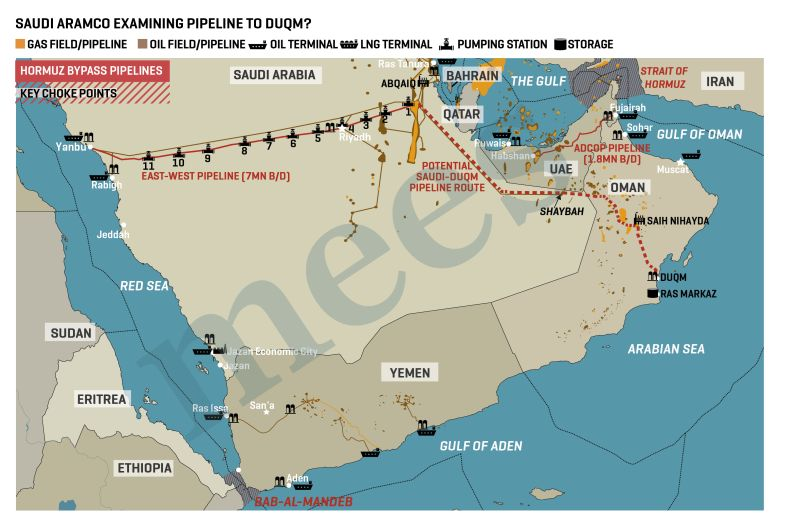
Aramco is looking at a pipeline from its eastern oil fields to 🇴🇲Oman's Duqm on the Arabian Sea.
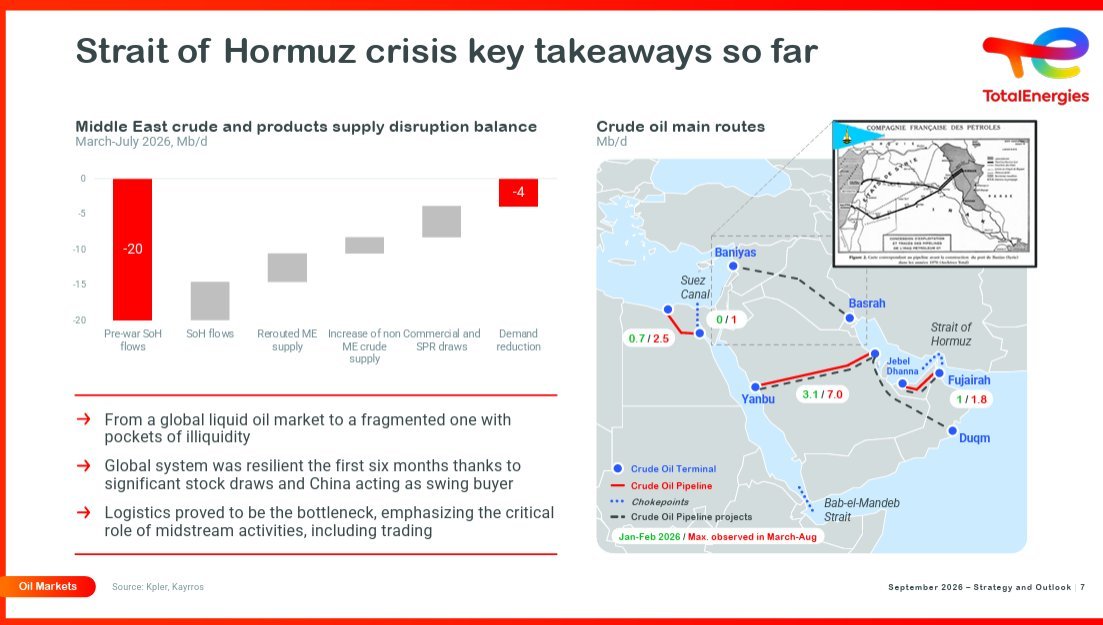
Saudi Arabia's current bypass is the 7M b/d East-West pipeline to Yanbu. It's now running above 80%, with about 6M b/d flowing and roughly 4.5M b/d available to export.
But Yanbu sits on the Red Sea and the Houthis took Bab el-Mandeb last month.
Riyadh is now preparing an offensive to win it back.
The 🇦🇪UAE's pipeline to Fujairah carries up to 1.8M b/d and gets out past Hormuz.
Duqm would do the same for Saudi crude, and it's clear of the Red Sea too.
If 🇸🇦Saudi and 🇦🇪UAE barrels can skip Hormuz for good, what leverage does 🇮🇷Iran have left?
Source: MEES
President Trump opened the door to Syria’s recovery. Restoring financial connectivity is how we help turn that opportunity into lasting prosperity.
Pleased to join the Treasury banking roundtable with Syrian financial leaders and U.S. banks and payment providers. Combating illicit finance, advancing credible reforms, and rebuilding confidence are essential to responsibly reconnecting Syria to the global financial system.
Another foundation stone in @POTUS’s bold vision to give Syria a chance.
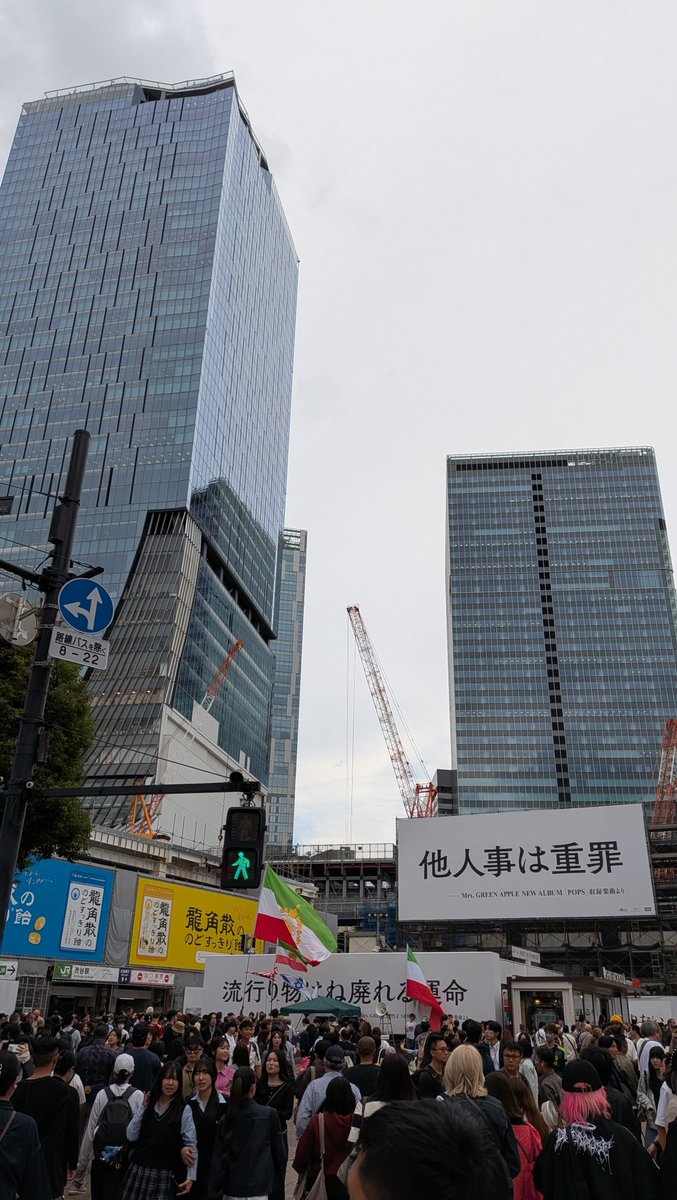
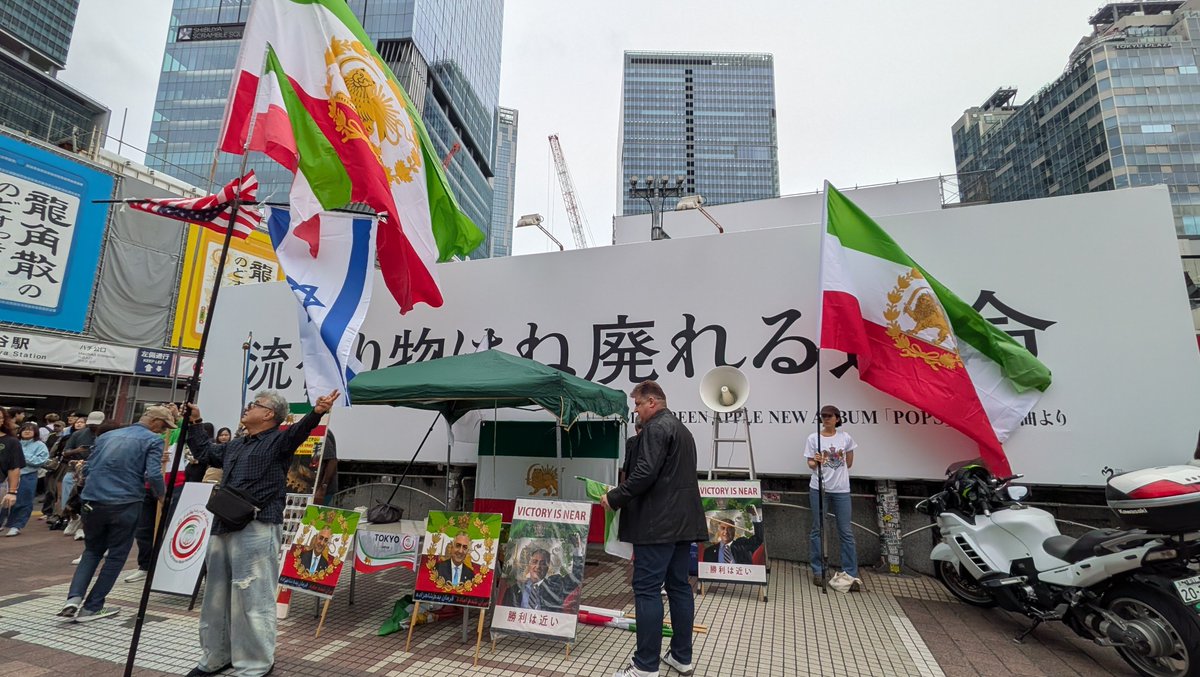
I never thought I’d come across flags of the lion and pictures of the legendary longtime resident of Potomac I’d become so familiar with while I had lived in Washington DC again, right here in Shibuya, in the heart of Tokyo! 😆
We must not allow Iraq under the Zaidi administration to become a country that permits the existence of ‘states within a state’, as is the case in Lebanon.
To this end, the international community will need to support the success of PM Zaidi’s economic policies, thereby strengthening public support and momentum.
My latest article argues that the geography of the Iran war is changing. The United States has gained the upper hand in the Strait of Hormuz. But Tehran will not surrender. It is instead looking to turn Iraq into a springboard for attacks on America’s regional partners.
With Hamas and Hezbollah weakened and the Syrian land bridge severed, Iraq has become central to Iran’s strategy. The American withdrawal gives the IRGC greater freedom to use its militias against Kuwait, Jordan, and the Kurdistan Region, potentially combining missile and drone attacks with raids, sabotage, and subversion.
Sustaining America’s gains at sea now requires defending its partners on land, against attacks from the country U.S. forces just left.
Even if some decision were made at this meeting, the results would likely not be made public until around the time of the midterm elections.
(I think it’s uncertain whether the naval assets currently heading to the Middle East will arrive in the target waters before the midterm elections.)
When considering whether the US is capable of launching a decisive strike sufficient to break the current deadlock, there appear to be many factors to consider in addition to the offensive (the targets, scale, and duration of an attack against Iran) and the defensive (the effectiveness and sustainability of protecting US military assets in the region, as well as critical infrastructure in the Gulf and Arab countries).
● The feasibility of maintaining a large-scale deployment consisting of three carrier strike groups (CSGs), two amphibious ready groups (ARGs), and one expeditionary sea base (ESB)
● The stockpile status of high-value munitions, including air defense interceptors and bunker-busting munitions
● Maintaining extensive supply lines given the current inability to resupply via port facilities in Gulf nations
● The reaction of Gulf nations (in light of developments after February 28, 2026, Gulf nations have come to understand that US assets alone cannot fully defend their countries)
● Protecting US air assets likely to be deployed from the US and Europe, amid reports of China supplying man-portable air defense systems (MANPADS)
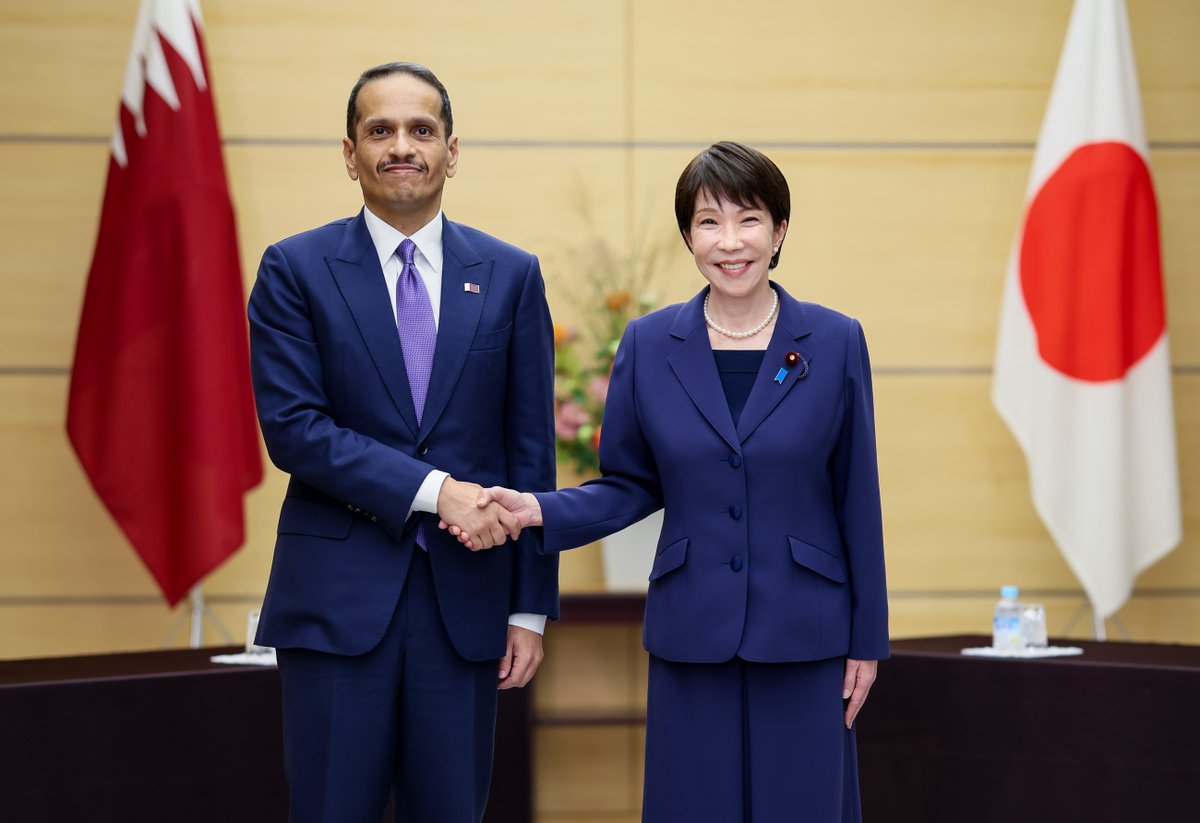
PM TAKAICHI met with H.E. Sheikh Mohammed bin Abdulrahman Al-Thani, Prime Minister and Minister of Foreign Affairs of Qatar, who is visiting Japan for attending the closing ceremony of the 20th Asian Games. She discussed the situation surrounding Iran and stated that Japan intends to make active contributions to enhancing the economic and energy resilience of the Gulf countries.
https://t.co/8dnVqXB1K3
(Photo: Cabinet Public Affairs Office)
Addition to 2 ARGs, they have already had an Expeditionary Sea Base (ESB) to the Arabian Sea according to the USNI report as of Sep 28.
It appears to have been intended to compensate for the reduction in ARGs.
If the arrangement involves an ESB remaining with 2 ARGs, it might be something special from the perspective of the Marines’ operational capabilities...
The Roosevelt Carrier Strike Group (CSG) and the Makin Island Amphibious Ready Group (ARG) have departed San Diego and are headed for the Middle East.
Based on past precedent, these assets are expected to join the Bush CSG and the Washington CSG, as well as the Boxer ARG already deployed in the Arabian Sea as early as mid-November, bringing the total to 3 CSGs and 2 ARGs.
Around April 2026, a similar scale of deployment was briefly achieved in the theater, but that was ultimately due to a rotation of CSGs, and the large-scale offensive operations were not conducted by 3 CSGs.
Some have pointed out that if 3 CSGs were to remain in the Middle East, it is said that it would be the first such occurrence since 2003, and this might demonstrate the Trump administration’s resolve.
With diplomatic contacts between the U.S. and China expected this fall and winter, there are currently no aircraft carrier strike groups in the Pacific theater.
Given this situation, I think it is likely that the Washington CSG, which is based in Japan, will leave the Middle East theater and return to the Pacific theater just as the Roosevelt CSG arrives.
https://t.co/1v952rPXws via @WSJ
That's true! @NateSwanson83
"The reality is, Trump is stuck with bad options for exiting this quagmire. The only thing worse would be doubling down on destructive and futile escalation."
Trump Unleashed - How the U.S. president might escalate against Iran after the midterm elections. https://t.co/oCe5XleIlF
😩😩😩
U.K. Prime Minister Andy Burnham said there were “strong indications” that Iran played a part in a foiled attack on RAF Fairford last weekend https://t.co/j7cVKb3eK0 via @WSJ
Temasek of Singaporean sovereign wealth fund deepen their engagements and operation in the Gulf despite the regional uncertainty would continue. 👍
"Temasek’s expansion into the Gulf also comes as regional governments increasingly focus on attracting foreign direct investment to drive economic diversification. Saudi Arabia’s Public Investment Fund has made attracting external investors a key part of its plan for the next five years, and state oil companies have been selling stakes in their pipelines and other infrastructure assets. Multibillion-dollar plans to build AI hubs and new export routes are also expected to create opportunities for foreign infrastructure investors."
Singapore’s Temasek will open its first offices in the Gulf early next year, joining a growing list of global investors expanding into the region despite ongoing conflict.
https://t.co/Posg5ABExc
This piece by @AliVaez describes the current US-Iran relations in the most neutral and realistic manner among the pieces which I have read these days.
I fully agree with his assessment.
No matter what statements or actions officials from both US and Iran—or representatives from mediating countries—may make or take, unfortunately, there has been absolutely nothing so far that could bring about a fundamental change.
The situation in which the inherent logic of both US and Iran takes precedence over all other assessments and factors is unlikely to change for the foreseeable future.
"Critically, both states have the resources needed to fight indefinitely—and both believe they have no choice but to use them. They think that if their side lets up, the other will press on until it has either humiliated them or achieved its main objectives. They carry out periodic talks, but there is no mutual trust."
"The war, then, will carry on as it has. There will not be a comprehensive resolution. There will be no lasting peace deal. But because the status quo is sustainable for each side, and because the parties lack the power to seize the upper hand, there will be no dramatic escalation, either."
"the United States can still afford to battle, and it believes that the costs of giving in exceed the costs of continuing. Iranian society is facing years of impoverishment and insecurity.
Yet the Islamic Republic itself is stable, and it does not think it can afford to make meaningful concessions.
Such is the paradox of this conflict. Both sides have emerged weaker. Neither can win. But they fight on regardless, because they find the alternatives to be completely unpalatable."
Seven months in, Iran & the U.S. each believe they have tools to make the other blink, fortitude to wait the other out, and disinclination to make concessions the other seeks.
My latest for @ForeignAffairs 👇
https://t.co/GrlVWBr8e0