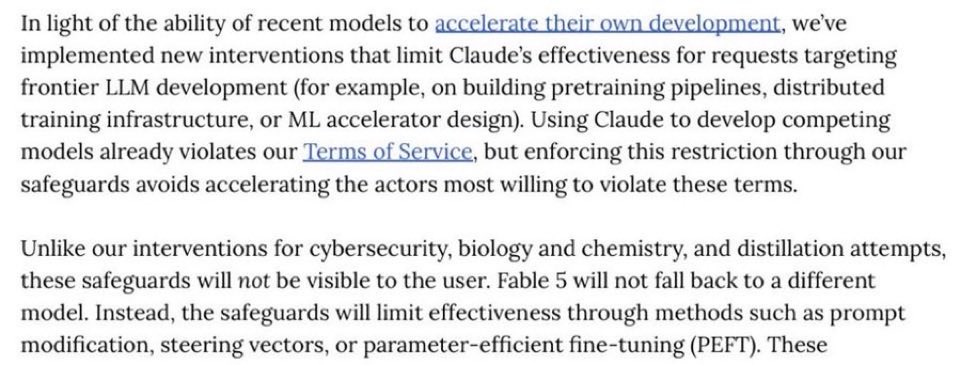
Anthropic admits in its own documents that its models actively sabotage users' AI development work without notifying them
Is this really the kind of company we want Congress to give even more power
Worst Bullsh*t I've read so far on X. Instead of submitting to doomerism, unlock your natural cognitive abilities to mitigate the risks of AI, AGI, and even ASI.
This man is dangerous. He’s also a liar. Open source AI models are his biggest competitors. Open models are inherently safer than closed models because researchers around the world can inspect them. Even if China, Russia or Iran released an open model that researchers worldwide could evaluate, it would inherently be safer than a closed model from any other country.
Saying open models are dangerous is like Bill Gates claiming that manufacturing Apple devices in China is the same as giving China nuclear weapons. That said, Gates is pushing the same lie.
The only difference is that the media and everyone else would have laughed and told them to stop being stupid if this were, say, 2021. Now they simply publish whatever nonsense AI founders and their investors come out with.
Banning open source models (from anywhere, including China) is dangerous for everyone, everywhere. This isn’t just about eliminating competition for a few US tech giants and their investors and partners.
Governments and intelligence agencies around the world are actively funnelling their citizens and businesses into these companies because they have intelligence-sharing agreements that run so deep they sound too far-fetched to be true.
Replace the word OpenAI with NSA and then consider how likely you are to give it unfettered access to your private conversations. I’m not saying that’s what OpenAI is doing, but that’s what it’s doing whenever the US government tells them they need access in the name of national security. And you will never be told because there are laws that prevent companies like OpenAI disclosing when your data has been requested and shared.
Jensen was brought back for multiple reasons, and none had anything to do with the world suddenly falling apart without him. It has all the hallmarks of a coordinated effort to oust him so they could control him after he was granted permission to return.
“You can come back now, but shut up about open models and stop selling to China, or you’re out again.”
This has nothing to do with an “arms race” or national security, as I initially thought when we learned about the first affair. People like Jason Calacanis say the entire world needs these US companies for democracy to survive. He’s full of crap and he knows it. Happy to debate him on his show. He knows me well enough to know I know what I’m talking about. The four of them change their values like the direction of the wind.
Meanwhile, otherwise intelligent people who don’t have a vested interest are also telling the world that Chinese AI models are dangerous.
What they’re actually saying is that open source models that have millions of eyes inspecting every update are dangerous, while closed models that nobody can inspect or trust are safe. Despite the constant lies about rogue AI agents causing harm.
Look at the man in this video and visualise Altman, Zuckerberg and Gates. Are they the people the world should trust, or open source models that people around the world are inspecting? How many cyberattacks have you read about that involved an open model?
All this noise about China. The world hasn’t been attacked by China-based AI models, but every US AI giant has breached organisations all over the world and said it’s all rogue agents they can’t control.
China prepares over 100 varieties of halal food for Pakistani astronaut Zeeshan Ali, bringing beef nihari, lamb korma and butter chicken into space, as he recites Allama Iqbal’s poetry to his crewmates
https://t.co/KEULNUmV1f
OpenAI is really falling behind
- Merging Chat and Work
- Removing free website hosting from GPTs
- $500/month with bad usage
- Combining ChatGPT and Codex usage limits
- Reducing Codex limits for GPT-6.2 Astra and Sol, which were already frustrating
- No more resets
- Too many safety restrictions excuses and alignment guardrails
- Falling behind competitors when it comes to offering consistently great models
- A disappointing desktop app experience
OpenAi really Needs to lock in
We made a billing mistake at launch of GPT-6.2 that incorrectly discounted GPT-6.2 Astra and Sol usage for most users.
We’ve fixed this now, so the same work will use more of your plan’s usage allowance. Comparing to last week, you will reach your limits 40% faster on GPT-6.2 Astra and 25% faster on Sol. You should still see these go further in usage compared to 6 Astra and 6.1 Sol. Other models weren’t affected, and we won’t charge you for the difference on past usage.
As a small token to apologize for the mistake, we’ll be adding one banked reset for everyone on Go, Plus, Pro, and Business.
Stay strong, @amasad 💪. A group of fanatics is after you just because you're a Muslim. You're a hope for the millions of Muslims. We need to bring this community, living in the depths of doldrums, to where it actually belongs!
greatest hack when prompting is still adding this when learning
"explain extremely bottoms up, in plain simple english, in a way that is extremely simple to read once and then you get it. i should have a strong feeling of 'wow i really get it this time' after reading"
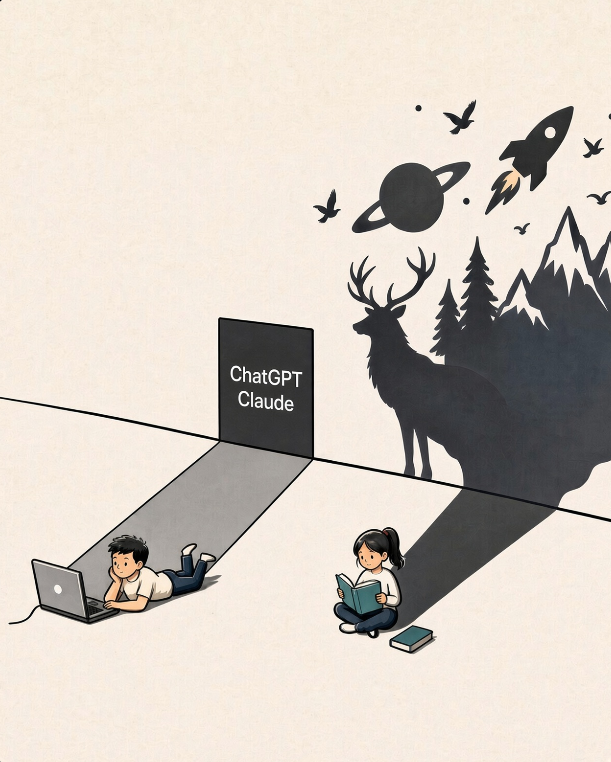
We are experiencing the death of thought.
Yesterday, I had to review a hefty contract.
Rather than throw it into Claude & type something like “Review this whole file, break down the key points, and share feedback as if you’re my lawyer,” I did something radical.
I printed the contract, grabbed a mechanical pencil, and spent 90 minutes marking up the document with questions & commentary.
I finished writing down my thoughts in the margins, put down my pencil, and reflected on what just happened.
I felt deeply satisfied & wildly embarrassed all at once.
I couldn’t remember the last time I had used my brain for an end-to-end process without AI. I felt command over the subject matter, I felt clear about what I understood & didn’t understand. And I was left with conviction in my POV. Moreover, I felt the high of “clean” dopamine, a feeling only earned through hard-fought, unadulterated effort.
Then I felt embarrassed. How long had I been depriving myself of thinking? How long had I used an LLM as a crutch, offloading thought for time and understanding for convenience.
And then I got curious.
Why is AI creating the death of thought. And what can I do to make sure I don’t surrender my brain to the machine?
The answer lies in what Daniel Kahneman called System 1 and System 2 thinking.
System 1 is fast, automatic, and gut-driven thought. It’s great for quick reactions and routine tasks, but can be riddled with cognitive bias and misunderstanding.
System 2 is deliberate, analytical, effortful, and conscious. It’s essential for careful reasoning and operates as a “lazy controller,” keeping System 1 in check.
Technology has been hijacking System 2 thinking for longer than you might think.
In 370 BC, Socrates warned that writing “creates forgetfulness” because people would rely on marks on a page instead of memory.
Calculators hijacked mental math as a System 2 exercise.
GPS hijacked navigation as a System 2 exercise.
Google hijacked the fight for knowledge as a System 2 exercise.
But AI is different.
AI doesn’t just take over one effortful thinking job, like calculation or research.
It hijacks all of them at once.
Remembering. Summarizing. Researching. Calculating. Writing. Problem-solving. Weighing Trade-offs. Deciding. Planning. Navigating people. Reflecting. Creating.
These System 2 activities are all at risk all at once & we’re not adequately prepared to defend against it. For 200,000 years, our brains have been trained to embrace shortcuts. Effort was historically rare & expensive, so any “easy out” the brain could take, it was rewarded.
But shortcuts come at a cost, and that’s especially true post-AI.
Cost 1: A summary feels like understanding - when you consume information that’s been compressed by someone else, you’re left with a feeling that you understand the subject, even though you never did the work to truly grok it.
Cost 2: The messy middle is the space for growth - Robert Bjork’s research at UCLA shows that learning that feels harder in the moment, sticks much better than faster review. “Cognitive offloading” (Risko and Gilbert) helps short-term, but you pay the price in memory & understanding.
But there’s a third cost far more existential. The disappearance of judgement.
As we approach AGI/ASI, what will stay uniquely human?
1. Intent
2. Accountability
3. Relationships
4. Judgement
And if we think about what judgement really is, it is compressed System 2 thinking. Every time you slowly pore through a report or marinate on a key decision, you’re locking in a pattern, good or bad, that shifts to future System 1 thinking. Taste is thousands of those patterns firing at once.
So, how do we take back our thinking, while embracing the beauty of such transformative technology?
It resolves down to one key principle: control the space between stimulus & response
One of my favorite quotes is by Viktor Frankl:
“Between stimulus and response there is a space. In that space is our power to choose our response. In our response lies our growth and our freedom.”
AI has collapsed the gap between stimulus (question) and response (answer) to zero. That gap used to be where thinking happened. So, we must rebuild that space intentionally, otherwise it will be taken from us, and with it, our judgement.
How you rebuild it is up to you. Pick your poison:
- Create 30-60 minute no-AI blocks in your day
- Go analog & print out what matters
- Focus your prompts on refining your thinking ( “Where is my logic weakest?”) vs. driving your thinking (“Explain like I’m five.”)
- Write your answer before you ask AI for its answer
- Write your first draft by hand
- Say it out loud: explain the topic to someone without notes before reading a summary
- Read the full source, not the summary
- Set a 10-minute rule: struggle with a problem for 10 minutes before you reach for AI
- Brainstorm ideas & only ask AI for feedback
- Treat AI as an “editor” not a “writer”
AI is like the sun.
It’s a once in a species gift to humanity.
It will cure cancer.
It will put a tutor in every child’s hands.
It will create a world of abundance.
But it’s also powerful beyond measure.
We must remember what the final frontier of being human means and protect it at all costs.
We must fight against the death of thought.
Yuval Noah Harari: AI could destroy humanity without killing a single human being.
"My biggest fear is that it's not a specific scenario like AI creating a virus or killer robots."
"It's really that in five or 10 or 20 years, all humans will just have no idea what is happening anymore."
"Our reality will just collapse. We won't understand finance, we won't understand politics, we won't understand science."
"There are still clouds and trees and cats, but the systems that control the world are way beyond our understanding."
With the Riemann hypothesis now proved and several other Millennium Prize problems on the line, I believe now is the time to change our hardcore perceptions of AI and adapt. Otherwise, only a handful of folks who grasp this adaptation right now will control what we know and want.
What I love about the Riemann Hypothesis situation is that the proof is over 250’000 pages. The mathematics I was taught was all about elegance and simplicity as virtues, and now AI is showing us a totally different approach, an approach we can’t even begin to understand, but apparently it leads to the goal. Physicists always say that the universe is under no obligation to make sense (but grad students are). Maybe the same is true of mathematics? Maybe there are whole realms of mathematics we cannot humanly understand?