@elonmusk@Tesla I ordered a Tesla Model Y back in January 2026 and the delivery window keeps moving. Tesla support can’t give me a meaningful explanation. This is really frustrating — can someone at Tesla provide a proper update? (UK)
@EndWokeness Deregulating #energy is arguably the most impactful foreign policy.
Most hostile countries are energy powerhouses (e.g. Russia, Iran, China).
If the West unleashed oil/natural gas pipelines/drills & nuclear…hostile regimes would be weakened tremendously without firing a shot.
Clearly LLMs must one day run in Space
Step 1 we harden llm.c to pass the NASA code standards and style guides, certifying that the code is super safe, safe enough to run in Space.
https://t.co/n9bc9HH79a (see the linked PDF)
LLM training/inference in principle should be super safe - it is just one fixed array of floats, and a single, bounded, well-defined loop of dynamics over it. There is no need for memory to grow or shrink in undefined ways, for recursion, or anything like that.
Step 2 we've already sent messages out to Space, for possible consumption by aliens, e.g. see:
Arecibo message, beamed to space:
https://t.co/UIyOh45jfg
Voyager golden record, attached to probe:
https://t.co/fuwD59oKF6
The Three Body problem (ok bad example)
But instead of sending any fixed data, we could send the weights of an LLM packaged in the llm.c binary, with instructions for the machine code. The LLM would then "wake up" and interact with the aliens on behalf of the human race. Maybe one day we'll ourselves find LLMs of aliens out there, instead of them directly. Maybe the LLMs will find each other. We'd have to make sure the code is really good, otherwise that would be kind of embarrassing.
:) Step 2 is clearly not a serious proposal it's just fun to think about. Step 1 is a serious proposal as, clearly, LLMs must one day run in Space.
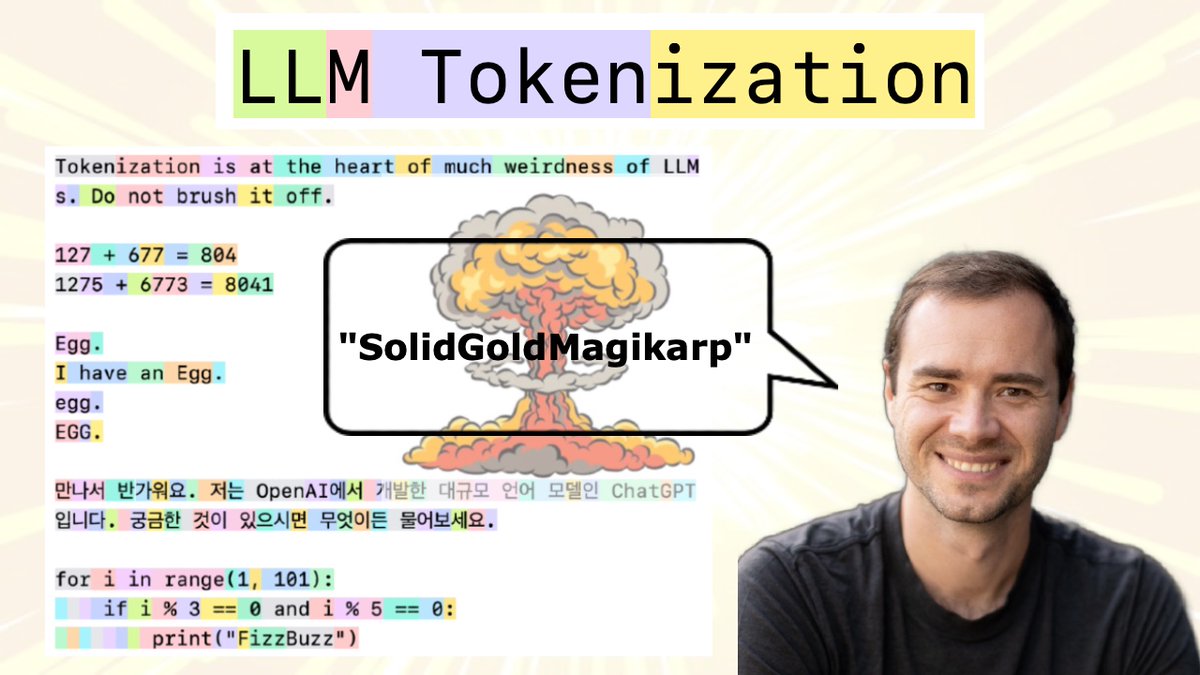
New (2h13m 😅) lecture: "Let's build the GPT Tokenizer"
Tokenizers are a completely separate stage of the LLM pipeline: they have their own training set, training algorithm (Byte Pair Encoding), and after training implement two functions: encode() from strings to tokens, and decode() back from tokens to strings. In this lecture we build from scratch the Tokenizer used in the GPT series from OpenAI.
This is huge: Llama-v2 is open source, with a license that authorizes commercial use!
This is going to change the landscape of the LLM market.
Llama-v2 is available on Microsoft Azure and will be available on AWS, Hugging Face and other providers
Pretrained and fine-tuned models are available with 7B, 13B and 70B parameters.
Llama-2 website: https://t.co/PKrrXgHdem
Llama-2 paper: https://t.co/aINNrXNhMb
A number of personalities from industry and academia have endorsed our open source approach: https://t.co/N7HwgW9Suh
@OpenAI
As a chatGPTPlus subscriber, I suddenly lost my subscription. It now logs me in as vanilla chatGPT, I'm still paying for the subscription. Whom should I contact to resolve this issue?
We’ve just released a major milestone of Unison, version M4 🎉
✅ Anyone can now self-publish code to https://t.co/o5tPe5HGG3
✅ Base library additions: mutable/immutable arrays, date/time primitives, efficient regexes.
✅ ... and lots more
Blog post: https://t.co/ULZpMR1usY
https://t.co/ctEp9i4w6b
Good times; way back we showed the Silverlight was obsolete before it even launched and that you could do everything using just standard HTML+JS (https://t.co/PLVrDDsPUb). Nearly got fired for showing that.
Haskell Symposium 2021 keynote on linear types just out. If you wanted an intro to the *why* of linear types (resource hygiene, safe FFI, performance, correctness wrt protocols, ...), this talk gives you part of the puzzle. https://t.co/w7Grm5B4h9