Does visual attention implicitly model physical regularities? In a new 📄 I report a cueing effect that shows how spatial orienting models the physical force of *friction*! Most objects are touching a frictive surface beneath (otherwise moving around would be quite frustrating).
The New School Perception Lab is en route to VSS. Come check out these presentations from the lab!:
Lab abstracts:
https://t.co/v4V1zh5NM5...
Presenters:
@LorenPMatelsky@HongBNguyen_
Sarah Lassise
Marina Pace
Didi Dunin
Lawrence Duan
Congratulations to Hong on the acceptance of her latest paper on intuitive physics and visual attention! Hong’s work shows that the visual system makes implicit assumptions about how the force of friction is acting upon objects, in order to predict where they will move next.
Does visual attention implicitly model physical regularities? In a new 📄 I report a cueing effect that shows how spatial orienting models the physical force of *friction*! Most objects are touching a frictive surface beneath (otherwise moving around would be quite frustrating).
We conclude that visual processing by default assumes that objects are in frictive contact with a floor, but also rapidly integrates visual cues to frictive contact with other surfaces, in order to orient attention toward where they will move next.
In Experiment 2, spatial orienting also factored in whether and how the wheel was touching another visible surface, indicating rapid, online analysis of visual cues to friction.
In Experiment 1, I found that this regularity of frictive floor contact is wired into attention: viewing a lone rotating ‘wheel’ automatically orients attention in the direction the wheel would normally move if in frictive contact with a floor surface beneath it.
Dynamical system 2: multistable attractor. This circuit naturally gravitates back to one of 3 stable points. By injecting current, we can get it to switch from one stable point to another. This could explain how the same group of neurons can store multiple memories.
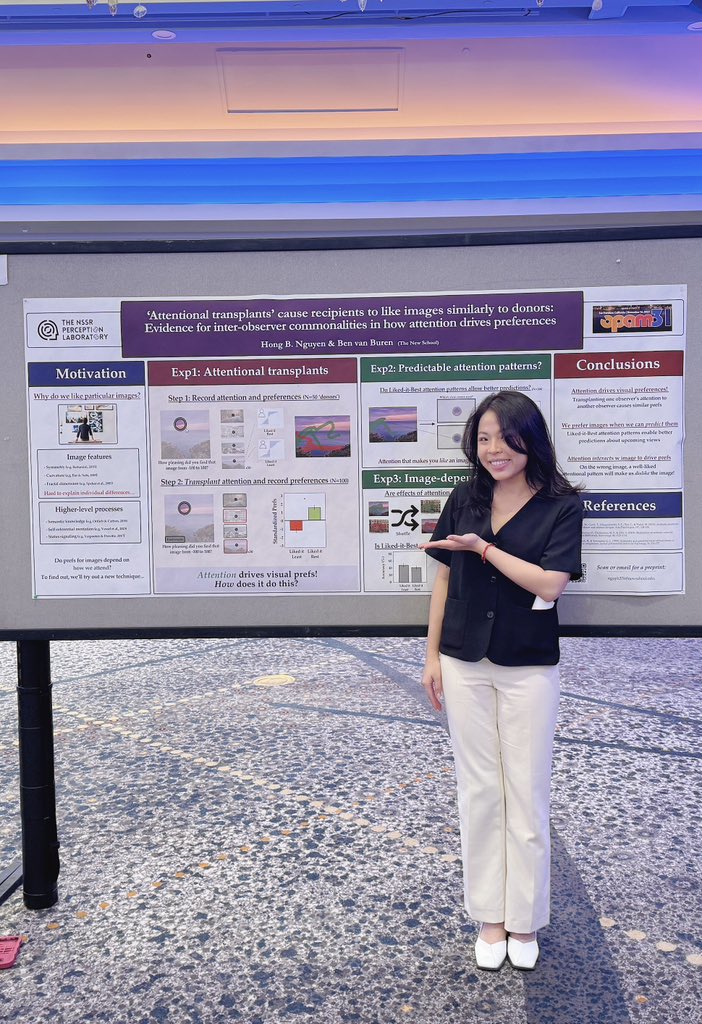
Good luck to all of the presenters who are in the last stages of preparing for the Object Perception & Memory Conference. This year’s program looks great - I wish I could make it out to SF to see your awesome work! #opam2023
Tomorrow (Sat), members of the New School Perception Lab will give three presentations at #VSS2023 discussing work on face perception @LorenPMatelsky, intuitive physical knowledge in visual attention @HongBNguyen_, and the perception of pictorial artworks @serenakxz@june_33rd!
When an object changes speed, what causes you to notice this?
Is visual detection orientation-independent — or might it depend on how a speed change is oriented relative to *gravity*?
Thrilled that my first perception paper has been accepted at JEP:HPP!
https://t.co/1hYHVtUG1R
Congrats to Hong, my awesome and talented lab mate and friend at the NSSR Perception Lab, having her first perception paper out on perception and gravity! Go check out her super interesting demo!