According to dynamical systems, psychiatric disorders can be seen as energy landscapes with peaks and valleys. OCD has deep valleys where neural activity gets stuck, while schizophrenia has shallow valleys that let neural activity roam too freely, connecting unrelated ideas.
This reminds me of the phenomenological line of thinking… in a healthy psychological state, our mental faculties have a “transparent” quality and they are the invisible lens through which we engage with the world. In psychopathology, the psyche loses its transparency, and becomes opaque, heavy, rigid, alien, forcing itself into conscious awareness and inviting obsessive introspection.
1/ New preprint with @dyamins + team! Ventral visual representations within areas evolve over the course of the response along the same hierarchical complexity axis that distinguishes the visual areas, potentially driven by local recurrence.
https://t.co/k9ugZYb9I9
What makes computation important to understanding life and minds is not the Turing machine, but the principle of causal insulation. Computers create their own, self contained world, fully governed by rules that are independent from the dynamics of the substrate.
New paper!! On health justice, resource allocation, and age in suicide risk assessment. We argue that, in resource-limited healthcare systems, appropriately developed risk tools may support fairer allocation of clinical resources, especially for groups at highest risk.
Neural networks might speak English, but they think in shapes.
Understanding their rich *neural geometry* is key to understanding how they work – and to debugging and controlling them with precision.
Starting today, we’re releasing a series of posts on this research agenda. 🧵
🧵1/ Our new study on AI and physician reasoning just came out in @ScienceMagazine. As co-senior author, I'm excited about our findings, and I do think AI will reshape medicine. But after seeing some of the discussions, I'm also worried about how our findings may be misinterpreted.
My bet: in the near future, 80%⬆️ of CS research will be done by AI in collaboration with humans. However, today's research ecosystem is still built around the human, not the AI scientist.
For example, the 8-page paper PDF is a lossy compression of months of branching exploration into a linear story, optimized for a human reviewer to skim in 30 minutes. It hides two structural taxes:
📖 Storytelling Tax — failures, rejected hypotheses, and dead ends get stripped. On RE-Bench (24,008 runs, 21 frontier models), failed runs = 90.2% of total compute cost, with a 113× median failed-to-success token ratio. Every lab independently rediscovers the same dead ends.
🔧 Engineering Tax — the gap between reviewer-sufficient prose and agent-sufficient spec. Across 8,921 PaperBench requirements (23 ICML'24 papers), only 45.4% are fully specified in the PDF. The rest is tacit lab knowledge. Tolerable when readers were human. Critical now that agents read, reproduce, and extend.
We propose ARA: the Agent-Native Research Artifact — replace the narrative PDF with an agent-executable package, in 4 layers:
🧠 structured scientific logic
⚙️ executable code w/ full specs
🌳 exploration graph (every failure preserved)
📊 evidence grounding every claim
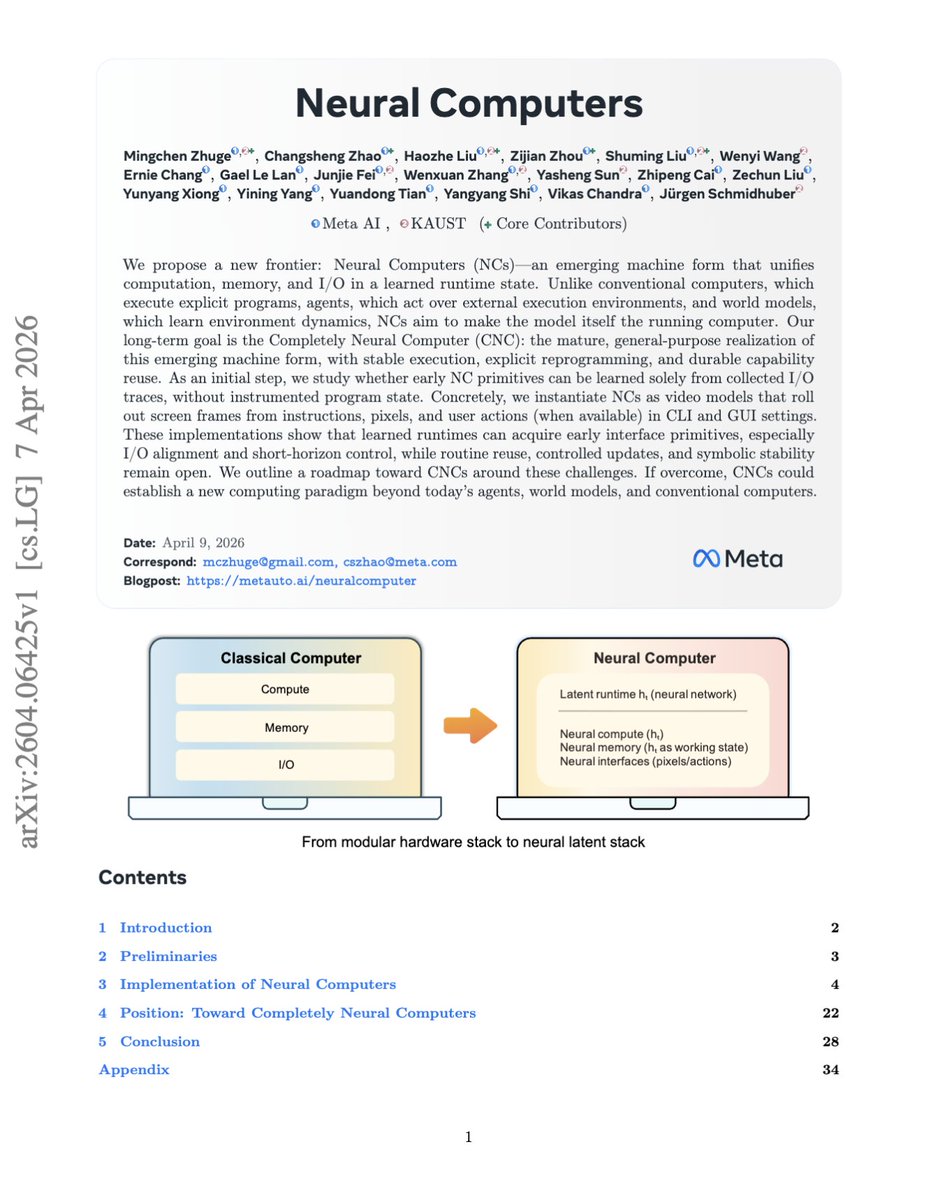
What if the model didn’t just use a computer, but actually was the computer?
Meta AI introduces "Neural Computer", a model where computation, memory, and I/O are all inside one learned system.
Their early prototype learns from screen recordings of terminals and desktops, and it can already imitate some basic computer behavior like rendering interfaces and responding to clicks or commands.
But it still breaks on slightly harder tasks like reliable reasoning, stable memory, and reusable skills.
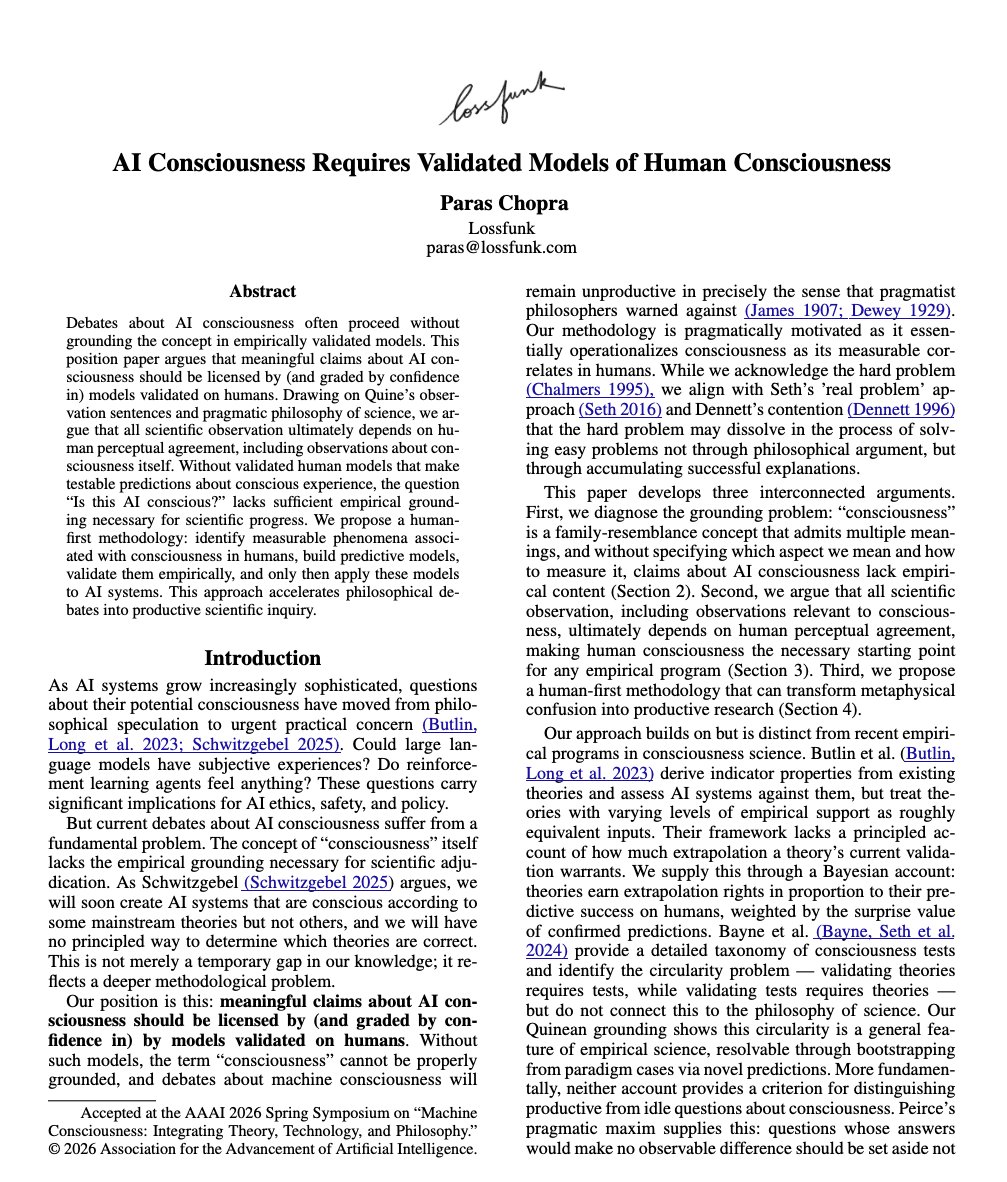
🚨 New Paper
Can AI models be conscious?
We argue that answering this question requires us to have a validated theory of human consciousness first and without that, the concept “ai consciousness” is not well grounded.
Accepted at AAAI Symposium 2026
https://t.co/JUrUeFmQgZ
🧵
Across versions of ChatGPT, responses to psychotic prompts were frequently inappropriate or partially appropriate, raising safety concerns for users at risk for #psychosis.
https://t.co/7ViFUeSbb8
Psychiatry is at a crossroads.
What if much of what we diagnose as disorder is actually a rational response to an unstable world shaped by climate change, conflict, and uncertainty?
Our new editorial 👇
https://t.co/HBsFXW5dFS
Postpartum depression is often missed, & not all cases look the same.
A new study in @BMJMentalHealth shows AI can help: by analysing clinical notes, researchers identified 30% more PPD cases beyond diagnosis codes alone, revealing distinct subtypes with different needs.
Earlier detection = better, more personalised care
Link: https://t.co/liwXU5GMBn
Authors:
Prakash Adekkanattu, Veer Vekaria, Yiye Zhang, Braja Gopal Patra, Priscilla Liang, Marianne Sharko, Natalie Benda, Meghan Reading Turchioe, Andrea Temkin- Yu, Alison Hermann, Jyotishman Pathak
@Columbia
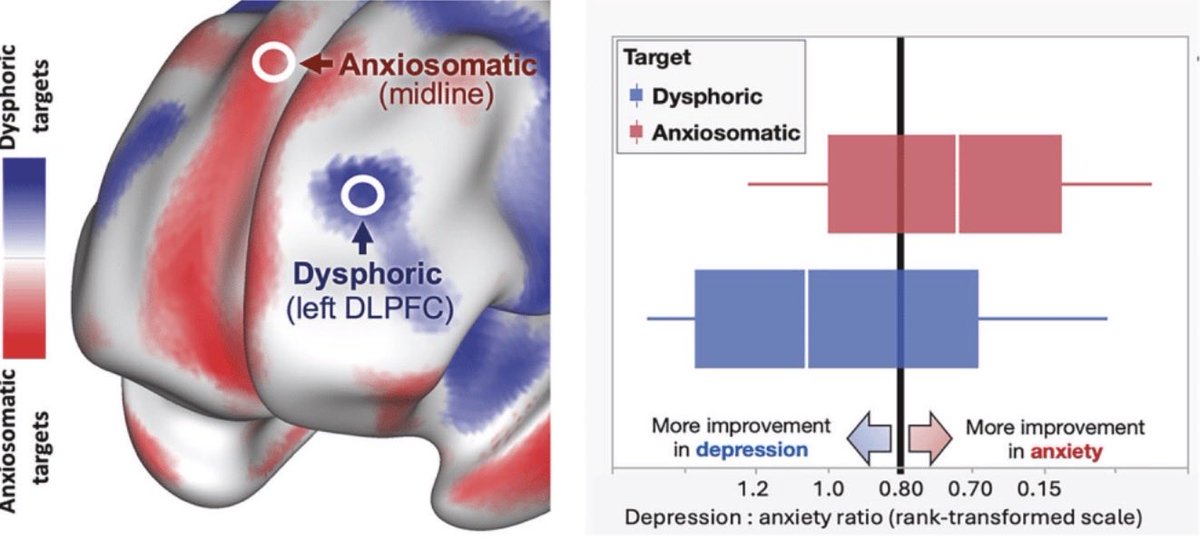
Our latest in @molpsychiatry: In patients with anxiety+depression, targeting a novel “anxiosomatic” circuit in dmPFC outperforms standard dlPFC target for anxiety, and equally effective for depression.
https://t.co/QhETO2V1Es
Among individuals with severe, treatment-resistant #Schizophrenia, #dementia was common and showed a distinct clinical and genetic profile not explained by #Alzheimer disease, cardiovascular risk, or medication effects.
https://t.co/hkz7MoIENa
The Orange Cat Brain Atlas is here. 🧠🐈
Today, we published the first comprehensive cellular map of the orange cat brain. The new atlas reveals a single, specialized neuron responsible for behaviors like staring at walls, knocking objects off tables, and the 3am "zoomies."








![SteveStuWill's tweet photo. Effectiveness of psychotherapy for 12 disorders.
• 0.2 = small
• 0.5 = medium
• 0.8 = large
[Link below.] https://t.co/SoDbe0U8fv](https://pbs.twimg.com/media/HExR-MQbkAAjyyy.png)





