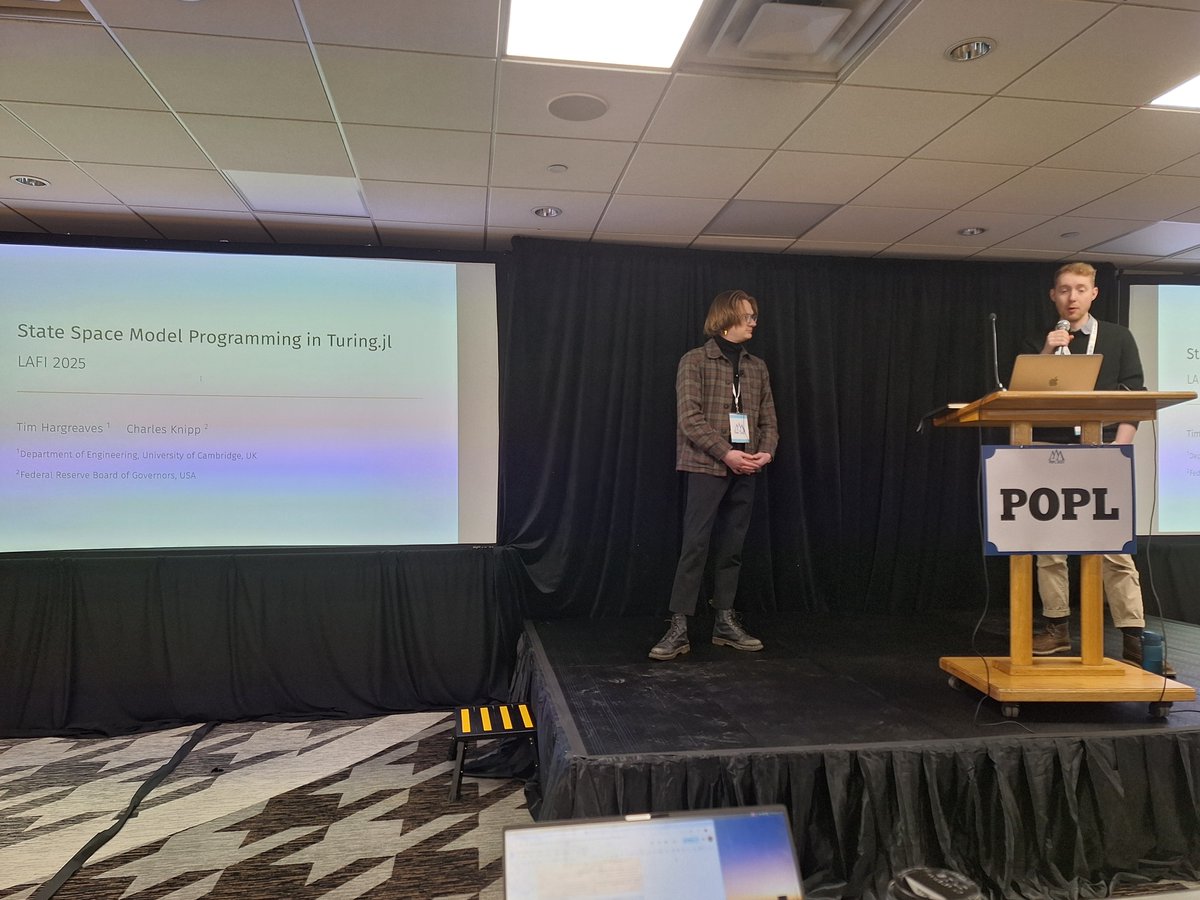
New publication out that I am a (tangential) coauthor on! I did some work on Turing.jl years ago. Big thanks to all my colleagues who did all the work in getting this prepped.
https://t.co/AT9tpULQRG
#julialang
@sirbayes@sirbayes, I'm curious why efficient implementation helps learning here: Are you hinting that previous attempts suffer from insufficient convergence due to longer runtime?
✨Applications are now open for PhDs at the Cambridge Machine Learning Group!✨
We're looking for outstanding candidates interested in fundamental ML research and applications to scientific domains!
More info: https://t.co/HSlE2s9HVQ
🧵Find more about PIs & focus areas below!
This award is very hard to respond to. I have received many hundred congratulatory notes, from former students, post-docs, Princeton University juniors and seniors, funding agencies and foundations, authors, signature collectors, amateurs, elementary school neural network followers, and on and on. An astonishing fraction of them has found their way into useful and interesting Neural Network careers by a casual interaction in class, at a meeting, hearing what I had to say about their ideas, learning from thinking about how I worked with a class, or from being my teaching assistants... There are some whom I remember well, and others for whom my reaction is “are they certain that our interaction sparked a single usable thought?” Yet they go on and comment “you changed my life” and follow on to explain that they heard me lecture when they were 15, and have been a member of the Neural Network brigade of the research army ever afterward.
I cannot make detailed comments to most of my letter writers. In sum I can only say that I tremendously enjoyed the interactions that the Neural Network community provided me with; that the mutual interactions have given me much pleasure over the years; that the community interested both in brain and in artificial brain has proved a good way for science to develop even if institutions have not always been sympathetic. Often these institutions found the enthusiasm infectious, after a period of doubt. In short, we often have won--. No, perhaps all we know is that we have not yet lost. I still believe that finding mind lodged in biological matter is the most profound question that physics can pose. And that the breadth of physics is a good base from which to begin.
In last week's flurry of Nobel Prizes with @Cambridge_Uni affiliations, it was poignant to recognise the connections to the late David Mackay in the two honorees for Physics. We talked to Dr Ramesh Mackay about two of her husband's "personal heroes".
https://t.co/yARDTaE6AW
It's paper day!
In a new paper, led by my colleague @hanyuzhang17 at @UWaterlooAstro , we work on improving the priors for EFTofLSS analysis by taking advantage of information coming from HOD galaxy mocks.
Here the main highlights in the 🧵!
@just_cameron Hopefully, Tapir will fix all the bugs! It is meant to be a ReverseDiff + Zygote rewrite to achieve ReverseDiff level performance or better, and do perform language-level autograd like Zygote. https://t.co/tq5ckXrj0Z
Exciting postdoc position with Matthew Juniper and myself at @turinginst, on Programmable Inference for PDEs in Turing.jl.
cc @CambridgeMLG
https://t.co/FGG1qvEI48
Here's @torfjelde with the obligatory first Bayes slide with the proportional posterior.
This talk is about @TuringLang, which is how I got into Julia seriously!
The Fusion team @GoogleDeepMind has open sourced Torax: our fast & differentiable Tokamak simulator to accelerate the use of AI in the development of practical systems for Fusion energy generation. @jon_citrin
Paper: https://t.co/yj2GYLI7G3
Code: https://t.co/q269VsMWHb
We are excited to announce that Turing.jl is participating in Google Summer of Code 2024 under @JuliaLanguage organization. Check out the projects at https://t.co/K7VKo9ZTrT and in 🧵.
Contributors will be able to interact with the Alan Turing Institute @turinginst. #GSoC
@just_cameron @JeppeJohansen3 I think @xukai92 managed to run Turing on much larger datasets using Turing and distributed computing. Turing is more friendly for larger-scale tasks due to its interoperability with the Julia ecosystem.