Risk appetite in South Korea is skyrocketing:
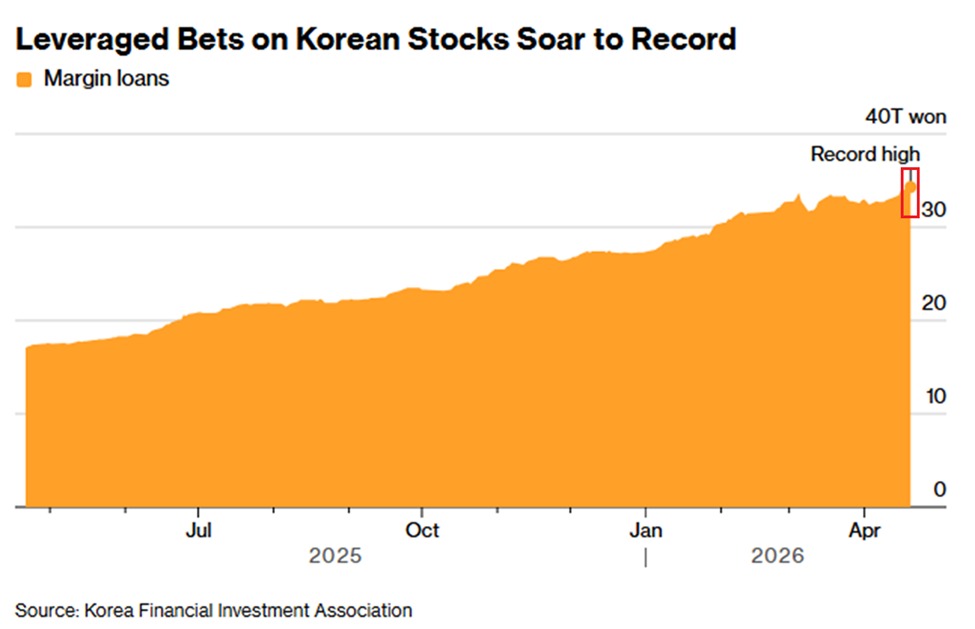
Margin loans outstanding jumped to a record $23 billion in South Korea.
Margin debt has DOUBLED over the last year and is now +37% above the 1-year average of $17 billion.
As a result, the KOSPI index has rallied +27% since the April 1st low and is up +52% year-to-date.
This has been driven by chip stocks, Samsung and SK Hynix, which are up +69% and +81% so far this year.
Both names together now account for ~40% of the Korean index.
Retail investors in South Korea are piling back into equities with record leverage.
Heard a few Korea stock stories:
- People who've never traded stocks are jumping in lately.
- Someone waited 3 hours just to open a brokerage account.
And that old saying came to mind, "when a pregnant woman shows up on the trading floor, that's the top"—maybe late-cycle vibes
No complexity. No accident.
10/10 was caused by irresponsible marketing campaigns by certain companies.
On October 10, tens of billions of dollars were liquidated. As CEO of OKX, we observed clearly that the crypto market’s microstructure fundamentally changed after that day.
Many industry participants believe the damage was more severe than the FTX collapse. Since then, there has been extensive discussion about why it happened and how to prevent a recurrence. The root causes are not difficult to identify.
⸻
What actually happened
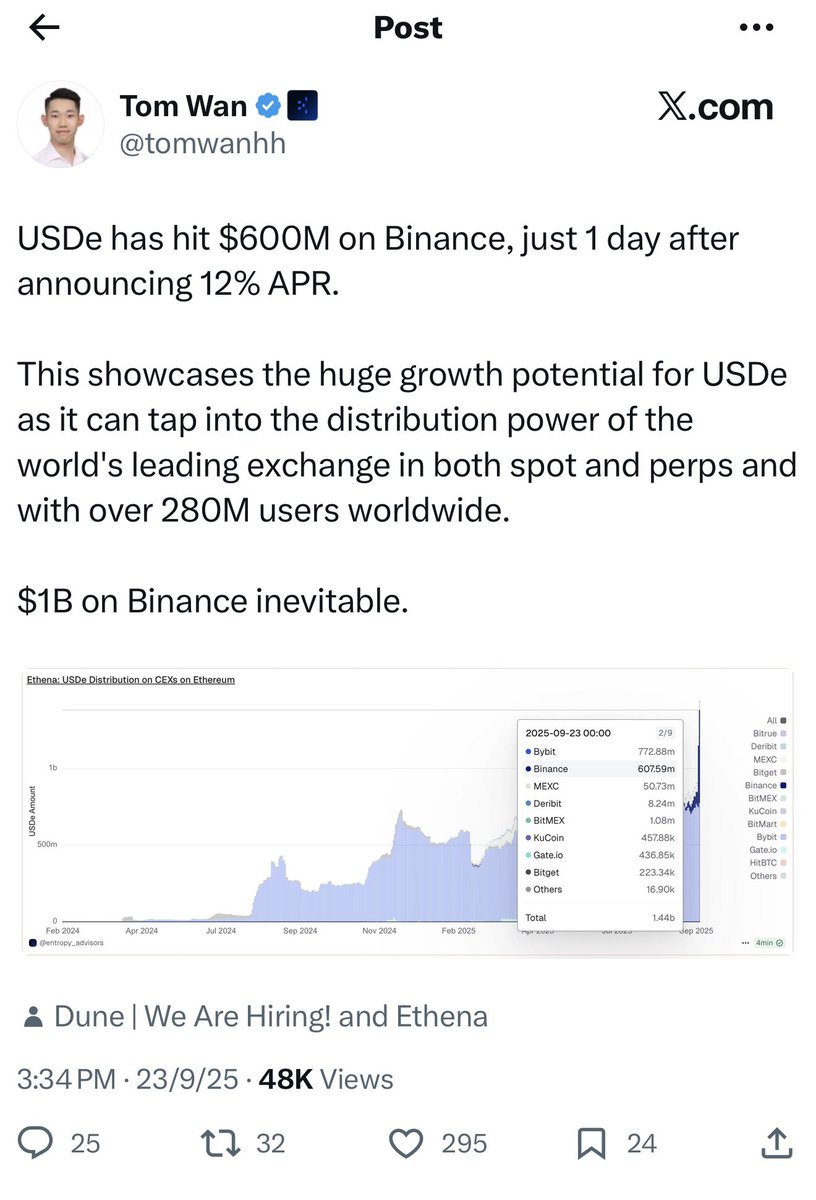
1.Binance launched a temporary user-acquisition campaign offering 12% APY on USDe, while allowing USDe to be used as collateral with the same treatment as USDT and USDC, and without effective limits.
2.USDe is a tokenized hedge fund product.
Ethena raises capital via a so-called “stablecoin,” deploys it into index arbitrage and algorithmic trading strategies, and tokenizes the resulting fund. The token can then be deposited on exchanges to earn yield.
3.USDe is fundamentally different from products such as
BlackRock BUIDL and Franklin Templeton BENJI, which are tokenized money market funds with low-risk profiles.
USDe, by contrast, embeds hedge-fund-level risk. This difference is structural, not cosmetic.
4.Binance users were encouraged to convert USDT and USDC into USDe to earn attractive yields, without sufficient emphasis on the underlying risks. From a user’s perspective, trading with USDe appeared no different from trading with traditional stablecoins—while the actual risk profile was materially higher.
5.Risk escalated further as users:
•converted USDT/USDC into USDe,
•used USDe as collateral to borrow USDT,
•converted the borrowed USDT back into USDe,
•and repeated the cycle.
This leverage loop produced artificial APYs of 24%, 36%, and even 70%+, widely perceived as “low risk” simply because they were offered by a major platform. Systemic risk accumulated rapidly across the global crypto market.
https://t.co/IK2gW4xUOP that point, even a small market shock was sufficient to trigger a collapse.
When volatility hit, USDe depegged quickly. Cascading liquidations followed, and weaknesses in risk management around assets such as WETH and BNSOL further amplified the crash. Some tokens briefly traded near zero.
The damage to global users and companies—including OKX customers—was severe, and recovery will take time.
⸻
Why this matters
I am discussing the root cause, not assigning blame or launching an attack on Binance. Speaking openly about systemic risks is sometimes uncomfortable, but it is necessary if the industry is to mature responsibly.
I expect there may be significant misinformation and coordinated FUD directed at OKX in the near future. Even so, speaking honestly about systemic risk is the right thing to do—and we will continue to do so.
As the largest global platform, Binance has outsized influence—and corresponding responsibility—as an industry leader. Long-term trust in crypto cannot be built on short-term yield games, excessive leverage, or marketing practices that obscure risk.
The industry needs leaders who prioritize market stability, transparency, and responsible innovation—not a winner-take-all mentality where criticism is treated as hostility.
Crypto is still early.
What we choose to normalize today will determine whether this industry earns lasting trust—or repeats the same mistakes again.
Over the past few days, centralized exchanges have seen significant asset outflows, with #Binance experiencing the largest outflow — $21.75 billion over the past seven days.
https://t.co/HW9ViO6mPV
1/ I took a major loss on Binance due to a system error during high market volatility (Feb 2nd, USDT-M futures).
My API orders kept failing with "Server is busy" errors — leading to full liquidation.
#Binance#API#Crypto
4/ I'm posting to warn fellow algorithmic traders.
If you're using Binance API:
➡️ Always log request/response
➡️ Add failover
➡️ Be prepared that in extreme cases, you may have no recourse
After a year of consideration, I finally managed to sell my claim successfully at @cryptoclaimspro
I had been reading their posts every week and decided to sell after visiting their website. Alex was very knowledgeable about claims transactions and matched me with a buyer who met my needs. The buyer was a large company in New York. Although there were some issues, Alex ensured the process went smoothly.
I am glad that I was finally able to exit the long process of bankruptcy.
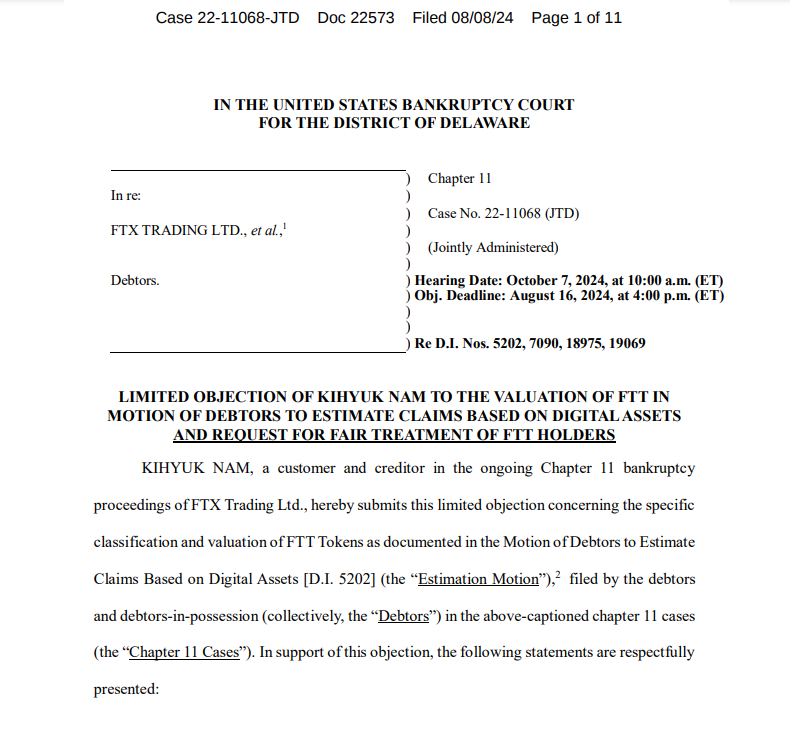
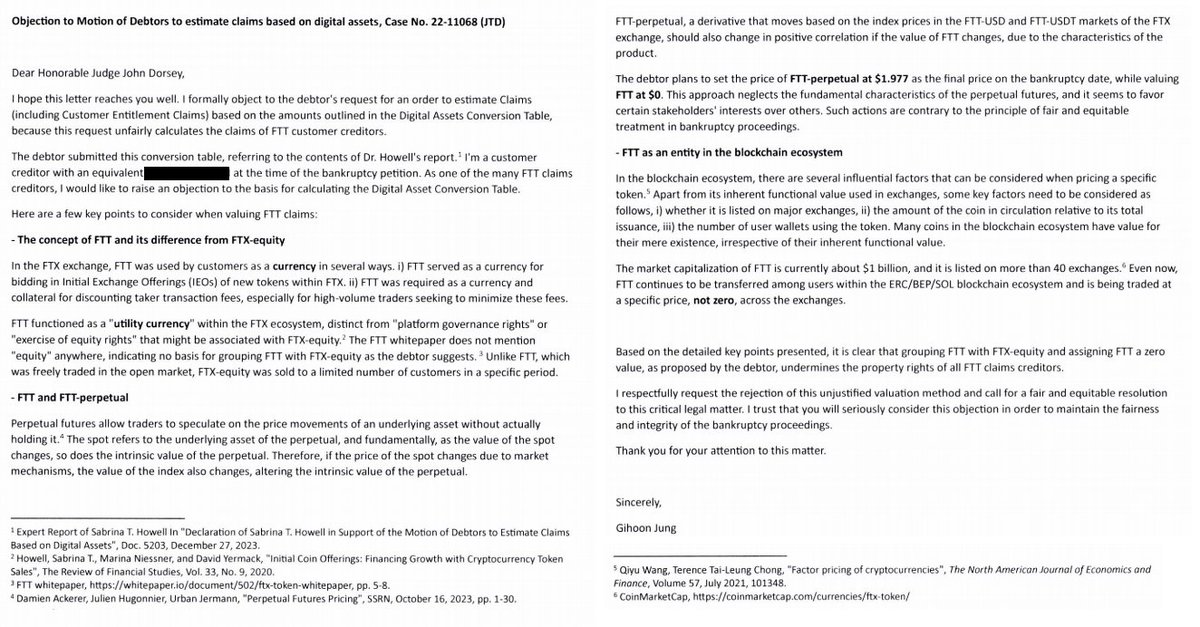
🚨Attention FTT Holders🚨
FTT has been unfairly valued at $0 in the FTX bankruptcy.
We’ve filed an objection regarding FTT Claims.
Debtors may argue only few holders are objecting.
We need more FTT holders to join us.
No need money.
If you’re an FTT holder, Please DM.
#FTT#FTX
One of my sub-accounts held X amount of FTTs and X amount of FTT-PERP shorts.
The FTX debtors treated the account as '0'.
U.S bankruptcy law is absurd.
Just a reminder that if you published anything uncritically parrotting the idea that #FTX was "returning 100% of the money," you were lying to vulnerable people on behalf of the powerful, and should feel endless, crushing shame for what you have done with the life God gave you.