Visualization and guided imageries has helped Harrison Barnes enjoy a breakthrough season, posting career highs in several categories. More importantly, it has helped him off the court as well. 💯
You too can enjoy the same benefits. https://t.co/XY0GaWO4Yc
Worry scheduling is a useful reminder that not every thought deserves immediate access to your attention.
Instead of letting anxiety interrupt the whole day, give it a contained window: 10-30 minutes, same time each day, preferably not right before bed. Write the worries down. Sort what is controllable from what is not. Take one small action where you can. Let the rest exist without trying to solve it.
The lesson for coaches, leaders, and performers is simple: attention needs boundaries. You are not suppressing the worry. You are training the mind to stop treating every anxious thought like an emergency.
https://t.co/aAy70yZn2l
FYI, have used visualization with both pro level athletic and business clients (for pitches, talks, etc.) and it's so incredibly effective.
Looks nuts, but backed by science and improves performance.
New U.S. Soccer research on visual perception using pose tracking from 32 Copa América games.
Counting head scans has zero predictive value for on-ball performance.
What predicts outcomes is whether the player saw the defended space before receiving the ball.
Not how often you look. What you see.
https://t.co/LPdE0fnBFg
The Thunder’s story is a reminder that success rarely comes from chasing outcomes.
It grows out of the disciplined pursuit of continuous improvement.
It originates in leaders who stay curious, ask hard questions, and roll up their sleeves when it matters most.
It results from teams that experiment boldly, treat feedback as fuel, and find meaning in the work they share.
Those are the habits that turn good teams into superteams.
Any team can cultivate them, whether in basketball, business, or beyond.
https://t.co/3dx7kM7WTy
Great decision-makers are not just skilled.
They’re calibrated.
Metacognition = knowing how well your judgment matches reality.
A key insight from the research: underconfident people are not always performing worse, they may just be worse at learning from their own good reps.
Feedback is not only for error correction. It is also for teaching people to recognize when they got it right. 🧠🎯
https://t.co/WFDo7v9j7y
There's a principle in economics called Goodhart's Law: when a measure becomes a target, it ceases to be a good measure.
The moment you pick a number to measure success, behavior quietly reorganizes around it. Reporters write to the metrics that define a good story. Sales teams and engineers ship what gets counted. Researchers optimize for publishable, citable, incremental work. Hospitals got penalized for readmissions within 30 days. Day-31 readmissions quietly went up.
The NBA version of this is the most honest place to see it.
https://t.co/uOubhttceN
Most coaching systems are built to confirm.
Popper would say: that's not a system. That's reinforced dogmatism.
The question isn't "does the evidence support my approach?"
It's "what would prove me wrong?"
https://t.co/aLlzlGKVbf
If you really understand something, you can make it simple.
Most coaches do the opposite.
Great teaching = clear structure:
• Define
• Compare
• Sequence
• Cause → effect
Not more info. Better organized info.
Learning isn’t easier. It’s clearer.
@olicav
https://t.co/FGRDJVmRSv
Conditioning appears in the heart of the Pyramid of Teaching Success in Sport. But it's not describing athletes.
It's describing coaches.
Moral, mental, emotional, physical endurance, across an entire season.
We track player load.
Coach load is an afterthought.
@WadeWgilbert@codyroyle
https://t.co/GZu8En4CeS
"Scan more" may be one of the most commonly misunderstood coaching instructions in sport. 🏀
Head turns ≠ scanning
Scanning ≠ perception
Looking ≠ seeing
You can train the appearance of scanning without training perception at all.
Better question: what does the environment demand that makes searching for information necessary?
New eye-tracking study on basketball decision-making under time pressure:
Experts got faster AND stayed accurate. Novices got faster and fell apart.
Experts fixated on fewer cues but the right ones. Novices scattered everywhere.
You can not drill your way to pressure-proof reads.
You have to practice deciding under pressure.
https://t.co/wTR026MUWF
When a player expects the right thing and it happens, their brain processes it faster 🏀
When they expect the wrong thing, it slows them down. Not just unhelpful, actually a brake on decision speed
Film prep and tendency breakdowns aren't just about knowledge. They change how fast players can process what they see.
Prepare them better.
They'll see the game faster.
https://t.co/XV4GdBl1KS
Mental fatigue may damage perception more than physical fatigue does 🧠
Under mental fatigue, players stop looking at the right things.
Not because of lack of effort.
Because the attentional system can't sustain focus long enough to act on it.
Quiet Eye duration drops.
Decision quality follows.
Cognitive load management deserves the same attention as physical load monitoring.
https://t.co/degiSyQ3vN
Attention doesn't fail because of weak willpower...
It fails because of structural overload 🧠
Fewer inputs beats more discipline.
Environment design beats moment-to-moment control.
Applies to how we design practice environments: protect attention by design, not effort.
@YousriMarzouki
https://t.co/KQTVC9dNjB
The language coaches use in practice is a constraint, same as spacing or defender position 🏀
"Don't force it" produces the image of forcing it.
"Stay patient" doesn't.
Questions direct attention better than statements.
Identity framing transfers better than behavioral instruction.
I made a self-talk "cheat sheet" that includes 7 of the most powerful questions you can ask yourself to instantly unlock motivation and confidence.
Get them here: https://t.co/8qkow8tedz
Unopposed work isn't inherently problematic, it's that the purpose is usually misidentified.
Most coaches use it to install technique. The more defensible use is exploration.
Giving players space to search through their own movement possibilities without the pressure of executing correctly.
There's no strong evidence that unopposed practice needs to precede opposed, game-like work.
The sequencing assumption (acquire the technique first, then apply it in competition) isn't well supported.
Players can enter alive environments earlier than most traditional practice designs allow.
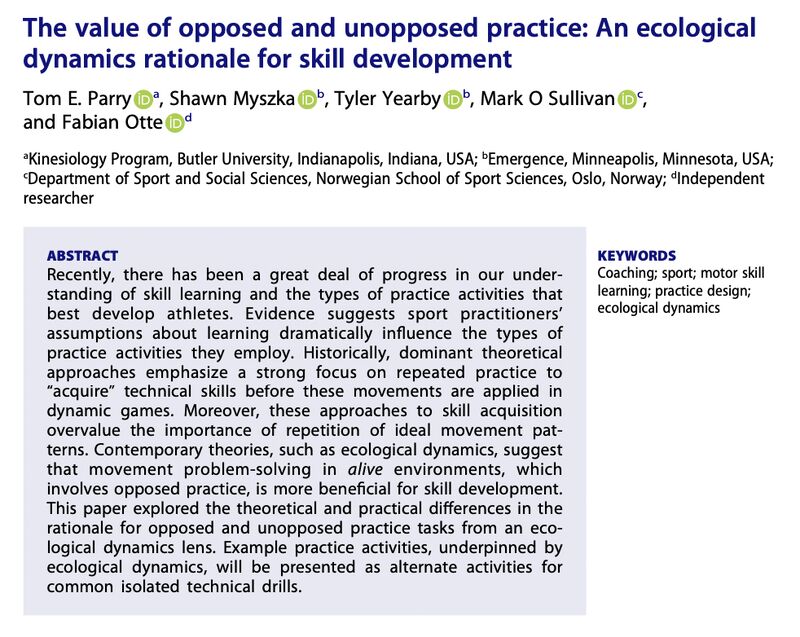
"The rationale for unopposed versus opposed practice tasks in sports is a critical consideration for coaches. In this paper, we presented an ecological dynamics justification for the predominant use of opposed practice tasks with reference to their potential for transfer to competition."
Get into our '25 paper, 'The value of opposed and unopposed practice,' here:
https://t.co/j9k3hgLI5n
Average load ≠ peak load 🏀
Fewer minutes played → higher peak demands hit
Fatigue suppresses output.
"Fresh" bench players aren't automatically ready.
Training almost never touches game peaks!
Good tools become blunt instruments when turned into doctrine.
Retrieval practice should punctuate learning, not replace it.
The goal is durable understanding, not permanent assessment.
The Lethal Mutation of Retrieval Practice
Five ways to get retrieval practice wrong and reflections on a new study which shows that when material is complex, retrieval can stop being a desirable difficulty and start being an undesirable one.
@C_Hendrick
https://t.co/0SuTHPnqba
Every rep is a negotiation. 🧠
Not coach vs. player, the player's brain vs. the question it never stops asking: Is this worth it?
Cohen & Shenhav (Princeton/Brown) call it the Expected Value of Control. Before committing effort, the brain runs a cost-benefit analysis.
Reward vs. difficulty vs. perceived learnability.
If athletes can't feel themselves improving, the brain quietly withdraws its investment. 📉
That's not a motivation problem. That's a design problem.
And design problems have solutions. 🔧
https://t.co/OpuhDirpva