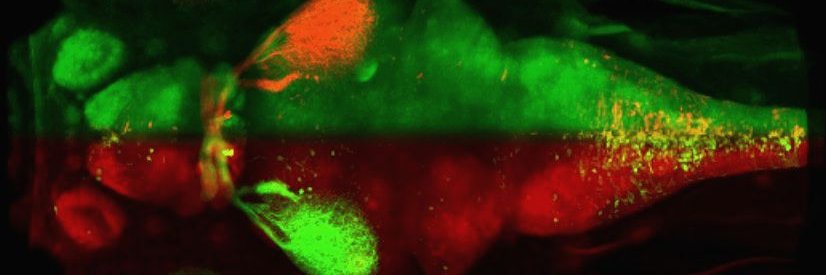
Grad student spotlight: John Hageter is a PhD candidate in the @Horstick1 lab who uses zebrafish to study how environmental stimuli alter visual processing and behavior. Here, John can see how neurons (yellow) respond to stimuli in a whole-brain GCaMP!
https://t.co/h7GTLaPZoB
Great story highlighting the recent collaborative NSF EPSCoR grant we are a part of and the exciting work we plan to do @wvutoday@WVUBiology@WVUEberly@EberlyResearch
This week’s #FluorescenceFriday user is Eric Horstick! #HCRimaging enabled @Horstick1 to test for gene expression and neural activity changes in vivo. View his beautiful HCR RNA-FISH images of larval zebrafish below, and check out his lab page for more info here: https://t.co/YnQuPmvnvy.
Latest preprint. Using a cross species approach (6 in total) we find behavioral lateralization is conserved in evolution with distinct forms that have an overlapping neural basis - and more. Thanks to great collaborations @eduboue & Jeff Mumm https://t.co/KHGyx1z4C7 @WVUBiology
We are excited to share our new preprint. We found a visual critical period in larval zebrafish where brief asymmetric visual experience instructs neural and behavioral asymmetries
@WVUBiology@WvuNeuroscience@WVUVisualSci#zebrafish#Science
https://t.co/mV5DV38czN
First paper finally in press. We developed zebrafish as a model of individuality. Come see how molecular dose-dependency and the environment generate unique motor behavior across genetically similar individuals
https://t.co/2XvOb4LYtr
@WVUBiology@FrontNeurosci#zebrafish
https://t.co/QmoJwUFLaD
Despite a year and counting with many roadblocks, we submitted our first paper - individuality in zebrafish and factors modulating inter-individual differences. Congrats to the lab and our great collaborators. @WVUBiology@NeuroscienceWVU
Reviewers: if you are assigned a manuscript that is well written and data are clear, can we agree to say no changes needed? It seems many suggest unnecessary changes just to feel they are a good reviewer. This is damaging to students, postdocs and PIs 😡 @AcademicChatter
NICHD former fellow interview and some of my thoughts on the exciting journal as an assistant professor @WVUBiology @NICHD_NIH #zebrafish
https://t.co/CYLRrivqkW
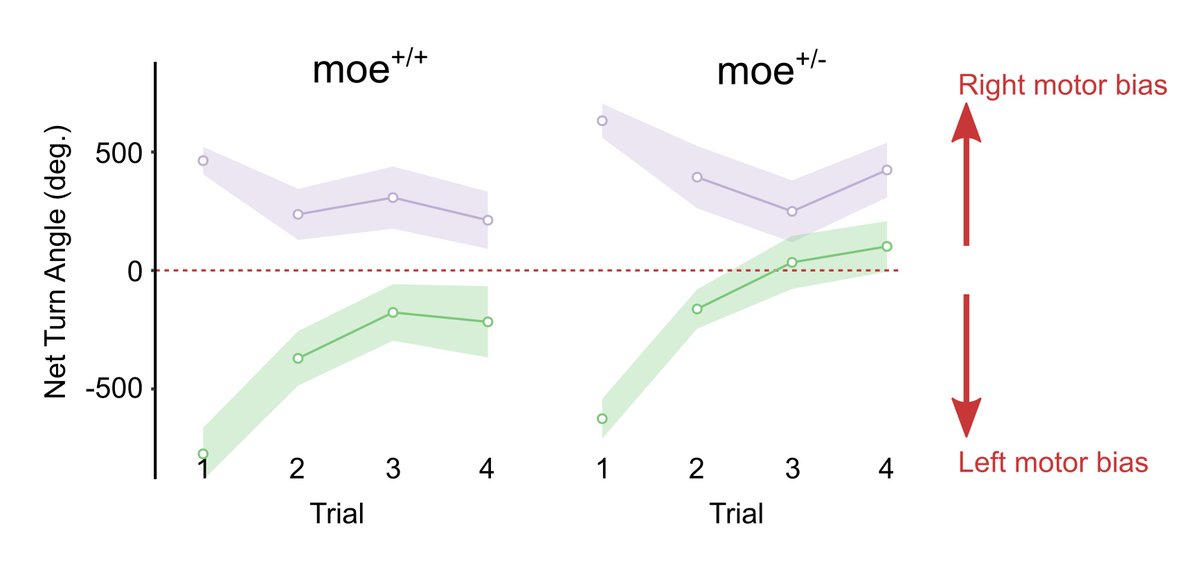
And sure enough normal looking mosaic eyes hets had only weak motor bias! Nice example of how heterozygous mutations can cause subtle behavioral phenotypes like 'handedness'.
Congrats @Horstick1 on publication of his cool story about 'handedness' in #zebrafish with literally a twist at the end of the tale! Here's how we worked it out...
https://t.co/h0FCG4XtE8