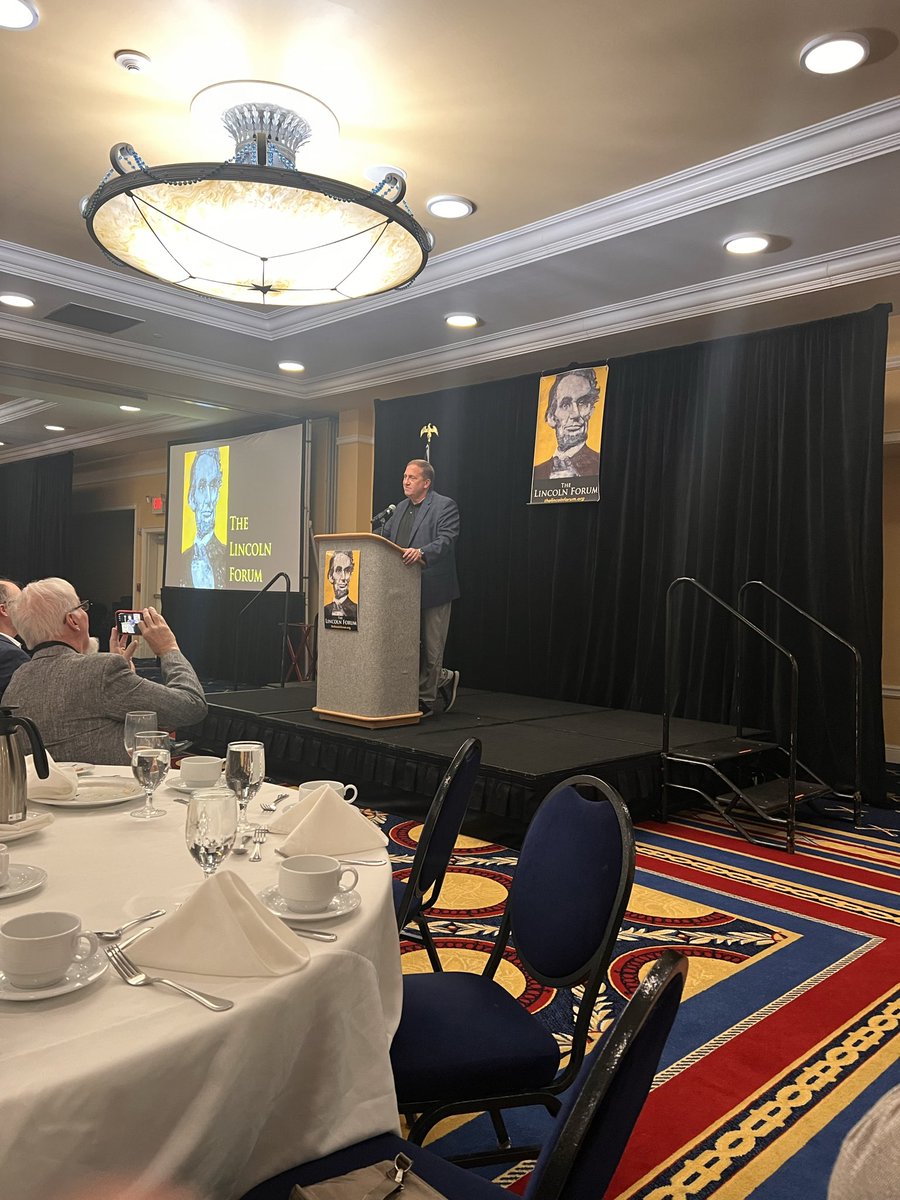
First night of the @TheLincolnForum was a success. Excellent talk by Matthew Pinsker @House_Divided. Just before he delivered his talk, the Lincoln Forum announced his new book, Boss Lincoln: The Partisan Life of Abraham Lincoln, received the organization’s prestigious book of the year award. Congratulations Matt!
Explore Lincoln’s enduring legacy Nov. 19 at Gettysburg College’s Fortenbaugh Lecture, featuring Matthew Pinsker and the Wind Symphony performing “Lincoln Portrait,” narrated by Bruce Boxleitner.
🎟️ Free tickets: https://t.co/IBDbk9oEFg
Resharing these AOC book recommendations, no reason, at all, whatsoever: “I was just gifted a book that I’m about to crack open called Boss Lincoln. It’s about the lost years when Lincoln was building a political machine before he ran for the presidency.“
On February 13, we're pleased to host our symposium, featuring Matthew Pinsker, Lois Romano, Angela Elder, Roger Billings, Joshua Claybourn, Kenneth Noe, Gary Gallagher, Jonathan Earle, & Edward Achorn. Attendance is free, open to the public. Reservations are required for lunch.
📖This week on #BookBreaks, Matthew Pinsker (Dickinson College) discusses his book "Boss Lincoln: The Partisan Life of Abraham Lincoln." Join us October 11 at 2pm ET! This is a free online program for history enthusiasts of all ages.
Register: https://t.co/ZuKHNJVb3Q
@wwnorton
Abraham Lincoln was somewhere between Jonesboro and Charleston, Illinois 168 years ago today.
The day before, he had spent three hours debating Stephen A. Douglas in Jonesboro. Two days later, they would do it all over again at Charleston.
But the campaign did not stop between the debates.
On September 16, 1858, Lincoln reached Centralia around noon, where the Illinois State Fair was underway. Douglas was there too. Crowds gathered whenever either man appeared, but neither delivered a formal speech. Lincoln retreated to the office of an Illinois Central Railroad superintendent and began writing letters.
One letter concerned political damage control from the previous day. Lincoln was worried that something he had said at Jonesboro about fellow Republican Martin Sweet would be blown out of proportion by the Democratic press. Lincoln wrote Sweet immediately to assure him that no disrespect had been intended. https://t.co/yOfUx78PNr
He wrote two other political letters that afternoon: one to Republican Congressman Elihu Washburne, asking whether it was true that Washburne opposed admitting any more slave states to the Union, as Douglas had alleged during the debate the day before. https://t.co/H3S7sZDJH6
Lincoln dashed off a final letter to fellow Republican Joseph Gillespie. By this point, he appears to have been out of paper, so he borrowed a sheet of letterhead from the superintendent. He also seems to have been in a hurry—his handwriting is noticeably less careful than usual. (Judge for yourself; I’ll attach the letter to this post.)
In the letter, Lincoln was alarmed to see news from New York that Republicans and the American Party had failed to unite and instead nominated separate candidates. He feared that something similar could happen in Madison County, Illinois, and urged Gillespie to do whatever he could to keep the various anti-slavery factions together. https://t.co/s3OM4Fsv5y
It’s a small letter, but a revealing one. Even between two of the most famous debates in American history, Lincoln was thinking about local party organization—coalitions, discipline, and votes. It’s exactly the sort of behind-the-scenes political work Matthew Pinsker brings to the foreground throughout Boss Lincoln.
That evening, Lincoln boarded another train and continued toward Charleston. He reached Mattoon early the next morning and spent the following day preparing for the fourth debate, set for September 18.
We often remember the Lincoln-Douglas Debates as seven momentous encounters. And they were. But the campaign of 1858 was relentless: trains, speeches, fairs, newspaper coverage, letters, political organizing, damage control—and then another debate.
The debates were the main events, but the campaign happened in all the miles between them.
And it never really stopped.
It had to be exhausting.
#LincolnToday
Pleased to join the @LincolnPresFdn last night for a discussion with @Erin_Mast & @House_Divided's Matthew Pinsker about our 16th president.
Almost two centuries after his Presidency, there is still much more to be learned about the Railsplitter and his political legacy in America.
https://t.co/tPqdiIvmVK
AOC says she's reading Boss Lincoln. Here's three lessons from the book that might help her or any Democratoc presidential candidate
New "Leaders and Legends" podcast (#367): Prof. Matthew Pinsker, author of “Boss Lincoln: The Partisan Life of Abraham Lincoln” https://t.co/DSFu3QMEfQ
“I was just gifted a book that I’m about to crack open called Boss Lincoln. It’s about the lost years when Lincoln was building a political machine before he ran for the presidency.”
PabloReports: Do you have any book recommendations?
AOC: I was just gifted a book that I’m about to crack open called Boss Lincoln. It’s about the lost years when Lincoln was building a political machine before he ran for the presidency. 👀
📖 What are you reading right now?
Author @loisromano talks about what she is reading right now: "Boss Lincoln" by Matthew Pinsker.
Learn more about Ms. Romano, her career, and writing on the latest episode of "America's Book Club," airing on #BookTV TODAY at 7pm ET on #CSPAN2
https://t.co/C4EyL0R8mS
What is Abraham Lincoln's true political leaning?
Author of "Boss Lincoln," Matthew Pinsker, explores Abraham Lincoln's politics as he rose to the presidency. Watch the full event this Saturday at 9:30 AM ET on @cspan 2 @cspanhistory.
After the program airs, watch the program on our website here: https://t.co/eHfn7iySOC