Join our Research team to hear how base year #recalculation works ahead of the GHG Protocol's Land Sector & Removals Standard (#LSRS) taking effect on January 1: what changes, what #data it takes, & how to separate real reductions from methodology effects. https://t.co/inb12jBHZw
CPGs are under pressure to reduce their emissions, yet up to 95% of their footprint can sit outside their direct operations. Hear from @MDLZ, @Ingredion & Oterra how the supplier–CPG relationship is changing as companies commit to Scope 3 reductions.
https://t.co/OvSgmc6s1f
Join us on November 4th to hear from @Ingredion & Oterra about how they are using #sustainability data and customer relationships to create commercial value, engage #CPG customers around sustainability and turn #data into meaningful insights and solutions. https://t.co/OvSgmc6s1f
“Two suppliers can footprint the same ingredient & get very different results, depending on which data they choose & which consultant they hire."
Ethan Soloviev @ HowGood on how a food-specific methodology built on existing standards could close that gap: https://t.co/D6Af4O5Z9P
"We're pleased to work with Oterra as it expands its sustainability capabilities & provides customers with greater visibility into the environmental impact of naturally sourced color solutions."
How we're providing PCFs for ingredient suppliers: https://t.co/xSb0JMHFO2
"Convergence happens when you put farmers and buyers in the same room around actual contracts, and when data is good enough that insurers and lenders can price risk at the field level instead of the county level."
-Ethan Soloviev @ HowGood in @Ag_Navigator
https://t.co/IwCbxP9NcK
Join us and @Danone tomorrow @ 10am EST to learn how (and when) to strengthen data quality, engage #suppliers in ways that support long-term collaboration & incorporate supplier-level initiatives into your emissions forecasts and corporate #climate targets.https://t.co/kcNpwNcopi
How do food companies move from estimated #Scope3 emissions baselines to a data-driven #reduction pathway?
Join HowGood & @Danone on 10/6 to learn how to strengthen data quality & incorporate supplier-level initiatives into your emissions forecasts: https://t.co/kcNpwNcopi
Join us tomorrow @ 10am EST to hear HowGood’s leadership team break down the biggest trends & signals from #REGENHOUSEClimateWeekNYC — including what’s gaining momentum, what’s changing & what it means for our collective work ahead.
Reserve your spot here: https://t.co/HvVzjZrmSA
SAI platform's latest white paper looks at the different methodologies, quantification approaches and systems boundaries behind these solutions and highlights that there is no one-size fits all approach to measuring GHG agricultural emissions and removals. https://t.co/mUwTrwjqrk
We're excited to enable food & bev companies to leverage Satelligence's Land Use Change (dLUC & jdLUC) data directly within HowGood’s platform to access higher-quality emission factors, enhance supplier risk profiling, and power data-driven climate action. https://t.co/VBcbz4VCSc
"Many companies cannot achieve #netzero without first prioritizing #nearzero#emissions.
This should not be seen as an admission of defeat, but rather a realistic and hard-won strategy for meaningful #reduction."
- Cate Battey @ HowGood in Food Logistics
https://t.co/DJk0Y9hVvl
"Collaborating with @thecarbontrust to assure our footprinting model added a crucial layer of trust for our customers. We can now demonstrate that their product carbon footprints are calculated in line with best practice, ensuring accuracy & transparency."
https://t.co/ledytnrdrD
We're proud to partner with @BobsRedMill to help guide their sourcing decisions — tracking emissions, water usage & soil health risks, and turning that data into action to reduce the environmental footprint of their rice supply chain. Read the full report: https://t.co/VXu32PUUZY
"Companies in the food system can't just keep funding [#regenerative#agriculture] on their own, paying out of pocket for it to happen. It needs to move to a larger scale. To do that, they need more finance."
- Ethan Soloviev, HowGood CIO in @Ag_Navigator
https://t.co/9GGDAZn3no
"You can’t credibly report against a FLAG [forest, land and agriculture] target without looking at inputs. Fertiliser mapping from a procurement concern to a Scope 3 reporting requirement is driven, in large part, by what retailers are now asking for.”
https://t.co/uLCv8cx2FF
The GHG Protocol just released its Land Sector and Removals Guidance for its #LSR Standard. Join HowGood & @perennialearth on 7/23 for a focused look at what the guidance means for #food & #beverage, including upstream and downstream implications. https://t.co/eZi1P2Kzhv
“The other piece this order can accelerate is data infrastructure. Real investment has to be paired with real measurement, or we risk repeating the mistake of funding activity without being able to prove outcomes.”
- HowGood CEO in @AgFunder https://t.co/M7g9Ty9jy3
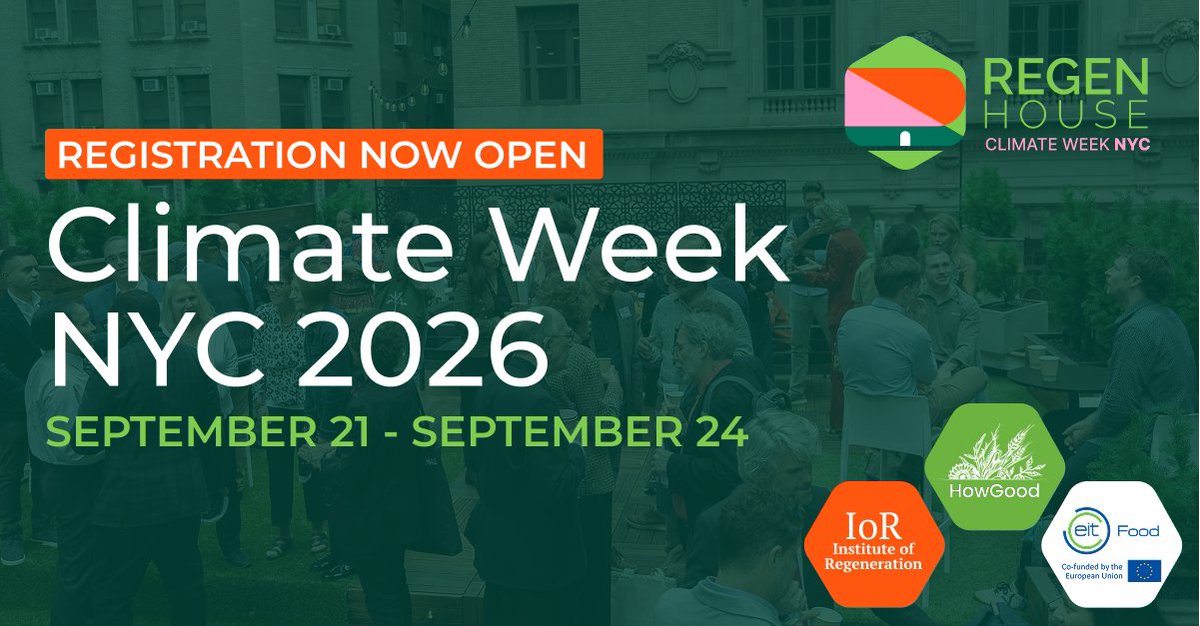
The most important conversations in the #food system don't happen on a stage—they happen around a table. That’s why #REGENHOUSE is returning to #ClimateWeekNYC from September 21–24 as the ultimate hub for advancing #regenerative food and ag systems.
https://t.co/XdFAuw9vIM
Join HowGood's leadership team this Wednesday 7/1 to hear a breakdown of the trends, announcements & shifting priorities that emerged from London Climate Action Week (#LCAW) & the Consumer Goods Forum (#CGF) last week.
Reserve your spot here: https://t.co/H82w5J8boC