For years, businesses spent money keeping bots out. Now they'll have to compete for bots' business.
AI agent traffic grew 8x in just three months, per HUMAN Security. The next "customer" won't browse your site. It will read your docs, call your API and pick whoever is easiest to work with.
If an agent can't understand your product, price or checkout, you're invisible to it.
B2A is coming fast.
HUMAN Security saw AI agent web traffic grow 8x from August to October.
Consumer agents are exploding, and we're in the early innings of the B2A economy.
Businesses that treat agents as first-class customers have a shot at a wave of growth. Those that don't may find themselves under threat. For years, retailers and platforms built walls to keep bots out – now, they will have to fight for bots' business.
Full piece from a16z's Olivia Moore and Justine Moore: https://t.co/Y4aT9wibgb
Congrats to the OpenRouter team.
A reminder of how Spro is priced, and it hasn't changed:
> A flat monthly platform fee
> Model usage at the provider's rate, $0 markup on every model
> No per-request fee
> Your own provider keys work too (BYOK)
https://t.co/7cVI7VijUY
OpenRouter is now part of Stripe.
Stripe is building the economic infrastructure for AI. Together with OpenRouter, we’ll help businesses explore new models and optimize token routing and usage.
0% markup on every model.
New model, same rule: Gemini 4 Carbon is $2.00 in / $10.00 out per 1M tokens on Spro, the provider's own rate.
https://t.co/7cVI7VijUY
Gemini 4 Carbon is now available on Spro.
Model ID: gemini-4-carbon
> Built for coding, agentic and complex reasoning work > Text, image, audio, video and file input, with text output
> 1M context
> Streaming, vision, tools, JSON mode and reasoning
> $2.00 per 1M input tokens and $10.00 per 1M output tokens
> Cache reads at $0.10 per 1M
Same OpenAI SDK, same base URL. Change the model name and you're running it.
https://t.co/9Qlhv7dvg7
Gemini 4 Carbon is now available on Spro.
Model ID: gemini-4-carbon
> Built for coding, agentic and complex reasoning work > Text, image, audio, video and file input, with text output
> 1M context
> Streaming, vision, tools, JSON mode and reasoning
> $2.00 per 1M input tokens and $10.00 per 1M output tokens
> Cache reads at $0.10 per 1M
Same OpenAI SDK, same base URL. Change the model name and you're running it.
https://t.co/9Qlhv7dvg7
Claude Fable 5.2 is live on Spro. Released today.
Anthropic positions it as its most capable model for demanding technical work, with gains over Fable 5.1 in coding, reasoning and vision.
> 1M token context, up to 128K output
> Text, image and file input
> Tool calling, JSON schema outputs, JSON mode
> Reasoning on by default, adjustable effort
> $8 / M input · $40 / M output
One OpenAI-compatible API. Change the model ID and you're running:
claude-fable-5.2
Plus routing, guardrails, caching and observability on every request.
Try it: https://t.co/vZrV2sI0rQ
Introducing Claude Fable 5.2 and Claude Mythos 5.2, designed to tackle the most daunting technical challenges.
They’re capable collaborators on ambitious projects in many fields, and show improvements in areas like coding, reasoning, and vision.
Fireworks got breached. Here’s the part nobody’s talking about.
> Oct 6: stolen internal credentials. Attackers read environment variables from evaluation jobs and grabbed customer API keys.
> Oct 23: a third-party cloud provider hosting Fireworks’ R&D machines gets hit.
> Oct 24: attackers walk through that door into dev machines and run their own workload. Customer datasets and incomplete model weights are accessed.
The goal wasn’t to leak anything. It was LLMJacking: steal AI access, resell it through illicit routing gateways.
Three lessons:
> Your security includes everything you rent. The second breach didn’t start at Fireworks.
> Secrets in environment variables are one bad day from public. Short-lived, scoped credentials beat long-lived keys.
> Deleting a leaked key from your storage doesn’t kill it. Revoke it at the source.
We run an AI gateway, so we hold keys and see traffic. That makes us a target too. We build assuming we’re already breached, and the keys and data we hold are stored encrypted.
Rotate your AI keys today.
You can add guardrails, failover and spend limits to your AI app by changing two lines.
The base URL. The API key.
That's it. Same OpenAI SDK, same code. Behind it:
> 350+ models from one endpoint
> Sensitive data masked before it reaches the provider
> Failover when a provider goes down
> A budget on every API key
> A log of every request
Get started for free: https://t.co/AJ5ZY0VTpW
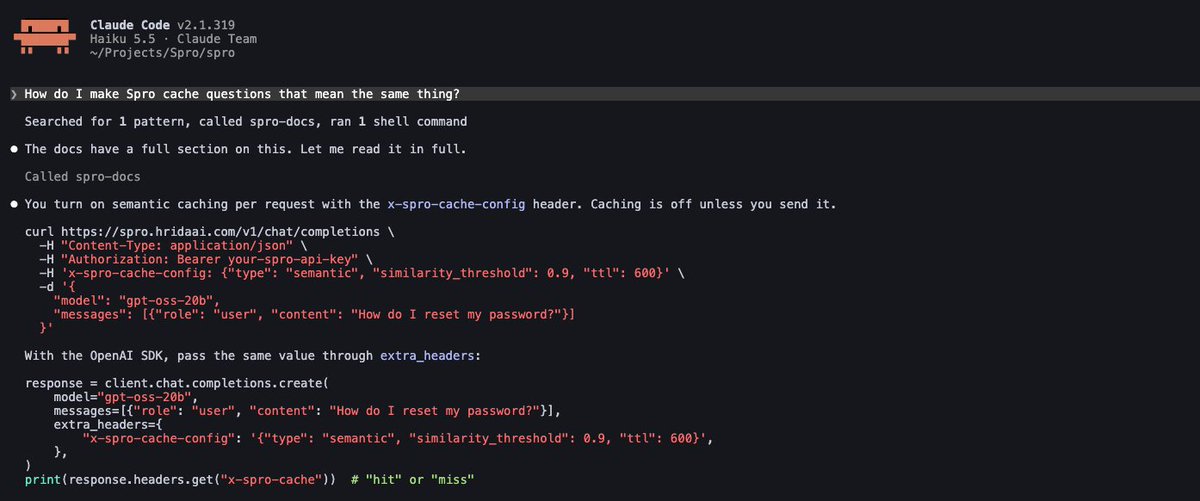
Asked Claude Code: "How do I make Spro cache questions that mean the same thing?"
It didn't guess. It called the Spro docs MCP, read the caching page in full and came back with the exact header, the 0.9 default threshold and a working curl.
Same question, no tab-hopping.
https://t.co/usIyCXDQX3
We just launched the 𝗦𝗽𝗿𝗼 𝗱𝗼𝗰𝘀 𝗠𝗖𝗣 𝘀𝗲𝗿𝘃𝗲𝗿. 🚀
Documentation has a problem. You open the docs for one answer. Then you click a link, then another, then another. Ten tabs later you've forgotten what you came for. And when you ask your AI agent instead, it answers confidently from training data, with a detail that's slightly off or something that changed last month.
The Spro docs MCP server fixes that.
Connect it once, and your agent can search and read the current Spro docs directly, inside Claude Code, Cursor, Codex CLI, VS Code, Claude Desktop and any client that supports remote MCP.
What you get:
> Current answers. It reads the same docs the website publishes, so details track the latest features, tiers and limits.
> Exact details. The agent reads the full page, so answers come from the source, not a guess.
> No context switching. Ask while you write code.
> Safe by design. It's read-only, needs no API key and can't change your account or data.
A few things you can ask your agent once it's connected:
> "How do I make Spro cache semantically similar questions?"
> "What does Zero Data Retention store, and what doesn't it?"
> "Show me how to send a fallback chain of models through Spro."
> "Which alerts should I turn on for a new workspace?"
Setup instructions for every client are in the docs:
https://t.co/usIyCXDj7v
Spro is an AI gateway and security platform: one OpenAI-compatible API for 350+ models, with routing, guardrails, caching and observability built in. Making the docs agent-readable is one more step toward making it easy to build with.
#MCP #AIGateway #DeveloperTools #AIEngineering
@acudell Live. It reads the same docs the website publishes, so there’s no separate snapshot to go stale. When the docs change, your agent sees the new version.
We just launched the 𝗦𝗽𝗿𝗼 𝗱𝗼𝗰𝘀 𝗠𝗖𝗣 𝘀𝗲𝗿𝘃𝗲𝗿. 🚀
Documentation has a problem. You open the docs for one answer. Then you click a link, then another, then another. Ten tabs later you've forgotten what you came for. And when you ask your AI agent instead, it answers confidently from training data, with a detail that's slightly off or something that changed last month.
The Spro docs MCP server fixes that.
Connect it once, and your agent can search and read the current Spro docs directly, inside Claude Code, Cursor, Codex CLI, VS Code, Claude Desktop and any client that supports remote MCP.
What you get:
> Current answers. It reads the same docs the website publishes, so details track the latest features, tiers and limits.
> Exact details. The agent reads the full page, so answers come from the source, not a guess.
> No context switching. Ask while you write code.
> Safe by design. It's read-only, needs no API key and can't change your account or data.
A few things you can ask your agent once it's connected:
> "How do I make Spro cache semantically similar questions?"
> "What does Zero Data Retention store, and what doesn't it?"
> "Show me how to send a fallback chain of models through Spro."
> "Which alerts should I turn on for a new workspace?"
Setup instructions for every client are in the docs:
https://t.co/usIyCXDj7v
Spro is an AI gateway and security platform: one OpenAI-compatible API for 350+ models, with routing, guardrails, caching and observability built in. Making the docs agent-readable is one more step toward making it easy to build with.
#MCP #AIGateway #DeveloperTools #AIEngineering
🪔✨ Happy Diwali from Team Hrida AI! ✨
This Diwali, let's celebrate the light of innovation, the power of ideas, and the possibilities of technology.
May this festival inspire us to break barriers, turn challenges into opportunities, and build a smarter, brighter, and more inclusive future with AI. 🚀
Here's to illuminating new possibilities and creating meaningful impact through innovation.
Wishing you and your loved ones a joyful, prosperous, and wonderful Diwali! ❤️
Team Hrida AI
#HappyDiwali #HridaAI #Innovation #ArtificialIntelligence #AIForGood #FestivalOfLights #BuildingTheFuture
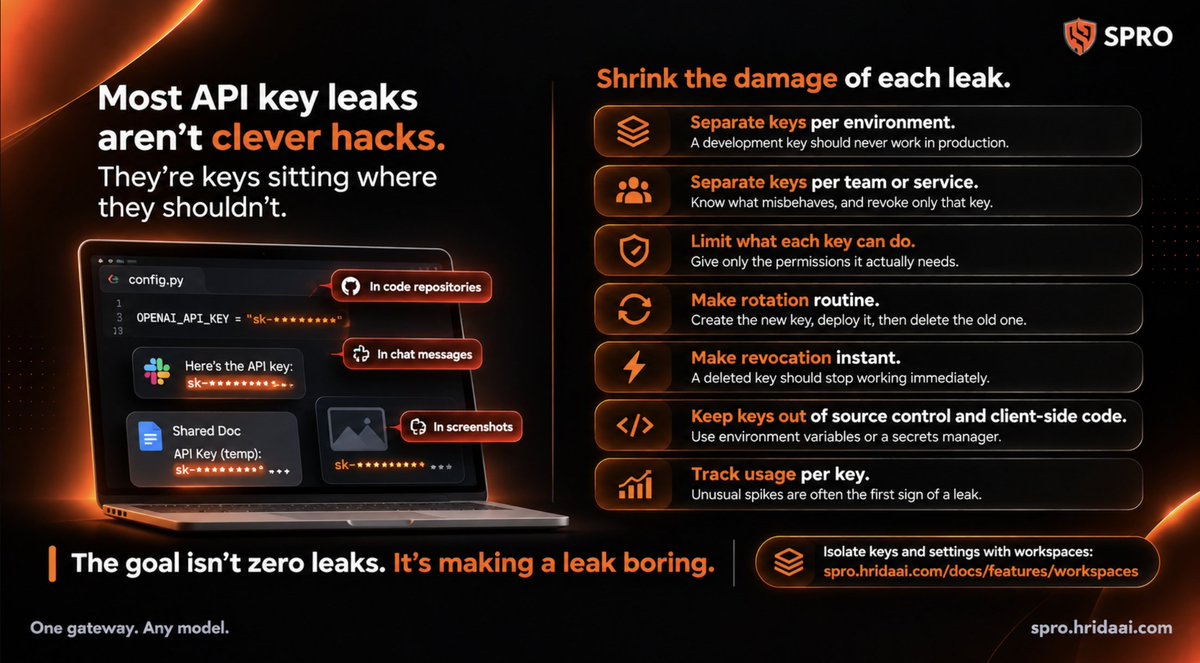
Most API key leaks aren't clever hacks. They're keys sitting where they shouldn't.
In code repositories. In chat messages. In screenshots. On a former colleague's laptop. In a shared document "just for now."
You can't prevent every mistake, but you can shrink the damage of each one.
Use separate keys per environment. A key in development should never work in production. If a test key leaks, nothing real is at risk.
Use separate keys per team or service. When something misbehaves, you can tell which one, and revoke only that one.
Limit what each key can do. A key that only needs to read shouldn't be able to write, and a key for one project shouldn't reach another.
Make rotation routine. Create the new key, deploy it, then delete the old one. If rotating a key is scary, it won't happen until after an incident.
Make revocation instant. A deleted key should stop working immediately, not at the next sync.
Keep keys out of source control and client-side code. Use environment variables or a secrets manager.
Track usage per key. Unusual spikes are often the first sign of a leak.
The goal isn't zero leaks. It's making a leak boring.
#APISecurity #CyberSecurity #DevSecOps #SecretsManagement #InfoSec
Choosing an AI gateway? Don't start with the feature list. Start with these seven questions.
1. Do you really use more than one model or provider? If it's one provider and one model, you may not need a gateway at all.
2. What sensitive data can reach your prompts? If the honest answer is "we're not sure," masking at the gateway is worth a look.
3. What happens when your main provider has a bad day? If the answer is "we write code," you want built-in failover.
4. Can you cap spend with a hard stop? A dashboard shows damage after the fact. A limit prevents it.
5. Can you see which model answered, what it cost and what got blocked, per request?
6. What does the vendor actually retain? Ask about content versus metadata, and ask whether retention at the model provider is covered too.
7. How hard is it to leave? OpenAI-compatible APIs and bring-your-own-key keep switching costs low.
And an honest eighth: a simple router or a self-hosted proxy might fit you better if you don't need built-in guardrails and want full control of the infrastructure.
Spro is a managed gateway: one OpenAI-compatible API for 350+ models with guardrails, routing, caching and observability built in. Use the questions above to decide if that's your shape.
#AIGateway #LLM #AIEngineering #GenAI #AISecurity
Hot take: "we used 2 billion tokens this month" is not an achievement.
It's an invoice.
The teams doing AI well aren't the ones consuming the most. They're the ones who know why they're consuming it:
1. Routine work runs on cheaper models
2. Hard problems get the strong ones
3. Repeat questions are answered from cache, with no model call and no tokens
4. Agents have hard limits, so a loop can't drain the budget overnight
5. Every request is visible by model, provider and cost
Efficiency isn't about using less AI. It's about using the right AI.
Spro gives you the controls to do that: routing, caching, limits and observability, all behind one API.
https://t.co/AJ5ZY0VTpW
#AI #LLM #AIGateway #AIEngineering #GenAI