Get #Yukitabi to plan and manage your next #Japan holiday. DM me for a FREE promo code.
One of the barriers when traveling in Japan is often communicating food allergies or dietary preferences. With Yukitabi, you can keep an allergy card which automatically translates to the relevant Japanese phrasing.
https://t.co/10BLxXwSyr
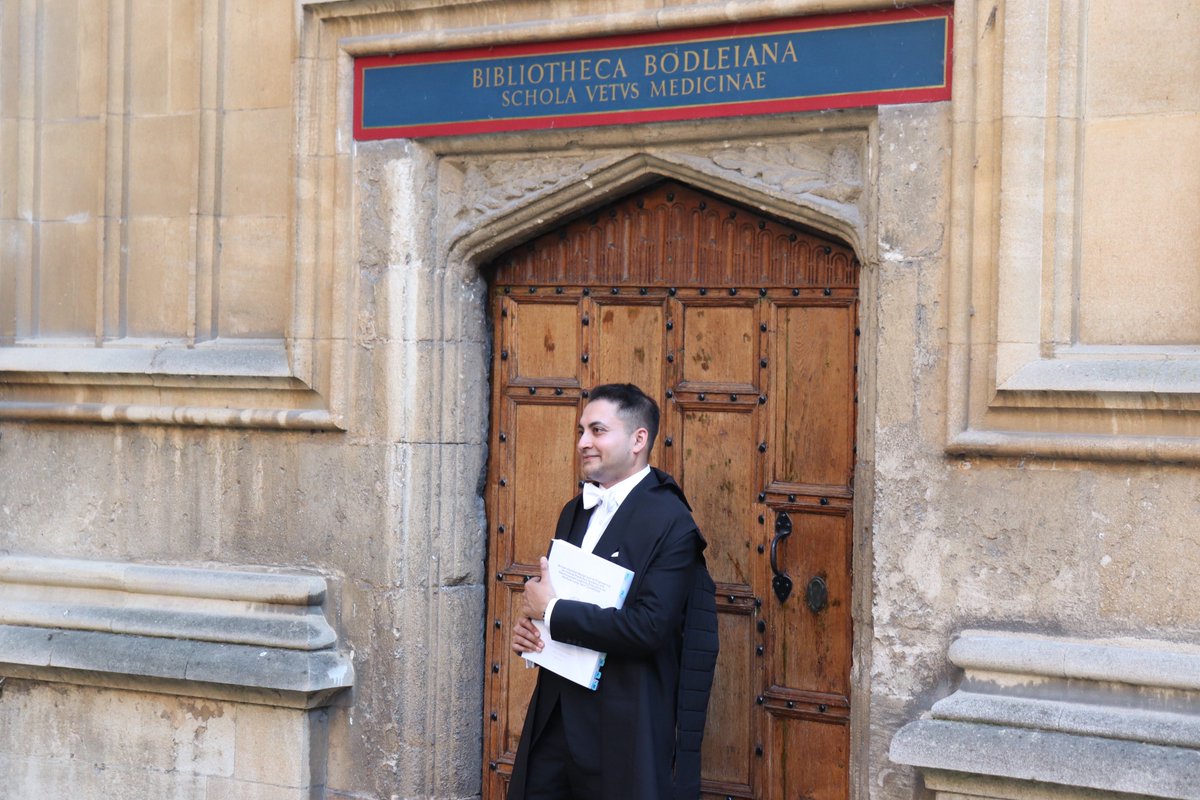
I present to you Dr Sami Adnan (Oxon)
Last week I passed the DPhil viva! 🎓
My thesis asks how AI can be made useful and trustworthy for people living with multiple long-term conditions: building clinical prediction models on a cohort of 6.8 million patients in the @NHS, using #reinforcementlearning to choose between competing models, and a human-centred design approach that keeps clinicians and patients at the centre.
I would like to express my sincere gratitude to my supervisors, Professor Rafael Perera-Salazar and Professor Clare Bankhead, for their mentorship and guidance. I am also thankful to my examiners, Professor John Powell, University of Oxford (internal), and Professor Niels Peek, University of Cambridge (external).
This long journey of 4.5 years would not have been possible without the unconditional support of my wife, Samara. Along the way, I became a dad to our two sons, Zayden (2 years) and Kaylon (8 weeks) — they have made it all both possible and special.
To my family and friends who cheered me on throughout: thank you. I missed more moments than I would have liked getting here, and I cannot wait to be there for all the ones ahead.
#DPhil #PhD #DPhilLife #PhDlife #healthAI #digitalhealth #machinelearning @ReubenCollege@UniofOxford@OxUniStudents@NIHRresearch@OxPrimaryCare
My #DPhil research impact showcased on our department's website by the wonderful team at #NIHR ARC OxTV. A project I loved working with, creating this body of work. I am thankful to all the people who supported and helped create this impact through my research. #healthAI #clinicalAI #primarycare #PhD
@UniofOxford@ReubenCollege@NIHRresearch@arc_oxtv
https://t.co/UJdiGQiKnG
YUKITABI is available now!
An app that I created based on my #Japan travel experience and planning guides. Checklists, cultural tips, Japanese phrases, airport information, and so much more!
It’s FREE during the launch (until 31.05.2026), so get it now, tell your friends who might be planning a holiday to Japan.
https://t.co/yr67mCrRfz
#japan #japantravel #travel #iPhone #iPad #Yukitabi
The #JapanTravel app that I’ve been working on is now in #beta if anyone wants to give it a spin.
It is aimed for first time travelers as well as pros. A culmination of travel guides, todos, checklists and more that I used for my own travels. #Japan
https://t.co/DseQqiQ8G4
There will be no AI jobpocalypse.
The story that AI will lead to massive unemployment is stoking unnecessary fear. AI — like any other technology — does affect jobs, but telling overblown stories of large-scale unemployment is irresponsible and damaging. Let’s put a stop to it.
I’ve expressed skepticism about the jobpocalypse in previous posts. I’m glad to see that the popular press is now pushing back on this narrative. The image below features some recent headlines.
Software engineering is the sector most affected by AI tools, as coding agents race ahead. Yet hiring of software engineers remains strong! So while there are examples of AI taking away jobs, the trends strongly suggest the net job creation is vastly greater than the job destruction — just like earlier waves of technology. Further, despite all the exciting progress in AI, the U.S. unemployment rate remains a healthy 4.3%.
Why is the AI jobpocalypse narrative so popular? For one thing, frontier AI labs have a strong incentive to tell stories that make AI technology sound more powerful. At their most extreme, they promote science-fiction scenarios of AI “taking over” and causing human extinction. If a technology can replace many employees, surely that technology must be very valuable!
Also, a lot of SaaS software companies charge around $100-$1000 per user/year. But if an AI company can replace an employee who makes $100,000 — or make them 50% more productive — then charging even $10,000 starts to look reasonable. By anchoring not to typical SaaS prices but to salaries of employees, AI companies can charge a lot more.
Additionally, businesses have a strong incentive to talk about layoffs as if they were caused by AI. After all, talking about how they’re using AI to be far more productive with fewer staff makes them look smart. This is a better message than admitting they overhired during the pandemic when capital was abundant due to low interest rates and a massive government financial stimulus.
To be clear, I recognize that AI is causing a lot of people’s work to change. This is hard. This is stressful. (And to some, it can be fun.) I empathize with everyone affected. At the same time, this is very different from predicting a collapse of the job market.
Societies are capable of telling themselves stories for years that have little basis in reality and lead to poor society-wide decision making. For example, fears over nuclear plant safety led to under-investment in nuclear power. Fears of the “population bomb” in the 1960s led countries to implement harsh policies to reduce their populations. And worries about dietary fat led governments to promote unhealthy high-sugar diets for decades.
Now that mainstream media is openly skeptical about the jobpocalypse, I hope these stories will start to lose their teeth (much like fears of AI-driven human extinction have).
Contrary to the predictions of an AI jobpocalypse, I predict the opposite: There will be an AI jobapalooza! AI will lead to a lot more good AI engineering jobs, and I’m also optimistic about the future of the overall job market. What AI engineers do will be different from traditional software engineering, and many of these jobs will be in businesses other than traditional large employers of developers. In non-AI roles, too, the skills needed will change because of AI. That makes this a good time to encourage more people to become proficient in AI, and make sure they’re ready for the different but plentiful jobs of the future!
[Original text in The Batch newsletter.]
Off to San Francisco all the way from Berlin to attend the #AIMI2025 and the #Stanford#AI week at @Stanford University.
Looking forward to meeting pioneers in the Health AI field and learn as much as I can. Say hi if you’re at the event.
📊 Just released Parquet Converter - a Python tool I built to convert text-based files to parquet.
✅ CSV/TXT to Parquet
✅ Batch processing
✅ Memory optimization
Try it: pip install parquet-converter
https://t.co/jJNV8bVPI4
#Python#DataScience#OpenSource#healthdata



















![AndrewYNg's tweet photo. There will be no AI jobpocalypse.
The story that AI will lead to massive unemployment is stoking unnecessary fear. AI — like any other technology — does affect jobs, but telling overblown stories of large-scale unemployment is irresponsible and damaging. Let’s put a stop to it.
I’ve expressed skepticism about the jobpocalypse in previous posts. I’m glad to see that the popular press is now pushing back on this narrative. The image below features some recent headlines.
Software engineering is the sector most affected by AI tools, as coding agents race ahead. Yet hiring of software engineers remains strong! So while there are examples of AI taking away jobs, the trends strongly suggest the net job creation is vastly greater than the job destruction — just like earlier waves of technology. Further, despite all the exciting progress in AI, the U.S. unemployment rate remains a healthy 4.3%.
Why is the AI jobpocalypse narrative so popular? For one thing, frontier AI labs have a strong incentive to tell stories that make AI technology sound more powerful. At their most extreme, they promote science-fiction scenarios of AI “taking over” and causing human extinction. If a technology can replace many employees, surely that technology must be very valuable!
Also, a lot of SaaS software companies charge around $100-$1000 per user/year. But if an AI company can replace an employee who makes $100,000 — or make them 50% more productive — then charging even $10,000 starts to look reasonable. By anchoring not to typical SaaS prices but to salaries of employees, AI companies can charge a lot more.
Additionally, businesses have a strong incentive to talk about layoffs as if they were caused by AI. After all, talking about how they’re using AI to be far more productive with fewer staff makes them look smart. This is a better message than admitting they overhired during the pandemic when capital was abundant due to low interest rates and a massive government financial stimulus.
To be clear, I recognize that AI is causing a lot of people’s work to change. This is hard. This is stressful. (And to some, it can be fun.) I empathize with everyone affected. At the same time, this is very different from predicting a collapse of the job market.
Societies are capable of telling themselves stories for years that have little basis in reality and lead to poor society-wide decision making. For example, fears over nuclear plant safety led to under-investment in nuclear power. Fears of the “population bomb” in the 1960s led countries to implement harsh policies to reduce their populations. And worries about dietary fat led governments to promote unhealthy high-sugar diets for decades.
Now that mainstream media is openly skeptical about the jobpocalypse, I hope these stories will start to lose their teeth (much like fears of AI-driven human extinction have).
Contrary to the predictions of an AI jobpocalypse, I predict the opposite: There will be an AI jobapalooza! AI will lead to a lot more good AI engineering jobs, and I’m also optimistic about the future of the overall job market. What AI engineers do will be different from traditional software engineering, and many of these jobs will be in businesses other than traditional large employers of developers. In non-AI roles, too, the skills needed will change because of AI. That makes this a good time to encourage more people to become proficient in AI, and make sure they’re ready for the different but plentiful jobs of the future!
[Original text in The Batch newsletter.]](https://pbs.twimg.com/media/HIIb1VGaUAAZoAB.jpg)


