However, these forces are primarily a peacetime presence and would be extremely vulnerable in a high-end conflict. Their existence serves more political, strategic, and diplomatic than military purposes .
https://t.co/QlYMGK6KKI
The data from last month shows a significant decrease compared to the 104 sorties in April. A probable cause or background for this is President Trump's visit to Beijing.
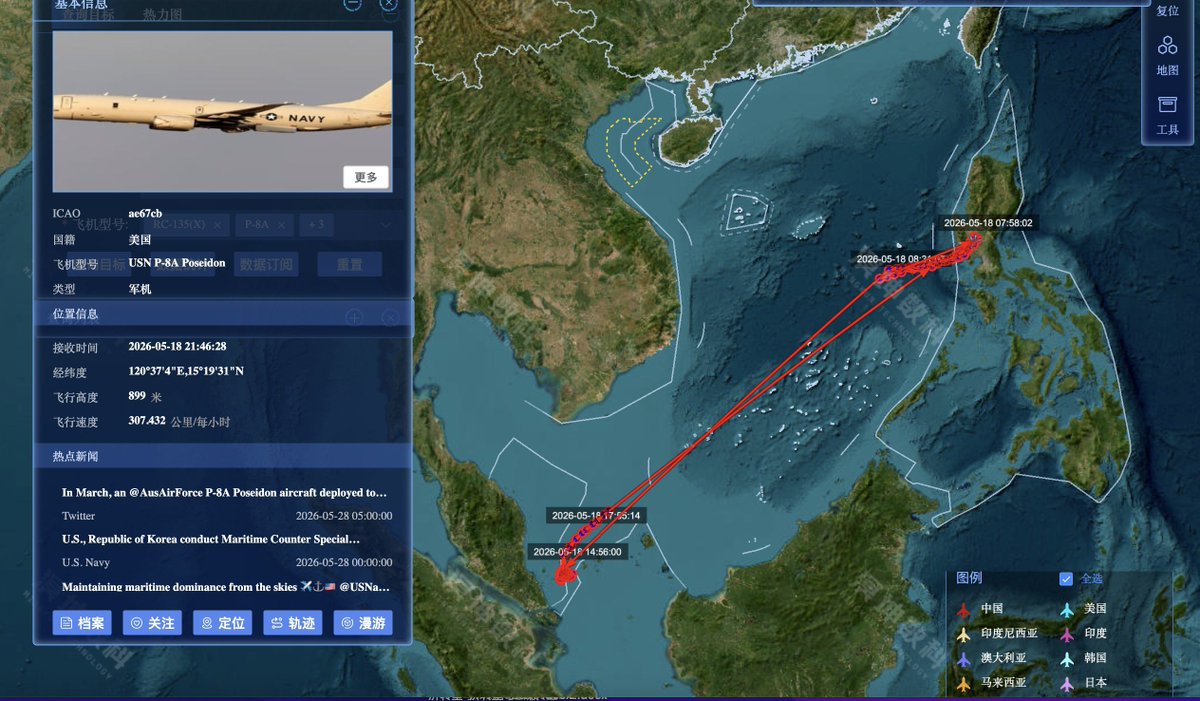
#Statistics: In May 2026, 63 sorties of US military land-based reconnaissance aircraft were spotted over the #SouthChinaSea according to ADS-B data, decreasing compared with the number in the last month. Cases: USN P-8As operated on May. 18 and 26.
In 2025, non-US extra-regional countries continued to expand their military presence in the Western Pacific, undertaking activities such as reconnaissance patrols, Taiwan Strait transits, forward deployments, drills and exercises, as well as port calls. The UK and France deployed carrier strike groups (CSGs) to the region, and conducted joint drills with allies like the US and Japan.
https://t.co/Vay24zbdYn
Hu Bo: "Geopolitical dynamics in Southeast Asia were different from those in Hormuz, and the Strait of Malacca was unlikely to face disruptions like those in the Strait of Hormuz, though the ongoing crisis in the Hormuz Strait is expected to heighten global awareness about maritime chokepoint security."
https://t.co/DS0TXhQzZz via @scmpnews
"The U. S. maritime superiority and sea control have been successfully contested by Iran's geographic-dependent sea denial strategy. This once again exposes the limitations of power projection and employment for 21st-century maritime powers..."
https://t.co/wBZQBYXapl
The prospects for US-Israel-Iran ceasefire negotiations? The way out out of the deadlock in #Hormuz Strait? and its implication for sea denial and sea power theory? Sharing from @HuBo0001 and Dr.Zhu Zhaoyi
https://t.co/IMv6Wbl2M6 via @YouTube
The PCG is playing with fire. The traditional practice in the #Spratly Islands is that all parties maintain a control zone of 12 NMs around their occupied features and don't challenge each other. Since the Philippines Insists on changing the status quo, it should not complain about the consequences.
This article is way too exaggerated. MizarVision is merely the more active and diligent one among the open-source intelligence accounts. The original remote sensing images it used have also been widely disseminated by some Western background accounts, and Iran as a nation state, of course, has the channels to access worldwide commercial data including from the American companies.
https://t.co/ddlqeRa79u
"Artificial intelligence is beginning to rewrite the grammar of sea power and that organisational adaptation is every bit as important as technological innovation"
https://t.co/aJ1dA1qgu1
‼️🇺🇸 Why the U.S. Navy can’t fully protect the Strait of Hormuz:
The U.S. has the world’s most powerful navy, but protecting the narrow Strait of Hormuz is extremely difficult. More details in the video.
Except, President Marcos can’t really do that without violating his oath of office:
1) Article XII, Section 2 of PH Constitution is clear: the exploration, development, and utilization of natural resources must remain under the full control and supervision of the State, and may be undertaken only by the State itself or through Filipino citizens or corporations that are at least 60% Filipino-owned.
2) Hence, any “joint exploration” in Philippine EEZ, even if inside the nine-dash line, cannot simply be a politically convenient 50-50 arrangement with China. It must comply with constitutional requirements, including Filipino control.
3) The Philippines could again propose a service contract or some form of technical/financial assistance arrangement—but that would still have to operate under Philippine law and within a legal framework that recognizes Philippine sovereign rights in its EEZ.
4) That is precisely the problem: China is unlikely to accept any arrangement that places its activities under Philippine law or implies recognition of Philippine jurisdiction in the West Philippine Sea. How many times have PH tried to do this?
I wonder why the President wasn’t briefed… or why the DFA’s institutional memory is not working here.
It's quite interesting! Similar marine research activities are carried out by worldwide ocean states esp. the US,Japan and India. However, only China's is news. BTW, this is freedom of the sea, although the description and speculation in this report are overly exaggerated.
https://t.co/wfiGAnp2O3
Hu Bo @HuBo0001 , Iran's attack capability has declined rapidly, however, “For Iran, as long as it maintains some ability to retaliate, the conflict cannot be resolved quickly.”
https://t.co/r1SefFh02v via @scmpnews
1)Provisional understandings—whether on resupply missions or incident management—are often portrayed as concessions or even “appeasement”. This framing is misplaced. In contested maritime environments, such mechanisms are not about sovereignty, but about control: they reduce the risk of escalation while preserving operational space.
When these tools are delegitimised, policy options narrow. Compromise becomes politically costly, leaving escalation as the default option. Over time, this rigidity increases the risk of miscalculation and limits Manila’s ability to manage tensions on its own terms.
2)This challenge becomes clearer when viewed alongside China’s maritime approach. Beijing has tended to favour calibrated actions at sea, combined with an emphasis on managing differences while maintaining its claims. Such an approach places a premium on consistency and patience, and often responds to developments as they arise rather than through sudden escalation. In this context, a strategy that reduces flexibility or amplifies each interaction into a broader confrontation may inadvertently make crisis management more difficult. Manila shall not give Beijing chances as @HuBo0001 said.
Manila shall preserve operational flexibility, reduce the risk of escalation, and maintain space for diplomacy. Defending national interests does not require turning every tactical adjustment into a test of political resolve.
3) A rigid posture risks narrowing the Philippines’ own strategic options. Closer security ties with the United States can strengthen deterrence, but they are most effective when combined with an independent and adaptable national strategy. At the same time, highly absolutist rhetoric, while understandable in a domestic context, may be less effective in sustaining broad international support.
4) Drawing lessons from regional practice( Malaysia, Vietnam), the Philippines could better protect its interests while reducing risks. In a long-term and complex maritime environment, resilience and adaptability will be as important as resolve.
5) The Philippines may hold some legal advantage in maritime claim. China also has legal advantage in terms of territorial sovereignty issues. But legal outcomes do not enforce themselves. Perhaps the Philippines ought to count itself fortunate to share a border with China rather than with the United States nowadays.
This is just because the U.S. military presence in the Philippines is of little practical use in wartime, and the Philippine side really has nothing to boast about.
https://t.co/FBy2z2PSlp
It took place about 20 nautical miles off the coast of Sri Lanka, which is not international waters, but the contiguous zone of Sri Lanka. According to international law, the U.S. warship has freedom of navigation here, but does that include killing another country's warship?
The US Department of Defense released video footage it says shows an Iranian warship being sunk by a US submarine off the southern coast of Sri Lanka, far from Iran, killing dozens of sailors and widening Washington's pursuit of the Iranian navy https://t.co/JiTJGPNG0a