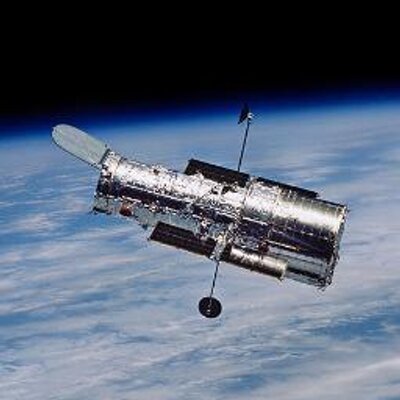
A former account for the Hubble Space Telescope. For more about Hubble, follow @NASAHubble. For more on Hubble's science operations, follow @SpaceTelescope.
FYI: We’re closing this account soon, but the latest Hubble news and images can be found over at NASA’s official Hubble account.
@NASAHubble shares mission updates, educational videos, and activities—like finding out what Hubble saw on your birthday. And @spacetelescope plans and schedules Hubble observations, as well as maintains its archive of data.
This account will be closed soon, but you can follow NASA’s official Hubble account @NASAHubble to get the latest news from the mission. Plus, follow along for award-winning videos and image sonifications like this one, showing the Pillars of Creation.
And to see how great science ideas turn into great science, follow the Space Telescope Science Institute (@spacetelescope), Hubble’s science operation center.
This account is sunsetting soon, but you can keep up with the mission over at NASA’s official Hubble account, @NASAHubble. To stay up-to-date with Hubble’s science operations center and data archive, follow the Space Telescope Science Institute at @SpaceTelescope.
Did you know @spacetelescope is the science operations center for Hubble? Their work spans the lifecycle of a scientific proposal for Hubble observations, which they have performed since its launch in 1990.
Follow ➡️ https://t.co/6Th7yvii09
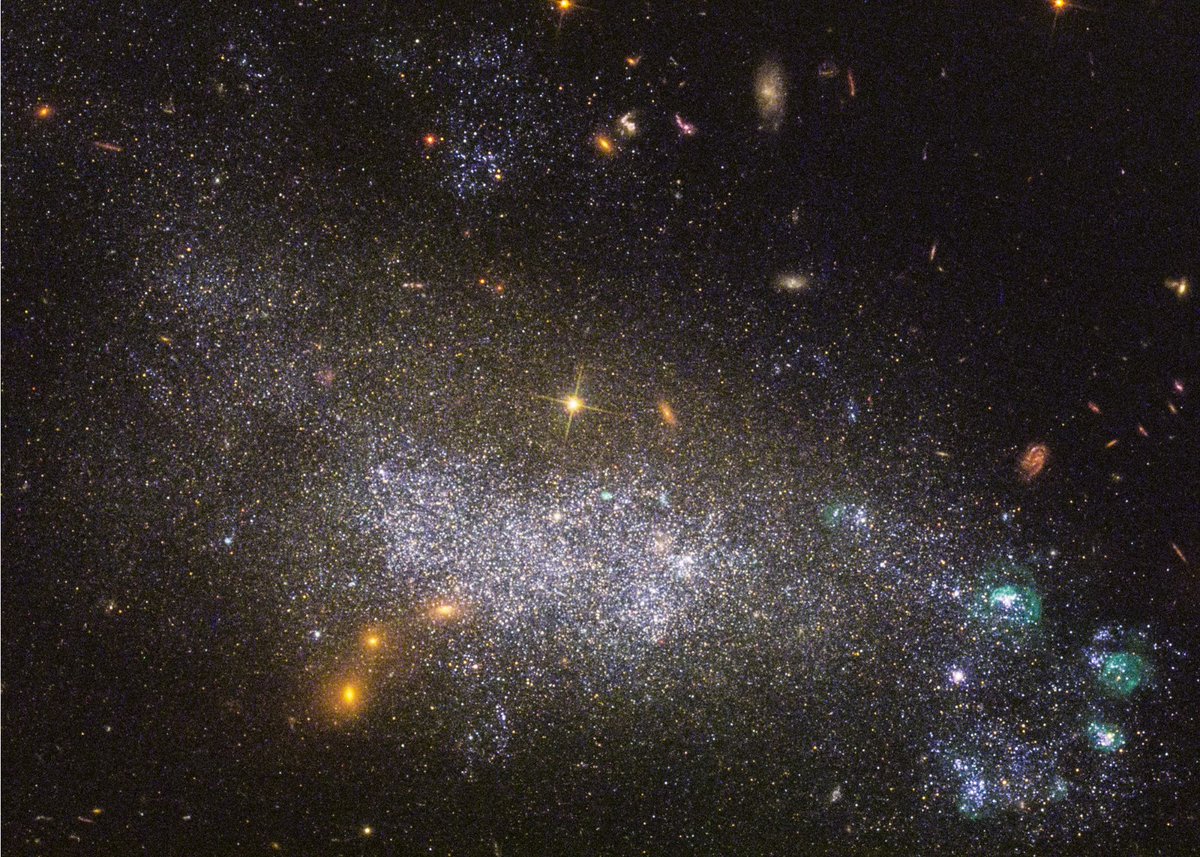
NGC 4214—an irregular dwarf galaxy—spawns many clusters of stars, which dramatically affect the region around it. The stars eject fast stellar winds, which plow into the surrounding gas, and create glowing bubbles: https://t.co/IYmCVEtk7Z
Did you know @spacetelescope is the science operations center for Hubble? Their work spans the lifecycle of a scientific proposal for Hubble observations, which they have performed since its launch in 1990. Follow them: https://t.co/6Th7yvii09
This Hubble image showcases the “Molten Ring” galaxy. These golden strands of cosmic taffy are the result of gravitational lensing, where the light of a background galaxy is distorted by the gravity of an intervening galaxy cluster: https://t.co/c62E10aH58
Astronomers using Hubble have discovered that the blowtorch-like jet blasting from a supermassive black hole at the core of galaxy M87 (left) seems to cause stars to erupt along its trajectory (right): https://t.co/vs59G2yosw
Did you know @spacetelescope is the science operations center for Hubble? Their work spans the lifecycle of a scientific proposal for Hubble observations, which they have performed since its launch in 1990.
Follow them: https://t.co/6Th7yvii09
Can you be-leaf that this Hubble image of supernova remnant N 63A is the result of only 1.3 hours of exposure time? 🍂 Each color represents a different component of the data that was collected in 1997 and 2000: https://t.co/XCrDSzKvU9
“Smudge” alert: The bright blue spiral galaxy on the right likely collided with another in the past. Look for evidence toward the bottom: Its brown dust lanes look like a triangle, no longer holding a delicate spiral shape.
See more galaxies: https://t.co/jPAoG1C9HI
It would take more than nine years for light to travel the length of this pillar of gas and dust in the Eagle Nebula. Eventually the ultraviolet light from the offscreen stars that leave it silhouetted against the nebula will erode the pillar completely. Credit: Hubble/NASA, ESA.
Using Hubble, astronomers have found more black holes in the early universe than previously thought. They went black hole hunting in the landmark Hubble Ultra Deep Field, first taken in 2004, and in following observations to look for black holes: https://t.co/OiTjgPHFYw
NGC 4618 appears lopsided in this Hubble image because it only has a single spiral arm rotating around the galaxy’s center. In contrast, our Milky Way likely has two major and two minor arms. Credit: NASA, ESA, I. Karachentsev.
Three interacting galaxies star in this Hubble image of Arp 195. Their mutual gravity is stripping stars and gas, creating the long tidal tail seen at lower right. Credit: NASA, ESA, J. Dalcanton.
What do these images have in common? All three are galaxies! M106 is a spiral galaxy, NGC 4589 is an elliptical galaxy, and UGC 5340 is an irregular galaxy.
Galaxies are collections of stars, gas, dust, and dark matter bound together by gravity.
Credit: NASA, ESA.
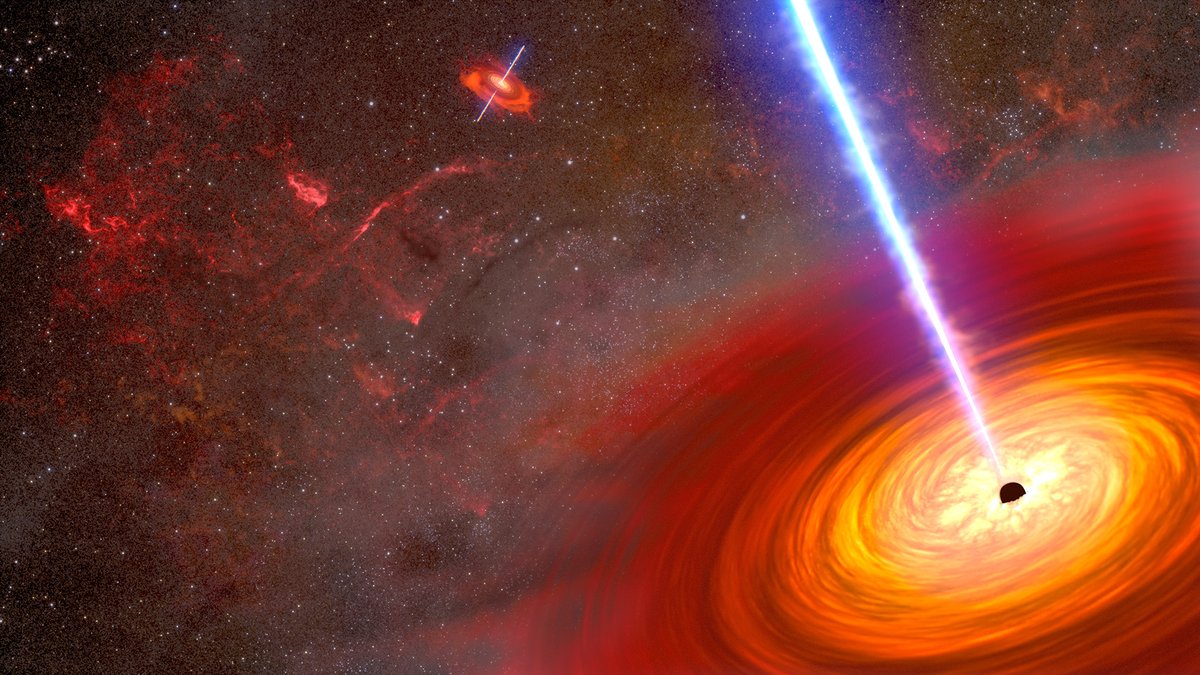
Hubble and @chandraxray have uncovered a pair of supermassive black holes that are just 300 light-years apart. They are buried deep inside the heart of a pair of colliding galaxies that will eventually merge to make a bigger black hole: https://t.co/prqF1J4d5o
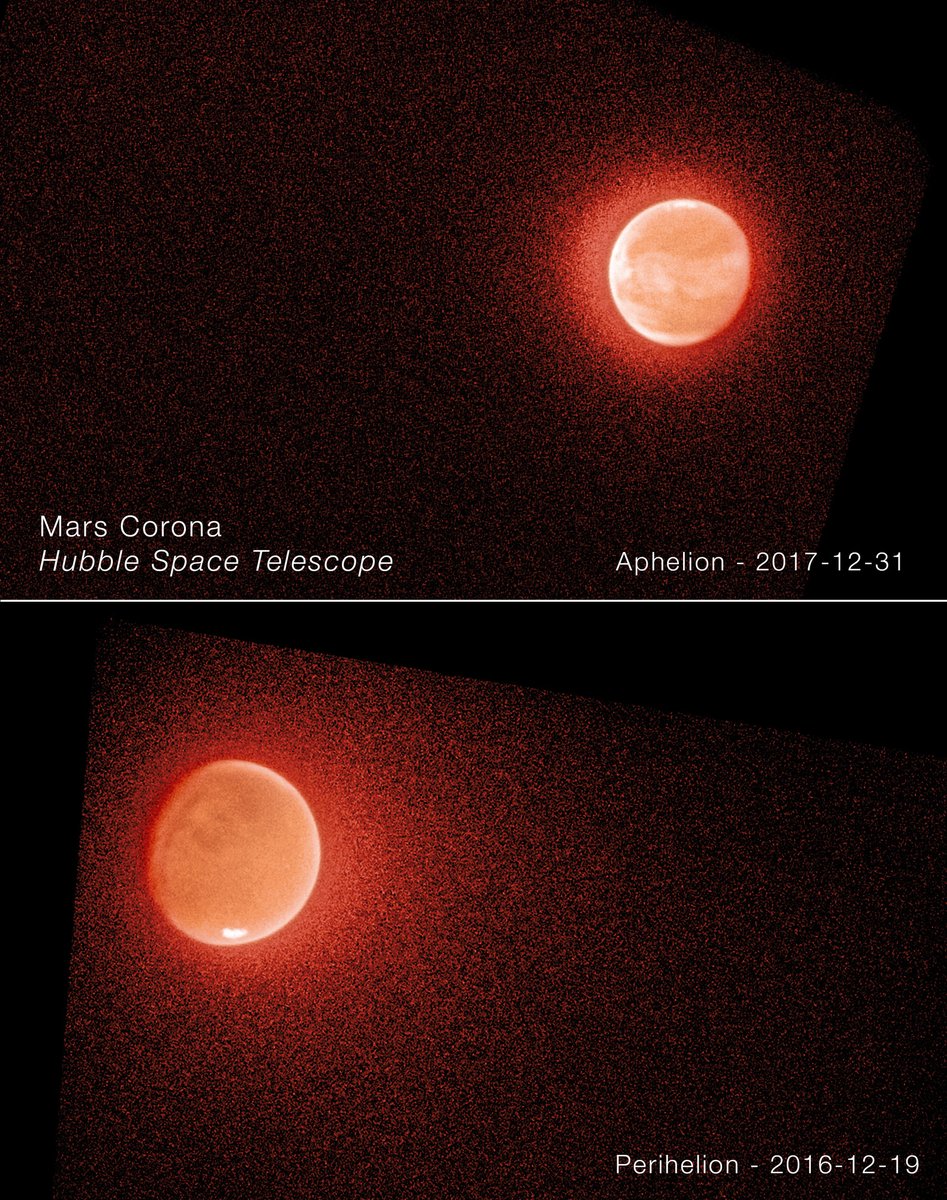
A Martian mystery: What happened to the water that once covered the Red Planet? Scientists know some of it went deep underground, but what became of the rest? Hubble and @MAVEN2Mars teamed up to help scientists understand the history of water on Mars: https://t.co/ZffwcRcAv7
The upcoming #NASARoman telescope will be able to survey the sky 1,000 times faster than Hubble. Dr. Ori Fox will discuss the details of the Roman mission, with a focus on potential studies on the discovery of new planets—TODAY at 8:00 p.m. ET. https://t.co/Wmys2QGZdx