“People get used to anything. The less you think about your oppression, the more your tolerance for it grows. After a while, people just think oppression is the normal state of things. But to become free, you have to be acutely aware of being a slave.” -Assata Shakur
This man was from Potchefstroom. His name was Daniel “Ntate Mokoena” Letsie. He was a community activist who spoke out strongly against corruption. Yesterday, he was gunned down and shot eight times execution style in his home. He had built a reputation as a fearless leader who was never afraid to speak his mind. This is the reality of life under the ANC’s South Africa. How many have departed in this nature and nothing even the government is not moved?
Yet, some believe their dementia ridden grandparents, who worked emakhitshini for whites their entire lives, think apartheid was better. A master-servant relationship is all they know. Every other month being given old clothes was a sign of how merciful their master was.
So you mean to tell me that someone down your ancestry line survived being chaıned to other human bodięs for several months in the bottom of a disease-infested ship during the Middle Passage, lost their language, customs and traditions, picked up the English language as best they could while working free of charge from sun up to sun down as they watched babies sold from out of their arms and women rapęd by ruthless sIave owners.
Took names with no last names, no birth certificates, no heritage of any kind, braved the Underground Railroad, survived the Civil Wąr to enter into sharecropping... Learned to read and write out of sheer will and determination, faced the burning crosses of the KƘK, everted their eyes at the black bodies swinging from ropes hųng on trees...
Fought in World Wąrs as soldiers only to return to America as boys, marched in Birmingham, hosed in Selma, jailed in Wilmington, assassinated in Memphis, segregated in the South, ghettoed in the North, ignored in history books, stereotyped in Hollywood...
and in spite of it all, someone in your family line endured every era to make sure you would get here, but you receive one rejection, face one obstacle, lose one friend, get overlooked, and you want to quit?
How dare you entertain the very thought of quitting. People, you will never know, survived from generation to generation so you could succeed. Don’t you dare let them down!
It is NOT in our DNA to quit!
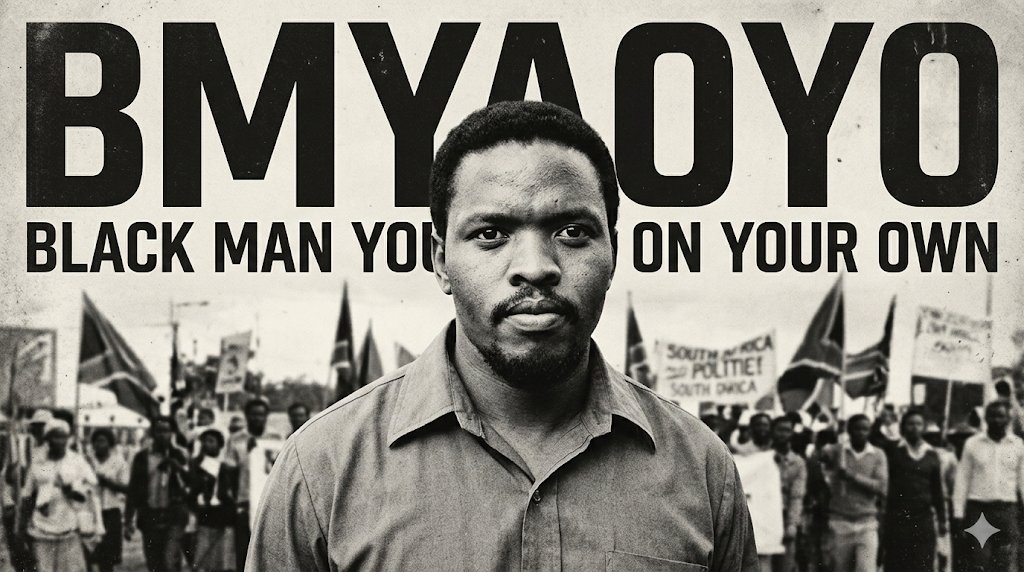
People assume that when Steve Biko said, “Black man, you are on your own,” he was expressing despair or abandonment. The assumption is that he was saying, “Don’t expect help,” or “No one is coming to save you.”
In reality, Biko meant the opposite. When you read Biko’s writings, it becomes easily apparent that he was pushing back against a few things, including the growing dependence of Black people on White liberal “allies.” He argued that even well-meaning White involvement would unintentionally reinforce power imbalances.
When he said the now-famous slogan, Biko was identifying a pattern where White liberals were leading Black organisations, which was causing natives to frame freedom in terms of entry into white-defined norms. His issue with this was that it kept Black people in a dependent position, or as a “perpetual pupil,” as he put it.
Biko saw White liberals as often wanting to “uplift” Black people within the existing colonial structure, rather than dismantle it. Their help, even if well-intentioned, kept Black people as junior partners.
Biko was frustrated by how the “freedom” many natives wanted was just better treatment within a White-run system, things like less harsh passes, slightly higher wages, a few parliamentary seats, while still playing under rules set by the coloniser. To Biko, this was not genuine liberation.
Biko further noted how, once liberation is framed as something White people teach about, Black people are forever in a learning position. According to him, the first lesson is that there is nothing to be taught from that position at all, that the pupil must declare the teacher irrelevant to that particular journey.
That’s why his Black Consciousness philosophy insisted on not rushing into policy negotiations, which is what the ANC eventually settled for, but a psychological revolution where Black people rejected the very premise that they needed White guidance.
Unfortunately, this is the trap the ANC fell into when it pursued exactly what Biko warned against by negotiating for a place WITHIN a fundamentally unchanged economic and political structure of neoliberal capitalism, a constitution protecting property rights inherited from Apartheid, etc.
In fact, Biko was so deep that the fight he saw wasn’t first against Apartheid laws, but against the internalised belief that a White-run world is natural; a belief that makes “freedom” look like asking for better seats on someone else’s ship, rather than learning to build your own.
If Steve Biko were alive today, he would bemoan a psychological revolution that never happened. A walk through modern South Africa, would lead him to conclude that the revolution was stalled at the ballot box.
He would be devastated to see that for many, “liberation” has been redefined as the ability to consume like the oppressor, to own the same luxury German cars, live in the same gated suburbs, and send children to schools that still prioritise Eurocentric curricula. To Biko, If you are still using the oppressor’s yardstick to measure your success, you are still mentally occupied.
Steve Biko would also see a psychological stagnation in how labour is still structured. Even with a Black government, the fundamental relationship of the Black servant to the White corporate master persists in the economy. Biko wanted a Black man who could stand upright and look the world in the eye; he would likely find that the crouched posture of economic dependency remains the default for millions of natives.
Biko’s greatest fear was that Black people would win the country but lose their souls to the belief that they are naturally inferior in the realm of governance. His fear has come true.
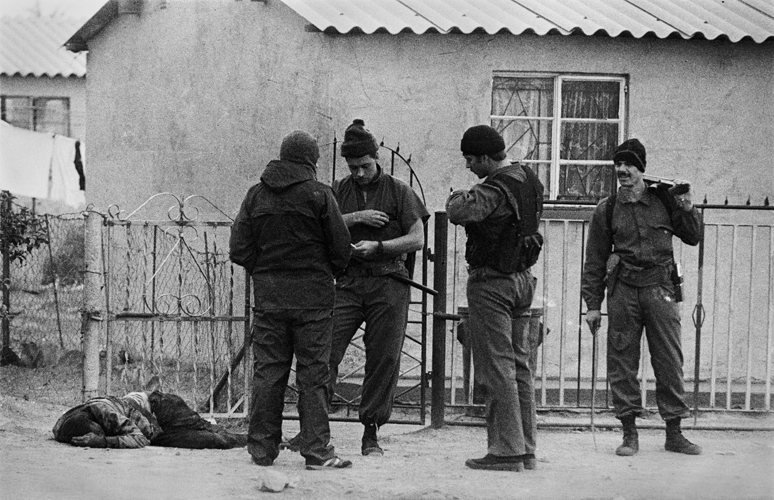
The Last Grave at Dimbaza (1973) is a seminal documentary that provided one of the first unflinching looks at the harsh realities of apartheid in South Africa for international audiences. Shot clandestinely with hidden cameras by South African exiles and British filmmakers, the footage was smuggled out of the country to bypass strict censorship laws. The producers included Nana Mahomo, Antonia Caccia, Andrew Tsehiana. Source: IMDb, Youtube
German colonizers in Namibia, due to their interest in evolutionary theory and missing links executed inmates and decapitated them.
Herero women were required to remove all flesh from the heads to create clean skulls suitable for shipment for study in German Institutes.
At the beginning of the twentieth century, German colonial rule in what is now Namibia led to one of the earliest genocides of the modern era, known as the Herero and Nama genocide. Between 1904 and 1908, tens of thousands of Herero and Nama people were killed through violence, forced displacement, starvation, and confinement in harsh conditions. This period reflects how colonial expansion was often enforced through extreme brutality and dehumanization.
Part of this system involved the misuse of science to justify racial hierarchies. Influenced by distorted interpretations of evolutionary theory, some European researchers sought to study human remains in an attempt to rank different groups of people. Victims of colonial violence were treated as objects of study rather than human beings. Remains were taken and sent to institutions in Germany, where they were used in research that promoted harmful and false ideas about race.
Herero women were forced under coercive conditions to handle and prepare these remains for shipment. This added another layer of trauma to communities that were already experiencing immense loss. These actions were not isolated incidents but part of a broader system that stripped people of dignity and humanity in the name of empire and so called scientific progress.
Today, this history is increasingly recognized and studied, and there have been ongoing efforts to return human remains to Namibia and acknowledge the injustices committed. Conversations about reparations, historical accountability, and remembrance continue as part of a larger effort to confront the legacy of colonial violence.
Filmmaker David Lynch's Diagram for Transcendental Consciousness is one of the greatest, easiest to understand explanations for how our reality is made of MIND first, MATTER second.
I promise this is genuinely worth your time.
It's fantastic.
"They have figured out their world is an illusion, their perception is engineered, their leaders are puppets, their entertainment is a distraction, their labour is meaningless, but will they do anything about it?"