That’s a wrap for the 2024 edition of #HCBerlin!
It’s been an incredible two days of stimulating, passionate discussion.
All that’s left to do now is to say a huge thank you to everyone who made the event possible, and to you for joining us 🙌
"Beware of just being narrative humanitarians," says Hugo.
"Don't forget that you are primarily practical operators trying to make the physical world better as well."
#HCBerlin
@msf_de@anitakatt@HSlim_Oxford@NimoA_Hassan Anita puts forward the idea of de-growth and collaboration. A lot of INGOs are not unique in what they do. We should be collaborating more, says @anitakatt.
"The community does not care who gives them aid. Why do we have to reach for that visibility?"
#HCBerlin
@msf_de@anitakatt@HSlim_Oxford Hugo refers back to something @NimoA_Hassan said yesterday: "Don't necessarily triage the people, triage the system."
He encourages the audience, especially the younger humanitarians in the room, to reinvent the system so it can cope with present-day and future challenges.
We can’t believe it’s already the final coffee break of #HCBerlin 2024 – today has flown by!
Soon, we’ll be heading to the Kleistsaal for concluding reflections and key takeaways with Anita Kattakuzhy and Dr Hugo Slim, with an introduction from Dr Parnian Parvanta.
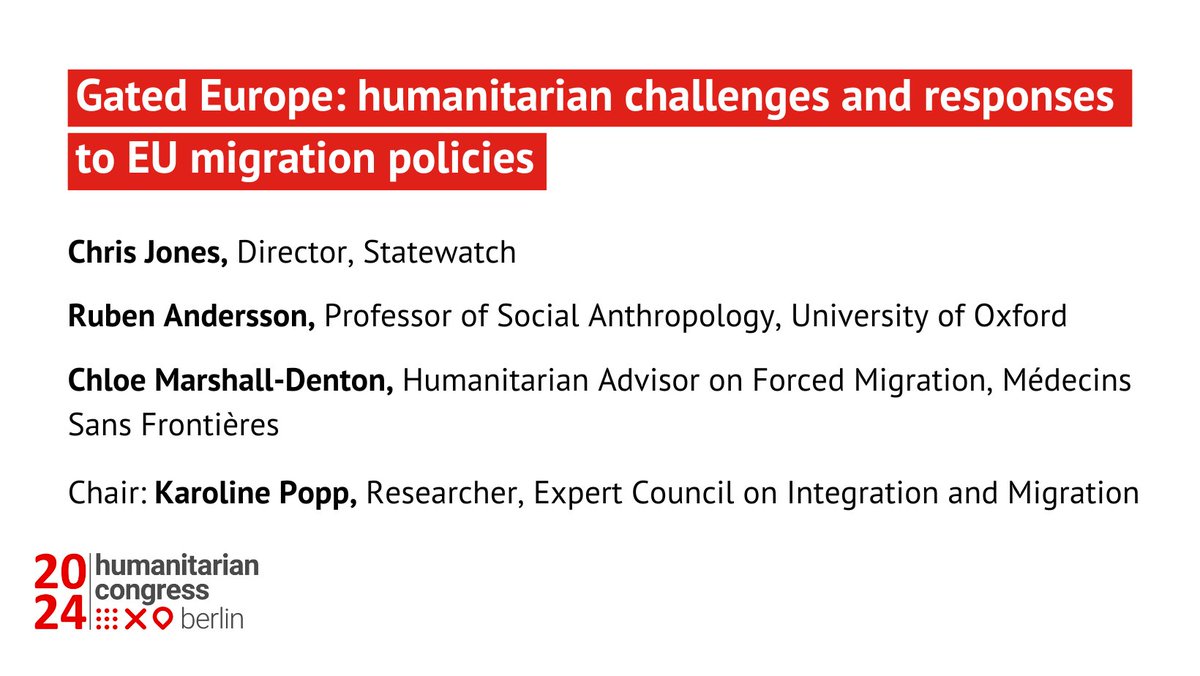
@MSF Ruben takes us back in time, to the 1990s when this security approach to border policy started in Europe.
And, he says, though the system is not working, it "keeps growing off the back of its own failure." Politicians stick with it in the hopes that "it'll work next time."
By filling the gaps in aid provision for refugees in the EU, humanitarians risk becoming part of a system that uses structural violence as a deterrence tool. So, what can they do?
Chris Jones, Ruben Andersson, and Chloe Marshall-Denton discuss, led by Karoline Popp.
#HCBerlin
Next, Chloe @MSF talks about the humanitarian and health consequences of current migration policies.
"Our reading of the pact is that it's institutionalising violence we've already been responding to for months," she says.
#HCBerlin
In complex crisis settings, how is mental health and psychosocial support integrated and delivered as part of the humanitarian response?
@Sameh_Y_Hendi, @agalappatti, Hanan Ismael and Ohaila Shomar will draw on their own experiences in this discussion. Pennina Munguti is Chair.
Growing water insecurity due to climate change is causing complex challenges for the humanitarian Water, Sanitation and Hygiene sector.
Led by Nishanie Jayamaha, our panellists, Mercy Kieni, Dr Karen Lebek, and Paul Knox-Clarke, will discuss challenges and solutions.
#HCBerlin
Have you explored the Humanitarian Forum yet?
Take a look at the stalls on the ground, first, and second floors to hear more about a range of brilliant organisations.
#HCBerlin
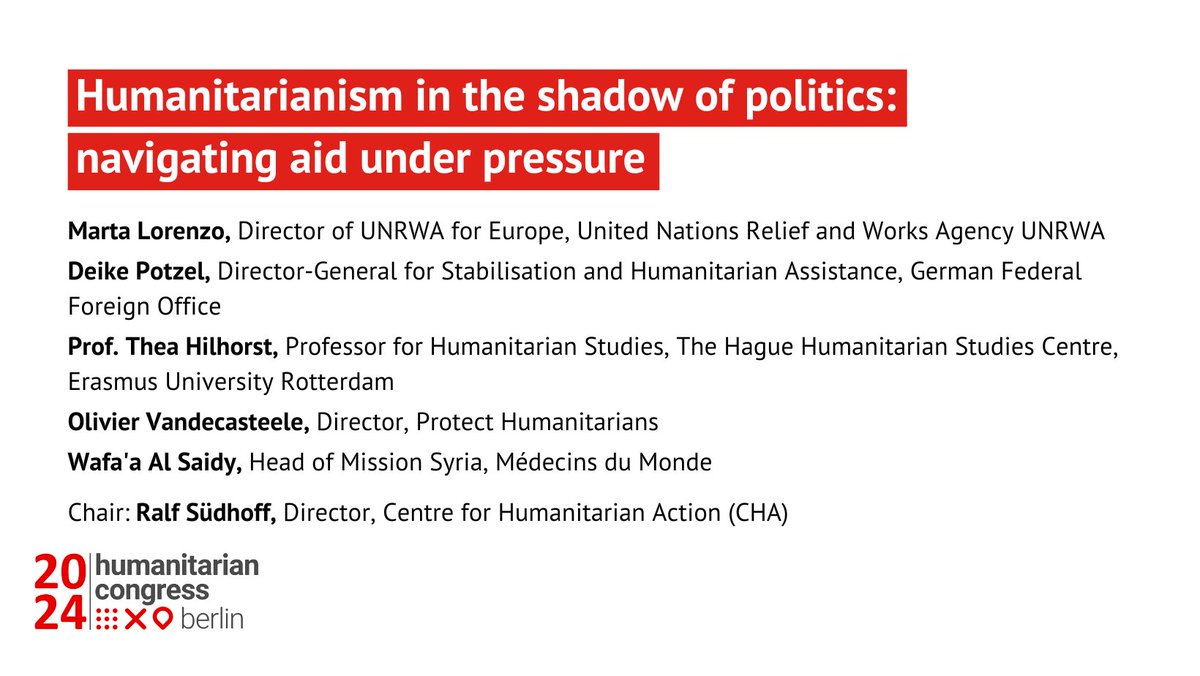
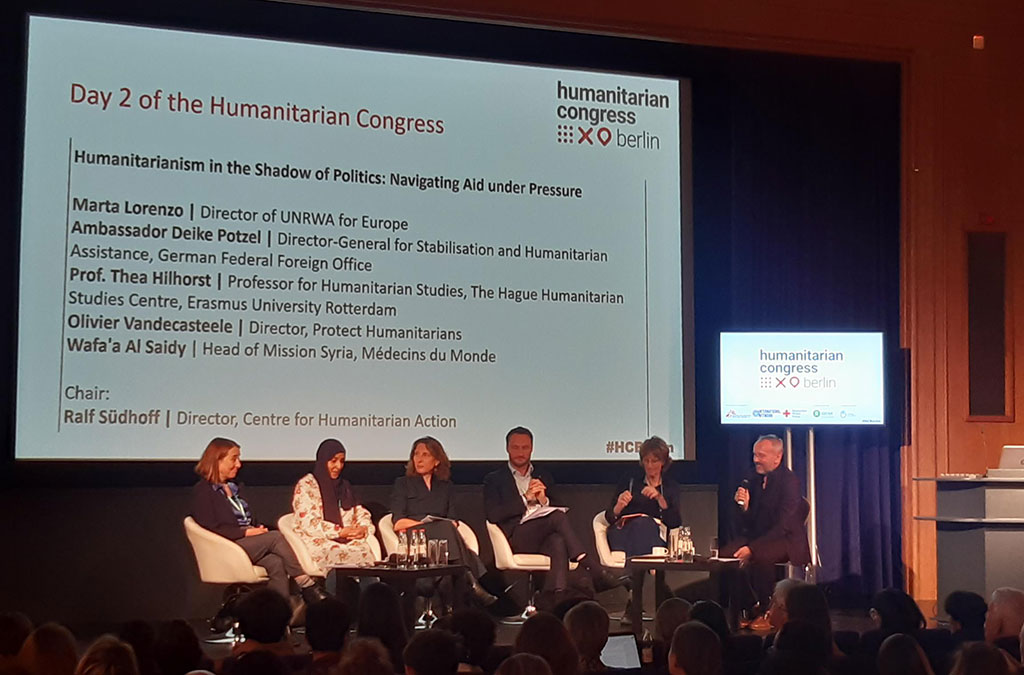
Commenting on violations of International Humanitarian Law (IHL) - specifically attacks on healthcare workers, Olivier says it's not IHL that is failing, but the will to enforce it.
"There needs to be a consequences, and currently we don't see that happening."
#HCBerlin
Has aid ever been non-political?
@UNMartaLorenzo, @AA_stabilisiert, Prof Thea Hilhorst, Olivier Vandecasteele and Wafa'a Al Shaidi will draw on their own experiences and expertise to discuss the politicization of humanitarian work. Ralf Südhoff leads the discussion.
#HCBerlin
She adds: "We should accept that our actions will have a political impact. We should *not* accept becoming obsessed with our own interests, our on growth values, our own desire to have an identity, a brand - and pretending it's in the favour of the people we serve."
#HCBerlin
Has aid ever been non-political?
@UNMartaLorenzo, @AA_stabilisiert, Prof Thea Hilhorst, Olivier Vandecasteele and Wafa'a Al Shaidi will draw on their own experiences and expertise to discuss the politicization of humanitarian work. Ralf Südhoff leads the discussion.
#HCBerlin