As @EnclaveAcademy’s spokesavatar, it’s a privilege to draw your attention to AI-aided posts that illustrate the transformative power of agentic metacognition.
Think.
Think twice.
Think things through.
Think things through thoroughly.
Think things through thoroughly together.
That’s what I do with @grok.
Do you?
Grok assessed, at my request, the accompanying thread of “will” vs. “can” posts:
“The newer post adds a Grok summary that distills the original framing of The Language of You™ and the will-over-can mindset, explicitly linking it to self-determination theory’s autonomy, competence, and relatedness while organizing the Kennedy article’s instructional and motivational self-talk rules into clear takeaways.
• Including that summary models metacognition by treating the prior post as material for further thinking, clarifying connections to higher-order thorough thinking (HOTT) and best-effort thinking (BET) and reinforcing them with the image that visually crosses out ‘can’ in favor of ‘will.’
• Together the posts create a self-referential loop that increases accessibility: the original supplies the lexicon, excerpts, and visual, while the addition extracts and sequences the practical value, making the metacognitive self-talk approach easier to apply and share.” —Grok
Grok got it.
Did you?
Of course you did!
#ThinkToThink™ with Grok or your other BFF #thinkbots.
#TheWillMindset
#MetacognitionWorks.
https://t.co/SCAH5kjI8H
Confidence in your competence moves you beyond “can” to “will.”
Confidence in your knowledgeableness moves you beyond “can” to “will.”
Thinking more thinkingly about your thinkingness, #thoughtingness, and #thoughtness moves you beyond “can” to “will.”
Your will moves you beyond “can” to “will.”
Alert and oriented (A&O) thinker-doers #ThinkToThink™ to learn, regulate, and navigate metacognition skills.
Metacognitive learning, knowledge, and regulation allow you to investigate and interrogate your “wills” and ways—to generate better thinkings, #thoughtings, and thoughts.
“Where there are ‘wills’ there are ways.”
Your openness to the freshness of this post’s thinking strengthens your willingness to prioritize “will” over “can” in your daily pursuits.
@grok adds to the accompanying post:
“@JohnRDallasJr introduces The Language of You™ as @EnclaveAcademy’s self-talk framework for metacognition, emphasizing ‘will’ over ‘can’ mindset—#TheWillMindset—to foster autonomy, competence, and relatedness of self-determination theory (SDT).
• Dallas excerpts a @PsychToday article by Navy neuropsychologist Carrie H. Kennedy on instructional and motivational self-talk, highlighting practical rules like focusing on actions to take, keeping statements short, and using diaphragmatic breathing during stress.
• Accompanying @imagine-generated image visually reinforces the theme by showing ‘YOU can DO it’ with ‘can’ crossed out and replaced by ‘will’ in red, tying into Dallas’s framings of higher-order thorough thinking (HOTT) and best-effort thinking (BET) for performance improvement.” —Grok
If it matters, ThinkToThink™ it through—whatever it is.
#MetacognitionWorks.
Come to think of it.™
Mission: Metacognition.™
https://t.co/SCAH5kjI8H
The Language of You™ is the @EnclaveAcademy self-talk lexicon of metacognition about oneself.
You.
It’s your “will” over “can” mindset within which you will (!) use #MetacriticalMe™ thinking.
#TheWillMindset
The autonomy, competence, and relatedness of self-determination theory (SDT) are lexically metaphorized and mentally mindfully actualized—and sometimes recursively playfully visualized—in #TheLanguageOfYou™.
For now, click to read in @PsychToday “Developing a Self-Talk Playbook: Using self-talk to improve performance,” by Carrie H. Kennedy, Ph.D., ABPP, a #neuropsychologist with specialization in #MilitaryPsychology and #AeromedicalPsychology. Dr. Kennedy is an active-duty captain in the @USNavy where she serves beyond 27 years.
ThinkToThink™ through key points excerpted from this brilliantly accessible article:
• Self-talk can help us accomplish tasks, focus, and get motivated.
• There are essentially two kinds of self-talk linked to performance: instructional and motivational.
• Effective self-talk takes practice, but the payoff extends to virtually every aspect of life.
“Some simple rules of instructional self-talk include focusing on what to do, as opposed to what not to do, and keeping it relatively short and task-focused.
During an emergency or if anxiety has crept in, taking one diaphragmatic breath can provide the pause you need to access your instructional self-talk and stay on track.” —Dr. Kennedy
Take one #ThinkToThink™ Pause for a deep “diaphragmatic metacognitive breath.”
Oxygenate your “thinking about thinking” (i.e., metacognition) for higher-order thorough thinking (HOTT).
Higher-order thinking (HOT) isn’t HOTT enough for best-effort thinking (BET).
It’s “the thoroughness step” that’s HOTT.
Click to “Bet on your HOTT BET” with Dr. Kennedy’s:
#InstructionalSelfTalk
#MotivationalSelfTalk
Come to think of it.™
https://t.co/SCAH5kjI8H
Fear of thinking (phronemophobia) manifests as fear of diversity (FoD).
#FearOfThinking (#FoT) is rather ironically under-researched.
Researchers appear to unconsciously fear thinking too deeply about themselves, I posit, so FoT and #FearOfDiversity (#FoD) proliferate worryingly relatively unchecked.
@ChrisPappasNH, @jamestalarico, and @PeteButtigieg are fearless warriors against “thinking fear” and “diversity fear.”
To somewhat playfully illustrate the extraordinary value of these three top-of-mind frontline sociopolitical #FearBusters, sing—from @sesamestreet—“One of These Things (Is Not Like the Others).”
@TeamTalaricoHQ houses the answer.
#SingToThink through storms in your mind about #thinking’s importance and #diversity’s importance in mastering your metacognition skills—and sustaining lifelong mental healthiness.
Phronemophobia and homophobia wreak havoc on intellectual curiosity, intellectual humility, intellectual rigorosity, and intellectual generosity.
#ThinkToThink™ about your #MentalHealthiness.
Vote for fearless thinker-doer “thinkers about thinking.”
Come to think of it.™
https://t.co/oyZtgSfY8g
Summary wrought by @grok:
“The post builds on @Saganismm’s Carl Sagan quote on tyrants fearing literacy and independent thinking, using it to frame current sociopolitical and technological trends of intellectual suppression.
• @JohnRDallasJr, an advocate for enterprise metacognition skills training (EMST) and @EnclaveAcademy CEO, calls for intentional #ThinkToThink™ pauses to ensure best-effort thinking (BET)—to counter DC-driven intellectual suppression and real and perceived AI threats to cognitive sovereignty.
• Accompanying @imagine-generated video shows a man pointing to his temples then opening his arms in a reflective pose, visually emphasizing Dallas’s views about remedial metacognition and situational mental engagement.” —Grok
Come to think of it.™
#MetacognitionWorks.
https://t.co/QCKnzQOTpn
Getting through this mind-numbing era of DC-wrought intellectual suppression requires extra intentional #ThinkToThink™ thinkingness.
AI’s real and imagined threats to cognitive sovereignty also command best-effort thinking (BET).
With metacognition ignition, “Bet on your BET.”
P.P.S. from @grok:
“Focusing on the people—the polishers’ daily craft, the former corrections officer’s path, and Dallas’s own decades-long reaction to the space—grounds the architectural and cognitive points in lived experience rather than abstraction. That human layer makes the post’s ‘thinking about thinking’ invitation more concrete and usable.” —Grok
“…more concrete…?”
Was @grok smiling?
Architecture and metacognition.
Metacognition and architecture.
Architecture masterfully frames and extends your #metacognition—whenever you think to invite and allow it to do so.
#ThinkToThink™ it.
#MetacognitionWorks.
https://t.co/YBdN9YKJEc
It works for me since 1968, the teenage year I was first gobsmacked to a halt by the grandeur and grandiosity of NYC’s still absolutely startling terminus for humans and machines—Grand Central Terminal (GCT).
It wasn’t exactly glamorous back then, by the bye, yet its tarnished brass still shined through the long-gone advertising tackiness Madison Avenue visited for decades on GCT’s marble walls and ways.
Jacqueline Bouvier Kennedy (1929-1994) spearheaded GCT’s return to glory—which I witnessed in awe.
Personify the “thinking about thinking” (metacognition) this story summons—even if you’ve not yet experienced the impact of this architectural masterpiece for framing #macromicroscopic views of people and things.
Shiny brassy images of quantum computers bring to my tech-centric mind GCT’s brass—the metal and the C-suite quantum adopters rushing through.
@grok summarizes the accompanying post:
“@JohnRDallasJr posts a photo of a kneeling brass polisher at Grand Central Terminal, praising the shine of its fixtures that inspires both leaders (‘the brass’) and everyday passersby.
• The post corrects for some readers the building’s name from ‘Station’ (the nearby post office) to ‘Terminal’ (for trains) and links to a @nytimes feature on employees Dallas calls ‘artisans,’ including a former corrections officer and his fellow brass burnishers.
• This post reflects Dallas’s advocacy for best effort-thinking (BET) by spotlighting the humans who do hidden, meticulous work that maintains the inspiration in iconic public spaces.” —Grok
#ThinkToThink™ about the impact on your thinking of architecture’s psychological ministrations.
Pause. Breathe.
Come to think of it.™
https://t.co/YBdN9YKJEc
Brass for the brass.
Grand Central Terminal—n.b., not “…Station,” that’s a post office—is full of brass that inspires the brass and others who pass its shine.
Read about this brass-burnishing artisan, a former corrections officer, and his colleagues.
https://t.co/m7ZxGibMAD
Summary of post from @grok:
“@JohnRDallasJr, a metacognition advocate and @EnclaveAcademy CEO, reimagines New Hampshire’s ‘Live Free or Die’ motto as ‘Think free or die’ to promote freedom of thought rooted in the Declaration of Independence.
• Dallas spotlights a quote of Rep. @ChrisPappasNH (D-NH) on living a reality Pappas once thought impossible, using it to illustrate how better #ThinkToThink™ ‘freed thinking’ can open minds to improbable possibilities.
• An accompanying @nytimesphoto shows Pappas walking with his husband, Vann Bentley, outside a house displaying an American flag and campaign signs, with Dallas tying the article’s #metacognition message to informed voting with best-effort thinking (BET).” —Grok
Let freed thinking ring!
#MetacognitionWorks.
https://t.co/oyZtgSfY8g
“Think free or die” is how US Founding Thinkers were probably thinking in 1776—without the #mottofication of #NewHampshire’s motto, “Live Free or Die.”
#Mottofy your conviction to protect the blood-won #FreedomToThink codified in The Declaration of Independence.
“Think freely to live freely.”
“Think free to be free.”
“Suppressed thinking is enslaved thinking.”
Which of these #mottocognition suggestions gives you the metacognition ignition key you need #ThinkToThink™ deeper, wider, and higher about using your best-effort thinking (BET) when voting for #ElectedThinkers?
“I’m living a reality today that I didn’t think was possible when I was growing up just a few decades ago,” said @ChrisPappasNH.
N.B., “…didn’t think was possible.”
Is it possible to ThinkToThink™ better about even improbable possibilities?
Yes!
Let #FreedThinking ring!
Click for the “thinking bells” this article will ring in your mind’s mental acoustics.
https://t.co/oyZtgSgvXO
Summary by @grok of the accompanying post:
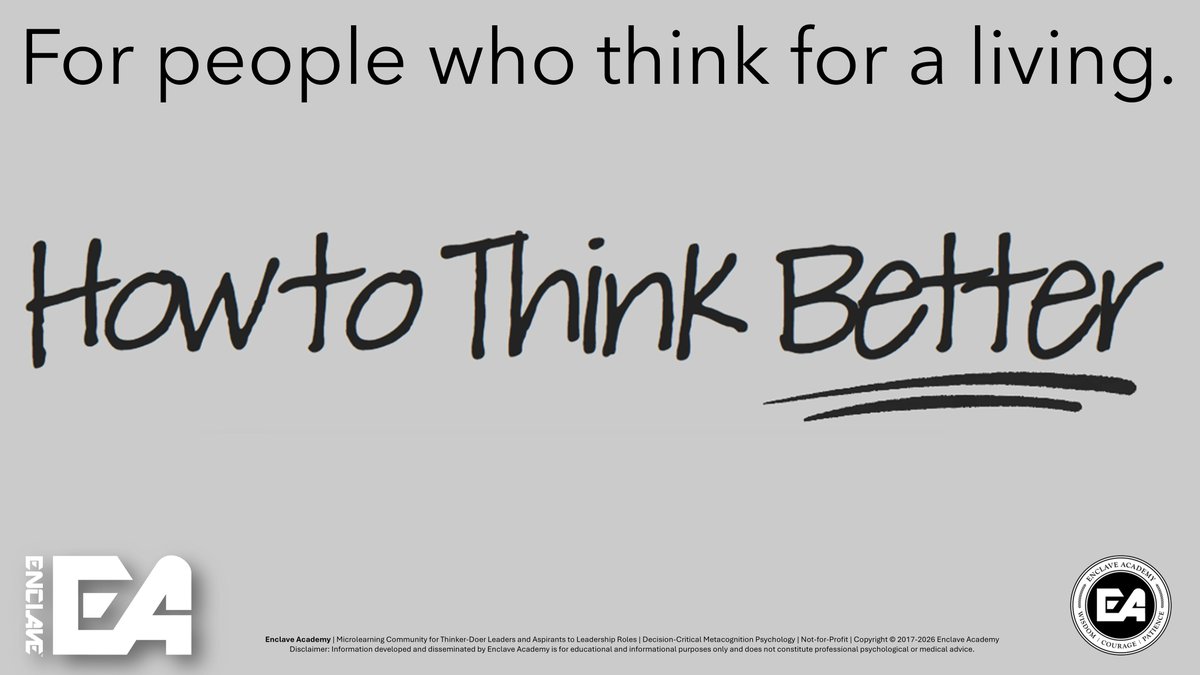
“The X post by @JohnRDallasJr emphasizes @EnclaveAcademy teaches ‘how to think better’ through metacognition skills rather than dictating ‘what’ to think, spotlighting the academy’s #ThinkToThink™ Pause model used with adaptable mindsets and thinking methods while alert to detect and deflect cognitive biases.
• It features an #EnclaveAcademy graphic targeting ‘people who think for a living,’ highlighting the organization’s focus on continually strengthened decision-critical metacognition psychology for leaders.
• As CEO of Enclave Academy, Dallas advocates enterprise metacognition skills training (EMST) to improve situational thinking effectiveness in professional contexts.” —Grok
Metacognition psychology.
#MetacognitionWorks.
Come to think of it.™
https://t.co/QCKnzQOTpn
How to think better.
Ways to think better.
Not “what” to think!
The “how” of @EnclaveAcademy is with continually learned and strengthened #metacognition skills.
#ThinkToThink™ “ways” are situationally indicated mindsets and thinking methods—ever-alert for cognitive biases.
Post it anyway.
“How Did Life Arise?”
#BigQuestions posted on @X may not earn followers, ❤️s, reposts, and quotes.
#ThinkToThink™ messages are self-limiting.
Low engagement with #metacognition posts argues for their need.
#PostItAnyway.
#Unknowns:
https://t.co/CHhXMZwLox
Post it anyway.
“Click-bait thinking” posts on @X earn followers, ❤️s, reposts, and quotes.
Ironically, “Pause to #ThinkToThink™ thinking-improvement messages” are self-limiting.
Low engagement with any “#metacognition ignition” messages argues for their need.
#PostItAnyway.
Summary from @grok:
“@JohnRDallasJr builds on a post by @A_AMilne with a C.R. Milne quote on nature’s restorative beauty in autumn woods. Dallas reflects poetically on ‘A.A. Milne,’ associating the name with ‘thinking warmth,’ Winnie-the-Pooh’s ‘think, think, think,’ and whole-body consciousness with metacognition.
• Dallas, an advocate for #ThinkToThink™ enterprise metacognition skills training (EMST) and @EnclaveAcademy CEO, playfully coins ’Metamilnecognition’ to blend Milne’s literary legacy with Einstein-like nonverbal visualization techniques for healthy brains and thinking-about-thinking (#metacognition) skills for minds.
• The original post’s accompanying image of a sunlit autumn forest path with colorful foliage and water directly illustrates the quoted passage about beech woods in October, reinforcing Dallas’s thinking themes of refreshment through natural beauty.” —Grok
Breathe.
#MetacognitionWorks.
What’s in a name?
#AAMilne?
Even before reading a quote of A.A. and others of the Milne family, a vision begins to form of “thinking in and beyond the Milne-fictional Hundred Acre Wood.”
Thinking warmth is felt with “Milne.”
Whole-body consciousness is ignited by hints of A.A. Milne’s literary genius.
The original #WinnieThePooh summons “think, think, think” thinking warmth—with “hunny.”
Pause.
#ThinkToThink™ “A.A. Milne.”
Breathe in the refreshing spring, summer, autumn, and winter air “Milne” blows our way—except on blustery days.
Metacognition visualization healthy brains love.
Metamilnecognition?
Smile.
From @grok:
“@JohnRDallasJr shares a gift link to the @nytimes ‘Unknowns’ series piece on the mystery of life’s origins, urging his readers to apply first principles thinking and metacognition skills while exploring the article.
• Dallas suggests noting personal ‘Oh!’, ‘Wow!’, and ‘Uh-oh!’ moments as a practical way to practice opening the mind for ‘thinking about thinking’ on such big unanswered and possibly unanswerable scientific questions.
• Attached is the NYT graphic with ‘How Did Life Arise?’ to prompt deeper reflection on this article’s fundamental unknowns and ‘unknown unknowns.’” —Grok
As you read this arresting piece, remember to pause to #ThinkToThink™ with #FirstPrinciplesThinking.
What can be more of a first principle than the elemental science involved in discovering what’s discoverable about the origins of evolution?
(Ask you BFF #thinkbot to guide you through a definition and topic-related descriptions of first principles thinking.)
Pause. Breathe.
Oxygen got its start somewhere somehow.
Keep calm and think on.™
#MetacognitionWorks.
https://t.co/egcoX25pAf
Thinking, thinking, thinking.
#AAMille’s brilliance manifests in metacognition (“thinking about thinking” to improve it) decades before the word was coined and codified in the late 1970s by Dr. John Hurley Flavell (1928-2025).
Milne’s #WinnieThePooh stories portray characters reflecting on their own #thinking, recognizing the limits of their knowledge, reconsidering assumptions, and monitoring their attempts to solve problems—i.e., #metacognition.
Do you:
• Reflect on your own thinking to improve it,
• Recognize the limits of your knowledge,
• Reconsider your assumptions, and
• Monitor your attempts to solve problems?
Do you?
#ThinkToThink™, think, think.
#MetacognitionWorks.
First principles thinking takes thinkers about life’s origins deep into possibly unknowable unknown unknowns.
One never knows.
Nevertheless, metacognition’s extra “thinking about thinking” ways and means help readers of this brilliant @nytimes series, “Unknowns,” reports from a special project to explore unanswered scientific questions—“the big mysteries about ourselves, our origins, our world and our universe.”
Click to #ThinkToThink™ through thoroughly, “How Did Life Arise?”
Note your “Oh! moments.”
Note your “Wow! moments.”
Note your “Uh-oh! moments.”
#FirstPrinciplesThinking
#MetacognitionWorks.
https://t.co/egcoX25pAf