love this. Does anyone really think a billion always-on autonomous machines are going to be using shared-ledger blockchains for settlement? Time for something new https://t.co/MEaxbotKeA
The best infrastructure often removes friction instead of adding more steps.
No approval queues.
No unnecessary waiting.
Just route swaps, create value, and get paid automatically.
Simple systems are usually the ones people keep coming back to.
That's what makes this approach from @Pact_Swap interesting.
Most DEXs make you ask permission to earn from the swaps you send them.
Pact skips that. Sign up with one call, set your cut, get paid in USDT automatically once you hit $100. No approval queue, no waiting on a yes.
Your funds never touch Pact's hands either.
Bitcoin was created to move.
Not to sit idle.
For years, putting BTC to work often meant adding extra layers of trust.
What caught my attention about @Pact_Swap is the idea of keeping Bitcoin native while making it useful across chains.
Sometimes the biggest opportunity isn't creating a new asset.
It's unlocking the potential of the one that already exists.
Bitcoin is 60% of all crypto mcap, yet only 0.46% of it touches DeFi.
The rest sits idle, because using it has meant wrapping it and trusting a custodian.
Native swaps with Pact change that: your BTC, working, without giving it up.
Many tokens are built around expectations.
Few are built around utility.
The difference may not seem important during hype cycles.
But over time, utility tends to outlast narratives.
That's one reason I'm paying attention to @Pact_Swap
The bridge is "processing."
Your funds are somewhere between two chains and three prayer emojis.
This is normal cross-chain UX. It shouldn’t be.
Pact settles natively.
Nothing to bridge. Nothing to wait on. Just the trade.
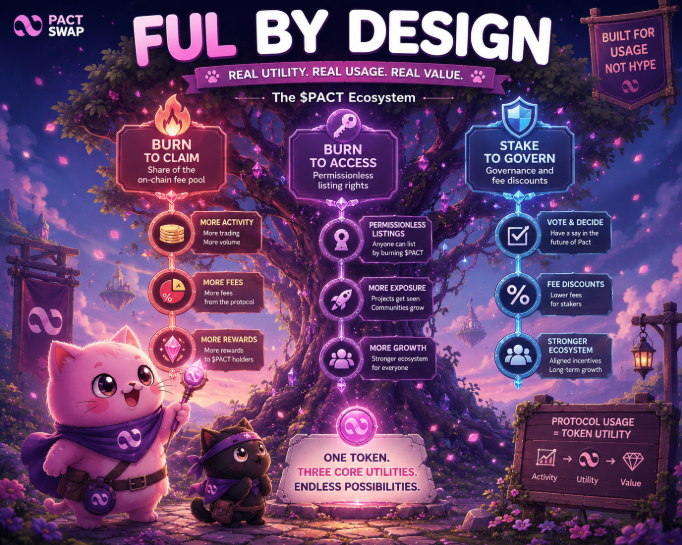
What $PACT actually does:
- Burn it to claim a share of the on-chain fee pool
- Burn it for permissionless listing rights
- Stake it for governance and fee discounts
Utility tied to protocol usage, not promises.
The strongest utility is often the simplest to explain.
Use the protocol.
Create activity.
Access the benefits.
That's what makes the idea behind $PACT interesting to me.
Not because it promises something in the future.
Because it already has a role today.
The market rewards attention.
Time rewards builders.
Years from now, nobody will remember every trend that dominated the timeline.
But they will remember the infrastructure that kept working while those trends came and went.
That's why @Pact_Swap stays on my radar.
Quietly building.
Relentlessly improving.
One step at a time.
Crypto moves fast.
New narratives appear every week.
New trends take over every timeline.
But the projects that last are usually the ones still building when the spotlight moves somewhere else.
That's one reason I keep following @Pact_Swap.
Not because it's chasing the next headline.
Because it's focused on building what comes after it.
The more I learn about @Pact_Swap, the more I realize it's not trying to reinvent everything.
It's trying to remove things.
No unnecessary wrappers.
No extra trust layers.
No complex reward mechanics pretending to be sustainable.
Just a focus on native assets, real liquidity, and infrastructure that actually serves a purpose.
In a space full of noise, simplicity can be surprisingly powerful.
Anyone can create yield.
The harder question is:
Where does that yield actually come from?
What caught my attention about @Pact_Swap is the simplicity of the answer.
Real volume in.
Real yield out.
No complicated emissions.
No endless inflation.
Just activity creating value for liquidity providers.
Sometimes the strongest model is also the easiest one to explain.
In crypto, people often notice the price first.
I tend to notice the infrastructure.
Prices can change in a day.
Infrastructure takes years to build.
That's one reason projects like @Pact_Swap keep showing up on my radar.
Not because they're chasing attention.
Because they're building something that could still matter long after today's narratives fade.
Most traders focus on fees.
The bigger hidden cost is often slippage.
When size starts increasing, even a small price difference can become a surprisingly large amount of money.
That's what caught my attention about @Pact_Swap.
Knowing the price before committing the trade feels like one of those things that seems obvious...
until you've traded without it.
Most people watch the charts.
I pay attention to the builders.
Prices move fast.
Narratives come and go.
But infrastructure is what stays.
That's one reason I keep an eye on @Pact_Swap.
Not because it's the loudest project.
Because it's still building while others are talking.
https://t.co/o4YoMqDUv4
"Just one quick cross-chain transfer."
20 minutes later:
Refresh explorer ✔️
Refresh wallet ✔️
Refresh explorer again ✔️
Question life choices ✔️
The "Still Pending?" meme hits a little too close to home 😂
@Pact_Swap knows exactly what they're talking about.
"Just one quick cross-chain transfer."
20 minutes later:
Refresh explorer ✔️
Refresh wallet ✔️
Refresh explorer again ✔️
Question life choices ✔️
The "Still Pending?" meme hits a little too close to home 😂
@Pact_Swap knows exactly what they're talking about.
Markets move on narratives.
Infrastructure moves the market.
While most people chase the next trend, @Pact_Swap keeps building the rails that value moves through.
Native assets.
Cross-chain liquidity.
Trustless design.
Not the loudest path.
But often the strongest one.
https://t.co/eWefn4AiIM
What caught my attention about @Pact_Swap isn't just the swapping.
It's the idea of becoming infrastructure.
The best protocols eventually become something other builders can build on top of — not because they're flashy, but because they're useful.
If liquidity can be accessed natively across chains through a single layer, that opens the door for a lot more than simple swaps.
That's the part I'm watching most closely. ⚡