Come and get your free PDF guide to The 18 Most Influential Behavioral Economics Books (2026 Edition)
Simply join our monthly newsletter for instant access – plus practical insights delivered to your inbox. https://t.co/fhUhoHVN4R
#behavioralscience#behaviouralscience
*NEW* --> 'The business of Dark Patterns (and other polite predators)'
A Behavioural Scientist’s field notes on what happens when incentives divorce themselves from reality – from B2B podcast funnels to Soviet chandeliers.
Phase 1: The Stone Age – Dumb Mechanical Friction
Phase 2: The Information Age – Reciprocity Engines
Phase 3: The Modern Era – Industrialised Flattery
Also the Soviet Chandelier Problem, and the Indian Cobra Effect
https://t.co/PsJA0sTtKp
*NEW* --> 'The business of Dark Patterns (and other polite predators)'
A Behavioural Scientist’s field notes on what happens when incentives divorce themselves from reality – from B2B podcast funnels to Soviet chandeliers.
Phase 1: The Stone Age – Dumb Mechanical Friction
Phase 2: The Information Age – Reciprocity Engines
Phase 3: The Modern Era – Industrialised Flattery
Also the Soviet Chandelier Problem, and the Indian Cobra Effect
https://t.co/PsJA0sTtKp
NEW --> 'You Should (pretend to) Kill Your Company' (+ a downloadable PDF worksheet).
https://t.co/69yWZ0FWgF
Welcome to a behavioural scientist’s case for inversion, zero-based thinking, the 50:50 rule, and AI Integration: Pick one part of your business: Kill it on paper. Zero-base it. Horizon-audit it. Run the E/A/D on its core process. What survives is what matters. What doesn’t – you already knew, somewhere.
The best incentive systems don't rely on motivation, culture, or surveillance.
They make the person who creates the risk the one who bears it.
4 examples. Each from a completely different world. All the same insight. Thread 1/5 -->
@Discoplomacy Oh this is great! I've just updated an evergreen blog with your name/post @Discoplomacy – we wrote 16 years ago on incentives, still holds up (us humans are consistent breed in many ways!) https://t.co/d23jWIJqi6
*NEW*: --> 'Looking at legacy giving through a behavioural lens'
https://t.co/tmITcjKPUp
"Asking someone to give money in their Will can be a challenge. You’re asking someone to act now, for a benefit felt by others, in a future they cannot clearly imagine, after an event they’d rather not contemplate. For some, this sounds like a non-starter.
But behavioural science – and the rise in legacy giving over the years - says otherwise."
By @oliverpayne on @RememberCharity
*REVIEW* --> 'The 18 Most Influential Behavioral Economics Books (updated 2026)' + download PDF option
https://t.co/7IhTxWe8wR
These 18 books offer a comprehensive introduction to the field, exploring the key concepts and applications of behavioral economics in the modern world across a wide range of domains.
NEW --> 'You Should (pretend to) Kill Your Company' (+ a downloadable PDF worksheet).
https://t.co/69yWZ0FWgF
Welcome to a behavioural scientist’s case for inversion, zero-based thinking, the 50:50 rule, and AI Integration: Pick one part of your business: Kill it on paper. Zero-base it. Horizon-audit it. Run the E/A/D on its core process. What survives is what matters. What doesn’t – you already knew, somewhere.
*NEW*: --> 'Looking at legacy giving through a behavioural lens'
https://t.co/tmITcjKPUp
"Asking someone to give money in their Will can be a challenge. You’re asking someone to act now, for a benefit felt by others, in a future they cannot clearly imagine, after an event they’d rather not contemplate. For some, this sounds like a non-starter.
But behavioural science – and the rise in legacy giving over the years - says otherwise."
By @oliverpayne on @RememberCharity
NEW--> Why do you feel psychologically 'frozen'? And how do you reset?
A Sensory Reboot, Vagal Hum, Physiological Sigh, and Micro-Movements show you the way...
https://t.co/C4fKPWgTdB
Wharton: "Players made quick decisions when the AI told them exactly what to do, but once they no longer had guidance, they struggled."
--> 'Should AI Nudge You or Tell You What to Do? - Knowledge' https://t.co/dE0Svgdk1r
Fortune: "What we’ve found is this: change doesn’t fail because people resist. It fails because leaders misunderstand how people really change."
Great --> 'We studied 6,000 executives and found the real reason 70% of transformations fail' https://t.co/1IIfPmPBkv
--> 'The Precision Mental Health Commission: transforming mental health through brain circuit science' - https://t.co/GXZGazFLy0
"Mental disorders are among the most urgent health challenges of our time. Depression alone affects more than 280 million people and is the leading cause of years lived with disability worldwide, with a global economic burden exceeding US $1 trillion annually. Mental health disorders also amplify the burden of other diseases... Despite this profound and enduring burden, mental health care still relies largely on a trial-and-error approach to treatment selection."
Might work. Difficult to know about what offer, and the timing, at the moment re: BeSci and AI. It'll be interesting to see --> 'Why VCCP Is Changing Cowry's Offer And Brand' - Creative Salon - https://t.co/Wnp8APb46I #GoogleAlerts
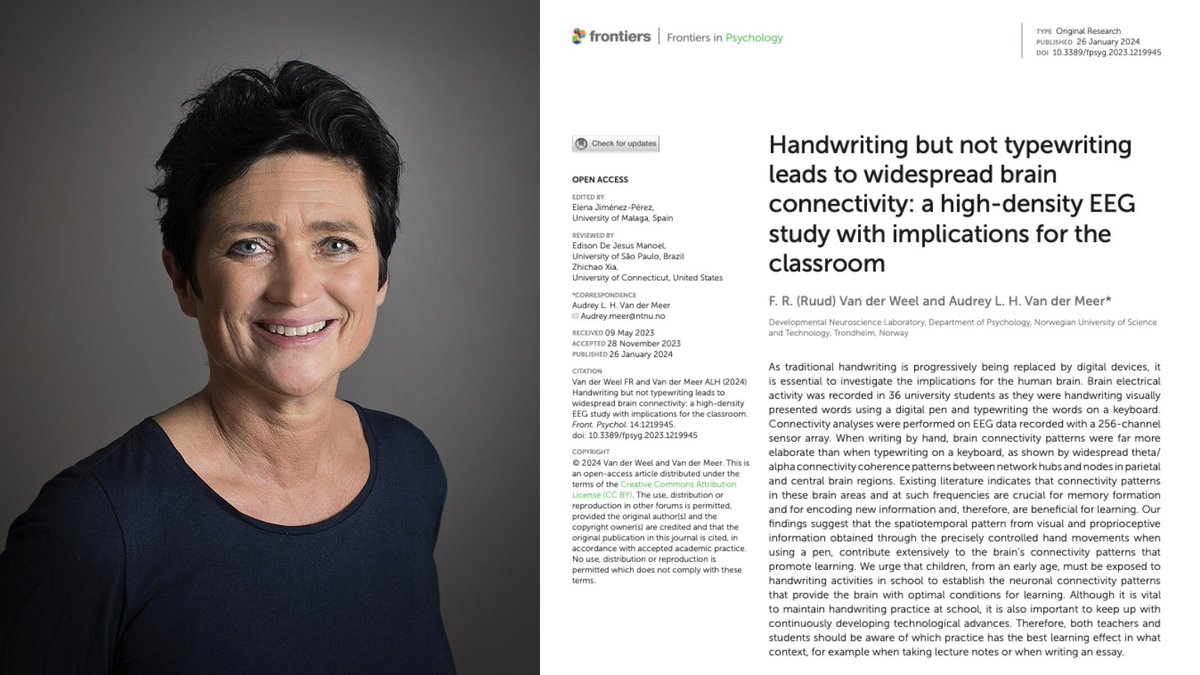
A Norwegian neuroscientist spent 20 years proving that the act of writing by hand changes the human brain in ways typing physically cannot, and almost nobody outside her field has read the paper.
Her name is Audrey van der Meer.
She runs a brain research lab in Trondheim, and the paper that closed the argument was published in 2024 in a journal called Frontiers in Psychology. The finding is brutal enough that it should have changed every classroom on Earth.
The experiment was simple. She recruited 36 university students and put each one in a cap with 256 sensors pressed against their scalp to record brain activity. Words flashed on a screen one at a time.
Sometimes the students wrote the word by hand on a touchscreen using a digital pen, and sometimes they typed the same word on a keyboard. Every neural response was recorded for the full five seconds the word stayed on screen.
Then her team looked at the part of the data most researchers had ignored for years, which is how different parts of the brain were communicating with each other during the task.
When the students wrote by hand, the brain lit up everywhere at once.
The regions responsible for memory, sensory integration, and the encoding of new information were all firing together in a coordinated pattern that spread across the entire cortex. The whole network was awake and connected.
When the same students typed the same word, that pattern collapsed almost completely.
Most of the brain went quiet, and the connections between regions that had been alive seconds earlier were nowhere to be found on the EEG.
Same word, same brain, same person, and two completely different neurological events.
The reason turned out to be something nobody had really paid attention to before her work. Writing by hand is not one motion but a sequence of thousands of tiny micro-movements coordinated with your eyes in real time, where each letter is a different shape that requires the brain to solve a slightly different spatial problem.
Your fingers, wrist, vision, and the parts of your brain that track position in space are all working together to produce one letter, then the next, then the next.
Typing throws all of that away. Every key on a keyboard requires the exact same finger motion regardless of which letter you are pressing, which means the brain has almost nothing to integrate and almost no problem to solve.
Van der Meer said it plainly in her interviews.
Pressing the same key with the same finger over and over does not stimulate the brain in any meaningful way, and she pointed out something that should scare every parent who handed their kid an iPad.
Children who learn to read and write on tablets often cannot tell letters like b and d apart, because they have never physically felt with their bodies what it takes to actually produce those letters on a page.
A decade before her, two researchers at Princeton ran the same fight using a completely different method and ended up at the same answer. Pam Mueller and Daniel Oppenheimer tested 327 students across three experiments, where half took notes on laptops with the internet disabled and half took notes by hand, before testing everyone on what they actually understood from the lectures they had watched.
The handwriting group won by a wide margin on every question that required real understanding rather than surface recall.
The reason was hiding in the transcripts of what the two groups had actually written down.
The laptop students typed almost word for word, capturing more total content but processing almost none of it as they went, while the handwriting students physically could not write fast enough to transcribe a lecture in real time, which forced them to listen carefully, decide what actually mattered, and put it in their own words on the page.
That single act of choosing what to keep was the learning itself, and the keyboard had quietly skipped the choosing and skipped the learning along with it.
Two studies. Two countries. Same answer.
Handwriting makes the brain work. Typing lets it coast.
Every note you have ever typed instead of written went into your brain through a thinner pipe. Every meeting, every book highlight, every idea you captured on your phone instead of on paper was processed at half depth.
You did not forget those things because your memory is bad. You forgot them because typing never woke the part of the brain that would have made them stick.
The fix is the thing your grandmother already knew.
Pick up a pen. Write the thing down. The slower road is the faster one.
Research by Fitouchi & @mnvrsngh suggests the tension between (evolutionary) deterrence, and (intuitive) retribution punishment motives is resolved by a model reflecting restoration of mutual benefit between cooperative partners→compensation+deterrence
https://t.co/hATw6ReLep
I'm always on the lookout for great success stories of behavioral nudges.
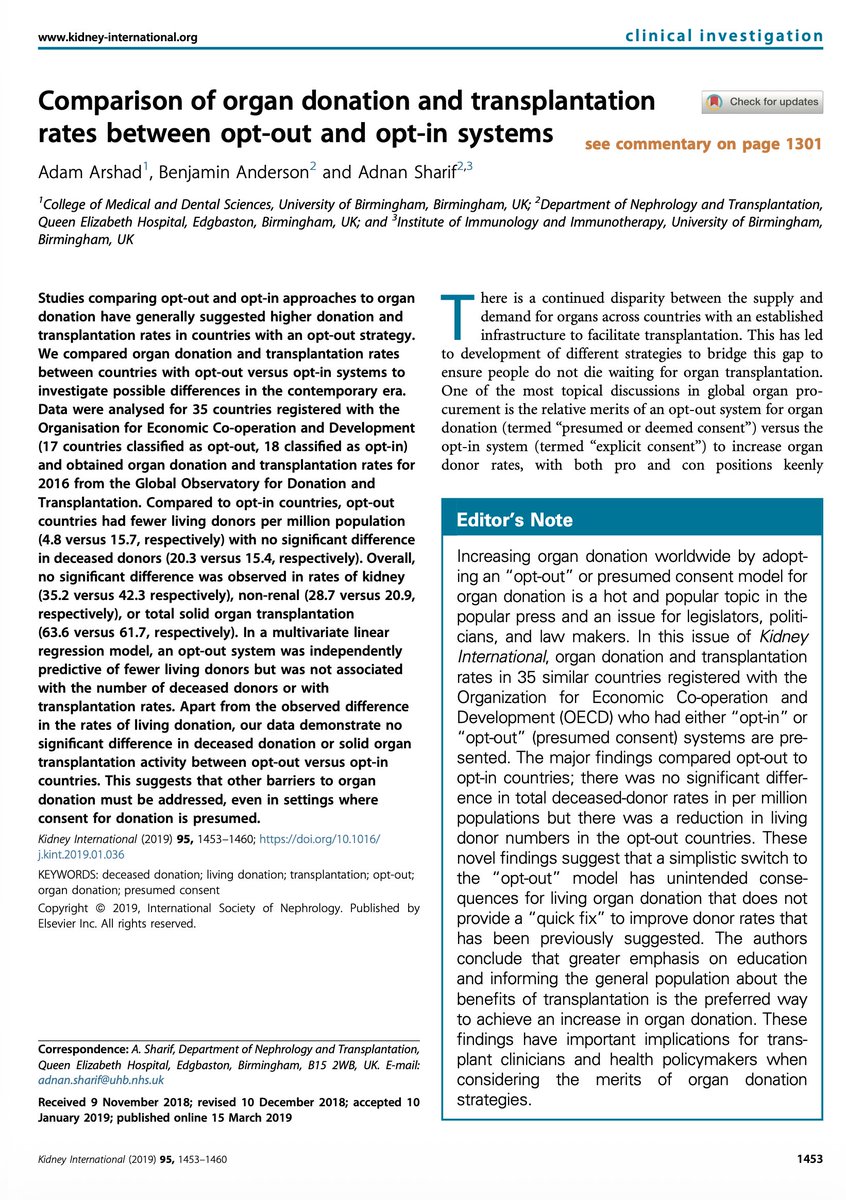
Organ donation is a favorite of the field: presume consent, and you'll have more registered organ donors.
Ok, but this paper here asks if that leads to more actually donated organs. Answer: not at all.
For #MentalHealthAwarenessWeek we share our work on examining 'A step-by-step approach to reducing suicide among men'
It's clear that men are less likely than women to actively seek help. The common misconception is that men don't want to talk. This is wrong.
https://t.co/ugfYQcAZv9
#MHAW2026 #MentalHealth
What if the biggest barriers to connecting with others are simply our own insecurities? #BehavioralScience
In the newest @BigBrainsUC episode, @ChicagoBooth's Nicholas Epley joins @paulmrand to discuss why we’re wired for connection but often avoid it.
https://t.co/pNDQTRZOwx