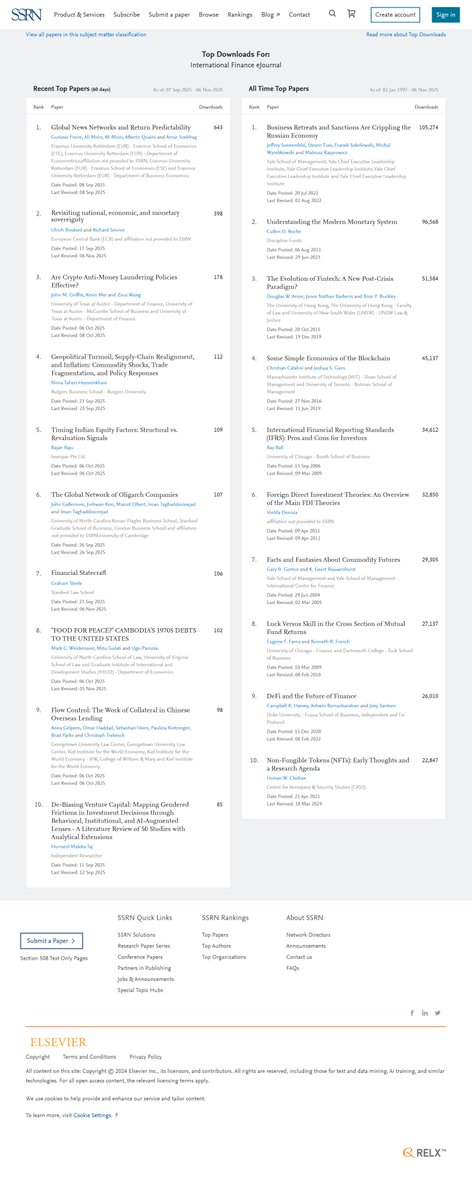
Humbled to see my working paper, “De-Biasing Venture Capital: Mapping Gendered Frictions in Investment Decisions through Behavioral, Institutional, and AI-Augmented Lenses - A Literature Review of 50 Studies with Analytical Extensions,” listed among the Top 10 Most Downloaded globally in @SSRN's International Finance eJournal.
Link to the top 10: https://t.co/IzMV77LImJ
Link to the working paper: https://t.co/oFfnPyHoFk
#VentureCapital #Finance #VC #Startups #SSRN #FinanceDaily #FinanceNews #Economics
FAANG to MANGOS
For nearly two decades, one acronym defined the technology industry: FAANG.
Today, a new acronym is going viral on X: MANGOS.
It stands for Meta, Anthropic, Nvidia, Google, OpenAI, and SpaceX, a group that could soon dominate the next era of technology as several companies prepare to go public.
But here's what caught my attention.
FAANG was built around the internet. MANGOS is being built around intelligence.
FAANG was defined by search, social media, e-commerce, smartphones, and streaming.
MANGOS is being defined by AI models, compute infrastructure, autonomous systems, and space infrastructure.
This isn't just a new acronym.
It may represent a shift in the technology economy - from companies that connected people to companies that are building intelligence itself.
The question is no longer, Who owns the biggest platform?
The question is, Who will own the infrastructure of the AI era?
I'm Hurratul, and this is The U Lab Daily Brief on venture capital, technology, and the future of innovation.
#FAANG #MANGOS #AI #AIInfrastructure #TheULab #technology
#FAANG to #MANGOS
The shift isn’t just from one group of companies to another.
It’s the shift from the internet era to the intelligence era.
Here’s why I think this shift matters:
https://t.co/jl3CabYrod
#technology#AI#artificialintelligence
Silicon Valley runs on capital. The conversation I had with Sacha Ledan unveiled the layers beneath that.
Capital matters.
But before capital often comes trust.
Before trust often comes relationships.
Before relationships often comes access.
And access is not distributed equally.
In our conversation, we explored founder signals that never appear in pitch decks, why institutional networks matter, what challenges immigrant founders face, and how opportunity actually moves through entrepreneurial ecosystems.
We also explored what investors are actually evaluating when they evaluate founders. The conversation suggested that the question is often not simply whether an opportunity is attractive, but why a particular team appears uniquely positioned to pursue it.
In this edition of The U Lab Conversation with @SachaLedan, I synthesize the key ideas, frameworks, and observations that emerged from our discussion.
#SiliconValley #StartupEcosystem #VentureCapital #Fundraising #TheULab #Raisable #SachaLedan
Most people assume AI is making it harder for new college graduates to find jobs.
A recent analysis highlighted by @a16z points to a more surprising possibility.
What if remote work is a bigger factor?
Researchers found that unemployment among younger college graduates has deteriorated more than for older workers, with the gap appearing particularly pronounced in occupations that can be performed remotely.
Even more interesting, one study found that once remote work is taken into account, much of the observed relationship between AI exposure and declining early-career hiring largely disappears.
By 2025, occupations with higher work-from-home exposure showed nearly a 2 percentage point decline in the share of new hires, while the AI-controlled estimate remained close to zero.
This does not mean AI has no impact.
But it suggests we may be asking the wrong question.
Perhaps the challenge is not simply whether AI is replacing entry-level workers.
Perhaps the challenge is whether remote work is weakening the apprenticeship systems that historically helped develop them.
If firms increasingly hire experienced talent who can contribute immediately, who will train the next generation of managers, operators, and founders?
I'm Hurratul and this is The U Lab Daily Brief on venture capital, technology, and the future of innovation.
#artificialintelligence #AI #jobs #a16z
What happens when intelligence becomes so powerful that access to it starts coming with conditions?
This week, @AnthropicAI released Claude Fable 5, the first public version of its Mythos model. But alongside the launch came something unusual: strict safety limits, blocked responses in high-risk areas, and a mandatory 30-day data retention policy, even for some enterprise customers that previously had zero-retention agreements.
Now, most people will focus on the model.
But I think the bigger story is what this says about where AI is heading.
For years, the race was about building smarter systems.
What's actually happening now is that leading AI labs are building governance systems around those models. Monitoring. Guardrails. Approval layers. Safety infrastructure.
Why's that?
Because once a technology becomes powerful enough, capability alone is no longer the bottleneck. Trust becomes the bottleneck.
And that raises a bigger question.
If the most advanced models require guardrails, monitoring, retention policies, and approval processes, who ultimately controls access to intelligence?
Think about that for a second.
We spend a lot of time talking about who will build the smartest AI.
But maybe that's becoming the wrong question.
Maybe the more important question is: who builds the trust systems that make that intelligence safe enough to use?
Because if intelligence keeps getting cheaper and more abundant, trust may become the scarce resource.
And that could end up being where the real power sits.
I'm Hurratul and this is The U Lab Daily Brief on venture capital, technology, and the future of innovation.
#AI #artificialintelligence #anthropic #claude
Some of the most important ideas don't emerge from certainty.
They emerge from curiosity, thoughtful questions, and the willingness to examine how we think, communicate, and connect with others.
This lecture by Professor Matt Abrahams at @StanfordGSB during the Me2We event was a reminder that great communication is not about having all the answers. It is about learning the frameworks for better conversations, clearer reasoning, and ultimately better decisions.
In a world overflowing with information, the ability to communicate with clarity may be one of the most valuable skills we can develop.
I feel fortunate to have met him and continue to learn so much from him.
One of the best practices is to take a step back and analyze a situation from a third-person perspective. It is a very useful exercise because it helps us analyze the situation with detachment and gain a macro perspective without being consumed by the micro details. I do that a lot. It could perhaps be categorized as a form of metacognition. Thanks for sharing this @RayDalio.
One question: as AI capabilities become increasingly abundant, how much of the economic impact will be driven by AI adoption versus trusted AI adoption?
Many organizations already have access to highly capable models, yet deployment into core workflows remains constrained by verification, governance, accountability, and organizational trust.
The bottleneck may be shifting from generating intelligence to trusting intelligence.
If so, future productivity gains may depend not only on model capability, but also on the trustworthiness of the institutional systems that make AI deployable at scale.
Curious whether future indicators might eventually capture that distinction.
I recently explored this idea through the lens of what I call the "The Trust Layer of AI": https://t.co/8ausLKunTx
For the last few years, the AI conversation has focused on one question: Who will build the smartest model?
I think a more important question is emerging.
What happens when intelligence becomes abundant, but trust does not?
Anthropic's recent release of Claude Fable 5 made me realize something.
The next bottleneck in AI may not be intelligence itself.
It may be the ability to trust intelligence enough to deploy it inside real organizations.
Hospitals. Law firms. Banks. Universities. Governments.
The more capable AI becomes, the more valuable the systems around it become.
Five economists helped me think through why: Herbert Simon, Kenneth Arrow, Ronald Coase, Douglass North, and Francis Fukuyama.
I explore that idea in my latest article: The Trust Layer of AI
Link in comments.
#ArtificialIntelligence #AI