I was looking at the $MRNA move and found an interesting onchain example behind it.
One trader entered MRNA at $58.99 with 5x leverage on @TrueCurrentX.
With MRNA at $151.15 in the data they shared, that position was sitting at +396%.
The return obviously looks good on a screenshot, but that's not really what I found interesting.
The trade was available onchain in the first place.
After some digging, I found that there are only a limited place to trade MRNA before this huge pump (https://t.co/8BJWSd4PKP)
That matters more with stocks than it might seem.
Crypto traders are used to having roughly the same major assets available everywhere. Stock perps are different. The universe is much larger, so what a platform decides to list can determine which TradFi stories you can actually trade onchain.
MRNA is a good example.
The stock had several catalysts behind its run, from developments around Moderna's flu vaccine to its broader pipeline and the latest cancer vaccine results with Merck.
If you had the right view on Moderna early, having that view wasn't enough.
You also needed somewhere to express it onchain.
In this case, TrueCurrent says the trader entered at $58.99, used 5x leverage and paid $0 in trading fees.
I'm less interested in treating one +396% trade as proof of anything though.
What I'd watch is whether the early listing itself becomes a pattern.
TrueCurrent currently has 75+ stock perps across healthcare, tech, semiconductors, finance and other sectors.
If they consistently bring these less obvious names onchain before other venues, that's where it starts becoming interesting to me.
The +396% trade is the headline.
Access to the trade before it became obvious is probably the better story.
Most referral programs have the same problem:
The people with the biggest audience usually have the biggest advantage.
You already have 100K followers? You’re ahead.
You have a smaller account but consistently create strong content and reach the right people? You’re often left behind.
Swaymark is trying to change that.
Their referral campaign introduces a more interesting approach where creators aren’t simply competing on follower count.
The weekly challenge gives creators a chance to compete based on performance, with $100 shared among the Top 3.
And there’s another detail that makes this even more interesting:
Geographic reach can impact the ranking.
That means where your audience comes from can actually matter not just how many followers you have.
The bigger picture is what I like here:
→ Weekly creator challenges
→ Rewards for the Top 3
→ Geographic reach considered
→ Performance-focused ranking
→ Part of a $20K campaign
This creates a different kind of opportunity for smaller and mid-sized creators.
You don’t necessarily need to be the biggest account in the room.
You need to create content, reach the right audience, participate consistently, and compete.
That’s a much more interesting model for creators who are tired of referral programs that feel like they’re only designed for accounts with massive followings.
I’m definitely keeping an eye on how Swaymark’s referral system develops.
The real question isn’t who has the biggest audience.
It’s who can turn their audience into meaningful reach.
#Swaymark
A platform grows because people keep creating.
ForgeGUI reaching 500,000 users shows just how much interest there is in empowering developers and creators with tools that help transform imagination into playable experiences.
The number is impressive.
The community behind it is even more exciting.
Here’s to the next generation of game creators building with ForgeGUI.
#GenerativeAI #AI
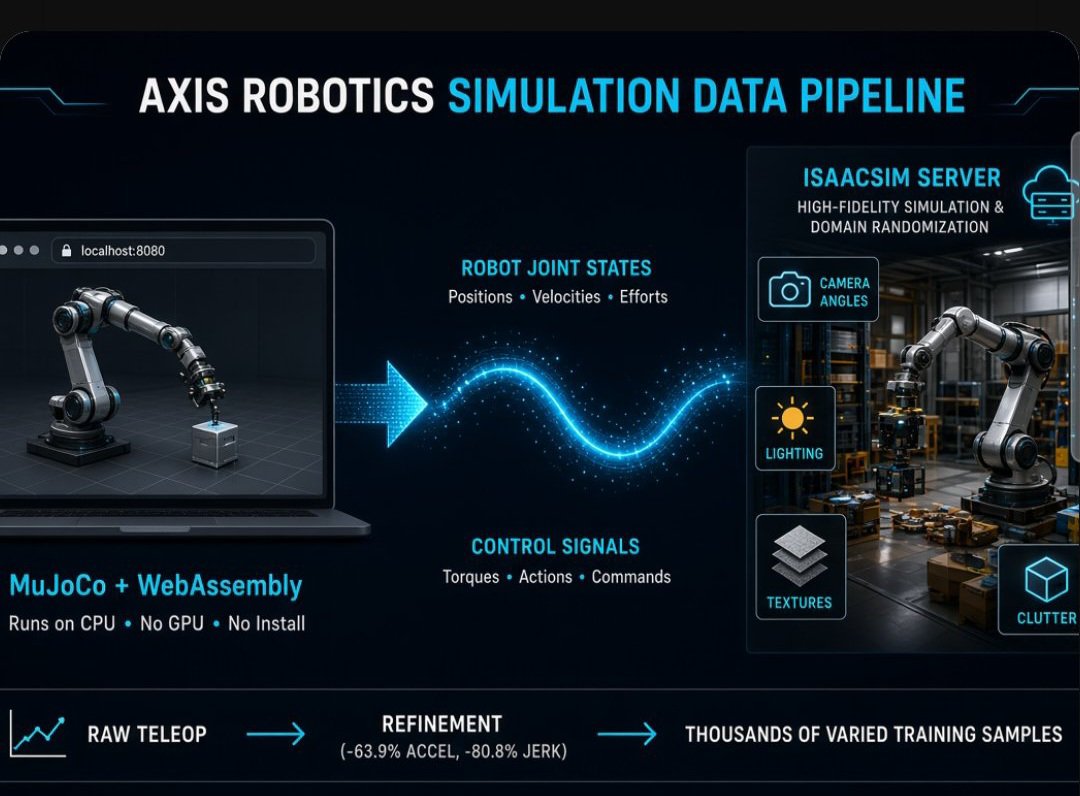
One technical detail in @axisrobotics that still flies under the radar is how they split the simulation stack for scale.
Contributors teleoperate in a pure browser environment. MuJoCo physics is compiled to WebAssembly so full collision detection, dynamics, and inverse kinematics run locally on the user’s CPU. No GPU, no install, no special hardware. Every accepted trajectory is then deterministically replayed on GPU servers running IsaacSim.
During that replay the system applies domain randomization across lighting, surface textures, camera angles, object mass, friction, and clutter. A single human demonstration expands into thousands of photorealistic, physically varied training samples while the exact control sequence stays intact.
Before any of that happens the pipeline also smooths the raw teleoperation data. Refinement cuts mean acceleration by 63.9 percent and mean jerk by 80.8 percent against the original browser recording. The result is cleaner labels that still preserve the contributor’s intent.
That lightweight-front-end plus high-fidelity-back-end design is what lets retail users generate data that actually compounds into stronger policies.
@axisrobotics
Prediction markets tell us what people collectively believe
they don't always tell us whose judgment deserves more weight
two people can land the same prediction, one has a strong track record behind it
the other got lucky once on the surface, identical calls but they're not worth the same
Prediction → your belief
Performance → your evidence
Behavior → your decision pattern
Consistency → your track record
Reputation → accumulated trust
@acepyr connects prediction activity with behavioral signals over time
so the real question isn't "who was right?" It's "who consistently makes better decisions?"
Prediction markets create the signal. Reputation makes that signal actually useful.
Salman explains why relying on generic LLMs for trading data fails due to SEO junk, and how Button lets traders curate their own trusted sources instead.
Salman: “When you ask Claude or ChatGPT a question, it searches Google, grabs the top 10 results, and puts that into its context. But if you search Google for a ticker, you just get a bunch of SEO-optimized pages filled with junk. What we want you to do is define the exact sources you care about like Ansem, a specific podcast, or four other traders you believe are sharps. That becomes your canonical set. By controlling the inputs, you know exactly what the AI is summarizing, so you can actually trust the output.”
Most RWA = token first, assets later.
@EthraShip = fleet since 2021, real TCE revenue, THEN token in 2026.
What @EthraShip is providing:
Stake $SHIP → unlock Fleet Visibility Dashboard (live vessel data) + access to SPVs backed by operating dry bulk ships.
80% world trade moves on ships, but 0% was on-chain. Until now.
$20T industry, $32B RWA market,
ships already moving. You still early via @NucleusCodes campaign 🚢
Lets study @River4fun
noticed a meaningful change on the @EthraShip RWA page.
the old version framed the next step around “Ethra 4.”
the live page now talks about “the first tokenization” and says it will use a vessel already operating in Ethra’s fleet, with real trading history, cargo and counterparties behind it.
what changed isn’t just the label.
the current RWA story is now explicitly anchored to an asset that’s already at work before the digital layer is added.
the tokenization is still in preparation and subject to approval.
SeaVerity remains the product vision. Harbor is where users can participate today.
A LITTLE GIVEBACK FOR THE COMMUNITY If I make it into the Top 1,000 on @commonsmade , I’ll give away 50% of my airdrop to everyone who supports me ❤️
BONUS: the account with the highest vouch points will receive 10$ !!
→ Visit: https://t.co/popdf0POtN
→ Sign up with X
→ Comment: Hey @commonsmade , I vouch for @madban77
I’m counting on you guys 📷
This video captures the idea behind Humyn Labs: robots will have to understand real life, not just controlled environments.
@humynlabs is building the human data foundation for that future by capturing multimodal experiences across vision, audio, movement and touch.
That matters because physical intelligence depends on context.
A robot mowing a lawn or navigating a grocery store needs to interpret far more than an image.
Humyn’s Fusion Engine brings these signals together into episodes, making human experience useful for Physical AI.
Looking ahead, I see Humyn becoming important as robots move into everyday spaces.
The future may not simply be smarter robots.
It could be robots trained on richer human experience.
Most people only know that a Beldex masternode needs 10,000 BDX collateral.
Almost no one explains how shared contribution actually works on the technical level.
On the @BeldexCoin network one masternode can be funded by multiple contributors.
The operator sets an operator fee percentage. The remaining reward is then split automatically according to each person’s contribution ratio.
Registration still uses a single time-locked output of 10,000 BDX total. Contributors do not need to run their own server. They only lock their share.
Rewards are distributed on-chain after every block the masternode produces or validates. The split happens according to the recorded contribution amounts.
This design lowers the entry barrier while keeping the full economic security of a complete 10,000 BDX stake.
It is one of the quieter mechanisms that lets more people participate in securing Beldex without forcing everyone to become a full node operator.
A common misconception in Web3 is that "if you have nothing to hide, you have nothing to fear."
In reality, digital privacy is about financial security and personal safety.
Exploit Protection: On fully public chains, attackers can analyze high net worth wallet addresses, trace holdings, and target users with targeted phishing attacks or exploits.
Business Confidentiality: Companies using blockchain technology cannot operate if competitors can view their payroll, supplier costs, or daily transaction volumes on a public ledger.
Censorship Resistance: Financial independence requires protection from unjust surveillance and data harvesting.
Beldex provides the necessary infrastructure to make sure decentralized finance and communication remain safe for everyone. @BeldexCoin
✨ @sleepagotchi started with a simple idea: make better sleep easier to stick with.
Now the bigger vision is becoming much more interesting.
Sleep data → AI understanding → personalized actions.
The Sleep Coach is already live, with more agents planned around wellness, ⏭️
Injective is expanding into regulated financial infrastructure with an SEC-registered transfer agent arm.
Its Institutional Services is now SEC-registered as a transfer agent that can track securities ownership transfers.
The rest of the stack was already live:
- A MiCA white paper released for the EU markets
- Injective Mint operating in private alpha/beta for asset tokenization
- LG CNS and Korea’s largest trading firm POSCO selecting Injective for its tokenization pilot
Together they cover ownership tracking, an EU regulatory disclosure path, an issuance platform, and a live institutional pilot customer, the core pieces of a regulated asset tokenization stack.
Institutional-grade RWAs are already live on @injective, now backed by its newly SEC-registered transfer-agent infrastructure.
I stopped joining creator campaigns where the rules show up after I've already submitted. You post the content, then you find out, sometimes, what the scoring actually weighted, whether performance mattered more than the writing, whether your account history counted against you. That's not a campaign, that's a blind bet with extra steps.
The fix isn't complicated, it's just rare. A campaign should hand you the map before you start walking, the brief, the content rules, the scoring weights, the reward pool, all visible before you write a single word, not reverse-engineered afterward from who got paid.
@swaymarkapp treats that as the baseline, not a bonus feature. Campaigns publish their scoring weights upfront, and content quality, performance, and reputation are broken out separately instead of folded into one mystery number. You know what you're being measured against before you're being measured.
Here's the practical version of why that matters, I write differently when I know quality is weighted at 50% versus when I don't know it's weighted at all. Clarity changes the work, not just the trust. A campaign that shows its terms early isn't being generous, it's just finally treating creators like people who can read.