More on number one: there are two versions of hell in the Bible... There is hell.... And there is the lake of fire..... All of hell will be scooped up and dumped into the lake of fire ....hell is like the local jail holding cell ....and the lake of fire is the federal penetentiary prison... Like going uptown overnight versus life in Alcatraz... Shoel is near hell ....shoel is under the earth.....soooooo......
My guy! I legitimately loved 3D pinball space cadet!! I was born in 95. Im 31 now. When I was only 4 I was exploring my grandfather's computer, and discovered pinball buried in the start menu options! It was an early introduction to a type of secret hidden Easter egg. I remember playing it five dozen plus times until around the time I was 8 or 9. Because after I was 5 the kids got to use one of the weaker older computers, it was a Packard Bell from around 1990. And it was SLOW! I also adore jezzball...!!! That needs a comeback...!!!
Im gonna say I felt 1248 pop into my head...don't know if that could apply anywhere along the number...I also felt like 6902 belongs somewhere.... possibly after
I have no clue....just the numbers that came to me....I don't claim to be a true psychic...but I've had various psychic or telepathic events or synchronicities occur often... also a 24 digit number would take remarkably specific precision...would be easier to use remote viewing or astral projection....would be even easier to talk to an angel/demon....but I'm not doing any of that shit no more....
@exQUIZitely Elon Musk fucks his associates...makes human children with anyone and everyone......nobody bats an eye....huang has one affair... everybody loses their minds!!!
I'm really tired of people wanting instant feedback or else they'll delete their wonderful supportive comments and pretend like you're nothing, just because I didn't respond to your comment in two or three days....I'm not chronically online like your useless ass... And if you're only going to be nice or show support if I'm immediately validating to you, you can go the fuck away and bark up another tree. I don't need fake support, I need real ones...💔🙏
The camera used to END arguments.
AI turned the camera INTO the argument.
A fake video can put words in a politician's mouth.
A REAL video can be dismissed with two words: "It's AI."
A chatbot can repeat lies or false claims like they're established facts.
The same technology can manufacture a lie AND provide an excuse to deny the truth.
We've entered an era where "I saw the video" isn't the end of an argument.
It's the beginning of an INVESTIGATION.
The next AI arms race won't just be about generating convincing unrealities.
It'll be about AUTHENTICATING them.
When anything can be fabricated, PROOF becomes PRICELESS.
And here's the paradox: as AI-generated content floods the internet, the forgotten archives of the pre-AI era may become some of humanity's most valuable digital treasures.
Old photographs, home videos, MP3s, MP4s, books, recordings, and "preserved" collections like the Internet Archive aren't merely nostalgia; they're potentially critical reference points for human history before generative AI became commonplace and vastly oversaturate.
With verifiable origins, these collections could become invaluable both for authenticating history and for training future AI systems on documented human created material.
Age alone doesn't guarantee authenticity, but provenance, preservation, and original records are very quickly becoming digital liquid gold.
The 90s Internet is nearly all gone....
The 2000s Internet is a hollow carcus....
The 2010s Internet is beginning to rot away....
The 2020s Internet is a dead Internet filled with synthetic bot gen traffic....
Hoarding and saving old original pre AI digital collections is seriously critical for the well being of tomorrows humanity...
This year and the next few years are a critical junction point for how this all ends up...
If the Internet archive's vast collections were to be censored, removed, hacked, deleted, or restricted it would be like an even worse modern burning of Alexandria....
The future of truth and the future orientation of progress may depend on how well we preserve the past.
-- Xander
Very good response, Dave! I fully agree with your broader point. It's about the tool for the job, the function for the utility. There's no one-size-fits-all measure of knowledge, skill, or expertise in such a broad-ranging field. Like you were getting at even the “best” code depends on whether we prioritize reliability, performance, elegance, necessary complexity, or debugging ingenuity.
Besides, computers have increasingly covered a wider breadth of subfields and use cases. As computational resource budgets and simulation resolution expand, so does our ability to represent increasingly complex systems. Computers now do a heck of a lot more than simple math, spreadsheets, and text manipulation!
Entire virtual worlds, digital planets, and computerized fractal dimensions exist with vast complexity: 3D models, physics engines, and detailed interactions. Entire other fields are squeezed into computer systems: biology (cells, DNA, proteins, hormones, skeletons), neuroscience (neural networks, simulated brains, psychological models), and physics (gravity, mass, velocity, fluids, forces, collisions, friction).
Computing has become an enormous umbrella field, with subfields branching into ever more specialized niches. Someone who excels at shader effects may know little about distributed systems; someone skilled at game physics might not know cryptography. Someone fluent in calculus and trigonometry may know little of abstract algebra, topology, measure theory, or category theory. None of that invalidates their expertise.
Consider someone who devotes nearly 100% of their effort to mastering one or two domains, versus someone spread across twenty or thirty. The specialist may achieve astounding depth; the generalist may gain versatility, a broad toolkit, and the capacity to connect seemingly unrelated ideas. Spreading yourself widely can mean spreading yourself thin; but not necessarily so.
Here's the wrinkle: not everybody's 100% is the same. Intelligence, education, intuition, learning speed, opportunities, experience, and quality of practice differ. Twelve hours grinding through repetitive menial tasks isn't necessarily equivalent to four or six hours of intensely focused new study, experimentation, and problem solving. People also extract different value from the same hours.
A highly capable multidisciplinary engineer may sometimes outperform a narrower specialist, even within that specialist's domain; and sometimes the reverse. Breadth doesn't automatically mean superficiality; specialization doesn't guarantee superiority. Expertise isn't a single scalar value, but a multidimensional highly variable landscape. The best code depends on the problem, the best expertise on the domain, and great engineering on recognizing which constraints matter and how to bridge the boundaries of one's own knowledge.
I'm wondering if Elons Blindsight will actually let the born blind see for the first time.
I heard about blind people getting there eyes surgically switched on, yet they still couldnt see.
Everything was a mess of colors and blurr... I'm thinking because they never saw before they didn't have the neural networking for sight built up.
The hardware was there but no software.....
I'm wondering if Elons blindsight can actually do better... 🤔🫠
🔺>>> What if computer engineers largely overlooked an entire dimension of symbolic information;
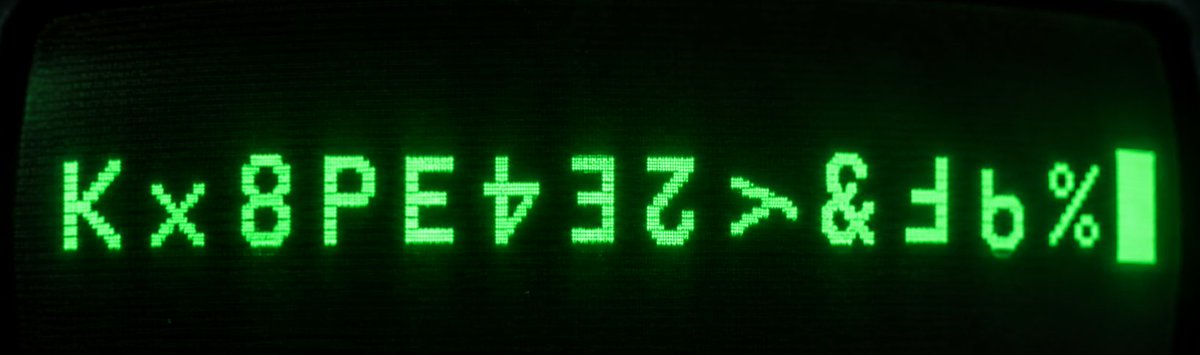
By 1984, Commodore 64 programmers could already rotate characters through 0°, 90°, 180°, and 270°.
But consider something deeper.
ASCII assigns numerical identities to characters, while treating their visual orientation as irrelevant to their encoded meaning.
But what if rotational-orientation were part of the alphabet itself?
Start and take 64 visually distinguishable glyphs, each with four reliably distinguishable rotations from each other.
64 × 4 = 256 unique symbols.
That's an entire byte's worth of possible values represented each by ONE visible rotated character position.
Glyph rotation quadruples your symbolic repertoire.
Mathematically, the glyph identity contributes 6 bits, while 4-way-orientation would contribute another 2 bits.
Even more intriguing, the alphabet needn't be human-readable; its purpose could be precise machine decoding, with a deliberately chosen font minimizing rotational collisions and ambiguity.
You could encode each single character as an entire nibble or byte, as part of a larger code-alphabet-schema.
Now imagine extending that principle across hundreds of characters, combining orientation with color, geometry, positioning, and independently encoded boundaries.
This is a smaller part of what I'm investigating with my "'Xan's ''Triklett-Bond-OP'' (Optical-Code),"'
or "T-BOP-Codes" my experimental
high-density optical encoding architecture.
Potentially a great deal denser than QR-Codes.
It increases the theoretical information capacity of a visual symbol. Actual recoverable capacity depends on ambiguity, resolution, noise, and error correction.
And orientation-based encoding does have some mild historical precedents.
But the underlying question remains fascinating:
Why do we so often treat a symbol's identity as information, yet its orientation, color, and geometric relationships as mere decorative presentation?
I suppose the next leap in encoding isn't inventing more symbols.
Perhaps it's extracting more layers and higher dimensions of meaning from the symbols we already have now. <<<🔺