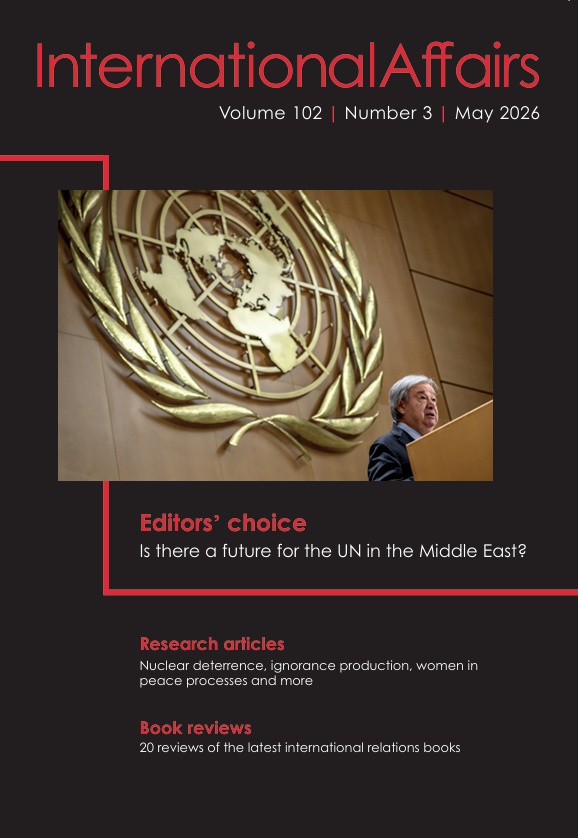
🚨New issue is out now!
🇺🇳 Is there a future for the UN in the Middle East?
💻 Have technologies revolutionized maritime security?
👀 How does ignorance shape world orders?
Read the latest research on these topics and much more, along with 20 book reviews, in our May issue: https://t.co/Not4pBleAt
🚆 In our May issue, @Zhu_Keren (@DavidsonCollege) & Karl Yan conceptualise a state-enabled globalization framework to better understand the factors contributing to China’s global engagement capacity: https://t.co/QDn2rqqeye
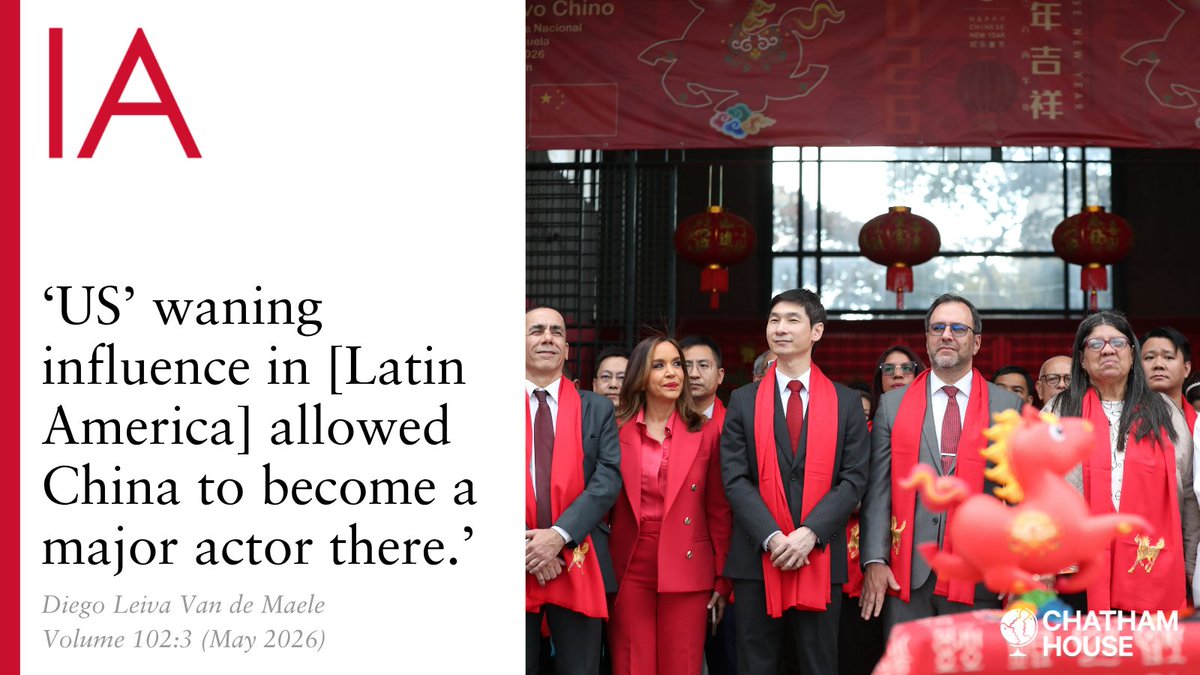
🌎 Trump’s first presidency offered an unprecedented policy window for attitude shifts towards China’s Latin America policy, argues @Diegoleivavdm (@Griffith_SGIR).
Read more about how the US has been responding to China’s engagement with Latin America: https://t.co/UEYybzwNsh
⌛ Last week to apply for the position of Book Reviews Editor (Consultancy) with our journal!
This is an an honorary position that will join our Editorial Board and will have responsibility for ensuring the book review section reflects the breadth and quality of the journal. Apply now 👇
https://t.co/2sVKKbs7rw
🔍 In our May issue, Brice Didier analyses the EU’s strategies since 1995 to unpack how the region has navigated the US-China rivalry.
Read more about the EU’s strategic pragmatism: https://t.co/CRrSzvhUZu
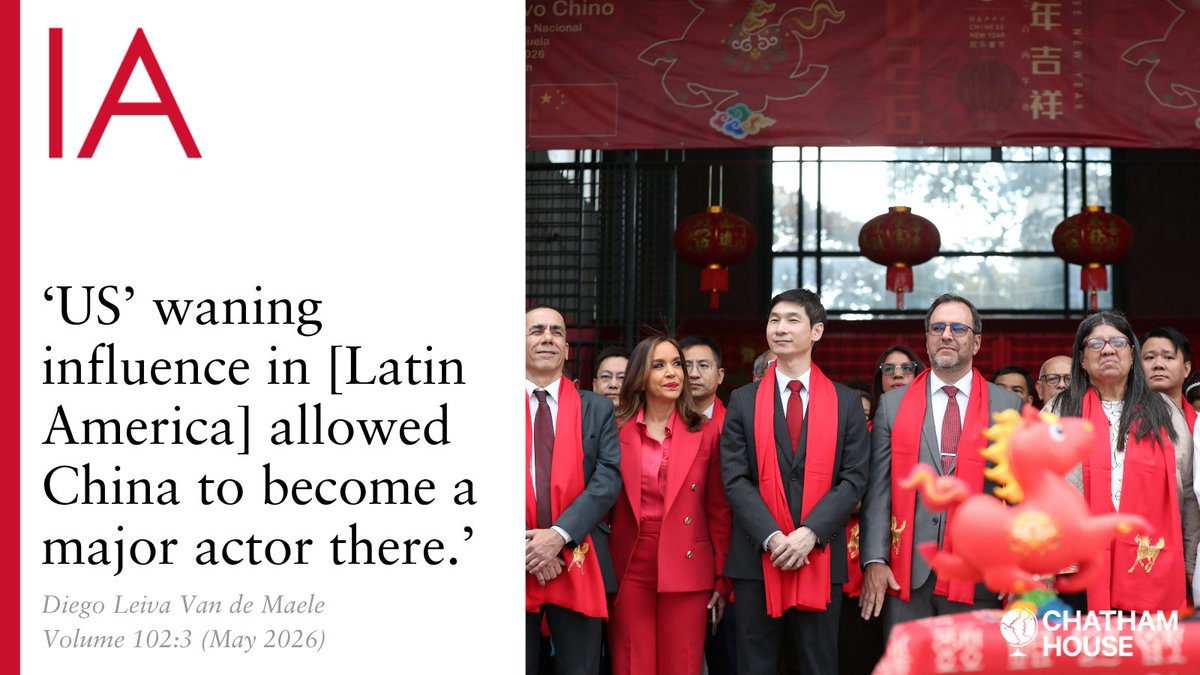
🌎 What were the reasons behind the US’s delayed response to China’s advancements in Latin America?
@Diegoleivavdm (@Griffith_SGIR) develops a neo-classical realist policy framework to understand this dynamic: https://t.co/HhkuGRa4kC
Thanks to @DanDePetris for his thoughtful review of my book "The Case For American Power" in @IAJournal_CH.
He calls it "a worthwhile contribution to the US grand strategy debate."
The chapter on hypocrisy is my favorite too 🙂
https://t.co/rFmZ9n1BUr
The practice of strategy in war is a form of moral economy, according to @tom_waldman (@lborouniversity).
Learn more about how narratives play a critical role in regulating the moral strategic field: https://t.co/viUgrLp33E
When I published my 2020 article on “wartime paradigms” in @IAJournal_CH, I was looking at what seemed to me a central paradox of contemporary warfare: war is getting faster and slower at the same time.
For decades, Western militaries assumed that operational superiority came from speed: faster sensing, faster decision-making, faster targeting, faster force projection. But adversaries understood this. And much of what we are seeing in Ukraine, and in the confrontations involving Iran, is a deliberate effort to slow Western warfare down.
At the tactical level, war is accelerating. Drones, sensors, precision fires, electronic warfare and targeting cycles compress the time available to commanders. Units are detected faster, targeted faster and forced to adapt faster.
But at the operational and strategic levels, tempo is decelerating. Campaigns become harder to initiate, harder to sustain, and harder to translate into political outcomes. Logistics are exposed and industrial capacity becomes decisive, while concerns about escalation management slows decision-making.
Ukraine illustrates this perfectly: tactical adaptation is extraordinarily fast, but the war’s strategic rhythm is defined by attrition, mobilization, ammunition production, fortifications, alliance politics and endurance. The Iran case points in the same direction. US/Israeli targeting may be flawless, but Iran understood that it had strategic leverage through a denial strategy of blocking Ormuz.
So the issue is not simply that Western militaries need to “go faster.” Instead, one of the key challenges of military theory and practice will be to reconcile these disjointed temporalities: tactical acceleration, operational pacing and strategic endurance.
https://t.co/9ggmEbTahg
Do mutual negative beliefs inevitably lead to escalation, or can they sometimes produce stability?
Read @Consuelothiers's (@EdinburghPIR) #openaccess article to learn how leaders’ beliefs in rival dyads influence escalation and cooperation: https://t.co/ldlYSUjfsM
🌏Our Policy Fellow and Nuclear Transparency Inventory Project Manager, Dr Lyndon Burford, published an article in the May edition of @IAJournal_CH, examining how nuclear deterrence impacts the #NPT. https://t.co/yMOpFi9JZX (1/4)
💼 Job title: Book Reviews Editor (Consultancy)
📍 Location: London, Hybrid
📝 Eligibility: An experienced and well-connected scholar of International Relations
⌛ Deadline: 7 June, Saturday
Apply here 👇
https://t.co/Jx1pTLRhmN
📢 JOB ALERT: We are looking for a Communications Manager who will devise a promotional strategy for our journal, drive article discoverability and grow the journal’s audience and networks.
Apply by 7 June below👇
https://t.co/CEIqaQ8LYr
Damage limitation is a deliberate, cautious approach to managing loss in a competitive world of shifting alignments, write @LuisSimn (@CSDS_Brussels@VUBrussel@rielcano) & @OliviaCheung_oc (@kings_eis).
Read more about China and Russia’s approach to EU’s geopolitical distancing: https://t.co/2ObwfZCKnn
🛰️ For remote sensing, AI and information-sharing platforms to become a coherent part of ocean protection efforts, sustained capacity training is required, writes @CMSchultheiss (@MPilHeidelberg).
Read more about maritime domain awareness and maritime security: https://t.co/HNZjyvFVtD