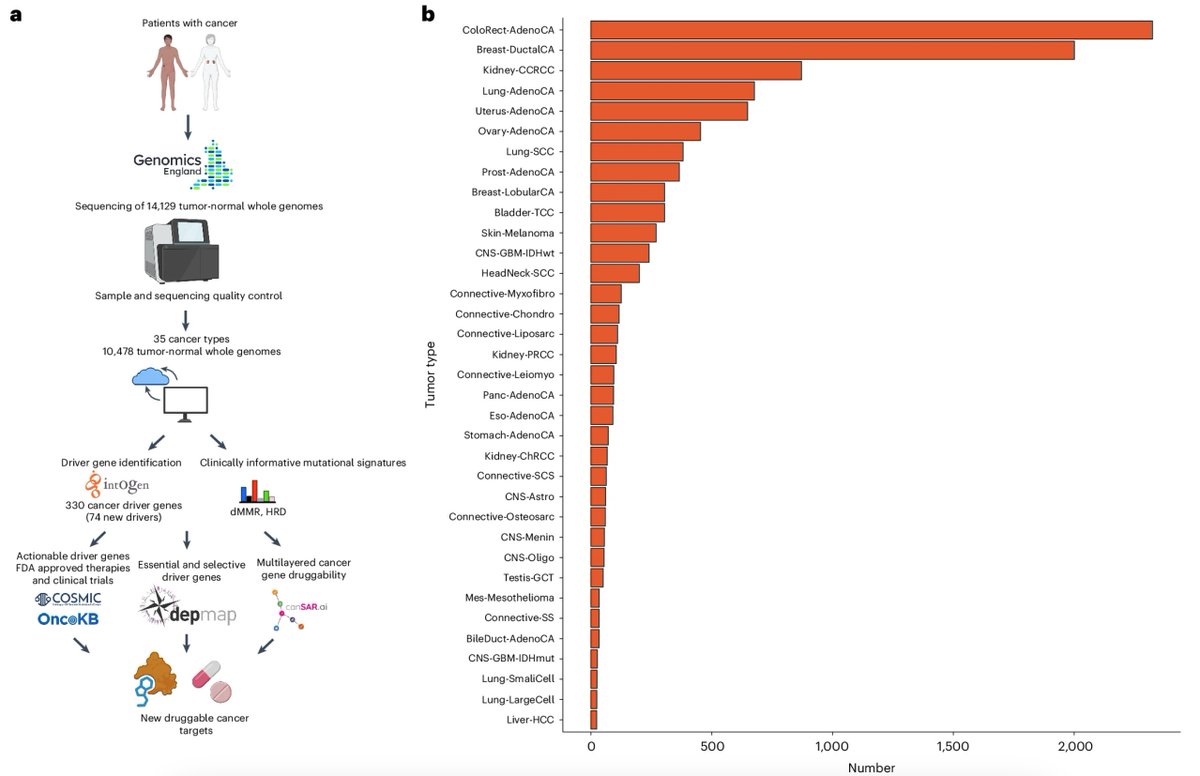
Incredible resource: analysis of Whole Genome Sequencing data on 10,478 cancer patients spanning 35 types identifies 330 candidate driver genes, including 74 new drivers.
TP53 is a driver in 29‼️tumor types, followed by PIK3CA(18), ARID1A(16) & PTEN (14)
https://t.co/Q6Y00l4F4f
Evolution of delayed resistance to #immunotherapy in a #melanoma#responder: "37 tumor samples over 9 years from a patient with metastatic melanoma with complete clinical response to ICB followed by delayed recurrence and death"
https://t.co/tFR9mRDJwE
Our multimodal model to combine TCR sequences with scRNA-seq is finally out. The most interesting part for me was observing a clear case where the combination of TCR sequence and cell state (RNA) preserved both clonotype and cell type information, leading to a more holistic cell representation that captures phenotype and functionality. We also decompose the contribution and importance of each modality. This was a really fun project spearheaded by @DrostFelix, whose amazing perseverance during a long review period, and collaboration with @schubert_benni and other fantastic collaborators, made it possible.
Read the paper :https://t.co/UtrYcb5EyY
The human chromosomes are numbered incorrectly (The fourth in an irregular series of threads about #Bioinformatics.) As most people know, 22 of our chromosomes are numbered from longest to shortest, plus we have X and Y... 1/6
A major problem with cell-free tumor DNA to detect cancer (Liquid biopsy) is its very low quantity. Today @NatureMedicine use of #AI to overcome that issue with impressive results for radical signal-to-noise enrichment
https://t.co/zMWaq3F8jP
free access https://t.co/VPLpESbw3a
We analyzed all 5734 of the available WGS samples from The Cancer Genome Atlas, and find far, far smaller numbers of microbes than previous reports that appeared (with great fanfare) in @Nature and @CellCellPress. With @YuchenGe1 et al https://t.co/qTUvkbCuPC