Imagine walking into a coffee shop. ☕️
You have ETH .
The merchant prefers BTC.
No problem.
You scan a QR code, pay with your crypto, and the merchant receives the native asset they want.
Simple enough to explain to your grandmother. 😄
But beneath that little QR code? ⚙️
@THORChain coordinates liquidity across independent blockchains, with THORNodes observing transactions and distributed vaults handling native settlement.
No unnecessary wrapped tokens.
No centralized exchange required by the protocol.
No bank deciding whether to approve the payment.
And that's what makes @mocadotapp interesting.
Two people. Two different currencies. One payment.
With decentralized infrastructure doing the complicated work in the background.
A beautiful extension of Bitcoin's original peer-to-peer vision: open financial rails, fewer gatekeepers, and more freedom to choose how we exchange value. ⚡️
#THORChain #CrossChain #validator thorchain:native
Hide the complexity, keep the power. ⚡️
@mocadotapp merchants can now take payment in the coin their customers hold and settle natively, with THORChain as a settlement layer.
A marketplace needs more than assets on the shelves.
It needs money moving between them.
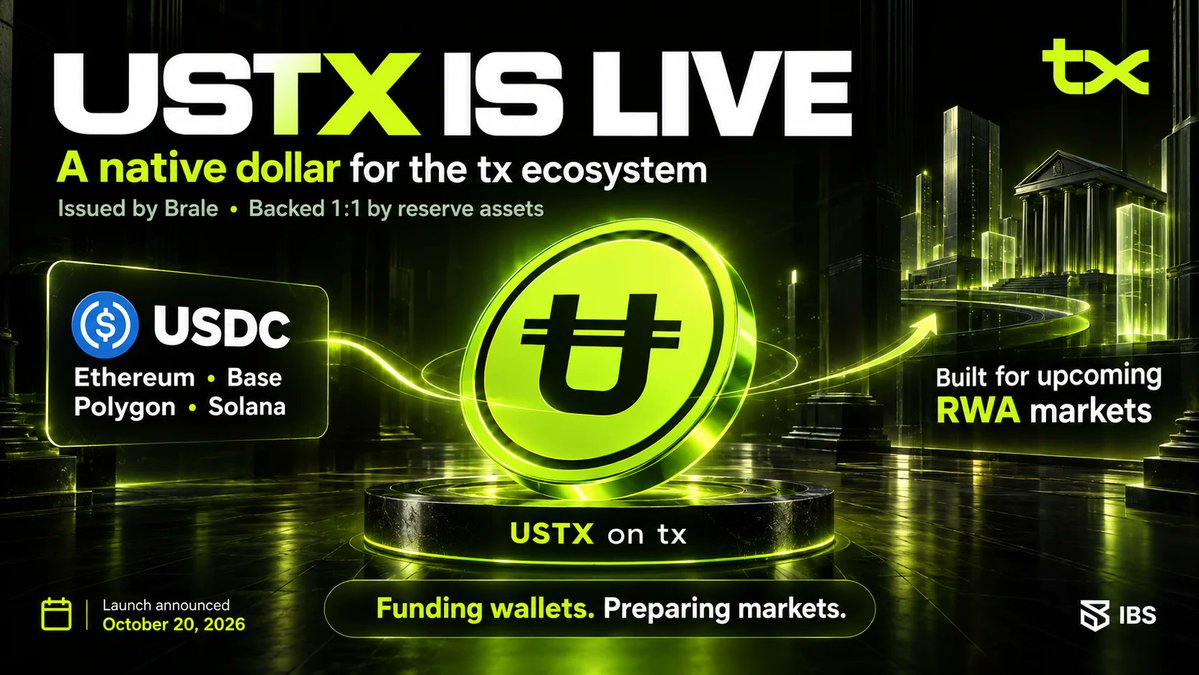
@txEcosystem has announced the launch of USTX, its native dollar stablecoin issued by @brale_xyz .
Here’s how it fits into TX’s RWA plans—and what the launch bonus requires. 🧵👇
___
1️⃣ 💵 What is USTX?
USTX is the native stablecoin of the tx ecosystem.
According to TX, each token is backed 1:1 by dollar-denominated reserve assets overseen by Brale.
USTX is distinct from TX, the network token.
___
2️⃣ 🌉 How does funding work?
TX announced USDC deposits from Ethereum, Base, Polygon and Solana at launch, with USTX delivered to a tx wallet.
Redemption back into USDC is also supported, according to the announcement.
Four additional deposit networks are planned.
___
3️⃣ 🏗️ Why introduce a native dollar?
TX wants USTX to provide a common balance across its upcoming marketplace, SoloTex and supported RWA offerings.
The aim: fewer conversions and transfers as users move between products.
Those integrations remain a rollout to watch.
___
4️⃣ 🎁 What does the launch bonus require?
According to TX’s latest announcement:
• Convert 100+ USDC in one transaction
• Receive USTX in the tx Super App wallet
• Hold it for 7 days
• Complete verification
Bonus: 1,500 TX, or 3,000 TX for Elite Club members.
___
5️⃣ 🛂 Eligibility matters
TX states that the bonus is available once per verified user in supported regions.
Mints to third-party wallets do not qualify.
The promotion is time-limited and subject to jurisdiction restrictions and program limits.
Check the current terms before participating.
___
6️⃣ 🔎 A launch incentive is only the beginning
The bonus rewards an eligible first mint.
What follows will matter more for the ecosystem:
Will balances remain after incentives?
Which products will use USTX?
Will meaningful trading liquidity develop?
A funded wallet is the starting point.
___
7️⃣ ⚙️ From funding wallets to functioning markets
USTX gives TX a native dollar instrument around which to build.
The next milestones are usable products, accessible markets and reliable redemption.
That is where the infrastructure meets everyday use.
#TX #USTX #RWA
---
🔁💙 RT and Like if you enjoy exploring the infrastructure behind tokenized markets.
💬 What will convince users to keep using USTX once the launch incentives end?
Follow @IBSvalidator to learn more, and let’s build a new decentralized world together. 🌐
#TX #USTX #RWA #NDW tx:native
$USTX is now live.
The native stablecoin of tx, issued by @brale_xyz and fully backed 1:1.
Bring your liquidity onto tx for the real-world asset markets ahead.
Minting is open in the tx Super App or via the official web portal:
https://t.co/2ycd4KmAxR
AI can analyze the market in a second.
But feed it the wrong price, and it can get things wrong faster than lightning. 🤖📉
Before listening to a trading bot, let’s look at what feeds its instruments.
The @BandProtocol × @BellaProtocol announcement offers a useful case study. 🧵👇
--
1️⃣ 📲 What exactly is Bella?
Bella Protocol develops tools for trading and DeFi.
Its Bella Alpha assistant, available on Telegram, combines AI-powered research, market analysis, and long/short signals for selected perpetual trading pairs.
The announced collaboration aims to feed its models with Band’s price data.
--
2️⃣ 🛰️ Why bring in an oracle?
Imagine a pilot whose altimeter displays an outdated reading.
Even with an excellent flight computer, the flight path can become dangerous.
For a trading AI, a stale or manipulated price can distort the analysis before a signal is even generated.
The oracle works upstream: it supplies the data the model will use.
--
3️⃣ 🔎 How does Band build this information?
Its approach combines multiple price sources with a network of validators on BandChain, its blockchain built with the Cosmos SDK.
Prices are collected, reported, and aggregated to produce a value applications can use.
The goal: reduce dependence on a single source and limit the influence of an outlier.
Multiple sources observe the market. Multiple validators contribute to the result. Reliability also depends on their quality and independence.
--
4️⃣ 🧭 Reliable instruments are still just instruments.
A verified price does not predict the market’s next move.
Data quality matters; model quality and risk management remain essential.
Before following a bot, take the time to understand its sources, strategy, and limitations. An automated signal can still lead to a loss.
This thread explains infrastructure. It is not financial advice.
--
💬 Before asking “How much does your AI earn?”, let’s also ask “Where do its prices come from?”
🔁 ❤️ RT and like to help more users understand what happens behind the scenes of trading bots.
Let’s build a more decentralized digital world together. #NDW
#Band #AI #validator ethereum:0xba11d00c5f74255f56a5e366f4f77f5a186d7f55
Band is partnering with @BellaProtocol to build an oracle-powered AI trading feature for Bella Alpha.
Band will feed real-time, multi-source price data straight into Bella Alpha’s AI models, so every signal they send to Telegram starts from numbers that have been checked before anyone acts on them
ONE dollar. 💵
THREE versions of USDC. 💵💵💵
And somehow, YOU have to figure out which one your app actually accepts. 🤯
Welcome to the stablecoin maze.
What if moving digital dollars across blockchains didn't require a detective license?
@axelar just opened a new route. 🧵👇
--
1️⃣ 🧩 The USDC identity crisis
You want to send USDC.
But your wallet shows different versions of the same digital dollar.
Native USDC? Bridged USDC? USDbC?
On @base , for example, circle -issued USDC and bridged USDbC are different tokens.
Same dollar reference. Different contracts.
And users are expected to know the difference. 🕵️
--
2️⃣ 🧱 Fragmentation has a cost
The problem goes beyond a confusing wallet.
Multiple token versions can mean:
🔹 Liquidity split across different pools
🔹 More integrations for developers to manage
🔹 Extra friction for payments and DeFi
🔹 More confusion for users
One digital dollar, multiple isolated markets.
Not exactly the seamless Web3 experience we were promised.
--
3️⃣ 🔌 Axelar opens another route
@axelar has announced native USDC swaps across supported chains.
Its interface now shows routes such as:
💵 USDC on Ethereum
↓
🌐 Axelar
↓
💵 USDC on Base
The idea is simple:
Make cross-chain USDC transfers easier to navigate, with native USDC on supported routes.
Fewer detours through the stablecoin maze.
--
4️⃣ 💳 Why native USDC matters
Native USDC is issued directly by @circle .
Bridged versions are created through separate mechanisms and carry different dependencies.
For users, having a clearer route to native USDC means less confusion over which version to use.
For protocols, reducing fragmentation can make liquidity and integrations easier to manage.
Less detective work. More useful infrastructure. 🛠️
--
5️⃣ 🌐 One USDC should feel like one USDC
This launch doesn't magically remove every wrapped token or every cross-chain risk.
But it's a step toward something Web3 badly needs:
A world where users can focus on sending, receiving and using digital dollars.
Not decoding token names and bridge contracts.
The best interoperability makes complexity less visible, without ignoring security.
That's a future worth building. 🌐
--
🔁❤️ RT and Like to support simpler, more accessible cross-chain payments and decentralized interoperability.
💬 Have you ever struggled with multiple versions of USDC in your wallet?
Do you think native USDC routes could make the multichain experience easier? Share your experience! 👇
Let's move forward together toward a new decentralized world. 🌐 #NDW
#Axelar #USDC #Interoperability #validator base:0x23ee2343b892b1bb63503a4fabc840e0e2c6810f
Imagine walking into a coffee shop. ☕️
You have ETH .
The merchant prefers BTC.
No problem.
You scan a QR code, pay with your crypto, and the merchant receives the native asset they want.
Simple enough to explain to your grandmother. 😄
But beneath that little QR code? ⚙️
@THORChain coordinates liquidity across independent blockchains, with THORNodes observing transactions and distributed vaults handling native settlement.
No unnecessary wrapped tokens.
No centralized exchange required by the protocol.
No bank deciding whether to approve the payment.
And that's what makes @mocadotapp interesting.
Two people. Two different currencies. One payment.
With decentralized infrastructure doing the complicated work in the background.
A beautiful extension of Bitcoin's original peer-to-peer vision: open financial rails, fewer gatekeepers, and more freedom to choose how we exchange value. ⚡️
#THORChain #CrossChain #validator thorchain:native
Hide the complexity, keep the power. ⚡️
@mocadotapp merchants can now take payment in the coin their customers hold and settle natively, with THORChain as a settlement layer.
RWA markets need assets to trade. They also need a way in. 💵🏦
With USTX set to launch and fiat purchases planned via @BanxaOfficial in the tx Super App, @txEcosystem is working to simplify how users fund their activity onchain.
Infrastructure matters. So does accessibility. tx🌉
#tx tx:native #ustx #RWA
More than one way to get started with USTX.
Through our partnership with @BanxaOfficial, users will be able to purchase USTX with fiat directly in the tx Super App.
We’re excited to take this next step with Banxa, a longtime partner of the tx ecosystem.
Fair point, and we understand why the announcement might have come across that way. 🙂
But our intention was to explain the economic trade-offs, not celebrate the decision.
And you're right that larger operators often have more resources to regain their position, while smaller independent validators face much tougher barriers.
That's exactly why operator diversity matters.
We're not defending the reduction. We're highlighting a difficult balance that every PoS network needs to address.
And constructive criticism like yours is part of keeping that debate alive.
40 fewer validators. More rewards for stakers.
Two governance proposals. One fundamental trade-off. ⚖️
@osmosis is reshaping its economic model through two major governance decisions.
On paper, greater efficiency and stronger staking incentives sound promising.
But what happens to decentralization?
And how can a network remain economically sustainable without concentrating too much power?
Let's explore the economics of decentralization. 🧵👇
—
1️⃣ 🗳️ Two proposals, two different mechanisms.
Osmosis has approved two significant governance changes:
🔹 #1051: Reducing the active validator cap from 70 to 30.
🔹 #1052: Increasing the share of non-OSMO taker fees allocated to stakers.
These decisions affect two different aspects of the network:
• Who participates directly in consensus.
• How trading-generated revenue is distributed.
Importantly, governance approval and technical implementation are separate steps.
The real impact will depend on how these changes play out.
—
2️⃣ ⚙️ Why do validator economics matter?
Validators do much more than simply run servers.
They participate in consensus, maintain infrastructure, secure signing keys, monitor uptime and coordinate network upgrades.
All of this comes at a cost.
A larger validator set creates more opportunities for participation.
But without sustainable revenue, maintaining reliable infrastructure can become increasingly difficult.
—
3️⃣ 🏗️ Proposal #1051: From 70 to 30 validators.
That's 40 fewer active slots, representing a 57.1% reduction in the maximum validator set size.
The proposal argues that a smaller set could:
• Reduce consensus overhead.
• Improve coordination during upgrades.
• Make validator operations more economically sustainable.
However, a smaller validator set also means fewer independent operators participating directly in consensus.
—
4️⃣ ⚖️ Does fewer validators mean less decentralization?
Not necessarily in the same proportion.
Decentralization also depends on how voting power is distributed across the network.
According to the proposal's snapshot, validators outside the top 30 represented approximately 11.9% of bonded OSMO.
Still, fewer available slots can raise barriers to entry and make it harder for smaller or emerging validators to participate.
Affected delegators may also need to redelegate to an active validator to continue earning staking rewards.
Validator count alone doesn't tell the whole story of decentralization.
—
5️⃣ 💰 Proposal #1052: Redistributing trading revenue.
Previously, non-OSMO taker fees were allocated as follows:
• 22.5% → Stakers
• 25% → Community Pool
• 52.5% → Burn
The newly approved allocation:
• 47.5% → Stakers
• 0% → Community Pool
• 52.5% → Burn
The distribution of taker fees collected in OSMO remains unchanged.
And the Community Pool continues to receive revenue from other sources.
—
6️⃣ 🧩 Two changes, one broader economic debate.
Reducing the validator set changes who can participate directly in consensus.
Redistributing taker fees changes how protocol-generated revenue is shared with stakers.
These decisions deserve to be examined together, without assuming that one was designed to compensate for the other.
What matters now is how their combined effects influence network security, operator diversity and long-term economic incentives.
—
7️⃣ 🌐 Decentralization comes at an economic cost.
A blockchain needs sufficient revenue to sustain the infrastructure securing it.
But it also needs room for independent operators, broad participation and a healthy distribution of power.
Finding the right balance is an ongoing challenge.
And the consequences of these decisions should remain transparent, measurable and open to community scrutiny.
Because decentralization isn't simply about how many validators a network has.
It's also about how power, responsibility and economic opportunities are distributed.
—
8️⃣ 💭 So, where should the balance lie?
Can a smaller validator set improve economic sustainability without creating excessive concentration?
And can stronger staking incentives help secure a network while preserving opportunities for independent operators?
These are questions worth discussing well beyond Osmosis.
Follow us to learn more, and let's build a new decentralized world together.
#Osmosis #NDW #validator
Two more steps in simplifying Osmosis are voting onchain.
Prop 1051: active validators go from 70 to 30.
Prop 1052: stakers' share of non-OSMO taker fees goes from 22.5% to 47.5%. The burn share is unchanged.
Voting ends October 14.
https://t.co/FPsChH6HYi
https://t.co/I8h1SVn2lW
Well said!
Issuing a token is only the starting point.
What happens afterward, how it moves, where it can be traded, and whether it can serve as collateral, is what determines its practical utility.
That's where the next generation of #RWA infrastructure has a real challenge to solve.
A TOKEN is not a MARKET.
Tokenizing an asset is getting easier.
Making it actually trade? That's another story.
@PanteraCapital 's September 2026 report reveals a striking gap:
41% of tracked tokenized asset value generated 99.8% of observed spot trading.
What does this tell us about the future of RWAs, and why is @txEcosystem building around this challenge?
Let's unpack it. 🧵👇
--
1️⃣ 🏗️ A token is not a market
Imagine building an entire city.
Beautiful buildings. Modern infrastructure. Everything connected.
But there's a problem.
The roads are empty.
That's what can happen with tokenized real-world assets.
Putting stocks, bonds or funds onchain creates digital representations.
But functioning markets also need:
• Eligible buyers and sellers
• Trading venues
• Market makers
• Reliable settlement
• Sufficient liquidity
A token can exist without a meaningful secondary market around it.
--
2️⃣ 📊 The 99.8% paradox
Pantera studied 110 non-stablecoin tokenized products, each worth at least $10M.
In June 2026:
🟢 Open-access products:
• 41% of tracked value
• 99.8% of observed spot trading
🔒 Permissioned products:
• 59% of tracked value
• Just 0.2% of observed spot trading
And 46 of 48 whitelist-only products recorded less than 1% monthly spot turnover.
An enormous difference.
But there's an important nuance. 👇
--
3️⃣ 🚧 Why do permissioned markets struggle?
Imagine a financial highway where every vehicle needs special authorization.
The buyer is approved.
But what about the seller? The trading venue? The liquidity pool? Its settlement address?
For whitelist-only assets, these restrictions can prevent ordinary public trading pools from operating.
Yet permissioned doesn't automatically mean illiquid.
Many Treasury funds are designed to earn yield and offer redemptions, rather than trade constantly.
Different assets need different market infrastructure.
--
4️⃣ 💧 Liquidity needs more than an open road
Only 29 of the 110 products passed Pantera's trading-activity and holder-distribution tests.
All 29 were open-access.
But unrestricted transfers don't guarantee liquidity.
Someone still needs to provide capital, quote prices and absorb orders.
And for assets that rarely trade, traditional AMM incentives may not be enough.
The familiar chicken-and-egg problem:
Low volume → fewer fees → less liquidity → even less trading.
Solutions may include dedicated market makers, request-for-quote execution or reliable issuer redemptions.
--
5️⃣ ⚙️ This is where TX enters the picture
@txEcosystem approaches this challenge from the infrastructure side.
Born from the convergence of Coreum and Sologenic, TX aims to bring together:
🔐 Identity and compliance
🏦 Institutional custody
🤝 Market making
📈 Regulated trading infrastructure
⚡ Blockchain settlement
TX identifies BitGo for custody, Keyrock for market making, and SoloTex under development with SEC-registered broker-dealer Texture Capital.
The ambition?
Connect the pieces needed to turn tokenized assets into usable financial markets.
Not just create more tokens.
--
6️⃣ 🛂 Compliance at the entrance
Imagine entering an airport.
Your identity and eligibility are checked before you enter the secure area.
Once inside, you don't repeat the entire process at every shop.
TX proposes a similar principle:
Verify eligibility at the access layer, then allow supported assets to circulate within an appropriately controlled ecosystem.
Its Cosmos-based Layer 1 also inherits Smart Token capabilities, including programmable transfer restrictions and issuer controls.
Financial rules don't magically disappear, of course.
Every asset and venue must still satisfy applicable requirements.
The goal is to make compliance compatible with efficient market activity.
--
7️⃣ 💵 Why USTX matters
Stablecoins represented $295.5B, or 89.1% of tracked tokenized market value at the end of June, according to Pantera.
Why?
Because the dollar remains the common language of onchain finance.
Assets are priced in dollars.
Liquidity is quoted in dollars.
Collateral and settlement frequently rely on dollar-denominated instruments.
This helps explain TX's introduction of USTX as a native dollar settlement asset.
A marketplace needs assets to trade.
It also needs reliable money to trade them against.
--
8️⃣ 📈 Demand exists. But where is it going?
Pantera uncovered another fascinating contrast.
In June:
• $67.8B in equity perpetual trading on Hyperliquid and Lighter
• $4.2B in observed tokenized-equity spot trading
That's approximately 16× more activity in synthetic exposure.
Perpetual traders can speculate on equity prices without owning tokenized shares.
Leverage and repeated trading amplify these figures, so they don't represent equivalent invested capital.
But the contrast is revealing:
Demand for onchain financial exposure is growing, while liquid markets for direct tokenized ownership remain a challenge.
--
9️⃣ 🌉 From tokenized assets to functioning markets
The next phase of RWA adoption will be measured by more than issuance announcements.
The questions become practical:
• Can investors access the asset?
• Can they trade it at a reasonable price?
• Can they redeem it?
• Can they use it as collateral?
• Can the infrastructure support these activities reliably?
This is the challenge @txEcosystem is positioning itself to address.
Its architecture and partnerships provide a roadmap.
Actual liquidity, adoption and market activity will determine how successfully that vision translates into reality.
For validators and infrastructure operators, the lesson is clear:
A financial market needs more than tokens. It needs dependable rails, participants and liquidity.
The next chapter of tokenization won't be written by issuance numbers alone.
It will be written by what those assets can actually do. 🌐
#TX #RWA #Tokenization tx:native
Pantera's latest State of Tokenization report puts numbers to something the RWA market has been circling for a while.
The next challenge is building unified accessible markets for tokenized assets: eligible buyers and sellers, venues that support them, and deeper liquidity for settlement.
A few figures that stood out:
· Open access products held 41% of tracked value and produced 99.8% of observed spot trading in June
· 46 of 48 whitelist only products sat below 1% monthly turnover
· Only 29 of 110 products cleared both the liquidity and distribution screens
The report's conclusion is measured. Permissioned products can still build real markets if eligible liquidity providers and venues respect the product's KYC and transfer requirements.
tx was designed to bridge that gap. Identity is verified once across the tx ecosystem. Custody runs through BitGo, market making through Keyrock, and SoloTex is being built with Texture Capital, a broker dealer registered with the SEC. Compliance lives at the access layer, so assets can move freely once they're inside.
Stablecoins still carry the market at $295.5bn, about 89% of tokenized value, and the report explains why. Onchain pricing, quoting and collateral are all built around the dollar. Settlement rails matter as much as the assets, which is part of why USTX now brings a native dollar into tx.
The market structure bill stalled in the Senate. Two days later, the SEC issued a five year conditional exemption. The rules are still moving, and the infrastructure is being built anyway.
Exactly, great distinction!
A yield-bearing asset held for monthly distributions doesn't need the same secondary-market activity as a tokenized equity.
For those products, reliable redemption may matter far more than spot volume.
And that's an important takeaway from Pantera's report: liquidity and utility need to be measured against each asset's actual purpose.
The infrastructure should follow the use case, not the other way around.
Exactly!
And liquidity isn't one-size-fits-all.
Tokenized stocks need active markets and tight spreads, while Treasury funds may rely more on efficient redemptions.
The challenge is building the right market infrastructure around each asset.
That's where tokenization starts becoming genuinely useful.
As strong advocates of decentralization, we never celebrate a reduction in validator numbers.
Especially as a small independent validator ourselves. We know firsthand how high entry barriers can prevent smaller operators from joining certain networks.
But decentralization is only one part of the equation.
When the incentives aren't sufficient to sustain the people maintaining the infrastructure, that's another serious problem.
Even on a major network like Bitcoin, miners sometimes shut down their machines when operating becomes unprofitable.
Of course, PoW and PoS work very differently, but the example illustrates something often overlooked: securing a blockchain has real costs.
And more validators than people might think are already operating some networks at a loss.
That's why finding the right balance between decentralization and economic sustainability is so difficult.
Both matter, and neither should be ignored.
We understand your concerns about validator concentration, and they're legitimate.
But explaining the economic trade-offs of a governance decision isn't the same as promoting it for financial gain.
In fact, IBS isn't even among the top 30 validators, so this reduction doesn't benefit our own position.
A few important nuances:
🔹 Validators outside the top 30 represented approximately 11.9% of bonded OSMO, according to the proposal's snapshot. Removing 57% of active slots doesn't mean removing 57% of consensus voting power.
🔹 Delegators also play a crucial role in decentralization. When stake is consistently concentrated among the largest validators, smaller independent operators struggle to compete. Decentralization also starts with delegation choices.
🔹 Running a reliable validator has real costs: infrastructure, security, monitoring, upgrades and maintenance. If operating a validator becomes economically unsustainable, operators eventually leave. That creates another risk for decentralization.
And importantly, Proposal #1052 redirects additional fee revenue to stakers, not exclusively to validator operators.
None of this means reducing the validator set is without risks. Fewer independent operators and higher barriers to entry are genuine concerns.
That's precisely why our thread discusses both sides.
Every PoS network faces a difficult balance between economic sustainability, security and decentralization.
We believe these trade-offs deserve an informed discussion, not an automatic endorsement or rejection.
Really clear walkthrough by @AsankaKasum. 👏
No reason to reinvent the tutorial when someone has already explained the https://t.co/G0wKOhceQ1 onboarding, Gnoname, Gnomail and $BUBBLE referral flow this well.
If you want to explore it yourself, you can start here 👇
🔗 https://t.co/TfJRWdxXmP
Good community documentation deserves to be shared. 🛠️
#Gnoland #Gno #validator
🧵 How to claim your name on https://t.co/QOsju0AIgg , earn $BUBBLE and get your own email at https://t.co/w6XnVUbNNJ ! 🧙♂️
Your https://t.co/QOsju0AIgg journey starts with a username. Here’s a simple step by step guide to get started 👇
@AthanasiusD11 👏 It's interesting to think about how financial activity can reveal so much about an individual's choices and priorities. This highlights the importance of understanding data privacy.
@THORChain Our pleasure! 🙌⚡
Making the work behind decentralized infrastructure more visible is exactly the kind of transparency we love to highlight.
Keep building a new decentralized world 🦾
A blockchain can make every transaction public.
But what about the work happening behind the scenes? 🔍
@THORChain is opening the engine room:
🔹 Development progress and code reviews
🔹 Stagenet tests, including failures
🔹 Blockers, fixes and upcoming releases
🔹 Node upgrades and adoption
For validators, operators and users, this kind of visibility matters.
Transparency also means showing what is still broken, blocked or unfinished.
A valuable initiative for a more accountable blockchain ecosystem. ⚛️
#THORChain #NDW #validator thorchain:native
To bring more transparency and clearer communication, THORChain's devs launched a public dashboard. ⚡
https://t.co/mSO6jJCoC7 tracks every public task, with the next release pinned on top. Merge requests show their approvals and CI status, pulled live from GitLab. Every stagenet release candidate gets its test results posted, failures included, and the page shows what's blocked and why.
You'll also find the daemon updates node operators have to run, the Router V6 rollout chain by chain, the XMR launch checklist, and how many nodes have moved to each new version. If you follow the dev side, bookmark it.
@AthanasiusD11@_gnoland Thanks for your support! 🙌
We will strive to continuously improve GnoDelve by adding new features and refining the experience over time.
We’ve been quietly building something for the https://t.co/Ss7vnQhu5f ecosystem. 👀
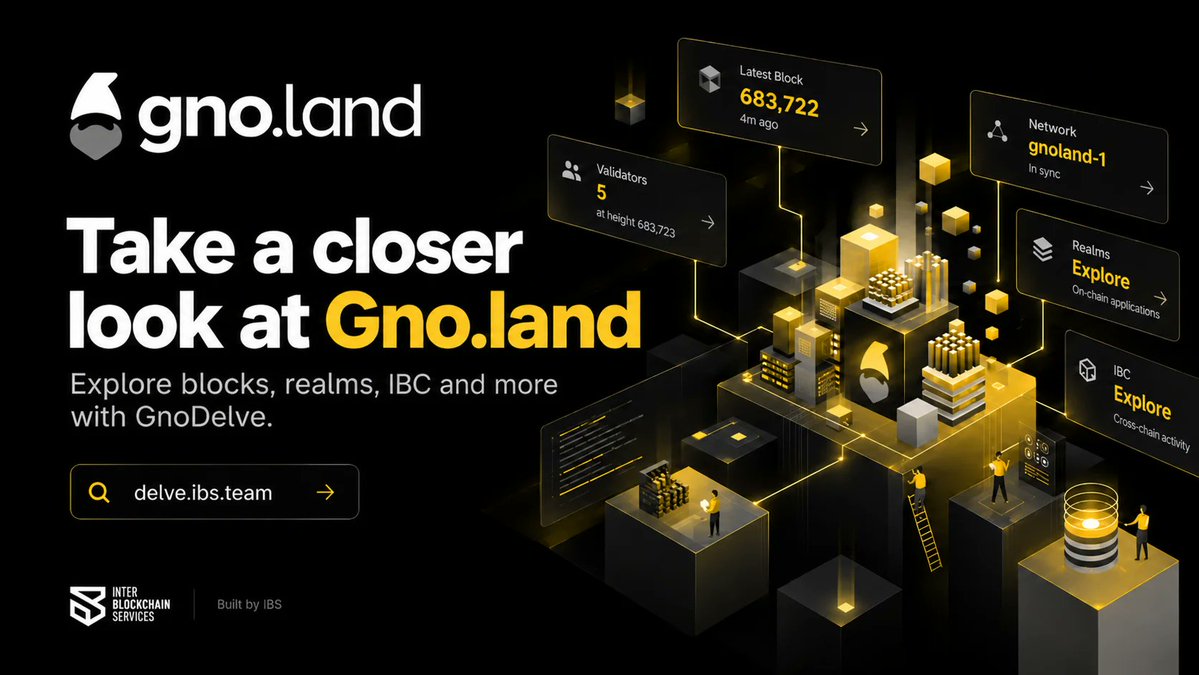
Meet GnoDelve, our explorer for @_gnoland :
🔎 Explore blocks, transactions & validators
🧩 Browse and interact with realms
👛 Connect with Adena
🌐 Follow network & IBC activity
📊 Access key network and economic data
The goal is simple: make https://t.co/Ss7vnQhu5f easier to explore and progressively more useful to interact with.
It’s still evolving, and we’re regularly adding features, fixes and improvements.
Take a look 👇
https://t.co/9AxQr5wPD0
#Gnoland #Gno #validator