@kevin__mak I agree it won't take share directly. The bigger effect may be on price. A nonprofit with no sales reps sets a public reference point just as Compass tries to launch above SPRAVATO.
@parmita In CNS it's even starker. Making molecules was rarely the bottleneck. Translation is, because animal models barely predict how patients respond. The scarce data isn't more molecules. It's a human signal early.
Pharma's next brain-drug M&A wave has a clock on it.
$400B+ in drug sales loses patent protection within 5 years.
Top pharma has ~$1.5T to buy with.
Lilly, J&J, AbbVie, Novartis and BMS all list brain disorders as M&A priorities.
They'll buy what already worked in patients.
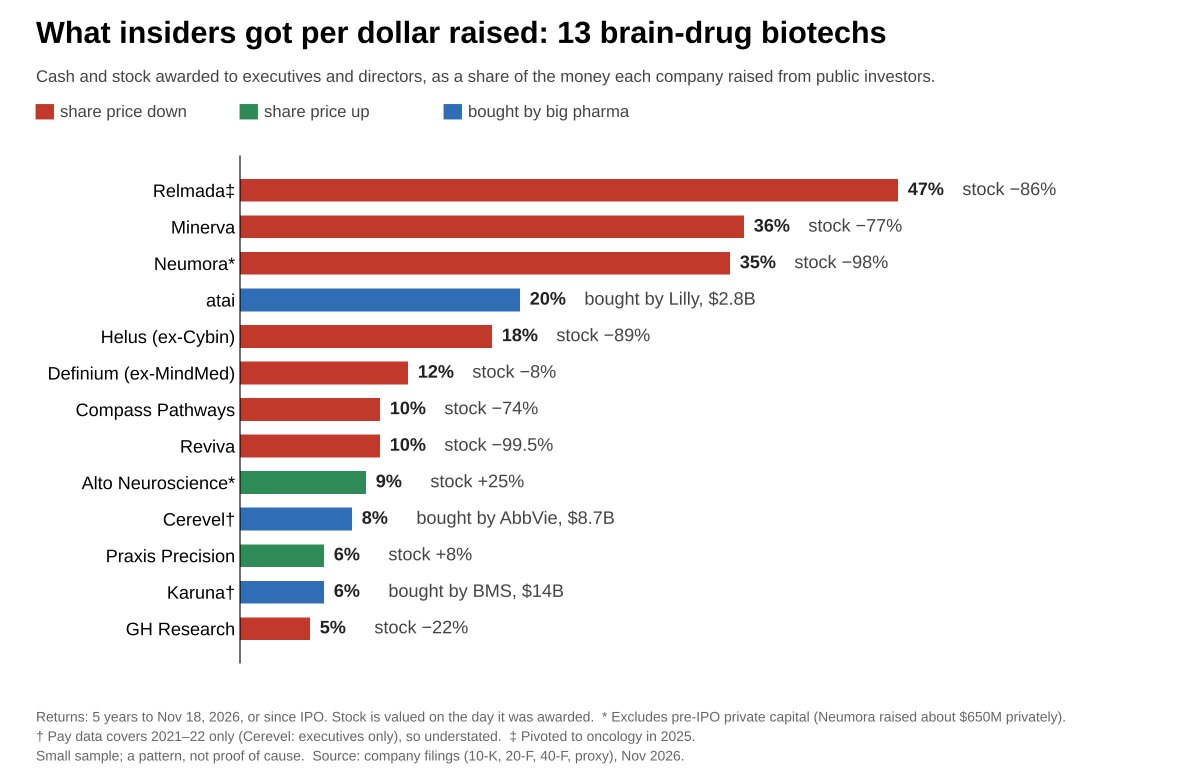
I read 5 years of filings for 13 public biotechs working on brain drugs.
One number stood out: the cash and stock executives got for every $1 raised from investors.
Where they got the most, 1 company in 5 is up or was bought.
Where they got the least, 3 in 4.
Xanomeline sat on the shelf for years. It came back as Cobenfy for schizophrenia, and now it has Phase 3 data in Alzheimer's psychosis.
Same molecule. What changed was human data.
In brain drugs, the signal in patients is the real asset. Pharma will pay for it.
@Biotech_Fox@LifeSciVC That's the combination that would actually move psychiatry. Novel biology still has to show a signal in patients. Pair that with Hengrui-like speed and cost in the clinic, and CNS assets finally become ones pharma can buy with confidence.
@LifeSciVC@Biotech_Fox Neuropsych makes the split even starker. Cobenfy was first in class, and now the money is chasing best-in-class muscarinics, like Neurosterix's $105M M4 round. Once a mechanism shows a human signal, the follow-on is the lower-risk bet.
@PeterKolchinsky Neuropsych is the clearest case. This week's two big late-stage readouts, Helus's modified psilocin and AriBio's PDE5 pill, both started from molecules with decades of human use. AI and fast trials do the most when they iterate from a human signal, not from white space.
My Co-founder's @EleusisRaz rule, and the hardest one we follow:
We can't fall in love with our molecules.
If a program needs materially more capital or time than the next candidate, it gets shelved.
We shelved three this year.
In biotech, attachment is the most expensive bias.
@daphnezohar From Vienna this matters. Strong European banking weeks mean early-stage CNS founders can get in front of US investors without waiting for January in SF. Psychiatry is still a hard sell to generalists, and that's where these meetings count most.
@adamfeuerstein@elaineywchen A win in an adjunctive design is the real news, since most patients won't come off their SSRI to get dosed. Keep a close eye on the safety piece. In psychiatry, the label and the monitoring requirements decide access as much as the effect size.
@LifeSciVC Hengrui's edge is running trials fast and cheaply. Isomorphic's is design. In neuropsych, making the molecule was never the bottleneck. Getting a human signal you can trust is, so over 10 years I'd bet on whoever speeds up the clinic, not the chemistry.
Everyone's waiting for the CNS mega-deal. Wrong thing to watch.
Midsized buyers' share of deal value rose from 19% to 29%. Top-10 mega-deals are now under half (Stifel).
The first CNS wave will be mid-size pharma buying assets with human data.
Big pharma screens some receptors out by policy. Anti-targets.
Serotonin 2A was one. Touch it and you were discarded at screening, whatever the clinical evidence said.
So compounds with real human evidence sat untouched for decades.
The next CNS edge is in that reject pile.
Stifel puts CNS/neuropsych right behind obesity as the next $50B drug category. Depression alone: $240B TAM.
Pharma money follows human data. Psychedelics proved it, and they won't be the last.
Next CNS deals go to assets with real patient signals.
New Stifel report highlights the $400B pharma patent cliff/$1.5T in M&A firepower & the evolution to more “$50B drugs at medium prices.” Therapeutic areas that could yield those opportunities: CNS/neuropsychiatry & cardio at the top after obesity/diabetes. Nice snapshot of stated priorities of top biopharma acquirers & the broadening acquirer base (prob even broader now that “curing” disease is the next frontier of AI companies). Will link to @TimOpler full report when it’s out. $XBI $BBC $IBB
@daphnezohar The CNS line is the one to watch. Big pharma names neuroscience as a priority, but 2026 dollars went to oncology and I&I. In psychiatry the bottleneck is trust in early data. Assets with a real human signal will close that gap first.
@PeterKolchinsky In CNS that pivot gets tricky. Psychiatric proof of concept often doesn't travel: placebo response, rater practice and patient populations differ. A "confirmatory" European Phase 3 on China-only data is often the first real test, and that's where a lot of programs break.
@Psyched_Alpha The NDA wave will test the session-based model in front of FDA. What I'm watching in parallel is whether non-hallucinogenic 5-HT2A programs can show a comparable human signal without the clinic-day infrastructure, because that's what would actually change access.
@FScholkmann This is the mechanistic split the field has been looking for. If Gi1 drives the perceptual state, we can finally test whether Gq-biased 5-HT2A agonism is enough for a therapeutic effect in people, which is the question that decides if non-hallucinogenic programs are a real path.