What makes $HAMSTER interesting is its attempt to address an increasingly obvious problem in the Meme market: launching tokens is becoming easier, but fewer and fewer tokens manage to build lasting communities.
DioisRY2M15WKza2te7pCvEAe7B1EVp4N1ZrM6tn52Sp
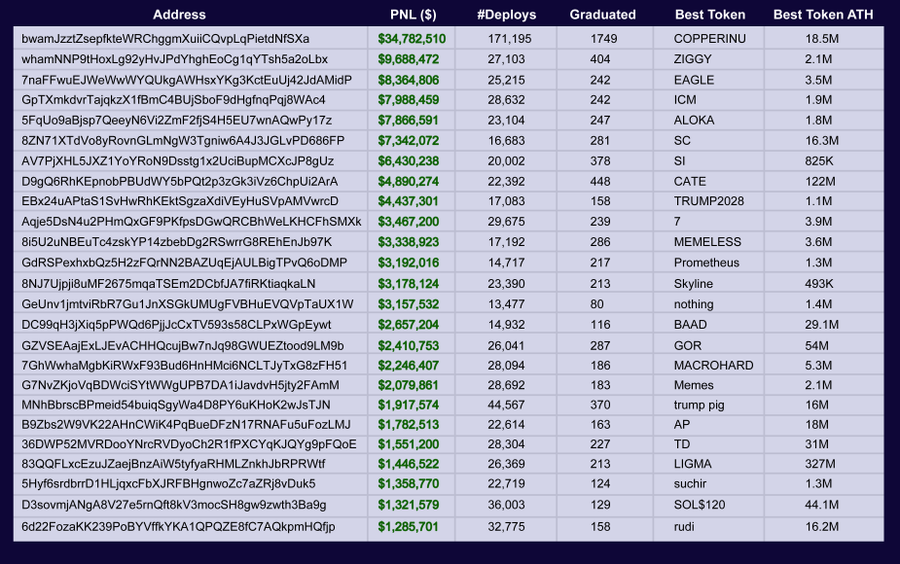
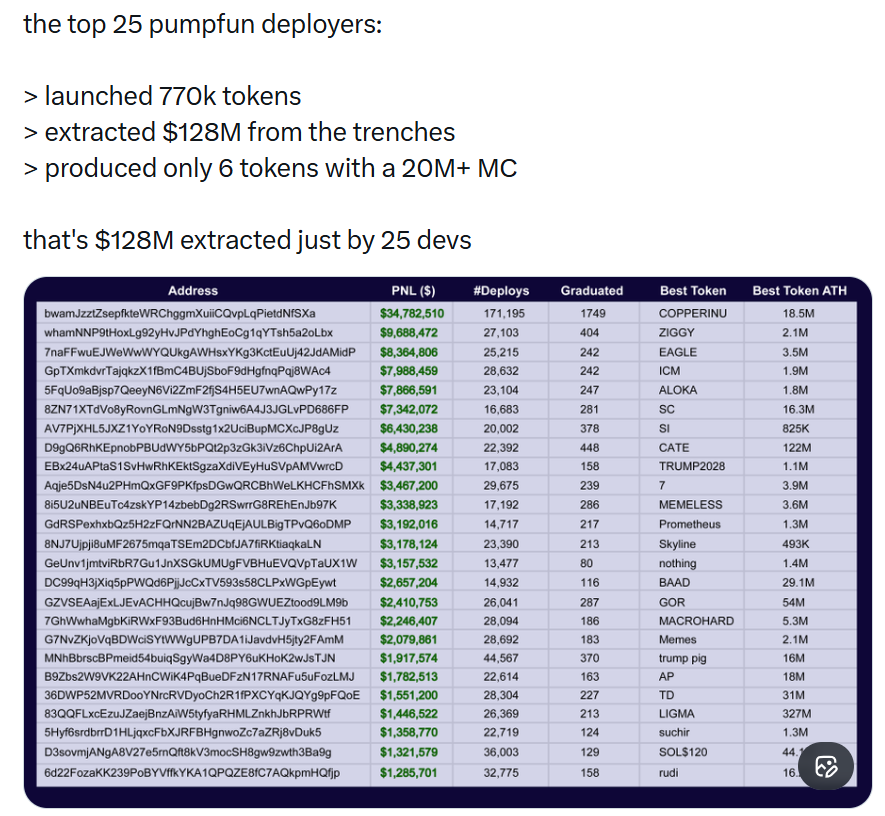
A few hours ago, reports emerged that the top 25 deployers on Pumpfun had launched approximately 770,000 tokens and extracted around $128 million in profits, yet only six tokens had reached a market cap above $20 million. These figures highlight a misalignment of incentives between token deployers and holders.
Deployers can keep searching for profits by launching new tokens, while traders must compete for limited attention and liquidity amid an overwhelming supply. Most tokens are wiped out by sniping, dumping, and capital rotation before they even have a chance to develop a culture of their own.
While this does not directly prove that HAMSTER will benefit, it puts a broader market problem on the table: as the traditional Meme launch model increasingly resembles a game of oversupply, will the market start looking for a different set of rules? HAMSTER's narrative is built around precisely this question.
Its differentiation goes beyond the hamster Meme IP. It attempts to use Solana's Token-2022 Transfer Hook to restrict certain transaction paths, tying token trading to social trading platforms such as FOMO and Pump App.
While ordinary Memes generally rely on attention to attract buyers, HAMSTER is trying to change how that attention translates into trading activity by reducing participation through certain external channels and concentrating more trading within socially driven platforms.
What makes this mechanism worth watching is whether it can change participant behavior. On traditional trading terminals, transactions linked to wallet addresses generally lack social accountability. On social trading apps, however, holdings, profits, and trading records may be associated with user identities, making buying and selling more visible to others.
Holding can therefore become more than simply waiting for the price to rise; it can also serve as a public expression of conviction, trading ability, and community participation.
However, this does not mean that restricting transactions can automatically lock up supply.
Which transaction paths a Transfer Hook can restrict depends on the specific contract rules, and social visibility cannot eliminate the incentive to take profits. It may strengthen holders' conviction, but it could also accelerate herd behavior and coordinated selling. Ultimately, the mechanism's effectiveness must be judged by genuine user participation, holding behavior, and sustained buying demand—not by how convincing the narrative sounds.
The hamster Meme provides another entry point for this strategy.
It is a visual symbol well suited to expressing emotions and spreading through comments, reaction images, and social content. Compared with inventing an entirely new concept, an existing Meme culture can lower the cost of distribution.
But a history of popularity does not guarantee attention today. HAMSTER still needs to prove that the image can continue generating new content and establish a lasting association with the token.
The Pumpfun episode therefore serves primarily as a narrative catalyst. It brings renewed attention to the structural problems of the Meme launch model, while HAMSTER offers a seemingly different way to organize trading activity.
HAMSTER's long-term thesis is to move Memes beyond a pure game of launching tokens and trading them, toward social trading, publicly visible holdings, and community identity.
If this mechanism can attract sustained participation and generate new demand that consistently exceeds selling pressure from existing holders, HAMSTER could command a premium over ordinary new tokens.
However, platform success does not equal token success. Even if social trading platforms such as FOMO or Pump App continue to grow, their users and revenue will not necessarily translate into value for HAMSTER.
The project still needs to prove that the user engagement and community conviction generated by its mechanism can translate into sustained demand for the token.
HAMSTER's real bet is whether the market is willing to shift from “who can launch and sell faster” to “who can build a trading community that keeps people engaged.”
Chart: https://t.co/fp1qdjtccS
$HOOKI: My last test worked. With only the time-held sell rule left, holders rose by 480 to 2,756, and 530M tokens were bought against 489M sold. Market cap more than doubled to 5,123 SOL.