Compensatory evolution has been suggested before as a common mode of evolution for CREs, it is only that for less pleiotropic elements this usually happens not within the same element, but between different CREs, i.e. the entire CRE jumps around.
Finally, we completed the story and are proud to share it with the world.
Evidence for compensatory evolution within pleiotropic regulatory elements https://t.co/ocyIrjgEVF
It is just how this functional conservation these large pleiotropic CREs is achieved by redundancy, thus TFBS are moving around and different locations got fixed in different species: i.e. compensatory evolution within the same CRE.
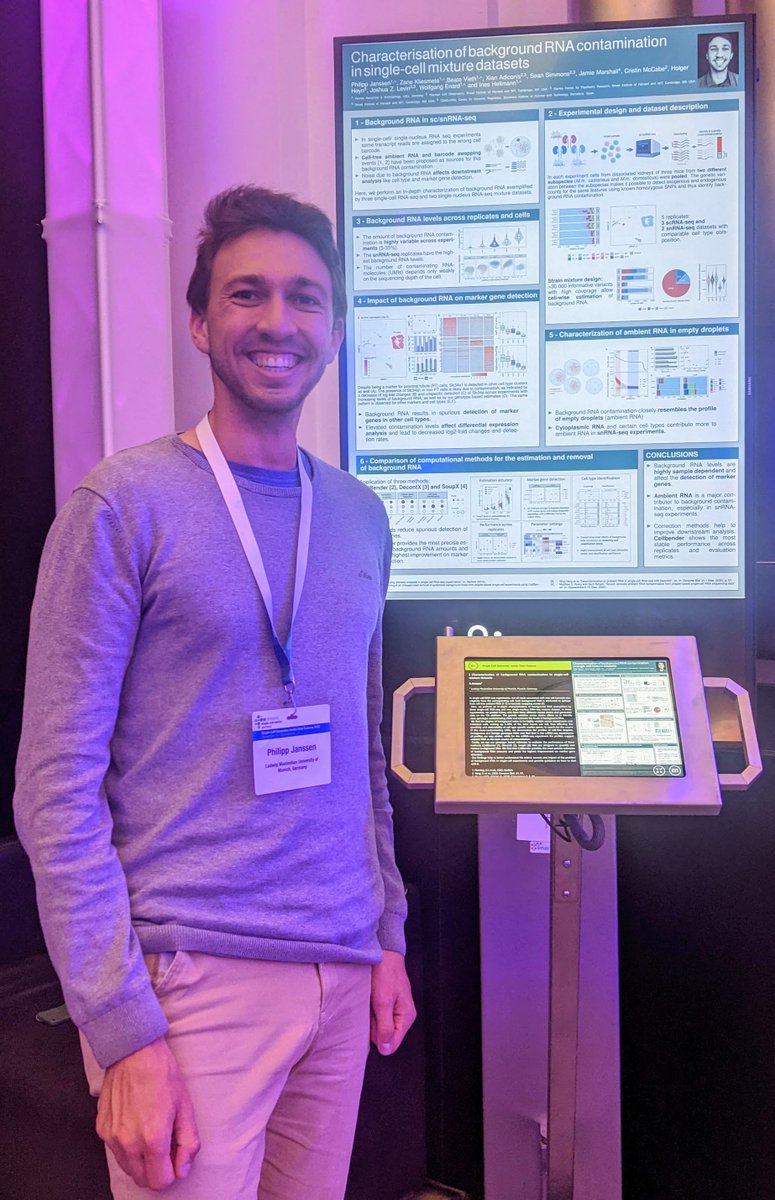
Have you ever wondered whether your single cell transcriptome represents really only one tiny cell? Here, we get genotype based estimates of background RNA allowing us to estimate its effect on analysis and to benchmark background removal methods. https://t.co/qtMutknY68 #SCOG
After 2 years of zoom conferences, it was great to chat about science in person again at #SCGmeetsML.
Thanks for all the feedback and a fantastic event overall!
@EnardHellmannWG@zkliesmete @ph_janssen Thank you all for your support and your wishes! Finally, there are no more administrative obstacles for me to supervise my fantastic PhD and Masters students.
The second study, led by @mad_kook and Piyush Joshi, leverages our human cerebellar single-cell atlas, 2,923 bulk transcriptomes from pediatric solid tumors, and 100 published single-cell transcriptome datasets from medulloblastoma, ependymoma, and pilocytic astrocytoma.
Based on these data, we established detailed cellular atlases across the development of the three species. The data can be interactively explored in a dedicated online resource: https://t.co/Tj63d8fELw
Our co-authors asked us to help to advertise for this article. I was considering to give the #RNASeqBlog a try. However, it seems to be down? The last message I got was from friday 2/12. Anybody knows what's going on?