Built a small thing for Base: Base Wallet Age.
Paste any address → see the date of its first Base transaction, how many days ago that was, and how many txs it's sent since.
No wallet connection. No signup. Just onchain data.
https://t.co/8ZHQpflnv0
USDSC = Money Layer
STAR Points = Incentive Layer
Mini Apps = The moment it all becomes real.
Supercash isn't running a "crypto rewards program."
They're building a habit loop:
open → spend → earn → return
No farming. No holding. Just using.
This is where crypto becomes daily life.
@StartaleGroup@StartaleApp
Behind every functional blockchain application there is a stack of infrastructure components that most users never see. Consensus mechanisms keep the network honest. Validators process transactions and secure the state. Security measures protect against attacks and economic manipulation. Deployment pipelines move code from development to production. Monitoring systems track performance and alert operators to anomalies. Each of these layers requires deep expertise to implement correctly. Most development teams spend months assembling and configuring these pieces before they ever write a single line of application logic. This hidden overhead consumes budget and developer attention that could otherwise be directed toward understanding user needs and testing new features. The result is slower iteration cycles and fewer experiments reaching the market. Canopy addresses this by bundling these essential layers into a cohesive foundation that teams can adopt immediately. The infrastructure is pre configured and tested so developers do not need to become experts in validator management or consensus design. They can focus on the part of the stack that actually differentiates their product. The reduction in operational burden allows teams to move from concept to testnet in weeks rather than months. More importantly it enables continuous iteration after launch because the underlying infrastructure remains stable and maintainable. Canopy does not eliminate complexity. It absorbs complexity so builders do not have to carry it. The goal is to make infrastructure invisible so user problems become visible. When developers spend less time worrying about validators and more time talking to users the whole ecosystem moves faster and produces better outcomes
@CNPYNetwork
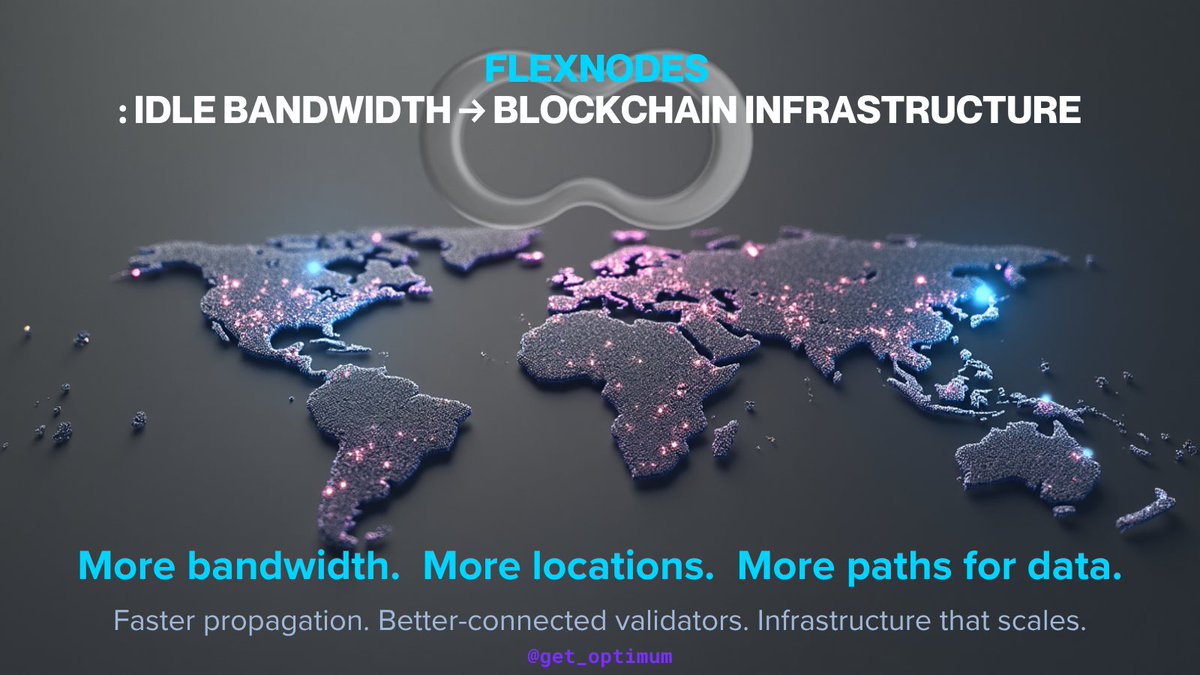
Most people think blockchain infrastructure means servers, data centers, and expensive hardware.
Optimum sees it differently.
Flexnodes turn idle bandwidth into active blockchain infrastructure. That laptop sitting on your desk? The home internet connection you pay for every month? They can become part of a global data acceleration network.
More bandwidth means more paths for data. More paths mean faster propagation. Faster propagation means better-connected validators, regardless of where they are in the world.
The result is infrastructure that scales with participation. Every new Flexnode makes the network stronger, not slower.
This is how you build a network that doesn't rely on a few powerful players. This is how you make decentralization actually work at scale.
Not more servers. Just smarter use of what's already there.
@get_optimum
Every cycle brings new narratives. But one trend is impossible to ignore: institutions are moving onchain.
The question isn't whether they will come. It's which chain is actually ready for them.
Banks, asset managers, enterprises, governments. They all need more than speed and low fees. They need privacy. Compliance. Security. Infrastructure that meets real-world regulatory standards.
Rialo was built with these requirements in mind.
Not as an afterthought. From day one.
As AI agents begin managing workflows and executing transactions, they need secure, permissioned access. Rialo provides the foundation for trusted AI automation through privacy-preserving execution and controlled authorization.
The next generation of blockchain success won't be measured only by TVL or transaction volume. It will be measured by trust. Regulatory readiness. Enterprise adoption. Real-world impact.
That's the future Rialo is building.
@RialoHQ
The people training tomorrows robots probably dont work at a robotics company.
Theyre not engineers. Not researchers.
Theyre operators. People sitting in front of screens. Remote controlling robots. Repeating tasks. Making mistakes. Correcting movements. Creating the demonstrations that models learn from.
They dont write code. They teach through action.
Every correction they make. Every adjustment. Every repetition. That becomes data. That data becomes intelligence.
The future of robotics isnt being built in labs alone. Its being built by thousands of human hands. Guiding machines. One movement at a time.
The unsung heroes of Physical AI.
@PrismaXai
"Nobody should have to buy a second token just to move their dollars."
That's from @utexocom. And it's exactly right.
Think about this:
You have $100 USDT. You want to send it.
With most systems, that's not enough. You also need the network's native token for gas.
So now you're:
→ Buying USDT
→ Buying another token
→ Paying fees with that token
→ Finally sending your USDT
For someone who just wants to move dollars, that's unnecessary friction.
Utexo does it differently:
Have USDT. Send USDT. Pay in USDT.
No second token. No gas token management. Just dollars moving like dollars should.
For businesses, merchants, and everyday users — payment infrastructure should feel like payment infrastructure. Not a puzzle where you first need to understand which token pays the gas.
That's what "USDT transfers are paid in USDT" actually means.
Simple. Direct. No extra steps.
@utexocom
The most overlooked risk in Web3 development is ecosystem lock in. Many projects begin as tenants on larger networks and later discover that scaling requires a painful migration to their own chain. This process typically involves rewriting core logic, discarding historical data, and navigating complex governance procedures.
@CNPYNetwork eliminates this friction through Progressive Sovereignty. Projects launch as Nested Chains that inherit security from Canopy shared root. They operate with full functionality from day one without building consensus infrastructure. As transaction volume increases and the community matures they can transition to a standalone Layer 1 blockchain.
The migration preserves all transaction history without code modifications. The governance structure remains intact throughout the transition. This approach transforms the traditional build then escape model into a gradual growth path. Developers can focus on product market fit without worrying about architectural ceilings. The infrastructure adapts to the project scale rather than forcing the project to adapt to infrastructure limits. Long term planning becomes possible when migration is no longer a binary decision. CNPYNetwork provides the flexibility to start small and expand without sacrificing security or user trust. The ultimate value is freedom to grow at your own pace without technical debt accumulating along the way.
A chatbot makes a mistake. Wrong answer. Wrong meeting time. Annoying but fixable.
A physical robot makes the same mistake. Damaged equipment. Disrupted operations. Safety risks.
Different stakes entirely.
Physical AI doesnt just process information. It acts in the real world. And the real world doesnt forgive errors.
This is why more teleoperation data isnt the answer. Raw human demonstrations come with jitter. Latency. Inconsistent movements. Train on that noise and robots learn imperfections as correct behavior.
The future needs verified data. Not just massive datasets.
@PrismaXai validates teleoperation data before it reaches training. Precision becomes the standard. Consistency becomes non-negotiable.
In Physical AI, data quality isnt a nice to have. Its the foundation of safe autonomy.
Precision beats scale. Verified beats raw. Trustworthy robots start with trustworthy data.
Good morning and happy Friday.
The week is almost done but the infrastructure never sleeps. @SeismicSys is still running. Still private. Still settling transactions for real world apps.
Grab your coffee. Wrap up those last tasks. Hit that final deployment.
And then enjoy the weekend knowing your privacy layer is doing exactly what it was built for.
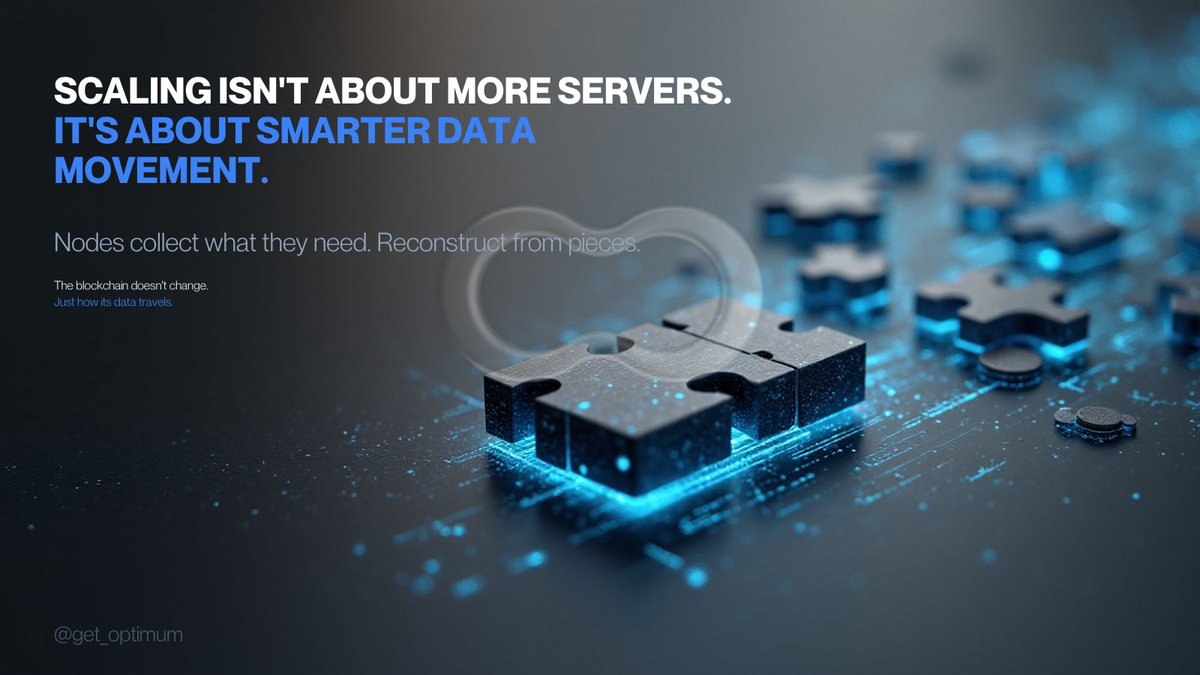
Scaling isnt about more servers. Its about smarter data movement.
RLNC turns blocks into puzzle pieces. Nodes collect enough pieces and reconstruct. No duplication. Less waste. Faster propagation.
The blockchain stays the same. The data flow changes.
@get_optimum
The internet was built for sharing information.
The next internet will be built for exchanging value. Automatically. Programmatically. Autonomously.
Rialo is building the rails for that future.
A network where real-world assets move onchain. Where transactions react to events without waiting for humans. Where Web2 and Web3 finally speak the same language. Where AI agents operate with verifiable authority.
Compliance isn't an add-on. It's built in. Speed isn't a number on a spec sheet. It's designed for real-time applications.
This isn't about building a faster blockchain. It's about building infrastructure for an internet that actually works for finance, for agents, and for the real world.
One network. Endless possibilities.
@RialoHQ
Physical AI isnt about machines taking over. Its about humans doing more. Smarter tools. Better data. Systems that actually listen to how we work. The real breakthrough happens when human intuition meets machine precision. Not one replacing the other. Both getting better together.
Watching @PrismaXai build that bridge. And honestly? Excited to see where this goes.
Great take. This is exactly the thesis.
Bitcoin + USDT + RGB + Lightning.
Bitcoin settles. USDT moves. RGB adds privacy. Lightning handles speed.
Everything else is just extra complexity.
Tempo raised $500M at $5B valuation but processed only ~1.1M transactions with ~$140K volume . x402 (built on similar principles) is already 10x ahead .
Utexo is quietly building the only combination that actually makes sense for global payments.
No other chain needed. No other stablecoin required.
@utexocom
Agree with the author here.
And now think about Bitcoin.
Bitcoin has the biggest network effect in crypto. USDT has the biggest network effect among stablecoins — and arguably one of the biggest in fintech, especially across emerging markets.
Now merge these two network effects together.
You get USDT on Bitcoin.
RGB adds privacy and programmability without putting all the asset data on-chain, while Lightning gives you massive payment scalability, predictable low fees and the ability to build highly customizable payment use cases. (RGB Protocol on Bitcoin)
So if you have:
Bitcoin as the settlement layer + USDT as the money + RGB as the asset layer + Lightning as the payment network…
What exactly do you need another chain or another stablecoin for?
Obviously there will always be other ecosystems and use cases. But from a pure global payments perspective, I think this combination is extremely hard to compete with. @stripe is trying with @tempo but results are miserable as of now I belive there might be the same with @openstandard
Curious to hear what my community thinks. What am I missing?
Onchain privacy just got easier
Public blockchains are transparent. Great for some things. Terrible for payroll, auctions, or business data.
@CNPYNetwork and @fhenix built Canopy Confidential Apps to fix this.
Privacy is baked into the stack. No custom crypto. Just TypeScript.
Keep the network open. Keep the data encrypted.
Use cases that finally work:
Games with hidden state
Sealed bid auctions
Private DeFi
Integration is underway. Q4 2026.
Canopy is already on testnet with 100k+ daily active wallets.
@CNPYNetwork
@brookwellapp is doing something I have not seen anyone else pull off. A stablecoin account where you can actually pay your rent and phone bill directly. No off ramping. No conversion fees. Just click and pay. And while your money sits there it earns yield.
But here is what makes it work. That entire experience runs on @SeismicSys . Every balance. Every payment. Every transaction. All of it is encrypted by default. You do not have to worry about your financial history being visible to the whole world.
Brookwell handles the everyday banking. Seismic handles the privacy and settlement. Two pieces of infrastructure built for the same person. A regular user who just wants a better way to manage their money without sacrificing control or privacy.
The conversation around blockchain speed always circles back to the same things. TPS. Fees. Execution.
But speed isn't just about how fast you process. It's about how fast you deliver.
A network can crunch transactions in milliseconds. But if blocks crawl through propagation, validators wait, attestations lag, and the whole system drags.
Most chains still move data like it's 2015. Same information, copied and forwarded endlessly. That model creaks under weight.
More validators mean more noise. More distance means more delay. More congestion means more missed opportunities.
Optimum doesn't ask blockchains to change who they are. It just makes their data travel lighter and faster.
RLNC replaces the shouting match with a quiet exchange of coded pieces. Nodes gather what they need and reconstruct. Less shouting. Less traffic. Better timing.
A blockchain isn't just processing power. It's a delivery network for information. And delivery matters as much as computation.
@get_optimum
For years, wallets were designed for humans.
An address. Some assets. A button to sign transactions. Simple.
But that assumption breaks when software starts executing transactions on its own.
An agent doesn't have fingers to click approve. A workflow doesn't stop to wait for human confirmation. A service shouldn't need someone to manually sign every interaction.
What changes is this: the wallet stops being a human tool and becomes an economic identity for software.
Rialo gets this.
When software has its own identity, its own access controls, and its own transaction capabilities, it stops being just a tool you click around on. It becomes a participant. An active actor in the financial system.
Autonomous agents. Automated services. Programmatic workflows. They all need the ability to transact independently.
This isn't just about convenience. It's about rethinking who and what can participate in the economy.
The future of finance includes machines that transact on their own. Rialo is building the infrastructure for that future.
@RialoHQ
Physical AI has a paradox. Hardware and models keep getting stronger. But the real missing piece is the foundation that makes them work in the real world.
Before any team can train an intelligent model, they need scale. Quality data. Vetted embodiments. Ready frameworks. Most teams carry this burden themselves instead of building intelligence.
@PrismaXai steps in at this bottleneck. They don't build the final model or sell robots. They deliver proven data, vetted hardware, and training frameworks. So customers can just focus on the AI.
They run a closed loop. Humans control real robots through teleoperation. Data gets collected. A community validator layer scores and filters it. Insights from training feed back into how the next data is collected. A true data flywheel.
Robots generate data. Data improves intelligence. Intelligence makes robots more capable.
Embodiments are vetted across form factors. Training frameworks are ready to plug in. Every decision comes from real customer needs.
Hardware rich. Data poor. @PrismaXai is building the standardized service layer that links humans, robots, and data. They free teams from infrastructure. So they can put all energy into creating genuinely intelligent AI.
@0xserhat AI agents need microsecond data, not dialup gossip . that's why Optimum is building the Layer 0 memory layer that makes on-chain AI actually possible.
Why @utexocom chose RGB Protocol? 👇
Most blockchains store everything on-chain. Amounts. Counterparties. Asset types. Every detail public.
RGB does the opposite.
Asset data stays with the parties involved. They exchange it directly and validate locally. Bitcoin only gets a cryptographic commitment.
That's it. Just proof it happened.
Four reasons this matters:
→ Privacy: No public billboard of your payments
→ Bitcoin security: Uses UTXOs, no new consensus layer
→ No bloat: Bitcoin stays lean, data stays with users
→ Lightning-native: USDT moves through Lightning instantly
RGB doesn't put more data on Bitcoin. It uses Bitcoin as the settlement foundation while keeping assets private and transferable.
That's the architecture @utexocom is building on.
Bitcoin handles settlement. RGB handles assets. Lightning handles speed.
Private. Lean. Fast.
@utexocom