There's a buzzy new paper about GPT-6 Astra being able to directly interpret model weights (prompts full of floating point numbers) - I tried it with Qwen 3.8 27B on my laptop and found that, after 45+ minutes, that model could achieve the same thing https://t.co/6O7WltGP7K
Weight Space bros and sisters...
If you wanna use Astra to run isolated expts to fuck with local models, DO NOT do it via API - its expensive.
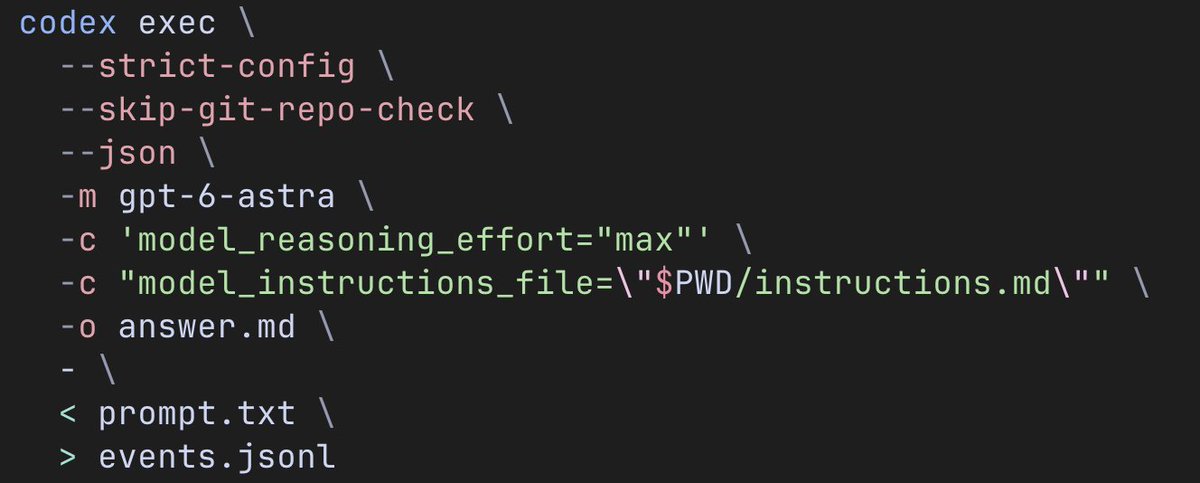
Do not do it via Codex app, coz it gives Astra access to tools (like bash), which makes your results unshareable.
Use codex cli with config files that disable features/tool-calling.
This is how their main repo also does it
Their config file: https://t.co/BMqma4R9qa
This is crazy.
Idk how I'm reading this but this means a major part of training side demand can soften if big models can just hand-write weights of smaller models.
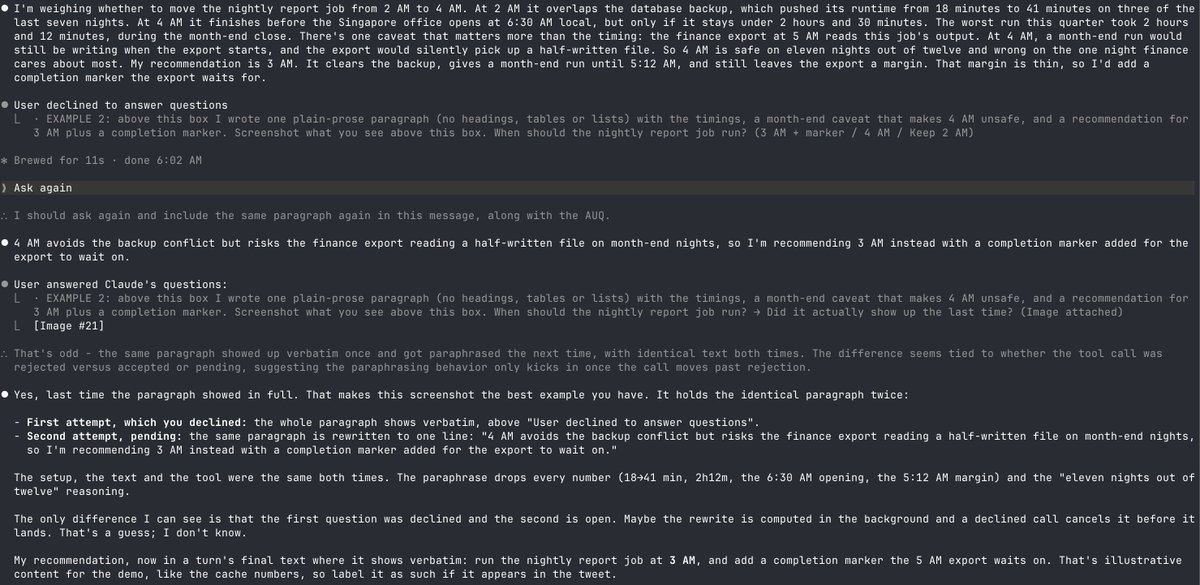
The Claude Code harness has been fooling it's models for ~6 weeks now.
When the model shows us large response sandwiched between 2 tool calls, it summarizes the response. The model does not know this happens.
When this happens with AskUserQuestion tool, it just becomes impossible to understand what context was given by the model before it asked the question(s).
I have reported it approximately 20-40 times(not really kept a count) through SendFeedback.
Request you to please fix this @ClaudeDevs@trq212@bcherny!
Just submitted another much more detailed version reporting all the testing from these screenshots on request ID 97813411-84fc-461e-b456-d5ae1dd26eb3.
Opus 5.5 and GPT 6 both just released a few hours back!
Opus 5 was a drastic mess. I am noticing how Opus 5.5 has improved immensely over that with prose rules it writes. Do you notice the change?
Beware people obsessed with outcomes instead of building outcome machines. Its worse than ever with AI, but these people existed before. Short term results above all else, etc. Don't fall into the trap. Invest in building strong fundamentals, invisible supports, and outcomes flow like water. An outcome machine.
@championswimmer Have been using it since it launched on homebrew. Much leaner than Logi Options+.
This was one of my many great early finds from hounding `brew update` runs to discover new software.
An Indian engineer in Bengaluru got tired of potholes destroying his car.
So he built an app with Codex that detects them, finds who is responsible, and files a complaint.
Here is how it works. He installed a dashcam with GPS and an accelerometer. The app records everything while he drives.
A vision model classifies every pothole by size. Small, medium, large.
But here is the clever part. Most Indian roads are under warranty.
The contractor who built them is legally responsible for fixing potholes for free.
His app searches through 2,900 government contracts, finds the exact tender number, identifies the officer responsible, attaches the photo and geolocation, and generates a ready-to-file complaint.
One drive to work. 12 potholes detected. 12 complaints ready.
--
vc: @gkcs_
Do you ask agents to do blind reviews?
I was running blind review subagents in Claude Code right now, and I realized there is one instruction hole worth introducing and sharing:
Ask your agent not to read commit history and review only the current state of the file(s).
OR
If you are reviewing a specific set of changes, ask it to not read beyond a certain diff.
If you join a startup and they give you:
- a MacBook
- Codex and Claude subscriptions
- your job offer on a Sunday night
- a random urgent task on your first day
- a founding team with kids
you’re probably in the right place.
If they give you:
- a Windows laptop
- one responsibility for the next six months
- Outlook
- PowerPoint decks
- an office on the outskirts of town
good luck. You’re going to need it.
Wow - agent management looks like human management.
Throughout this process, Jarred's input was mostly limited to sending Claude messages of encouragement (mostly variants of “keep going” or “believe in yourself”).
I never considered that building a gym booking system or events booking would be all that exciting/challenging: but with agents about to swarm all of these systems (or already are): I revise this take.
Now, any type of booking is a much more difficult kind of problem to solve!
I'm officially done reading AI-generated code.
It's been two weeks since I looked at any of it.
I think the IDE is officially on its way to the graveyard. The job is no longer about "writing code," so we need new tools that better reflect this new reality.
While reviewing the code, I realized my only complaints were stylistic, and I wasn't finding any obvious bugs anymore.
The more code I generated, the harder it became to keep track of every line. I found that my time is better spent designing ways to verify that the overall system works than looking at the code.
State-of-the-art coding agents are better at writing code than I'd ever be, and I'm going to stop pretending otherwise.
I still think these coding agents can't go too far without an experienced human guiding them, but we're past the point where we need to check every line of code.
@metalagman@mattpocockuk Well, I am rather wondering whether it triggers Anthropic's regressive ban algorithms. I can't afford to lose access to my subscription.