Ziaur Rahman’s ancestors were all Pakistanis & their graves are also in Pakistan.
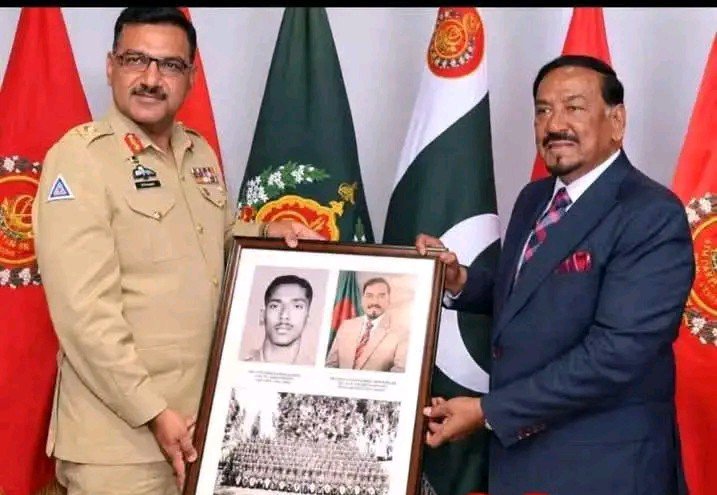
This is precisely why the so-called government of Tarique displays such an overflowing affection for #Pakistan—which is why the ‘fake’Bir Bikrom Hafiz, has gone to express his love for Pakistan 😂
বেগম খালেদা জিয়া জীবিত আছেন!
তিনি বর্তমানে পাকিস্তানে জানজুয়া সাহেবের বাড়িতে অবস্থান করছে।
খবরটি অত্যন্ত গোপনীয় তাই BTV ও অন্যান্য সংবাদমাধ্যমে প্রকাশ করা হয়নি।
তাঁর সঙ্গে দেখা করতে গিয়েছে যুদ্ধের সময় পাকিস্তানকে গোয়েন্দা তথ্য দেওয়ার অভিযোগে আলোচিত স্পিকার হাফিজ উদ্দিন।
A question for all world leaders, judges and international journalists:
If Prime Minister Sheikh Hasina of Bangladesh did not resign on August 5, 2024,
then how—while maintaining the 1972 Constitution—did Yunus call for an ELECTION & how could TARIQUE become Prime Minister.?
Zulkarnain Saer’s Indian TV interview is a blatant spread of lies & propaganda.
#Bangladesh cannot be fooled by fabricated narratives.
Since August 5-2024,the nation has witnessed a reality the world cannot ignore.
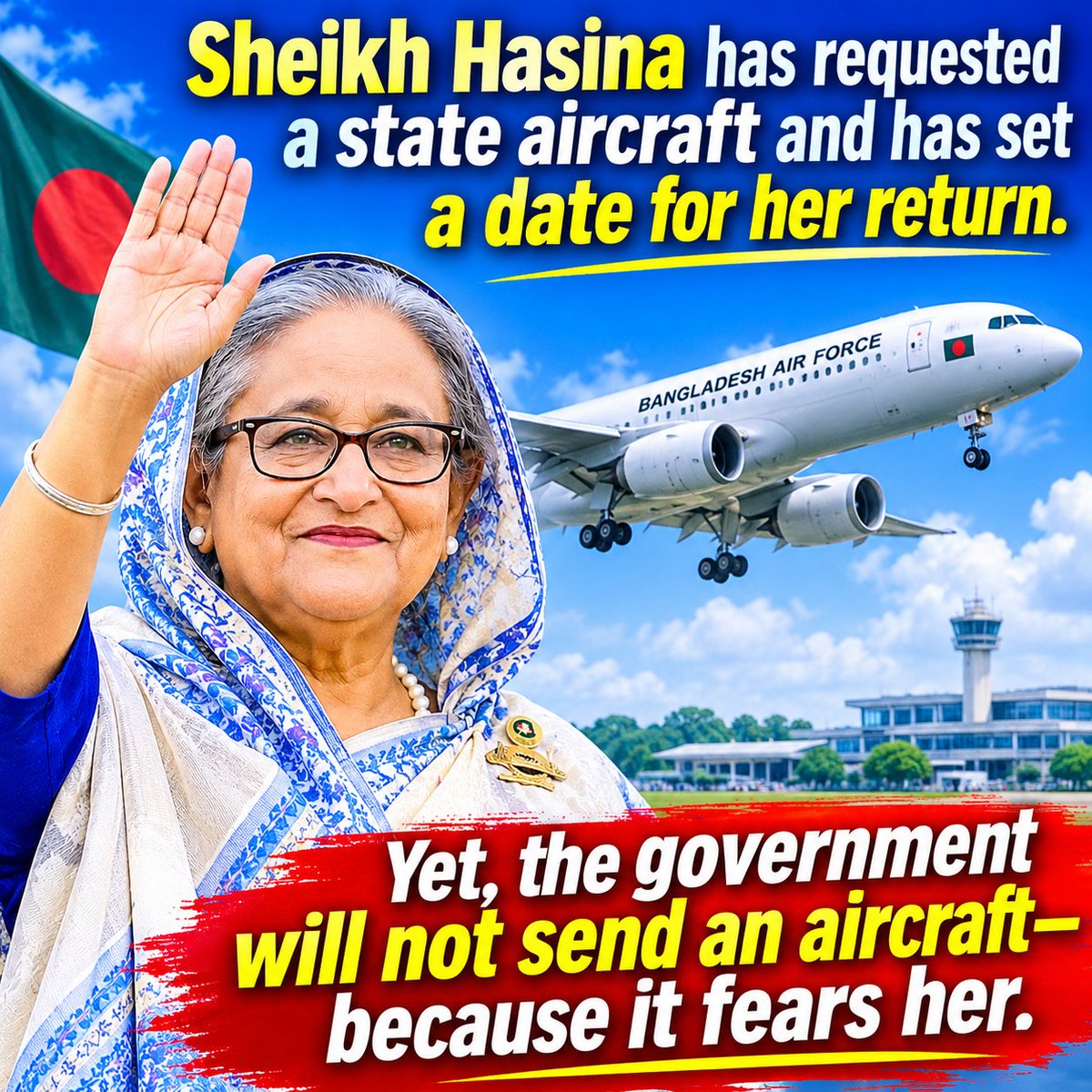
Millions await Sheikh Hasina’s RETURN.
THE TRUTH WILL PREVAIL!
The State Minister for Foreign Affairs, along with Jamaat-NCP, the BNP, and Tarique, demand that India hand over Sheikh Hasina.
Yet, the moment Sheikh Hasina requests an NID, a passport, and a flight to return home, they begin to tremble with fear.
#SheikhHasina#16December
All forms of mobile banking have been shutdown in an attempt to suppress Gopalganj.
At any moment,The government—led by the so-called 'militant' Tareq—might even cut off electricity & mobile network services in Gopalganj.
But even then, will it be possible to suppress Gopalganj?
In Gazipur today (23 Nov 2026), garment workers are peacefully protesting for a living wage after years of pay too low to sustain basic needs. The BNP–Jamaat-led authoritarian Ragim has responded with a severe brutal crackdown, treating demonstrators as enemies of the state.
After 5th August 2024, Sheikh Hasina is no longer seen as just a politician. She is the one who loves her people like a mother loves her children protecting them, standing for them, and putting the nation above everything else.
Joy Bangla ✊
In Gazipur, BNP’s police thugs attacked garment workers protesting for wage hike. Then one of these police deliberately fired a tear gas shell at a female worker, laughed like a psychopath, and said “It hit right on the spot.” where is people who lectures about human rights?
“Demand Fair Wages, Get Branded Awami League and Threatened with Life Imprisonment!”
A local BNP leader is seen threatening garment workers demanding fair wages with false political charges and life imprisonment. Instead of addressing workers’ legitimate demands, the authorities are using political intimidation and legal harassment to silence them.
Over 20 days, thousands of garment workers have reportedly been implicated in cases, with scores detained and languishing in jail. Branding protesting workers as Awami League activists has become a tool to suppress their demands for fair wages.
Is demanding a living wage now a crime in Bangladesh?
#Bangladesh #HumanRights #GarmentWorkersProtest 🇧🇩
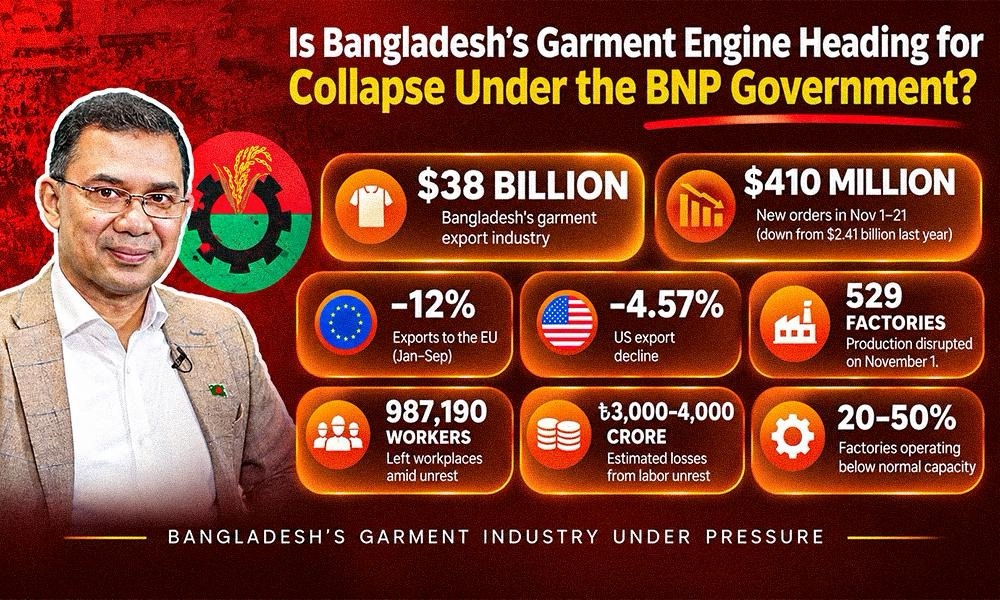
BANGLADESH’S GARMENT INDUSTRY IN FREEFALL: NEW ORDERS PLUNGE 83%, EXPORTS DECLINE AND NEARLY ONE MILLION WORKERS FACE UNCERTAINTY UNDER THE BNP GOVERNMENT.
Key figures expose the crisis:
- 83% drop in new orders: US$410 million this November versus US$2.41 billion last year.
- US$1.348 billion lost in exports to the European market.
- US$614 million lost in the US market.
- 529 factories disrupted on November 1, affecting nearly 987,190 workers.
- Tk 3,000–4,000 crore in reported losses from labour unrest.
- Factories operating at 20–50% below normal capacity.
With cancelled orders, energy shortages, labour unrest and declining global competitiveness, Bangladesh's RMG sector faces a deepening crisis. Millions of livelihoods and a vital source of foreign exchange are at stake.
An industry built over decades is being pushed towards collapse.
Full Report: https://t.co/zlYa0PBRV9
#GarmentWorkersProtest #Bangladesh
খাম্বা তারেক বলেন ২০২৪ শের জুলাই ম্যাটিকুলাস ডিজাইন প্লান সাকসেসফুল করতে গিয়ে যারা শহীদ 😂 হয়েছে এই রকম মৃতদের বিদেশ পাঠানোর উদ্যোগ নিয়েছে 😁
কি বুঝলেন......….?
#JulyConspiracy#JulyTerroristTareque
Lies won’t change Bangladesh’s reality!
Zulkarnain Saer’s Indian TV propaganda cannot erase the truth.
Since August 5, 2024, the world has witnessed Bangladesh’s reality.
Millions await Sheikh Hasina’s return.
THE TRUTH WILL PREVAIL!
#Bangladesh#SheikhHasina#StopPropaganda
Is Bangladesh Heading Towards Another 2004? The 405-Tonne Chemical Shipment, the Ten-Truck Arms Scandal, and the Shadow of August 21
Twenty-two years after Bangladesh was shaken by the infamous ten-truck arms scandal under the BNP-Jamaat coalition government, another disturbing development has raised serious questions about the country's national security, regional stability, and the possible resurgence of clandestine weapons networks.
This time, the alarm has come from Indonesian waters.
On November 7, Indonesian naval authorities intercepted the Comoros-flagged cargo vessel MV Star Line near Belawan, North Sumatra. The vessel, reportedly travelling from China to Bangladesh, was carrying approximately 405 tonnes of sodium perchlorate, a chemical with legitimate industrial applications but also potential relevance to rocket-propellant production.
According to Indonesian naval officials, the quantity could theoretically provide material for approximately 100 missiles, depending on the chemical formulation and weapon system involved. The disclosure, made public on November 20, immediately raised troubling questions about the shipment's intended recipient.
Who ordered such an enormous quantity? Who financed the transaction? What industrial or military facility in Bangladesh was supposed to receive it? And why has no Bangladeshi end-user been publicly identified?
These questions become particularly unsettling when examined against Bangladesh's history of arms trafficking, militant violence, and controversies involving political and intelligence establishments.
The timing is equally alarming. Bangladesh is still struggling with the consequences of the violent prison breakouts during the political upheaval of 2024, when thousands of prisoners, including individuals convicted or accused of militant offences, escaped custody.
The combination of an unexplained strategic chemical shipment, unresolved militant escape cases, and the historical record of the BNP-Jamaat era demands urgent scrutiny.
The Ghost of the 2004 Ten-Truck Arms Haul
On April 2, 2004, Bangladesh witnessed one of the largest illegal arms seizures in South Asian history.
At the Chittagong Urea Fertiliser Limited jetty, law enforcement personnel discovered an extraordinary consignment of weapons being unloaded from vessels and transferred onto ten trucks.
The shipment included approximately 4,930 firearms, 27,020 grenades, hundreds of rocket-related weapons, 2,000 grenade-launching tubes, and roughly 1.14 million rounds of ammunition.
This was no ordinary criminal smuggling operation.
Investigators subsequently linked the weapons to the United Liberation Front of Asom (ULFA), an armed separatist organisation operating against the Indian state.
The operation occurred during the BNP-Jamaat coalition government headed by Prime Minister Khaleda Zia. Tarique Rahman, Bangladesh's current prime minister, was then an influential political figure within the ruling party.
The investigation eventually implicated senior government officials and intelligence personnel, raising serious questions about whether elements within Bangladesh's state apparatus had facilitated an international arms-trafficking network.
The case became one of the defining security controversies of the BNP-Jamaat period.
Although subsequent judicial proceedings altered important convictions and findings, the seizure itself and the investigation's connection to ULFA remain part of the historical record.
The parallels with the latest Indonesian interception are therefore difficult to dismiss.
Both incidents involve strategically sensitive shipments moving through commercial maritime channels. Both raise questions about the identity of the ultimate recipient. Both carry potentially serious consequences for Bangladesh's relations with neighbouring countries.
There is, however, an important distinction: the 2004 shipment contained completed military weapons destined for an identified insurgent network, whereas the intercepted Indonesian cargo contains a dual-use chemical whose final purpose has not been established.
That distinction makes an independent investigation essential, rather than diminishing the seriousness of the questions.
August 21, 2004: When Political Violence Became National Tragedy
The ten-truck arms scandal was not the only devastating security controversy of 2004.
Just months later, on August 21, grenades exploded at an Awami League rally on Bangabandhu Avenue in Dhaka, targeting a political gathering addressed by then-opposition leader Sheikh Hasina.
Twenty-four people were killed, including prominent Awami League leader Ivy Rahman, while hundreds were injured. Sheikh Hasina narrowly survived the attack.
It remains one of the darkest episodes of political violence in Bangladesh's history.
In 2018, a Bangladeshi court sentenced Tarique Rahman to life imprisonment in connection with the August 21 grenade attack, while several other defendants received death sentences. Subsequent judicial proceedings overturned those convictions, but the attack itself, the loss of innocent lives, and the historical questions surrounding the security establishment during the BNP-Jamaat government's tenure remain matters of profound national importance.
The judicial controversy surrounding the case cannot erase the suffering of the victims or the political consequences of an attack that nearly claimed the life of Bangladesh's principal opposition leader.
Two extraordinary security catastrophes occurred in the same year under the same government: an international arms-trafficking scandal involving insurgents operating against a neighbouring country, and a grenade attack that devastated the country's principal opposition party.
The historical convergence of these events demands reflection.
Now, with Tarique Rahman occupying the office of prime minister, the responsibility to prevent any repetition of those security failures rests squarely with his government.
Can Bangladesh afford to disregard the lessons of 2004 when questions about strategically sensitive shipments and militant networks are once again emerging?
The Militants Who Escaped During the 2024 Transition
The latest interception becomes even more concerning when examined alongside the breakdown of prison security during Bangladesh's violent political transition in 2024.
On July 19, 2024, attackers stormed Narsingdi District Jail, vandalised the facility, looted its armoury, and enabled 826 prisoners to escape.
Among those who escaped were members of banned militant organisations, including Jama'atul Mujahideen Bangladesh and Ansarullah Bangla Team.
The attackers reportedly looted 85 firearms and thousands of rounds of ammunition.
Following the change of government on August 5, violence and disorder erupted across multiple correctional facilities, resulting in further mass escapes.
Official figures subsequently indicated that approximately 2,247 prisoners had escaped during the disturbances. By August 2026, authorities reported that 690 remained fugitives.
Not all of these fugitives were militants, and the number of specifically identified militant escapees still at large was substantially smaller. Nevertheless, the failure to account for hundreds of escaped prisoners represents a significant security vulnerability.
The concern extends beyond prison escapes.
The post-transition period also witnessed the release on bail of several notorious criminal figures, including individuals long associated with organised crime. Their releases were legally distinct from the violent prison breakouts, but together these developments intensified public concerns about law enforcement and the possible reactivation of criminal networks.
Bangladesh is therefore confronting an uncomfortable security reality: prisoners remain unaccounted for, weapons stolen during the upheaval have not all been recovered, and questions about militant and organised-crime networks remain unresolved.
Against this backdrop, the interception of 405 tonnes of strategically sensitive chemicals reportedly destined for Bangladesh warrants far more than a routine diplomatic response.
There is presently no established evidence linking the chemical shipment to escaped militants. However, a government already confronting unresolved security vulnerabilities has a heightened responsibility to establish the shipment's actual purpose.
India's Security Concerns and the Lessons of the Past
Bangladesh's internal security has consequences extending far beyond its borders.
India's northeastern states have historically faced armed insurgencies, and the 2004 ten-truck arms scandal demonstrated how Bangladeshi territory could be exploited for the movement of weapons intended for groups operating against India.
The ULFA connection made the scandal a major regional security concern.
India's defence and intelligence establishments have long had reasons to monitor illicit weapons movements across the region. However, no specific assessment by India's Defence Intelligence Agency concerning the intercepted MV Star Line shipment has been independently established in the available reporting.
That distinction matters.
A chemical consignment originating in China and destined for Bangladesh is not, by itself, evidence of an anti-Indian military operation. China is a major industrial chemical exporter, and sodium perchlorate has legitimate commercial applications.
Nevertheless, the scale of the shipment, the reported irregularities in the vessel's documentation, and the absence of a publicly identified recipient justify close examination.
Indonesian authorities reported that some of the vessel's administrative documents had expired and that investigators were examining the circumstances of the voyage.
A transparent investigation should establish the purchaser, the financing arrangements, the declared end-user, and whether the shipment was connected to any authorised industrial or defence programme.
The alternative—allowing speculation and uncertainty to persist—could undermine Bangladesh's credibility with its regional partners.
Is Bangladesh Heading Back Towards 2004?
The comparison with 2004 should not be understood merely as a historical coincidence.
It concerns the institutional conditions under which illicit arms trafficking, militant violence, and failures of state oversight can flourish.
The BNP-Jamaat era demonstrated the potentially devastating consequences of inadequate accountability within political, intelligence, and security institutions.
The present government must therefore answer several fundamental questions.
Was the 405-tonne consignment intended for a legitimate industrial manufacturer? Was the import properly authorised? Who was the beneficial purchaser? Were Bangladeshi customs or intelligence agencies aware of the transaction? And could any part of the shipment have been intended for an undeclared recipient?
These questions are not accusations of proven criminal involvement. They are questions that any responsible government should be prepared to answer.
The available evidence does not establish that the BNP government, its leadership, or any militant organisation ordered the chemicals. It also does not establish that the cargo was intended for missile production.
But uncertainty surrounding such a large shipment cannot simply be ignored.
Bangladesh should immediately seek the complete cargo manifest, commercial invoices, consignee details, payment records, and end-user documentation from Indonesian authorities.
The government should also provide an updated public accounting of escaped militants, unrecovered weapons, and ongoing investigations into the prison violence of 2024.
A credible national-security strategy requires transparency, effective intelligence coordination, and institutional accountability—not political assurances alone.
A Warning Bangladesh Cannot Afford to Ignore
Twenty-two years ago, the ten-truck arms scandal exposed an international weapons-trafficking operation with connections to armed insurgency and allegations involving senior figures within Bangladesh's security establishment.
Just months later, the August 21 grenade attack demonstrated the catastrophic consequences of political violence and failures in national security.
Today, hundreds of escaped prisoners remain unaccounted for, weapons looted during the 2024 upheaval have not all been recovered, and a massive shipment of dual-use chemicals reportedly destined for Bangladesh has been intercepted in foreign waters.
These developments do not establish that another 2004 is already unfolding. They do, however, present warning signs that demand serious investigation.
The burden of ensuring that Bangladesh never again becomes vulnerable to clandestine weapons networks or militant violence now falls upon the government of Prime Minister Tarique Rahman.
The historical record makes that responsibility especially consequential.
Bangladesh must not wait for another ten-truck arms scandal, another August 21, or another mass-casualty attack before confronting the vulnerabilities within its national-security establishment.
The immediate question is who ordered 405 tonnes of sodium perchlorate and why.
The larger question is whether Bangladesh has learned anything from the darkest chapters of its recent history.
Is the country moving towards another security catastrophe—or will its leaders act before history has the opportunity to repeat itself?
#Bangladesh
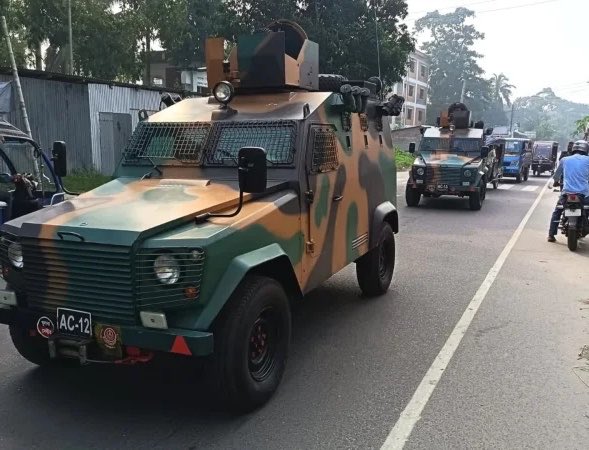
Under the orders of the Director General of the Border Guard Bangladesh (BGB), a force consisting of over a thousand armed personnel, supported by several Armored Personnel Carriers (APCs), is preparing to carry out a massacre in Gopalganj district of Bangladesh.