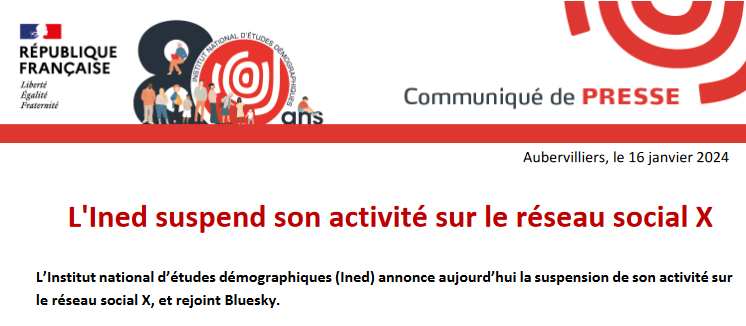
| Presse release | INED is suspending its activity on the social medium X and switching to Bluesky : https://t.co/eMsgxHKwOe
More information: https://t.co/1Stzx1Pau1
| RESEARCHERS COMPETITIONS | In 2025, INED is recruiting one senior tenured researcher (directeurs·trice de recherche, DR) based on one job profile.
Deadline for final validation and submission of online applications: 12 February 2025, noon Paris Time https://t.co/7g6Ra2fRsE
| RESEARCHERS COMPETITIONS | In 2025, INED is recruiting two tenured research scientists (normal category) based on one job profile.
Application deadline: January 29, 2025, 12 noon, Paris time.
More information ➡️ https://t.co/XMMuQc84oq
#recruitment
“‘I set the table every day’: The contribution of 10-year-olds to domestic tasks”
Ariane Pailhé, Anne Solaz
https://t.co/IzZiYMRSS8
#PopulationandSocieties#INEDJournal
|📚 #FridayReads | Our Researchers’ Latest Publications |
Advancing Health Equity Metrics: Estimating the Burden of Lung Cancer Attributed to Known Carcinogens by Socio-economic Position
https://t.co/6hb6SkJk2f
| RESEARCHERS COMPETITIONS | In 2025, INED is recruiting one senior tenured researcher (directeurs·trice de recherche, DR) based on one job profile.
Deadline for final validation and submission of online applications: 12 February 2025, noon Paris Time
https://t.co/7g6Ra2fjD6
| The issue today | Women and relations with #neighbors
More women than men start and maintain relations with neighbors. Why is that?
➡️ https://t.co/KIJNlXUHyJ
What is the position of #stepparents in blended families?
How are parenting tasks distributed between parents and stepparents? Does stepparent’s level of involvement in those tasks vary by gender?
Does parents’ child custody arrangement have an impact?
https://t.co/uu0AjDTYIO
| RESEARCHERS COMPETITIONS | In 2025, INED is recruiting two tenured research scientists (normal category) based on one job profile.
Application deadline: January 29, 2025, 12 noon, Paris time.
More information ➡️ https://t.co/XMMuQc84oq
#recruitment
"Eugenics – the ideology that human populations can be ‘improved’ through policies such as selective reproduction – emerged as a popular political movement in the early 20th century. During this period, academia was instrumental in promoting eugenics, and eugenics was influential in the development of several academic disciplines. Its popularity ostensibly waned during the late 20th century, but eugenic ideology never went away, and is now resurging. In this talk, I briefly consider the historical relationship between the academic discipline of demography and eugenics, but mostly concentrate on the 21st century revival of eugenic ideology. I focus particularly on the issue of scientific racism – the misuse of science to justify racial inequalities and hierarchies. Scientific racism aims to further the ideology that certain people and groups are inferior to others, a fundamental principle of eugenics. I end by discussing how academia can counter this exploitation of the research community for political ends."
With Rebecca Sear, Professor and Director of the Centre for Culture and Evolution at Brunel University London and Nicolas Robette (enseignant à l'UVSQ & chercheur au Laboratoire PRINTEMPS UMR 8085 UVSQ/CNRS, chercheur associé Ined)
Release | “‘I set the table every day’: The contribution of 10-year-olds to domestic tasks”
Ariane Pailhé, Anne Solaz
https://t.co/IzZiYMRl2A
#PopulationandSocieties#INEDJournal
| FOCUS ON | Demography of the Greater Caribbean
The Greater Caribbean comprises forty distinct geopolitical territories. In 2020, the population of the Greater Caribbean was estimated at 301 million.
More information: https://t.co/35bZ3Y2W3q