India is waging a war against its own researchers:
In Careers360’s Research Summit, Prof. Ram Gopal Rao, Vice Chancellor of BITS Pilani described India’s lack of investment in research beautifully. He said “India’s Higher Education is described as African Budgets, American ambitions, Russian methods, Chinese opacity and Indian Bureaucracy.
In the past decade, we have seen a slide in scientific temper and investments in research.
1. Non-NET fellowship are stuck at ₹8,000 a month since 2012, for 16,270 scholars in 45 central universities.
2. JRF stipend: In 2014, the JRF was Rs.25,000 per month. In 2019, it was revised to Rs.31m000. it is ₹37,000 PM. The hrowth hasn’t even kept pace with inflation and in real terms, it has FALLEN. IISc scholars even went on a hunger strike demanding an increase.
3. Maulana Azad fellowship: where more than 1,400 scholars have had stipends stalled since January 2025.
4. OBC fellowships: lists for three NET cycles in 2024-25 were held back, which the social justice ministry put down to insufficient funds.
5. INSPIRE: fellows have their stipends unpaid for 3 to 9 months. The schemes now under Vigyan Dhara fell 67.5% between 2016 and 2025.
6. KVPY: scrapped in 2022, after nearly two lakh students a year had taken its test.
7. JRF bottleneck: only 5,108 of 7,35,614 candidates (0.7%) got JRF in December 2025. Minister Sukanta Majumdar gave no year-wise data when asked.
8. The University of Hyderabad stopped Rohit Vemula’s ₹25,000 stipend in July 2015, and his last letter said he hadn’t been paid for seven months. He later committed suicide.
9. India’s R&D spending: fell from 0.82% of GDP in 2009-10 to 0.64% in 2020-21. PMRF spending was revised to ₹290 crore, less than half its ₹600 crore outlay.
10. SC fellowships: fell 61%, from 4,841 to 1,872, between 2020-21 and 2022-23.
If India indeed wants to be a Vishwa Guru, India should be investing in research, in creating quality Higher-Ed institutions. We cannot be cutting down on stipends, not paying our researchers, holding back payments, scrapping scholarships, not increasing fellowship amounts even to match inflation and still expect students to choose research.
The President, INSA and the entire Fellowship of the Academy heartily congratulates our distinguished Fellow Prof. Ashoke Sen, FNA (1996), on being awarded the prestigious Oskar Klein Medal 2026 for his pioneering contributions to string theory.
The Office of the Principal Scientific Adviser to the Government of India congratulates Dr. Ashoke Sen, @ictstifr-Infosys Madhava Chair Professor, Bengaluru, on receiving the Oskar Klein Medal for 2026. He is the first Indian physicist to receive this prestigious honour.
Prof. Sen is globally recognised for his pioneering contributions to string theory, particularly his work on S-duality, the precision counting of black hole entropy and string field theory. His research has played a significant role in advancing modern string theory and deepening our understanding of fundamental physics.
Jointly awarded by @Stockholm_Uni and the Nobel Committee for Physics of the Royal Swedish Academy of Sciences, the Oskar Klein Medal recognises distinguished contributions to physics. This recognition adds to Prof. Sen’s distinguished achievements, which include the Breakthrough Prize in Fundamental Physics (2012), the Dirac Medal (2014), the Padma Shri (2001) and the Padma Bhushan (2013).
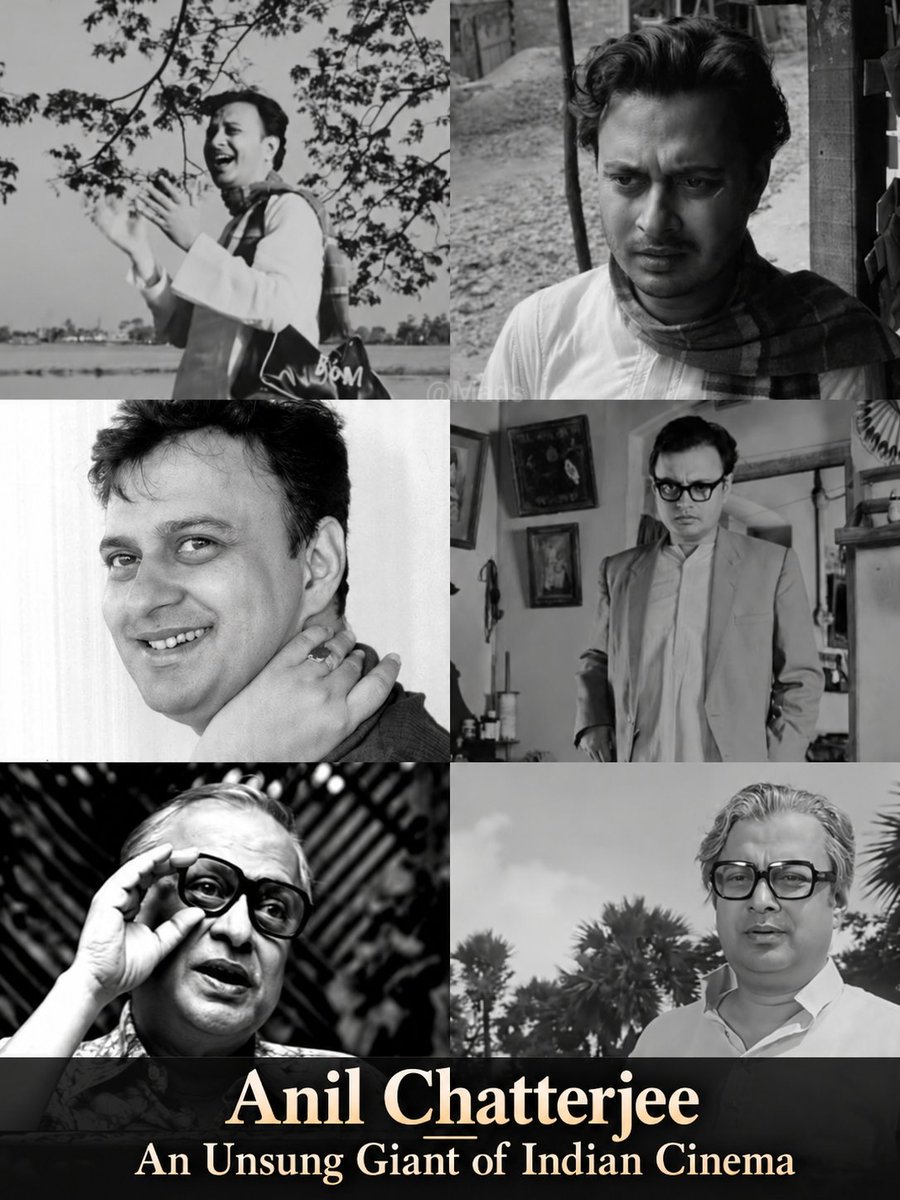
From Meghe Dhaka Tara, Nirjan Saikate & Mahanagar to Sagina Mahato & Amanush- Anil Chatterjee showcased extraordinary versatility.His portrayal of Deshbandhu Chittaranjan Das was another notable chapter in his career.
A remarkable actor who deserves to be remembered & celebrated.