'The Breakfast Tray,' (1910) is arguably Elizabeth Okie Paxton's most provocative work; it is one of the first paintings she made after a decade away from her studio after marrying the Boston School artist William McGregor Paxton.
A worm frozen in Siberian permafrost for 46,000 years — since woolly mammoths still roamed — was thawed in a lab dish and simply woke up, began eating, and started reproducing, because its species can shut its metabolism down to a complete standstill in a survival state biologists call cryptobiosis | Brendan Brown, ScienceBlog
Forty metres below the surface of the Siberian Arctic, in the frozen wall of a riverbank called Duvanny Yar, scientists dug out a fossilized burrow. An arctic ground squirrel had packed it with grass and seeds sometime in the depths of the last Ice Age, back when woolly mammoths and cave lions still walked the Kolyma lowlands, and then the whole thing had frozen solid and stayed that way.
Inside the ancient nest material, alongside the dead grass, were microscopic roundworms. Researchers placed some of the thawed soil in a dish of nutrient solution, kept it warm, and waited.
The worms woke up.
Just add water
They did not merely twitch. Within days the tiny nematodes, each about a millimetre long, were wriggling, feeding on bacteria in the dish and laying eggs. One of the study’s authors, evolutionary biologist Philipp Schiffer of the University of Cologne, put it plainly: they are alive because they move, they eat, and they reproduce. Life had simply resumed, as if the intervening dozens of millennia were a pause between two heartbeats.
The soil around the worms was the key to their age. Radiocarbon dating of the plant material in the burrow put it at roughly 46,000 years old, and because permafrost at that depth never thawed in between, the worms could not have wandered in later. They had been locked in since the late Pleistocene. Anatomically modern humans were still sharing the planet with Neanderthals when these animals last ate a meal.
A new species from a lost world
The revived worms turned out to be something science had never seen. Genome sequencing and analysis, published in PLOS Genetics, showed they belonged to an undescribed species, which the team named Panagrolaimus kolymaensis after the Kolyma River.
The species has a convenient trick for rebuilding a population from nothing: it is all-female and reproduces by parthenogenesis, cloning itself without any need for a mate. A single thawed survivor can found a dynasty, and in the lab that is exactly what happened. The original Ice Age individuals have since died of ordinary old age, a nematode’s natural lifespan being a matter of weeks, but their descendants have been cultured for more than 100 generations and are still going. Somewhere in a laboratory today, worms are eating bacteria whose great-many-times-grandmother hatched before the invention of agriculture, writing, or the wheel.
The pause button
The trick behind the survival is called cryptobiosis, and it is one of the strangest capabilities in biology. An organism entering cryptobiosis is not hibernating or sleeping. It shuts down entirely. Metabolism drops to levels no instrument can detect, oxygen use stops, and by every practical measure the animal is dead. Except that it is not, because the state is reversible. Add water and warmth, and the machinery restarts.
Tardigrades, the famous microscopic “water bears,” use the same trick, and it is why they can survive being dried out, frozen, and even exposed to the vacuum of space. The Siberian worms showed how it works at the molecular level. When the researchers compared P. kolymaensis with C. elegans, the lab workhorse of nematode science, they found the two species share much of the same genetic toolkit. Both, when preparing to shut down, flood their cells with a sugar called trehalose, which protects membranes and proteins from the damage of freezing and drying, essentially vitrifying the cell’s contents so nothing tears when the water leaves.
The mildly dried worms in the study survived being frozen at minus 80 degrees Celsius and came back fine. Prepared correctly, the pause button seems to hold almost indefinitely.
The record, and the fine print
Before this, the credible record for revived nematodes stood in the centuries-to-millennia range, and the same Siberian team’s earlier claim of 42,000-year-old worms had been met with scepticism about contamination. The new work answered much of it: precise dating, a sealed frozen context, and a full genome showing a distinct species rather than a modern stray.
Some caution survives, as it should. A few researchers note that the freezing experiments in the lab, where worms were dried first and then frozen abruptly, do not perfectly mimic conditions in wet Arctic soil, so exactly how the original animals entered their long pause remains partly open. But the central fact, that complex multicellular animals sat lifeless in the ice for 46 millennia and then resumed living, is now about as well-documented as such a claim can be. One biologist not involved in the work called it, accurately, mind-boggling.
What 46,000 years of sleep means
The find rewrites an assumption about time and life. For these worms, 46,000 years was not a lifetime; it was a skipped chapter. A species can apparently step out of existence during a bad epoch and step back in when conditions improve, which means the permafrost is not just frozen dirt. It is a seed bank of paused animals, some of which are waking now as the Arctic thaws.
For humans, the interest is practical. Understanding how trehalose and its supporting genes preserve cells through a total shutdown could improve how we store transplant organs, blood, vaccines and other living tissue. The worm that woke up after 46,000 years is a proof of principle written by evolution: life, correctly prepared, can wait almost forever.
https://t.co/l0yRuFIjl2
A 2-day-old foal bouncing with excitement to see her mom 🐎💞
I watched this video and found it so adorable 🥰
It’s just a little filly, only two days old, named Miss Tehya. They were leading her out of the barn. And yet her legs kept bouncing, her head stretched forward as if she was about to meet someone very important.
She wanted to run to her mom.
Her legs were still clumsy, her steps unsteady, but you could clearly see how happy she was. It was as if the only thing worth doing at that moment was getting closer to her mother.
Foals can usually stand up and follow their mothers just a few hours after birth. That’s an instinct that keeps them from being left behind. But watching Miss Tehya, it didn’t feel like just instinct. It felt more like a little child eagerly running toward the person she trusts the most.
Miss Tehya was born at a rescue farm and is being raised safely. But while watching the video, I didn’t think much about that. I just saw a baby horse happy to be with her mom, and it made my heart feel a little lighter.
For people who raise horses, this moment probably means even more. It reminds us that the bond between a mare and her foal starts very early, and that keeping them close from the very beginning really matters.
Just a two-day-old foal, bouncing along toward her mother.
But it was enough to make me smile ☺️
'Portrait, Paul Verlaine.' (1868) During his lifetime, Frédéric Bazille sold not a single picture; he died at age 28 in the Franco-Prussian War in 1870, a loss which counts among the greatest losses to the history of art and seemed to condemn him to the limbo of art history.
This view of the harbour at St Ives in Cornwall (c1890) was painted by William Osborn and shows local people catching sardines in drift nets. Osborn was often near poverty and frequently exchanged paintings for food and lodgings, bartering works to earn a living.
When Texan collector Nelda Stark passed away in 1999, her estate executors hired a curator. The curator examined the paintings in the house one by one, moving those deemed 'valuable' into secure storage. But one painting looked so small and ordinary that the curator didn't see the need to move it, and left it right there in the bedroom. That painting was Gerrit Dou's 'Resting Dog'.
In 2005, Christie's auction experts arrived to appraise the contents of the home. They stopped in their tracks when they saw this small panel hanging in the bedroom. Measuring 16.5 x 21.6 cm, it's an oil on panel. They set an estimated sale price of $2 - $3 million. The final sale: $4.7 million.
Gerrit Dou (1613 - 1675), working in Leiden, painted this piece in 1650 when he was around 37 years old.
On February 14, 1628, at the age of 14, Dou became Rembrandt's first pupil. Rembrandt was 21 at the time; he was working closely with Jan Lievens and likely sharing a studio with him. Dou remained by his side for about three years. When Rembrandt moved to Amsterdam in 1631 - 1632, Dou stayed behind in Leiden. Over time, though, he chose a path that distinctly diverged from his master's.
While freer, more visible brushwork would define Rembrandt's later years, Dou developed a pictorial language defined by its small scale, intense detail, and highly polished finish. His surfaces often achieved an enamel-like smoothness. This approach ultimately laid the groundwork for the tradition later known as the Leiden fijnschilders, or 'fine painters'.
Dou applied finely ground paint in numerous overlapping thin layers. He combined transparent and semi-transparent layers of paint with opaque transitions and small, hatch-like brushstrokes. The result was a rich depth of color and a soft luminosity.
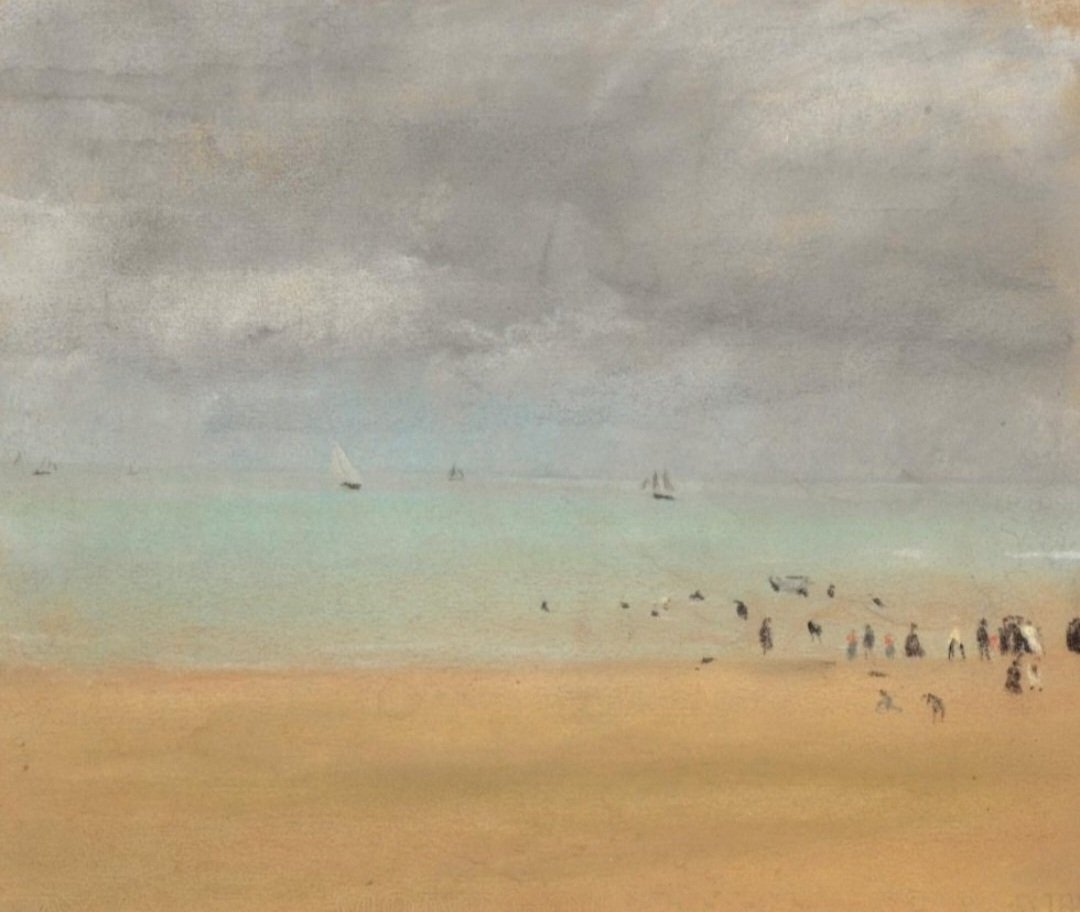
'Beach at low tide.' Landscapes by Degas are comparatively rare; for me they remain among his most compelling works. He created his first important group of landscapes in 1869, the year this work was made during a trip to the Normandy coast around Cabourg and Villers-sur-Mer.