$BB Blackberry Baird Conference Takeaways
• Turnaround complete. BlackBerry says it has shifted from cost-cutting to growth mode, with QNX guiding ~15% growth and increased reinvestment into expansion.
• QNX backlog continues to grow faster than revenue recognition. More design wins, longer vehicle programs, and increasing software content per vehicle support multi-year visibility.
• Vehicles now need more QNX "sockets" than ever. Beyond infotainment, QNX is expanding into smart cameras, ADAS, zonal controllers and high-performance compute domains.
• SDP 8 adoption is accelerating. Customers report enough efficiency gains that some can even downgrade hardware requirements while improving performance.
• Alloy Kore remains the most underappreciated part of the story. Management says it can increase ASPs by 2-4x versus traditional RTOS royalties by moving higher up the software stack.
• First Alloy Kore design wins could be announced within weeks to months. Mercedes has already publicly discussed evaluating the platform.
• China momentum continues. QNX is positioning itself as the global safety-certified platform for Chinese OEMs targeting export markets, creating an advantage versus domestic-only alternatives.
• Robotics may become the next major growth vector. Management sees autonomous forklifts, warehouse robots and industrial automation as having nearly identical requirements to automotive: safety, security and deterministic computing.
• NVIDIA robotics partnership is significant. QNX is being positioned on NVIDIA's robotics stack just as it has been on automotive platforms. Similar opportunities are emerging with other silicon vendors.
• Balance sheet is strengthening. BlackBerry generated ~$50M operating cash flow last year and is guiding toward ~$100M this year, giving optionality for strategic acquisitions.
Bottom line: QNX is evolving from a vehicle RTOS provider into a broader safety-certified software platform spanning automotive, robotics, industrial automation and medical systems. Alloy Core and Robotics remain the biggest potential upside drivers that the market appears to be underestimating.
It is very obvious that $IREN is about to sign new hyperscaler deals in the coming weeks and months.
$IREN still has 350 MW (IT) up for grabs at its Childress campus, representing 50% more capacity than the $MSFT deal, as well as an additional 1.4 GW (gross) at its Sweetwater site, which will be energized in April.
In the current energy constrained market, $IREN's negotiating leverage is growing by the day. But I do not believe the company’s power capacity will stay idle for long.
One advantage of $IREN's first hyperscaler deal that does not get talked about enough is the credibility boost that came with it.
A tier 1 hyperscaler such as $MSFT conducts months of due diligence before signing multi billion dollar deals.
This has the knock on effect of other hyperscalers now taking $IREN more seriously and ramping up their respective negotiations with the cloud provider.
$IREN's CCO, Kent Draper, spoke about this in a recent interview with @power_analys1s. I highly recommend you watch the clip below if you have not seen it yet.
...More deals are coming. 📈
AI is driving unprecedented demand for compute.
The ability to rapidly design and construct data centers at scale is the critical bottleneck.
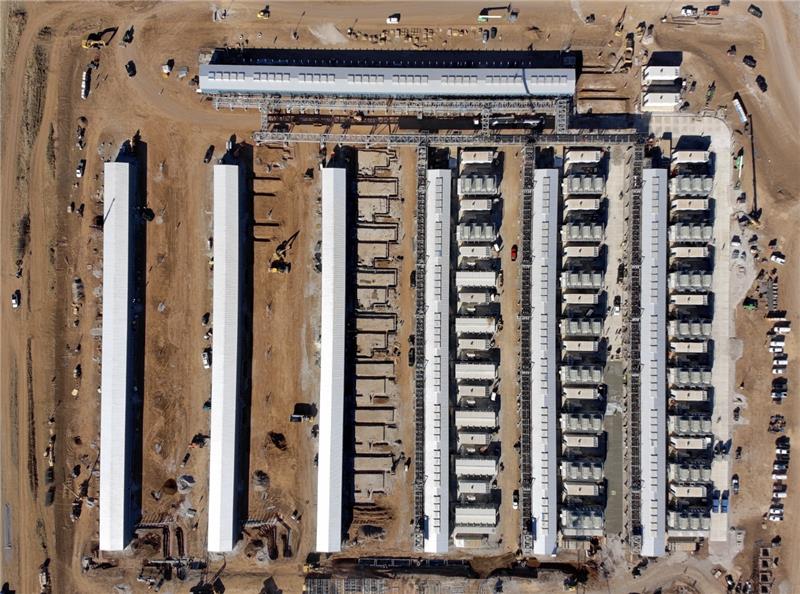
$IREN ’s 1,000+ site team at Childress is meeting that challenge head on, and momentum is building for our AI Cloud deployment for @Microsoft.
Construction is well advanced across Horizon 1 and 2 data halls and supercluster infrastructure, with internal electrical and mechanical works progressing to plan and generator and UPS load banking in progress. Horizons 3 and 4 are also on schedule, with civil works and grading well underway.
Execution is the differentiator.
As the New Year gets underway, the opportunity ahead for $IREN and energy-intensive computing has never been clearer.
Model capability keeps accelerating, AI adoption is broadening, and demand for compute is rising faster than most expected.
When Will and I set out to build this business 7 years ago, we had a simple goal: to create a data center platform capable of supporting the next generation of energy-intensive computing.
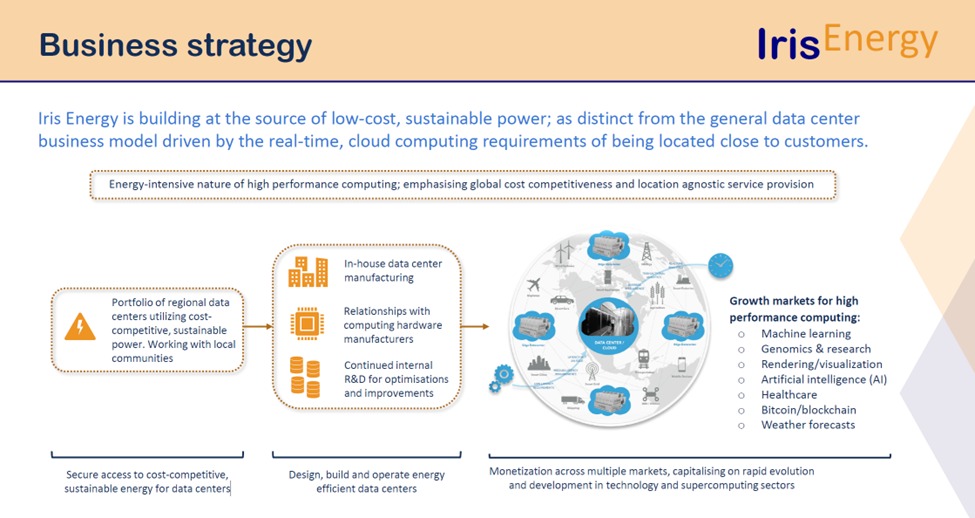
From the start, we designed the platform with a wide range of use cases in mind, including machine learning, video rendering, and what would eventually become today’s AI workloads.
7 years on, we’re still executing against that same core strategy - now with a substantial portfolio of operating data centers, a clear growth pathway ahead, and a world-class construction and operations team with deep expertise in this rapidly evolving industry.
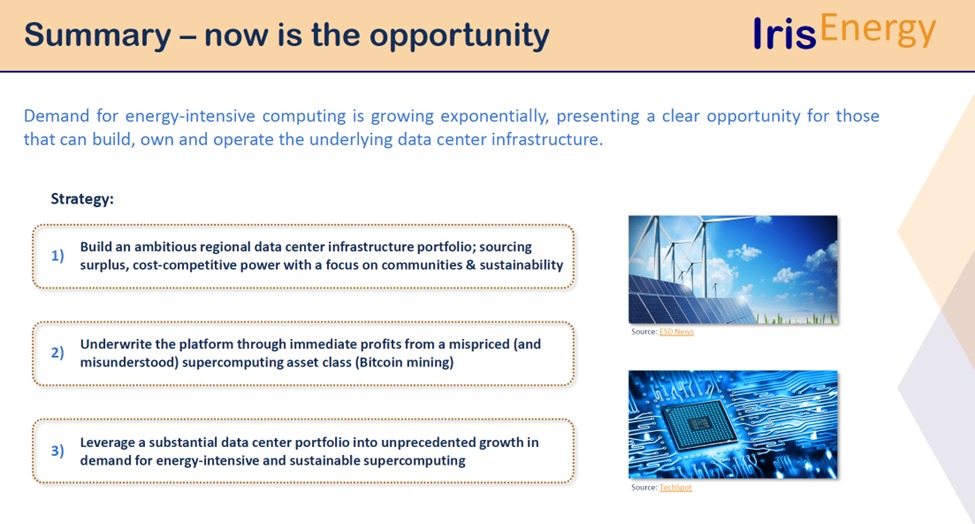
We initially bootstrapped the platform through Bitcoin mining and are now leveraging our data center footprint to support a growing set of high-growth, energy-intensive computing applications.
We’ve always stayed agnostic to the end use case, because we believe the greatest long-term value sits in owning and operating the real-world infrastructure behind these technologies: the power, the data centers, and the compute.
The picks and shovels of the digital age.
The progress we’ve made reflects the incredible effort of teams across IREN, working day and night to deliver on our commitments, as well as the support of our partners - including @Microsoft, @togethercompute, @nvidia, @Dell, @fluidstack, and @FireworksAI_HQ, to name a few.
As 2026 begins, we’re proud of how far we’ve come - but even more excited about what’s ahead!
Many people think the AI arms race is just about chips and software, but a huge underlying factor is power infrastructure — data centers need massive electricity and energy storage to operate and scale AI workloads. That’s where companies like $EOSE and $FLNC come into play