Helping technology leaders succeed through books (The Phoenix Project, Team Topologies), events (@ITRevSummit), research, podcasts (#TheIdealcast), and more.
Another wonderful honor: Team Topologies, 2nd edition, took home bronze in the IBPA + PubWest Book Design Awards! A huge congratulations to authors Matthew Skelton and Manuel Pais, and designer Devon Smith, who has made many of our book covers and interiors match the quality of the content inside.
Flowtopia 2026 has a packed lineup—including ITRev authors Matthew Skelton, Steve Pereira, and Helen Beal. If you've read their books, hearing them live in a virtual summit is pretty hard to pass up.
https://t.co/r1hCSP6vEJ
We're delighted and honored to share that Vibe Coding was awarded silver in the IBPA Book Awards in May. A huge congratulations to authors Gene Kim and Steve Yegge, and to all the other winners and nominees!
Read more about the awards: https://t.co/KbU1VdnKk7
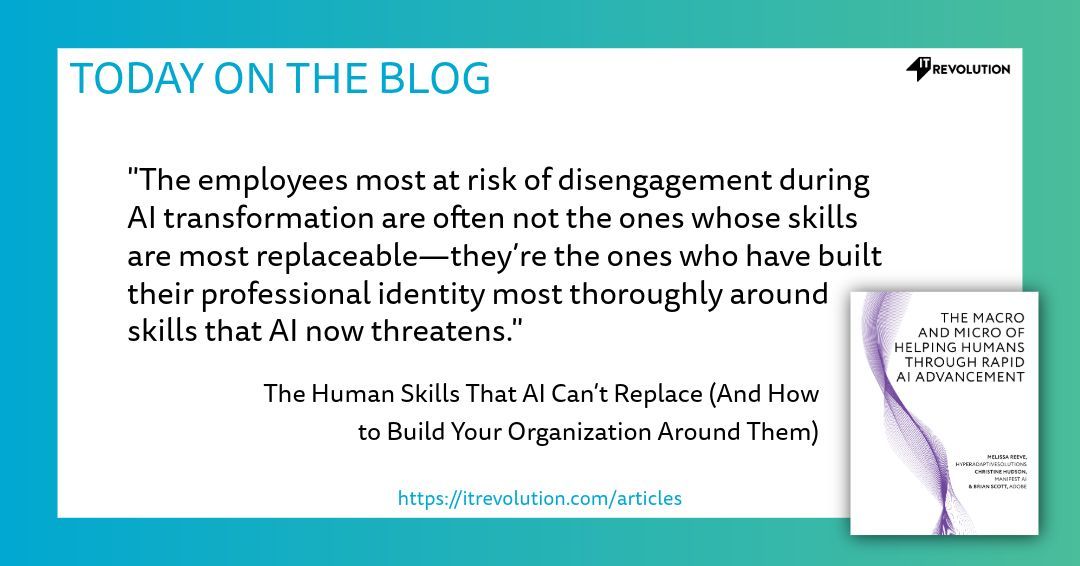
Our latest article looks at one of the papers from the Enterprise Technology Journal Spring 2026. In "The Macro and Micro of Helping Humans Through Rapid AI Advancement," authors Christine Hudson, Melissa M. Reeve, and Brian Scott dig into the human skills that AI can't replace.
"The employees most at risk of disengagement during AI transformation are often not the ones whose skills are most replaceable—they’re the ones who have built their professional identity most thoroughly around skills that AI now threatens."
Read more: https://t.co/s0Sni70WoG
Did you miss any articles this month? Here's what was happening over on our blog...
"Why Change Efforts Fail: The Missing Ingredient" - https://t.co/SMWgIJyYjI
"Hyperadaptive Author Melissa Reeve on What It Takes to Thrive in the Age of AI" - https://t.co/qmiipdoLjg
"Melissa Reeve On AI Extinction Events, Unlearning Agile, and What Stage 5 Actually Looks Like" - https://t.co/AGPmGPRHAs
"The Five DevOps Lessons Hyperadaptive Carries Forward" - https://t.co/OAUDsjftdQ
"Your Strategy Isn’t Failing. Your Feedback Loop Is." - https://t.co/jLwS1YwXb2
Catch up with these and more: https://t.co/3xwzCO26hx
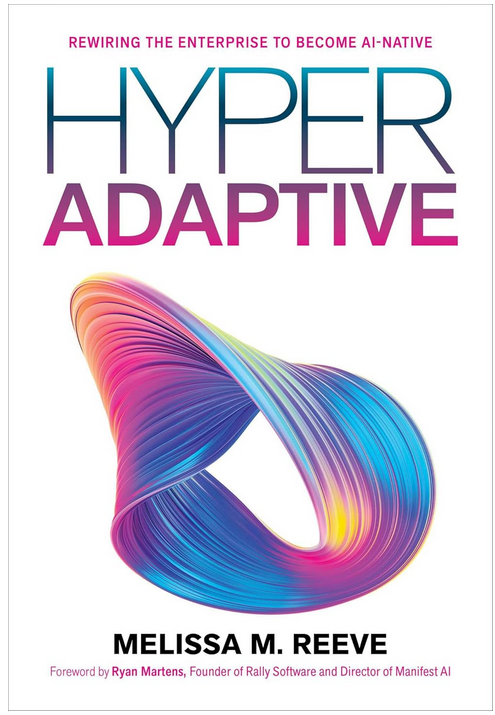
Most AI transformations stall before they scale—not because the technology falls short, but because the organization never evolved around it. Melissa M. Reeve's new book gives leaders the blueprint to close that gap.
Order Hyperadaptive today:
https://t.co/LB3qWWlW9y
The next competitive advantage doesn't belong to companies with the most AI tools—it belongs to organizations that have evolved to use them. Melissa M. Reeve calls these Hyperadaptive Organizations, and her new book shows you how to build one.
Order today: https://t.co/wOIQOV9PmY
You've followed Bill Palmer through the chaos of the Phoenix Project launch. You've watched him scramble, struggle, and start to find his footing. Now, in the final volume, it all comes together.
Order Volume III and complete your collection!
https://t.co/x4vPzMeMdL
"I realized that AI would create a crisis so total and fast that it made breaking down silos, flattening the organization, and 'rewiring' the organization no longer optional."
—Hyperadaptive: Rewiring the Enterprise to Become AI-Native by Melissa M. Reeve
Order now: https://t.co/wOIQOV9PmY
In today's article, we look at the Outcome Loop and the Outcome Tree from Mik Kersten's upcoming book, Output to Outcome.
"Most organizations manage either inputs or outputs. Strategy and budgeting processes define inputs. Agile and DevOps practices manage outputs. What’s missing is the closed loop that connects them—and then connects outputs back to actual outcomes so you can learn whether any of it worked."
Read more: https://t.co/KlDDPfTIZq
When competitors are eating your lunch and the board is threatening to split the company, most executives look everywhere for answers—except IT. That's a mistake that costs companies everything.
Order The Phoenix Project Volume III today, and complete your collection!
https://t.co/nmuahkb6r4
Most executive AI curricula cover the technology. Few address what actually determines success: whether an organization can evolve around it. Melissa M. Reeve's new book closes that gap—with four decades of organizational research reimagined for the AI era and case studies built for executive discussion.
Order Hyperadaptive today: https://t.co/wOIQOV9PmY
You can now keep track of Mik Kersten and his upcoming book, Output to Outcome, through his new website and newsletter! He's got some exciting things planned, so stay tuned...
Website: https://t.co/reaLCXi8gK
Newsletter: https://t.co/3ePHgDtH7E
If you work in flow or value stream management, Flowtopia 2026 is kind of the event to have on your radar. Get insights from ITRev authors Matthew Skelton, Steve Pereira, Helen Beal, and other great speakers!
https://t.co/r1hCSP6vEJ
Why should you read Hyperadaptive? It speaks for itself...
"The twentieth-century operating system has been obsolete for years, yet most companies still rely on it. They are about to become fossils. The question isn’t whether you should embrace AI. It’s whether you can rewire your organization before it’s too late."
—Melissa M. Reeve in Hyperadaptive: Rewiring the Enterprise to Become AI-Native
Order now: https://t.co/wOIQOV9PmY
Brendan Hopper, Matt Beane and I have a thesis, one that I've been sharing around lately, and we want CEOs and boards to hear it.
Before I get to the thesis, let's revisit Clayton Christensen's Innovator's Dilemma (ID), the theory he developed at HBS to explain why big companies often get eaten by upstarts during technology shifts.
In short, the ID says incumbents serve their best customers so well, and tune themselves so ruthlessly for doing exactly what they do today, that they can't chase the disruptor tech coming up from below until it's too late.
The classic solution to the Innovator's Dilemma is to create a "bubble" in your company. You carve out an innovation team with a budget and mandate, as unfettered as practical by the parent organization. This is to combat the 2-level trap presented by the dilemma.
The economic trap is Christensen's original point: a disruptive technology can't justify itself under your existing P&L, because it serves smaller or weirder customers at margins your real business would never accept.
The governance trap is what gets piled on top once you're big: SOC2, FedRAMP, etc. mean every new idea has to clear a lot of process before it can move. The bubble is intended to escape both at once, with its own economics and permission slips.
The standard innovation "bubble" solution famously doesn't work very well. You may solve the problem inside your bubble, but you often can't roll it out to the rest of your company for the original reasons. Everyone is focused on doing their current stuff, and nobody has time for a major change.
Our thesis is that there is an entirely different way out of the dilemma this time around. No bubble needed, as long as you follow a simple rule. That rule is, let your people play. Give them back any time they earn from automating their jobs with AI. Then incentivize them to use that time to improve the company's processes.
When you see an engineering team announce a 40% productivity boost from adopting AI — a number that's been showing up in plenty of LinkedIn posts lately — your first reaction as a CEO or manager is probably to say, that's awesome, we can do more work now! Or you might simply expect to see 40% more output from the team.
Either way, you have just asked them to spend their extra time building faster horses (your current business) instead of letting them go figure out what a car would look like for your company. They gained some productivity from AI, which could have been your ticket out of the Dilemma, and you immediately slurped it back for your existing business.
This will get your company killed in the medium to long haul, because your company tomorrow will look almost nothing like it does today. Conway's Law says your software and your org chart mirror each other; as AI rewrites how you build software, the org has to shift to match. But if you're stealing the hours back saved by your employees, then you're not letting your org pivot naturally in the direction it needs to shift.
@RealGeneKim and I saw this in person at @arkanalabs a few weeks back. As long as your people know they'll be recognized and rewarded if they improve the company's processes — public credit for cross-team workflow wins, promotion criteria that actually count process improvements, managers who treat freed-up hours as a feature rather than a budget line — then they will use their "play time" to seek out other teams, and start pivoting you to becoming AI-native. This way it can unfold in whatever bespoke way is most natural to your company, rather than in some ivory-tower research bubble. For every company, the way it unfolds will be a bit different.
I think of this approach, of giving the time back to the humans who automate parts of their jobs with AI, as the new solution to the Innovator's Dilemma. The old bubble solution was to separate a bunch of people from their regular jobs, and try to give them the freedom to solve the problem in isolation.
In contrast, by giving your regular employees their hours back, the innovation bubble is still there, but it's now dispersed across the company, as lots of very tiny bubbles: one bubble per person who has liberated some hours.
If you've ever read Slack by DeMarco and Lister, a great book from back in the 90s, then our thesis should resonate. What companies need is to empower their own employees, the ones who actually work together (even across departments)--the ones who know how the business works--to shift the company in the new directions together. Gradually, but with intentionality.
You still have the frankly awful problem of token budgets. For every employee you upskill into baseline AI literacy (which I'd define loosely as using coding agents throughout the workday), you've added a non-trivial opex spend — for the heaviest agentic users it can run into five figures a year. I won't sugar-coat it; you need to find that money somehow. I don't have a magic solution, but I'm very happy that other models are catching up to Claude, because they're becoming good enough for real work now.
But token budgets alone aren't enough. To live through the Innovator's Dilemma this time around, your employees need a time budget, too. Give it to the ones who earn it using AI, then incentivize them properly, and I think you're headed in roughly the right direction.
Thank you for coming to my TED tweet.
We've got more wisdom from Melissa M. Reeve in this continuation of the interview.
"We have to explicitly tell our teams: 'I want you to develop skills to be better humans that AI can amplify.' Only after establishing that psychological safety can you begin the structural work of the Hyperadaptive model."
Read the rest:
https://t.co/yHQN88TxCm
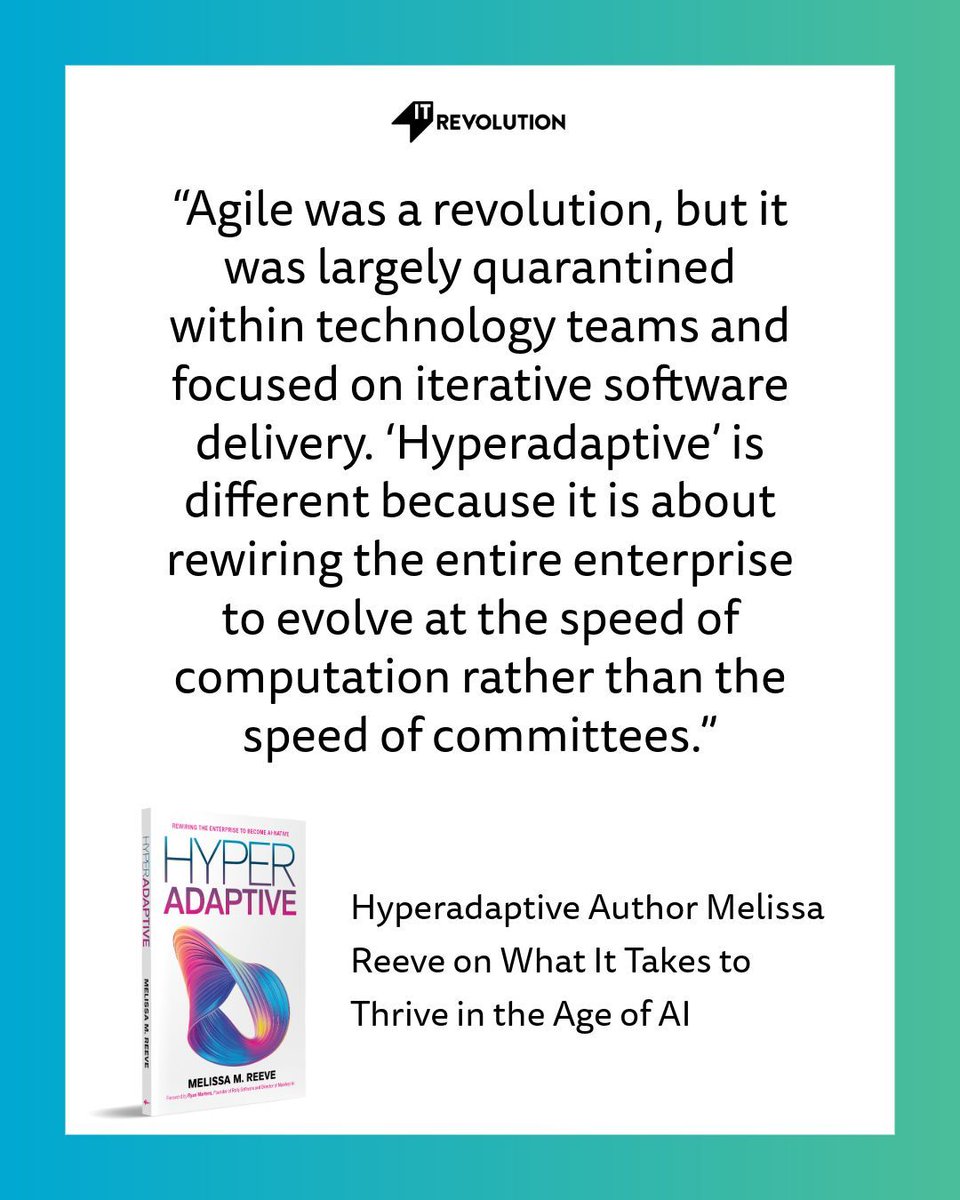
We sat down earlier this week with Melissa M. Reeve to talk about her new book, Hyperadaptive.
"Agile was a revolution, but it was largely quarantined within technology teams and focused on iterative software delivery. 'Hyperadaptive' is different because it is about rewiring the entire enterprise to evolve at the speed of computation rather than the speed of committees."
Read the interview: https://t.co/HJFugiv4op
Bill Palmer thought surviving the Phoenix Project launch was the hard part. He was wrong. Now, with market share collapsing and competitors pulling ahead, he has to prove that IT isn't a cost center—it's the company's last hope.
Order today:
https://t.co/x4vPzMeMdL