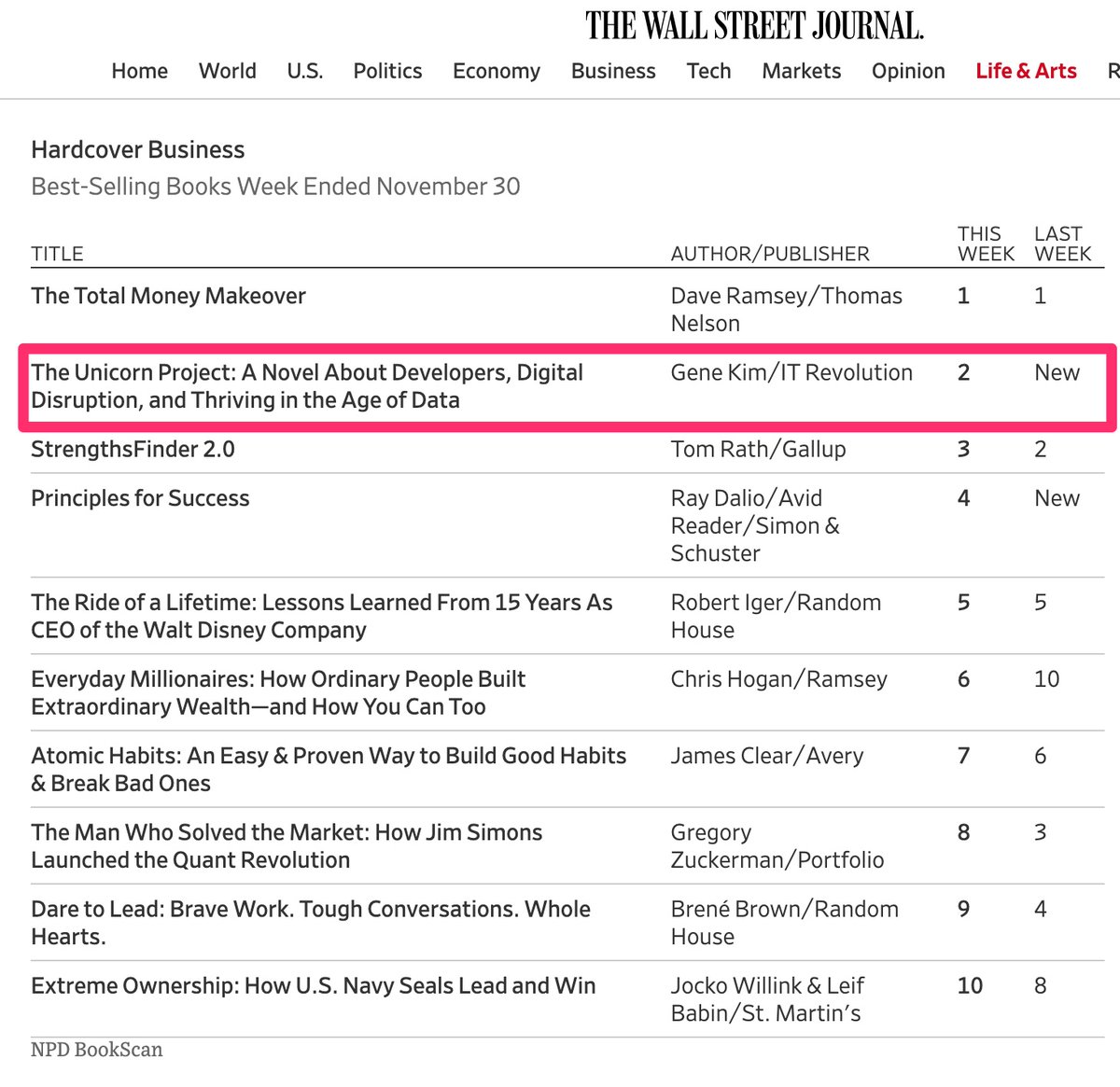
Holy cow. The Unicorn Project is on the Wall Street Journal bestseller lists!!!
#2 in Hardcover Business category!
And astonishingly, it’s also #8 across all Non-Fiction E-Books!!!
A DevOps book!! 🤯🤯🤯
🙏❤️🦄🌈
Paywall: https://t.co/2nEeC2HDMg
#UnicornProject
"We will ship that <today/tomorrow/this week>"
vs.
"I'm advocating internally to our PMs to include this on our Q4 roadmap and will let you know after our next exec review"
the gap between day to day operations at AI native and establish companies continues to increase at pretty remarkable rates. i think we're past the point that incumbents will have much to sell ai natives, because they simply don't understand how they operate anymore
Tonight's activity was upgrading firmware on an LG monitor. It started flashing with MacOS 27. I thought it was dying. Then reddit told me I wasn't the only one.
This is the first USB-C monitor from LG for Mac.
• LG app in App Store has no update mechanism.
• LG app stand alone Mac app crashed at 1%.
• Spent about an hour trying various Claude derived patches posted on GitHub but none of those would complete.
• Finally gave up and installed LG app on Windows which included an old .NET and it almost finished but died at 44%. Worried I bricked monitor--a flash every few hours >> bricked monitor.
• Even though it is a Turing machine I rebooted everything and tried again.
-> Firmware updated.
• Now uninstalling all these updater apps.
this is why "le traditional way" to store secret which is dotenv/.env doesnt really work in agentic development anymore
you want secret vars condom for your agent to use and can deploy safely without agent read and fuckup your secret
in this case i use combination of sops+secretspec, something like infisical and openbao work as well
In March, an anonymous site rated 649 RSA Conference exhibitors and called 62% of them "cooked": replaceable by a weekend of vibe coding, or just a GPT wrapper. Six months later, vRon checked on the patients. The ten cooked stocks are up 73% on average, against 19% for the S&P 500. Four of them doubled. One cooked startup bought another for a billion dollars. Code got cheaper. Customers, data, FedRAMP and the analyst who picks up at 3 a.m. did not.
https://t.co/CPs3IdwQiF
We did the same for many years at Mailchimp. When it was time to announce the payout in December, our CFO would come out dressed as a giant pizza slice (long story).
If you are ever trapped inside a locked-down Linux container that doesn't have curl, wget, or netcat installed, you can still make raw TCP network connections.
Bash has a secret built-in network stack wired to /dev/tcp:
The next generation of @GraalVM is shaping up nicely: fast startup, low CPU and memory usage, with no build step or project changes required! 🚀
Here’s a simple benchmark using a single-file program:
😟 It's always so sad to see layoffs - especially at a company like Netflix, which has always set a high bar for hiring + engineering excellence.
If you were impacted and are interested in roles at Google / DeepMind, my DMs are open! And this is just a blip, onward and upward.
I am thrilled to tell you that Swamp Club has raised $7m in seed funding from @AmplifyPartners, Encoded Ventures, @jesserobbins, and @stolinski. Swamp is a platform for building AI systems from repeatable behaviors, rather than from token-hungry agent-centric designs. More exciting to me than the money (which I'm stoked about,) or the product itself (which continues to surprise and delight me every day,) is the incredible group of people who have started solving real, practical, everyday problems with Swamp. They teach me new and exciting things about how to build with AI every day.
I'm grateful to my co-founders, who have poured every ounce of their creativity, passion, and intelligence into Swamp. I'm grateful to our users and customers (big and small) - there is no greater gift you can give to an entrepreneur than the validation that comes with voting with your wallets. And I'm grateful to our investors, who see the opportunity we see, and want to make it happen with us. It's such a cliche to say that there has never been a better time to build - but really, it feels like there has never been a better time to build. Come join the Club.
https://t.co/1YyHkbB1Ob
💔 Heartbreaking news this morning: @ghc was canceled for this year, very abruptly, due to funding constraints and fewer registrations.
Many young women in computer science and software engineering found their first jobs, and first internships at Grace Hopper. Not having this opportunity to connect is truly unfortunate, especially now.
Does anyone else have interest in hosting a virtual conference, as an alternative (albeit an imperfect one)? cc: @Google@GoogleDeepMind@GoogleDevs@GoogleStartups
Whelp I got banned on @github randomly with 0 warning or explanation after 15+ years. Not a repo taken down, my entire account removed. 100s of repos, deploys, and logins. Decades of history at various org’s. Gone.
Support ticket filed, but 2 days later no response, and no reason why… 😭😭😭
On the off chance any of my followers work at GitHub, any chance you could help escalate this support ticket, thanks 🙏
4847303
Only info I have is an automated sweep marked my account as maybe violating the terms, and requires manual review. Which I don’t think I did? But if I did on accident, I’m happy to fix & remedy any way I can.
I dont understand why they wouldn’t pull down a single repo if there was an issue. I just want my account back. I have literal years of my life and work saved there. This sucks. Trust broken.
We announced next-gen SCM at Transcend in June, with Nick from Anthropic on stage. Their new post shows why: merges went from 2,500 to 30,000+ a day in four months. They built Scion for their unique needs, enterprises will need that scale on Git, governed end to end, cloud or air-gapped, without migrating their code, CI and compliance workflows to get it. That's what we're building. Latest:
https://t.co/S4Qx8jqJ8S
For the last several years, it felt like the AI world was so closely paralleling the AI of Avogadro Corp. Now with all the threats of AI escaping, it feels like we're squarely in AI Apocalypse territory.
Saying software is dead because everyone can create it with agents is like saying movies are dead because billions of ppl have a high res video camera in their pockets
Movies doing better than ever+more ppl make a living from videos, movies, TV than ever
(Analogy from @simonw)